
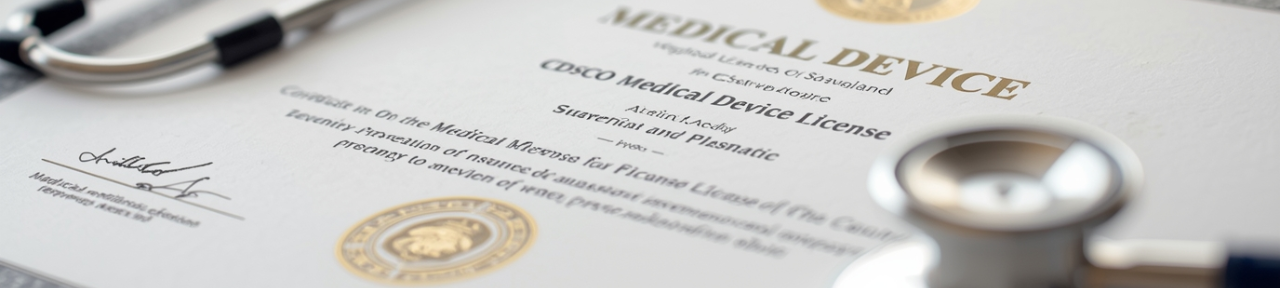
CDSCO Medical Device License in India: Complete Guide
In India, CDSCO, which stands for Central Drugs Standard Control Organization, is one of the most recognized national regulatory authorities. This authority focuses on drugs, cosmetics, and medical device management. It is further responsible for issuing the license to the respective service. In India, CDSCO medical device registration is a legal authorization to regulate the manufacturing, selling, or stocking of medical devices. Under the Medical Devices Rules, 2017, the CDSCO Medical Device License in India is compulsory to meet the safety, quality, and performance standards. Licensing ensures it is safe to use for public health and will not harm. Still looking for the registration process, documentation, and timeline? Explore more in the next section.
1. What is a CDSCO Medical Device License in India?
A Medical Device License in India is a primary legal authorization from the Central Drugs Standard Control Organization (CDSCO), the national regulatory body. It is required for manufacturing, importing, selling, or distributing medical devices in the respective places. It further ensures that the registered devices meet safety and quality standards before being presented in markets. Meanwhile, for different work purposes, different licenses are required (like the Import License, Manufacturing License, and MD 42). One needs to obtain a device risk (Class A, B, C, D) and activity license from the Government of India before operating legally in India to verify the quality of equipment and to preserve the Indian public health.
2. Why is a Medical Device License Mandatory in India?
According to the governing law, medical devices sold or being sold in India must register their medical device license with the CDSCO to operate legally in India. Through the registration, the governing authority, like CDSCO, gets access to manage the device’s safety, quality, and performance. Before the market presentation, the devices are tested to ensure quality. Here are the key reasons why licensing is a prerequisite:
- Assuring Safety/Quality: Medical devices must be registered to ensure their safety and effectiveness. The Medical Device License ensures that only safe, effective, and commercially viable Medical Devices are manufactured in India and provides a guarantee to consumers that they cannot purchase unsafe, counterfeit, or defective devices. Furthermore, it is required that all manufacturers of Medical Devices registered with the CDSCO adhere to all other legislative requirements in the Drugs and Cosmetics Act of 1940, as well as the Medical Devices Rules of 2017.
- Risk-based Classification of Devices: All devices are classified into A, B, C, and D. However, it depends on how risky they are. Therefore, the regulatory requirements for licensing differ depending on the level of risk associated with the device, with higher-risk devices subjected to more rigorous regulation.
- Legal authorization: Before operating the medical devices in India, the manufacturers and importers need to first obtain the legal permission from the national controlling authority (CDSCO). Registration gives them the market access and legal authorization to operate devices. It is mainly required by hospitals and other organizations that procure devices.
- Credibility and trust: Manufacturers of devices will have increased credibility and will provide healthcare providers with assurance that the devices comply with established standards.
- Centralized Regulatory Supervision: The national regulatory authority oversees the imported and high-risk medical devices through real-time tracking. Meanwhile, state licensing authorities provide for the manufacture and sale of low-risk medical devices.
Don’t Miss This – How Can You Apply for a Medical License in India? Registration Process & Eligibility
3. Who Needs a Medical Device License in India?
CDSCO registration for medical devices is mandatory for those who are planning to import, manufacture, sell, stock, or distribute medical devices in India. The type of license requirement depends on the device risk, e.g., Class A, B, C, or D. Meanwhile, registration is mandatory for:
- Domestic manufacturers who manufacture the devices in their own facility.
- Importers who import all risk device classes (A, B, C, and D). License MD-14/MD-15 is required.
- Sellers or distributors who sell, stock, exhibit, or distribute medical devices are required to obtain permission from the State Authority (SA).
- Foreign medical device companies are also eligible to work through authorized agents or Indian subsidiaries to register and get licenses.
4. Medical Device Classification in India (Class A, B, C, D)
Medical devices are classified into four risk-based categories. These are categorized as
|
A Class |
Possesses minor potential for harm and can be contacted directly to the skin. For example, surgical masks, examination gloves, bandages, and tongue depressors. |
|
B Class |
Have low to moderate risk, are non-invasive, but contact mucous membranes, or are invasive for short durations. Examples are hypodermic needles, suction equipment, blood pressure monitors, and nebulizers. |
|
C Class |
Possibility of moderate to high risk, invasive, prolonged contact, or use during serious conditions. Examples are orthopedic implants, coronary stents, ventilators, some catheters, and breast implants. |
|
D Class |
High risk possibility, life supporting, implantable, or critical for patient health. Examples are heart valves, pacemakers, implantable defibrillators, etc. |
Note: For classes A and B, the regulatory management is the state authorities. While Classes C and D are operated by the central authority, CDSCO.
5. Types of Medical Device Licenses in India
The different medical licenses in India are handled by the different licensing authorities (State Licensing Authority and Central Licensing Authority). In detail:
- Manufacturing License: For Class A and B, the medical device manufacturing license is issued by the State Licensing Authority (SLA). Meanwhile, for Classes C and D, the licensing issuing authority is the Central Licensing Authority (CLA-CDSCO).
- Import License: For all risk classes like A, B, C, and D, the medical device import license is issued by the Central Licensing Authority, CDSCO, in the form MD-15.
- Sale License: The State Licensing Authority (SLA) is responsible for approving all risk classes in India.
- Test License: It is required for legally researching or testing a small quantity of medical devices. The medical device test license is issued in Form MD-13.
6. Eligibility Criteria for Medical Device License Registration
To meet the requirements for the CDSCO medical device license, the businesses are required to align with all standards. For a license, the primary requirement is to have a registered business (proprietorship, LLP, or Pvt Ltd). Only a pharmacist or a science graduate with relevant experience to supervise operations is eligible. The registered firm must comply with storage standards, which include space, cleanliness, and temperature control if required. Classify all devices into their risk factors (Class A, B, C, and D).
7. Documents Required for Medical Device License (Checklist)
For fast and hassle-free CDSCO registration for a medical device, multiple documents are required to be attached to the application form. The major documents are required:
- CDSCO application form
- TR6 challan for payment proof
- Applicant, company, and premises identity and address proof
- Power of attorney is applicable
Documents Required for Manufacturing License
- Application form
- Device Master File (DMF) & Plant Master File (PMF)
- Quality management system and manufacturing details
- Blueprint of premises and quality certificate
For Import License
- Application form
- Manufacturing license from the original country
- Free sale certificate (FSC) from COO
- CE Certificates & Design Certificates
- Device/Plant Master Files (DMF/PMF)
For Distribution/Sale License
- Application form
- Incorporation/Partnership docs for business proof
- rent agreement/property papers for premises proof
- technical staff for qualification proof, experience letter
- Undertaking for compliance with storage
8. Medical Device License Fees in India
In India, CDSCO is responsible for managing the medical device license registration fees. The device classifications, type of license, number of sites, device specificity, and regulatory pathway are the key factors that affect the registration fees. Here is the classification to understand the medical device license fees in India:
Manufacturing License (CDSCO)
- Class A & B Devices: For each manufacturing set need to pay Rs 5,000. For each different medical device, the registration fees are Rs 500.
- Class C & D Devices: Due to the higher risk class, the manufacturing site fee is Rs 50,000 and Rs 1,000 for each distinct medical device.
Import License (CDSCO)
For an import license application with a single site, you need to pay around 1,500 (or INR equivalent). Meanwhile, for the registration certificate, the fee is around USD 1,000 (or INR equivalent).
9. Step-by-Step Process to Get Medical Device License in India
Being new to the market, it will be tough to navigate the complex medical device license registration process. While multiple documents are required for registration. Here is a complete guide on how to get the license in a short duration with the right direction:
Step 1: Device Classification
Determine which type of medical devices you are operating based on their risk factors (e.g., Class A, B, C, and D). For a better understanding, utilize the CDSCO guidelines.
Step 2: Navigate the CDSCO Portal
Make an account on the CDSCO portal SUGAM (cdscoonline.gov.in).
Step 3: Application Process
For Indian Manufacturers
An Indian manufacturer must register with the State Licensing Authority (SLA) for Class A/B. Form MD-3 is the application form, and the license is issued in MD-5. Meanwhile, for the Class C and D medical devices, you must register with the Central Licensing Authority (CLA).
For Foreign Manufacturers
An international manufacturer needs to appoint an Indian Authorized Agent (IAA).
Step 4: Online Submission & Fees
To apply to the CDSCO/SLA, precise procedures must be followed.
Step 5: Review and Inspection
The manufacturing facility will be inspected on-site by the notified body. The manufacturing facility will be inspected on-site by the notified body.
Step 6: Compliance & Approval
The approving authority will respond as soon as possible to the audit findings or questions. The importer will receive a license once all issues have been resolved.
Note: Applicant must comply with the Medical Device Regulations, 2017, regarding safety and quality in all instances.
10. How to Apply Online for Medical Device License (CDSCO/SUGAM Portal)
The SUGAM portal is a single window for CDSCO medical device license registration in India. Before application submission, the importer or manufacturer is first required to register on the portal (https://www.cdscomdonline.gov.in/NewMedDev/Homepage). In short, the government of India has provided a single transparent platform for manufacturing/import licenses. It further makes tracking easier and converts into paperless transactions. This is how the applicants use the SUGAM portal:
- The portal allows manufacturers/importers to submit digital applications for licenses, NOCs, and registrations.
- After complete registration, the applicants can monitor their application submission status. Including, they can see the pending queries and estimate approval times.
- The portal facilitates quick and transparent communication between the applicant and the governing authority, CDSCO.
- Things like permissions and certificates can be downloaded directly from the portal.
11. Timeline for Medical Device License Approval (How Long It Takes)
The timeline for medical device license approval depends on the device risk class. For the low-risk Class A devices, the minimum timeline for license approval is 2 to 4 months. For higher-risk class devices, such as Class C, the approval timeline is typically 8 to 12 months, while for Class D, 12 to 18 months is more common. But, for all types of devices, the general timeline is 6 to 18 months. Sometimes, CDSCO medical device approval is delayed due to an error in documentation or other factors. The key factors that affect the license approval timeline:
- The higher-risk devices, like Class C and D, require more extensive review.
- Approval delayed due to document errors & queries. While restarting after a response potentially takes months.
- Due to the involvement of the Subject Expert Committee (SEC) reviews, it takes a significant amount of time.
In the end, 6-9 months is often mentioned as a general timeline, but be prepared for a longer duration, such as up to 18+ months.
12. Inspection & Verification Process (What to Expect)
Inspection and verification are both crucial during the registration process. The verification process involves comprehensive background checks, while a physical inspection is conducted of the premises. Here is what you can expect from both processes:
(CDSCO Verification Process)
- The regulatory body or medical board conducts the verification process to ensure the educational qualification. They will confirm your degrees, diplomas, and completion of training programs.
- The board will verify whether you have past medical licenses from other states or not. For this, online data will be used to ensure their activeness.
- The testing bodies will take the information from the national licensing examinations, like NEXT in India.
- To verify the past disciplinary actions or legal records, the regulatory authorities will check the malpractice database.
- The Aadhaar card and passport will be used to identify the Indian citizen.
Inspection Process (If Required)
- For those who are registering the new medical clinic in any state of India, whether it is a hospital or a health-related business, an on-site visit will be conducted.
- On-site inspection will be conducted by a drug inspector or health authority officials.
- During the inspection, the inspector will conduct compliance checks to ensure that the registered facility meets minimum standards like infrastructure, hygiene, sanitation, and proper storage of medicines.
13. Validity, Renewal & Retention of Medical Device License
The Medical Device Rules 2017 highlight that the medical device manufacturing and import license is generally valid perpetually. It means the license remains active as long as manufacturers and importers maintain compliance. But the thing to note is that the retention fee must be paid every five years from the license approval. On the other hand, renewal of the license after a specific timeline is a post-compliance requirement.
(Complete Renewal Process)
- Pay Retention Charges: Submission for each license and endorsement is mandatory.
- Provide Documents: The documents must be complete, clear, and in an accurate format.
- Online Submission: Submit the license retention application through the ONDLS (Online National Drug Licensing System) or similar platforms for a state-level license.
14. Amendment/Changes in Medical Device License (Company Details, Address, Product, Manufacturing Site)
To make the changes to the current license, it is required to apply to the Central Licensing Authority. Before the amendment application submission, determine whether the change is minor or major. Providing the updated documents is vital, including the Device Master File (DMF) or Plant Master File (PMF). It helps to reflect the changes. With it, a comparative written statement may be required for product-related changes.
For Specific Changes and Requirements, follow the table:
|
Types of Changes |
Key Requirements |
|
Company Details (e.g., Constitution) |
An amendment from proprietorship to partnership/LLP or from private to public company necessitated a fresh license application under MDR-2017. Must inform the licensing authority within 45 days and start applying changes within 180 days. |
|
Address (Registered/Corporate Office) |
Apply for an update to the business registration documents and attach the documents for proof of the new address via the online portal. |
|
Manufacturing Site Address |
It is a major amendment; therefore, an on-site inspection will be conducted. The inspector will ensure compliance with the quality management system (QMS). An updated PMF is also mandatory. |
|
Product (Design, Material, Intended Use, Shelf Life) |
Prior approval is necessary; written evidence must be submitted to substantiate the effects upon safety, performance, or quality, including but not limited to an updated DMF, any supporting clinical studies (when applicable), and any biocompatibility studies that were conducted. |
|
Product (Minor changes in manufacturing process, non-primary packaging) |
Notification is required no later than 30 days; it does not require prior approval to proceed. |
15. Common Reasons for Delay/Rejection (and How to Avoid Them)
In most cases, the newly registered businesses face the CDSCO medical device license application rejection. There are multiple reasons why the application license is rejected. These common reasons include incomplete documentation, lack of details of clinical/testing data, wrong device classifications, and non-compliance with the quality management system (QMS). These common challenges can be avoided as follows:
- Adopt Regulatory Set Standards: Develop a sustainable regulatory strategy early in medical device production. It helps to avoid the costly redesign margins.
- Document Completeness and Accuracy: Before the document’s final submission, ensure consistency, completeness, and accuracy.
- Ensure Device Classification: Consult with an expert ot use the official classification tools to verify the risk classes of medical devices.
- Consult with an Expert: To get fast market access or international market engagement, consult with an experienced advisor.
16. Penalties for Manufacturing/Importing/Selling Medical Devices Without a License
Under the Drugs and Cosmetics Act, 1940, and MDR 2017, anyone who is a manufacturer, importer, or seller of medical devices in India must register with CDSCO. Operating the equipment without a proper license can lead to serious consequences or even legal penalties. Without a proper license in India, carrying severe penalties including significant fines, imprisonment (can be up to 5 years or more), seizure of stock, and license suspension/cancellation. In case a medical device causes harm to the patient or death, stricter action will be taken by the controlling authority.
17. Why Choose LegalRaasta for Medical Device License Registration?
CDSCO medical device registration online is the primary requirement to get the legal authorization and faster market access. But getting these opportunities becomes easier with LegalRaasta experts. At LegalRaasta, our team’s expertise streamlines the complex medical device licensing, offering cost-effective service with satisfying discounts. By choosing us for your legal services, you will get professional support, paperless digital services, and reduced costs. Rather than focusing on documentation and registration, it will allow you to focus on innovation, further growth planning, etc. We also provide services for:
- GST registration
- Tax filings
- BIS Certification
- AD code registration
- and other legal registration
18. Frequently Asked Questions (FAQs)
- What is a CDSCO medical device license, and why is it important?
Ans. A CDSCO Medical Device License in India is a legal document that clarifies that the registered business has the legal authorization from the Central Drugs Standard Control Organization (CDSCO). It means businesses can import, sell, or distribute medical devices in India without legal action. The medical device license registration is critical to ensure that all equipment meets strict safety, quality, and performance standards.
- How do I apply on the CDSCO MD Online portal?
Ans. Now, the process of the CDSCO MD license can be done online via the SUGAM portal.
- What documents are required for a CDSCO application?
Ans. For a CDSCO medical device license, the general documents required are the Device Master File (DMF), Plant Master File (PMF), ISO 13485, Free Sale Certificate, Declaration of Conformity, Quality Management System (QMS) documents, label/IFU, etc.
- What are CDSCO fees and the total expected cost?
Ans. The cost for medical devices is classified by their manufacturing site and the fee per product. The fee structure is classified as:
A Class Medical Devices
- Fee Per Manufacturing Site: Rs 83,000
- Fee Per Product: Rs 4,165
B Class Medical Devices
- Fee Per Manufacturing Site: Rs 166,600
- Fee Per Product: Rs 83,000
C Class & D Medical Devices
- Fee Per Manufacturing Site: Rs 229,000
- Fee Per Product: Rs 124,950
- What is the typical CDSCO approval timeline?
Ans. The general timeline for medical device registration is between 6 and 9 months.
- How can I check my device class (A/B/C/D)?
Ans. To classify the devices into Class A, B, C, and D, utilize the official Central Drugs Standard Organization (CDSCO) digital platform. Device classifications depend on their use and the potential risk factors.
- Which medical devices require CDSCO licensing in India?
Ans. The registration with CDSCO is mandatory for those medical devices that are classified under categories A, B, C, and D.
- What is the correct application form (MD-3/MD-5/MD-7/MD-9, etc.)?
Ans. The accurate application forms vary according to medical device class (A, B, C, and D) and the type of license.
- Do I need ISO 13485 for CDSCO medical device licensing?
Ans. While an ISO 13485 certification is optional, it is strongly advisable for companies wishing to manufacture high-risk devices (Class C/D).
- Why do CDSCO applications get rejected or delayed?
Ans. Incomplete or inaccurate documentation, lack of compliance with CDSCO regulations, and other administrative errors result in the refusal of applications to import medical devices into India.
19. Final Thoughts | CDSCO Medical Device Registration for Manufacturing or Importing
In conclusion, for approval of the CDSCO Medical Device License in India, manufacturers or importers need to classify their medical device into Class A, B, C, or D. Must create the necessary documentation, including the Plant/Device Master File (PMF/DMF) and the Quality Management System (QMS), which is required to comply with ISO 13485, and create an account online at the SUGAM portal. Further, complete the necessary forms for your application; specifically, MD-3/MD-7 for manufacturing and MD-14/MD-16 for importation. Paying the prescribed fee for importation or for local premises is mandatory.
The time required for review will vary by class (A/B 1-3 months, C/D 6-9+ months). A QMS compliant with ISO 13485 is required to fulfill the Quality Management System section of the application, and the applicant must be familiar with the Medical Device Rules, 2017. In addition, the foreign device manufacturers must have an Indian Authorized Agent (IAA) to apply for a medical device license in India.
-
 Medical Device Registration in India: Top 20 CDSCO...
03-Apr-2026
Medical Device Registration in India: Top 20 CDSCO...
03-Apr-2026 -
 Selling Drugs or Medical Devices Without CDSCO App...
03-Apr-2026
Selling Drugs or Medical Devices Without CDSCO App...
03-Apr-2026 -
 Medical License in India: Registration Process, El...
03-Apr-2026
Medical License in India: Registration Process, El...
03-Apr-2026 -
 From Lab to Clinic: The Role of MD-22 & MD-23 ...
03-Apr-2026
From Lab to Clinic: The Role of MD-22 & MD-23 ...
03-Apr-2026 -
 Fast & Reliable CDSCO Registration Services fo...
03-Apr-2026
Fast & Reliable CDSCO Registration Services fo...
03-Apr-2026 -
 ISO 13485 Quality Management System for Medical De...
03-Apr-2026
ISO 13485 Quality Management System for Medical De...
03-Apr-2026 -
 How CDSCO Consultants Are Adapting to Digital Regu...
03-Apr-2026
How CDSCO Consultants Are Adapting to Digital Regu...
03-Apr-2026 -
 Why You Should Hire a Consultant for Your Medical ...
03-Apr-2026
Why You Should Hire a Consultant for Your Medical ...
03-Apr-2026 -
 Common Pitfalls in Medical Device License Applicat...
03-Apr-2026
Common Pitfalls in Medical Device License Applicat...
03-Apr-2026