
E-Waste Credit Transfer in India: Rules, Process & Compliance Guide
A digital-first approach to sustainability has enabled the fundamental redesign of electronics and IT asset management in India in 2026. The E-Waste Credit Transfer in India is the pillar of this development, which is not a voluntary environmental gesture anymore but rather a mandatory market-driven system. Within the Extended Producer Responsibility (EPR) framework, sellers are no longer producers, importers, or brand owners (PIBOs); they are the best custodians of the end-of-life cycle of their products.
Learning to use Central Pollution Control Board (CPCB) portals to trade e-waste credits has now become a key enterprise development skill. Whether your company deals with consumer electronics, IT assets, or medical devices, it is up to your skills in successfully implementing an e-waste credit transfer in India that will decide whether your business prospers or suffers with devastating environmental fines. Collaborate with LegalRaasta now and have the ability to include your business and get digital compliance services, ensuring that you have a future.
The 2026 Regulatory Shift in E-Waste Credit Transfer Rules
The introduction of the E-Waste (Management) Rules, 2022, has increased the integration of the various waste streams. The current e-waste policy management rules, compared to the fragmentation in the past, are now aligned using a single digital register.
- Mandatory Four-Stream Segregation: Strict segregation at source is mandatory under new regulations on April 1, 2026, and has resulted in higher amounts of high-quality dry waste being made available to credit.
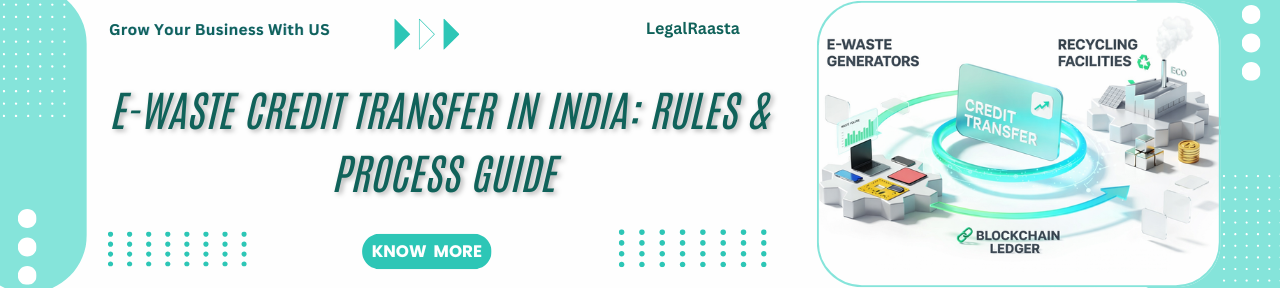
- Blockchain Verification: The CPCB has implemented blockchain-based verification to avoid the sale of phantom credits. Every e-waste credit transfer in India now requires a timestamped digital certificate backed by a physical recycling event.
- Target Escalation: Recycling targets for most electronic categories have reached 70%, making internal collection almost impossible for large brands and forcing them toward the e-waste credit trading market.
Detailed Step-by-Step E-Waste Credit Trading Process
The implementation of an e-waste credit transfer in India is a series of online handshakes on the centralised EPR portal of the CPCB. The process is crafted to be transparent, but one needs to be accurate in data entry.
-
Unified EPR Portal Registration
Every stakeholder must first obtain a unique registration ID. PIBOs must upload their sales data, while recyclers must upload their processing capacity certificates. These are connected with the GSTIN and PAN in 2026 in order to have the financial information reflect the environmental claims.
-
Generation of Recycling Certificates
Credits originate with the recyclers. Once an authorised recycler processes a ton of waste, they upload the proof of processing (electricity bills, material recovery logs, and end-product sales invoices). The CPCB portal then generates “EPR Recycling Certificates” in the recycler’s digital wallet.
-
Negotiating the E-Waste Credit Transfer
When there are credits available, a producer may look into finding a recycler who has excess credits in their particular category (e.g., ITEW-C2 E-Waste). While the portal facilitates the e-waste credit transfer in India, the commercial negotiation regarding the price per kg is handled offline.
-
Portal-based Credit Transfer Execution
- Initiation: The recycler provides the registration number of the producer and the number of credits that should be transferred.
- Authorisation: A secure OTP will be sent to the authorised signatory of both companies.
- Validation: After verification, the credits are subtracted from the recycler and added to the compliance ledger of the producer. It cannot be deleted or edited; the transaction is final.
Understanding 2026-27 Recycling Targets for Compliance
To manage your e-waste credit transfer in India successfully, you have to be aware of the number of credits you require. The 2026-27 targets are the most precise in the past.
|
Waste Category |
2026-27 Recycling Target |
Basis of Calculation |
|
E-Waste (IT & Telecom) |
70% |
Average life of product (e.g., 5-year cycle) |
Precious metals such as Gold, Silver, and Copper are amongst the e-waste management rules that demand recovery. To make an e-waste credit transfer in India valid in the e-waste market, the certificates need to indicate the recovery of these particular metals according to CPCB guidelines.
Common Pitfalls in EPR for E-Waste Credit Trading
Many businesses fail to meet compliance not because of a lack of funds, but due to procedural errors in the e-waste credit transfer in India.
- End-of-Life (EOL) Misuse: By January 19, 2026, the MoEFCC cancelled the possibility to resort to EOL disposal certificates in achieving recycling goals. You now have to purchase actual recycling credits.
- Expiration of Credits: EPR credits last up to two financial years. Attempting to use expired credits for the 2026-27 compliance cycle will result in an automatic rejection by the portal.
The “Polluter Pays” Principle and Environmental Compensation
Failure to comply with the e-waste credit transfer in India rules leads to the Environmental Compensation (EC) mechanism. It is not a tax, but rather a punishment to discourage irresponsible attitudes towards the environment.
Penalties for 2026-27
Failure to achieve the target by the producer, who did not reach the target by a collection method, and/or credit provision, the producer will have to pay EC in terms of the costs of handling and treating the waste they were unable to recycle.
- Delayed Filing: Fines range from Rs 1,000 to Rs 5,000 per day of delay.
- Target Shortfall: These are calculated in per kg of waste. These fines may be in the form of hundreds of thousands of rupees per tonne in high-value materials such as precious metal recovery or e-waste copper.
- Revocation of License: The result of persistent failure to engage in the e-waste credit trading process may result in the revocation of the EPR registration of the company, wherein they will be effectively barred from the Indian market.
Why Compliance is Complex: Common Filing Mistakes
E-Waste credit transfer in India has caused a lot of complexity, where companies handle it like a mere accounting exercise and not a regulatory process.
- Inconsistent Weights: Filing the weight of the product without packaging on one portal and including packaging on the other portal.
- Unverified Recyclers: Purchasing credits with recyclers with an out-of-date SPCB Consent to Operate (CTO). Whenever there is a revocation of registration of the recycler, the credits of the producer are also cancelled.
- Missing Quarterly Returns: The 2026 rules mandate quarterly sales data updates. Failure to file these “interim returns” blocks the user from executing an e-waste credit transfer at the end of the year.
Comparison of DIY Compliance vs. Expert Management
A credit market and portal monitoring is necessary on a daily basis to manage an e-waste credit transfer in India.
|
Feature |
Internal/DIY Management |
LegalRaasta Expert Support |
|
Market Access |
Limited to 2-3 recyclers |
Access to 500+ vetted recyclers |
|
Data Accuracy |
High risk of manual errors |
Automated verification against GST |
|
Credit Pricing |
Subject to “March Rush” peaks |
Strategic year-round procurement |
|
Legal Updates |
Delayed reaction to new notices |
Real-time adaptation to 2026 rules |
|
Audit Readiness |
Reactive and stressful |
Proactive, audit-proof documentation |
The Role of Refurbishers in the Credit Ecosystem
One of the distinctive characteristics of the 2026 e-waste credit transfer in India is the integration of refurbishers. If you are a brand that is repairing and reselling old laptops or servers:
- Life Extension Credits: Refurbishers may create certificates, which postpone a recycling requirement of a producer by extending the duration of the product.
- Hybrid Obligations: The need to balance the material flow necessitates a complex re-use of credits and re-use of refurbishing certificates, which are both different kinds of recycling credits.
India-specific Compliance Scenarios for 2026-27
In some areas, there is an added complexity of e-waste credit transfer in India due to local authority interference.
- Multi-State Operations: You will be required to register centrally with the CPCB if you are selling in more than two states. But your transfer of e-waste credit can also be wastage checked by the SPCB, the place where the recycling plant is situated.
- Imported Electronics: The importers of second-hand equipment are required to pay a 100% recycling fee. Imported waste is not subject to any percentage quotient relaxation; each gram has to be secured by a credit transfer.
Future Outlook: Circular Economy and the 2027-28 Transition
The e-waste credit transfer in India is a stepping stone to a complete circular economy. The government will present the Recycled Content Certificate by 2027-28. It will imply that companies will no longer have to simply recycle their waste; they will have to demonstrate that they are dissimilarly utilising the recycled product in their new merchandise. The only solution to getting ahead of these future requirements is to begin contributing to your compliance journey with an e-waste credit management system in 2026-27.
How Legalraasta Helps You Navigate the Credit Portal
LegalRaasta would make the process of e-waste credit transfer in India easy through its role as your committed compliance partner. Our services include:
- End-to-End Registration: We deal with CPCB/SPCB registrations on all streams of waste.
- Credit Sourcing: Our sources work within the network to get the cheapest known credit, which has been verified within your specific type of category.
- Form Filing: Then we take care of your quarterly and annual returns (Form-3) to make sure that there is no deadline to miss.
- Audit Representation: When the CPCB is doing inspections, we support your data and make sure your ledger dealing with e-waste credit transfer in India is impeccable.
Conclusion
With the further tightening of the e-waste credit transfer in India, there is no more room to miss. The ongoing 2026-27 financial year is the real challenge to Indian industries to demonstrate that they are capable of maintaining growth consistency as well as environmental sustainability. With knowledge of EPR for e-waste rules and proper utilisation of the e-waste credit trading process, your business will be able to transform the regulatory burden into a competitive edge. Stress-free regulatory filing and guaranteed 100% compliance make the legal experts at LegalRaasta.com take care of all your licensing and legal filing needs.
FAQs
- How to transfer EPR credit?
To initiate an e-waste credit transfer in India, the enrolled recycler should log in to the CPCB portal and type in the unique ID of the producer. Once both OTP authentication is completed, the credits are transferred between the wallet of the recycler and the producer ledger.
- What are e-waste credits in EPR?
E-Waste credits are electronic currencies that represent a certain amount of recycled material. These credits reduce the environmental responsibilities of producers under EPR credit transfer provisions, as producers can achieve their capacity to meet these responsibilities by buying evidence of recycling by an authorized processor rather than physically collecting waste themselves.
- What are the 4 types of waste management?
The four main approaches are recycling, composting, landfilling, and incineration. The plastic waste management rules 2026 focus on high-value recycling and credit trading to reduce the use of landfills and encourage a circular economy by using digital tracking.
- What is the difference between EPR and CPCB?
EPR is a policy framework that holds the producers accountable for product disposal, and the CPCB is the regulatory authority that checks CPCB EPR registration. CPCB operates the digital infrastructure on which the producers will be required to state that sales were recorded and recycling credits are bought.
- What are the 7 types of waste in industry?
The waste found in the industrial sector usually consists of chemical waste, solid waste, toxic waste, hazardous waste, plastic waste, electronic waste, and metal waste. The control of these streams is regulated by a strict e-waste credit trading procedure, which guarantees the recycling of industrial sewage and its recognition on the national portal.
- Who is eligible for EPR registration?
Any trading entity that produces, imports, or sells electronics, plastics, or batteries is welcome as a producer, importer, or brand owner (PIBO). These businesses are required to complete CPCB EPR registration in order to legally sell their products and comply with credit markets.
- What are the four main types of waste?
The four primary categories that are governed by the portal are municipal solid waste, hazardous waste, industrial waste, and e-waste. The current e-waste recycling targets impose more specific demands on the producers to pay attention to the high-precision recovery of the elements of the electronic flow.
- What are the 8 methods of waste?
They are common strategies such as reduction, reuse, recycling, recovery, composting, fermentation, landfills, and waste-to-energy. The battery waste management 2026 guidelines particularly prioritize the methods of recovery and recycling in order to reuse the valuable metals such as lithium, cobalt, and nickel.
- How much gold is in 1 kg of electronic waste?
The average circuit board weighing 1 kg on average gives about 200-800 milligrams of gold. To ensure environmental compensation in India, penalties, recyclers are to adopt the use of superior material recovery procedures to recover and determine the weight of such precious metals.
- Who needs an EPR certificate?
All EEE producers, manufacturers, and importers of plastic packaging and batteries must have an EPR certificate to achieve their legal targets. These certificates are mandatory to submit yearly returns and seek to evade the excessively high fines linked to environmental compensation in India.
-
 EPR Rules for Electronic Waste in India 2026 – Com...
03-Apr-2026
EPR Rules for Electronic Waste in India 2026 – Com...
03-Apr-2026 -
 Why EPR Registration Is Essential For Sustainable ...
03-Apr-2026
Why EPR Registration Is Essential For Sustainable ...
03-Apr-2026 -
 A Practical Approach To EPR Plastic Waste Reportin...
07-Apr-2026
A Practical Approach To EPR Plastic Waste Reportin...
07-Apr-2026 -
 How FMCG Businesses Can Meet EPR Plastic Waste Obl...
07-Apr-2026
How FMCG Businesses Can Meet EPR Plastic Waste Obl...
07-Apr-2026 -
 EPR Plastic Waste Obligations For Manufacturers An...
07-Apr-2026
EPR Plastic Waste Obligations For Manufacturers An...
07-Apr-2026 -
 How EPR Is Shaping The Future Of Plastic Waste Man...
07-Apr-2026
How EPR Is Shaping The Future Of Plastic Waste Man...
07-Apr-2026 -
 The Importance Of EPR In Reducing Plastic Waste Po...
07-Apr-2026
The Importance Of EPR In Reducing Plastic Waste Po...
07-Apr-2026 -
 EPR Plastic Waste Rules And Penalties: What Every ...
07-Apr-2026
EPR Plastic Waste Rules And Penalties: What Every ...
07-Apr-2026 -
 The Role Of EPR In Sustainable Plastic Waste Manag...
07-Apr-2026
The Role Of EPR In Sustainable Plastic Waste Manag...
07-Apr-2026