
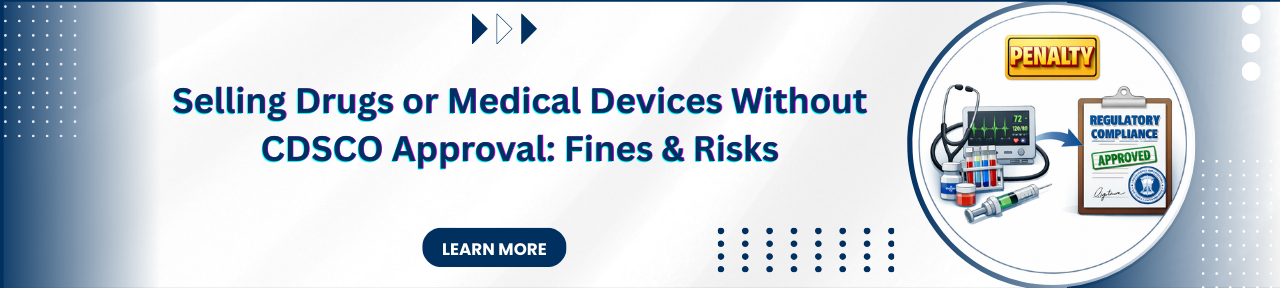
Selling Drugs or Medical Devices Without CDSCO Approval: Fines, Legal Risks & Penalties
The pharmaceutical and medical device regulatory landscape in India has reached a critical turning point in 2026. With the full integration of the Jan Vishwas Act Pharma Penalties 2026 and the newly notified Drugs and Cosmetics (Compounding of Offences) Rules, 2025, the Central Drugs Standard Control Organisation (CDSCO) has shifted toward a “trust-based” yet high-stakes enforcement model. While the government has moved to decriminalise minor technical errors, the CDSCO approval penalties for quality-related negligence—such as the sale of spurious drugs or non-compliance with QR code mandates—have become more aggressive, involving immediate Pharma Stop Production Orders (SPO) 2026 and nationwide product seizures.
The regulatory experts at LegalRaasta can help to keep your pharma or medical device venture within the recent 2026 requirements.
The Jan Vishwas Act Pharma Penalties 2026: A Paradigm Shift
The Jan Vishwas Act Pharma Penalties 2026 is an enormous piece of legislation that attempts to decriminalize about 280 offences in several central acts. Within the pharmaceutical industry, this implies that incarceration covering minor or venial technical violation instances has yielded to formally constructed monetary CDSCO approval penalties.
Key Highlights of the 2026 Reform:
- Administrative Adjudication: Many offences are not processed immediately through a criminal court, and instead, the process is direct to the Administrative or what is referred to as the Adjudicating Officer, where fines can be imposed.
- Automatic Inflation Adjustment: Any monetary penalties would increase by 10% regularly under the new rules every three years, beginning in 2026, which serves as a baseline.
- First-Time Offender Advisory: For 76 specified minor offences, the CDSCO can now issue a formal warning or advisory for first-time contraventions instead of an immediate fine.
CDSCO Compounding of Offences Rules 2025: Settlement Procedures
The CDSCO Compounding of Offences Rules 2025 provide a statutory “exit route” for manufacturers and importers who have committed non-serious violations. Compounding essentially allows the accused to pay a fine in lieu of prosecution.
Eligibility and Settlement Framework
|
Aspect |
Regulation / Detail |
|
Primary Authority |
Compounding Authority SOPs India (ADGHS or State Drug Controller) |
|
Applicability |
Offences under Section 32B of the Drugs and Cosmetics Act |
|
Exclusions |
Offences punishable with “Imprisonment only” or “Imprisonment + Fine.” |
|
Immunity Status |
Full immunity granted upon Minor Contravention Settlement, CDSCO |
|
Payment Deadline |
Must be remitted within 30 days of the compounding order |
Drugs and Cosmetics Act Legal Risks: 2026 Risk Categories
The CDSCO classifies the Drugs and Cosmetics Act Legal Risks at three levels according to the effect on the health of citizens. The 2026 enforcement regime uses CDSCO Risk-Based Inspection Penalties to target manufacturers who consistently fail to meet “Good Manufacturing Practices” (GMP).
- Tier 1: Minor/Technical Contraventions
These include errors in record-keeping, minor labelling mistakes (excluding QR codes), or failure to notify changes in administrative details. These are generally compoundable.
- Tier 2: Major/Quality Contraventions (Misbranded & Adulterated)
Violations involving Misbranded Drug Legal Consequences 2026 fall here. If a label fails to disclose necessary ingredients or claims false therapeutic benefits, the CDSCO approval penalties are strictly monetary but significantly higher.
- Tier 3: Critical/Criminal Contraventions (Spurious Drugs)
The Spurious Drug Sale Fines 2026 are still the most extreme. Selling drugs that are imitation products or substituted by other ingredients carries mandatory imprisonment and fines that can extend to the total value of the seized goods.
Pharma Stop Production Order (SPO) 2026 & Seizure Guidelines
The CDSCO has updated its enforcement manual to include the CDSCO Product Seizure Guidelines, which are triggered immediately after a failed risk-based inspection.
Enforcement Actions and Timelines
|
Enforcement Action |
Triggering Event |
Legal Consequence |
|
Stop Production Order (SPO) |
Failure of critical GMP/Schedule M standards |
Immediate cessation of manufacturing |
|
Product Seizure |
Detection of Spurious or NSQ drugs |
Detainment of raw materials and finished stock |
|
License Suspension |
Repeated Form 42 Registration Violations |
Temporary ban on trade/manufacturing (1-6 months) |
|
Blacklisting |
Fraudulent data submission in the SUGAM portal |
Permanent bar from participating in government tenders |
Medical Device Non-Compliance Fines India: 2026 Risk Classification
The CDSCO approval penalties on non-compliance with medical devices have been tightened with the publication of the final risk classification lists associated with Oncology and Radiotherapy equipment in January 2026. Medical Device Non-Compliance Fines in India are now strictly mapped to the device’s class (A, B, C, or D).
- Class A (Low Risk): Focuses on “Improvement Notices.” Failure by the manufacturer to correct the mistake within 30 days attracts a fine of Rs 1 Lakh.
- Class D (High Risk): Any non-conformity in the production of implants or life-critical equipment prompts an automatic Pharma Stop Production Order (SPO) 2026 and will be followed by possible criminal charges under the 2026 norms.
QR Code Compliance Fines Schedule H2 & Digital Mandates
The 2026 digital-first compliance initiative has made QR codes on primary packaging non-negotiable for all Schedule H2 drugs.
The CDSCO Approval Penalties for Digital Non-Compliance:
- QR Code Compliance Fines Schedule H2: Batches found without a functioning, readable QR code containing the unique product ID, batch number, and expiry are classified as Misbranded.
- Data Integrity Fines: The punishment for the QR code information that has nothing to do with the physical batch records can go up to Rs 2 Lakhs per batch.
Unlicensed Cosmetic Import Penalties & Form 42 Violations
For importers, the CDSCO approval penalties 2026 have introduced a “Zero Tolerance” policy on Unlicensed Cosmetic Import Penalties. The importation of cosmetics without a valid Registration Certificate (RC) results in the following:
- Product Confiscation: Under the CDSCO Product Seizure Guidelines, the entire consignment is in custody at the port.
- Form 42 Registration Violations: Fraudulent use of Form 42 (application form) or providing false manufacturing site information leads to a permanent block of the importer’s IEC code on the ICEGATE portal.
Comprehensive Penalty Schedule 2026
The following table outlines the consolidated fines as per the Jan Vishwas Act Pharma Penalties 2026 and CDSCO Compounding of Offences Rules 2025.
2026 Penalty & Settlement Schedule
|
Offence Category |
Relevant Section / Keyword |
Penalty Range (INR) |
Compoundable? |
|
Minor Procedural Lapse |
CDSCO Decriminalization of Minor Offences |
Rs 10,000 – Rs 50,000 |
Yes |
|
Non-Disclosure of Manufacturer |
Section 18A / 28 |
Rs 20,000 – Rs 1 Lakh |
Yes |
|
Schedule H2 QR Failure |
QR Code Compliance Fines Schedule H2 |
Rs 50,000 – Rs 2 Lakhs |
Yes |
|
Misbranded Drug Sale |
Misbranded Drug Legal Consequences 2026 |
Rs 5 Lakhs – Rs 15 Lakhs |
No |
|
Spurious Product Sale |
Spurious Drug Sale Fines 2026 |
Rs 10 Lakhs + Imprisonment |
No |
|
Import without License |
Form 42 Registration Violations |
Rs 2 Lakhs + Blacklisting |
No |
Managing CDSCO Risk-Based Inspection Penalties
In 2026, the CDSCO performs Surprise Risk-Based Inspections of the facilities with past records of NSQ (Not of Standard Quality) alerts.
Survival Guide for Inspections:
- SOP Alignment: Ensure that the manufacturing SOPs you use are consistent with the Compounding Authority SOPs in India.
- Self-Audit: Perform monthly internal audits that will help you avoid a Pharma Stop Production Order (SPO) 2026.
- Traceability: To prevent the Data Mismatch penalties, ensure that the SUGAM portal is real-time updated with batch data.
Conclusion
The 2026 regulatory framework will give incentives to transparent, quality-conscious companies and bring bad actors out of the supply chain in a systematic manner. The government has offered the honest mistake a lifeline through the CDSCO Decriminalization Minor Offences initiative. Nevertheless, to those who disregard the QR Code Compliance Fines Schedule H2 or voluntarily put patient health at risk, legal ramifications and imposed CDSCO approval penalties are immediate and harsh. This could be a settlement by the CDSCO Compounding of Offences Rules 2025 or a battle over a Pharma Stop Productions Order (SPO) 2026; you need an expert lawyer.
LegalRaasta can help your business navigate the difficult issues of CDSCO compliance and penalty settlements in the present and secure its future.
FAQs
- What are the CDSCO Compounding of Offences Rules 2025?
The CDSCO Compounding of Offences Rules 2025 are a set of regulations that allow manufacturers and importers to settle specific legal violations under the Drugs and Cosmetics Act by paying a monetary fine instead of going to court.
- How does the Jan Vishwas Act Pharma Penalties 2026 impact a first-time offender?
The Jan Vishwas Act Pharma Penalties 2026 lays down that first-time offenders with some technical violations can be given a warning or an advisory (instead of a fine) as an option, which is one of the strategies to have a trust-based compliance regime.
- Which violations qualify for a Minor Contravention Settlement CDSCO?
A Minor Contravention Settlement CDSCO can be used with regard to procedural shortcomings, including minor labeling mistakes, record-keeping delays, or administrative modifications, none of which affect the quality or safety of the drug.
- What is the penalty for failing QR Code Compliance Fines Schedule H2?
Non-compliance with the QR Code Compliance Fines Schedule H2 standards in 2026 may result in the declaration of the batch as Mishandled and impose a fine of between Rs 50000 and Rs 2 Lakh on each batch, and a compulsory recall of the product.
- Can a Pharma Stop Production Order (SPO) 2026 be challenged?
Yes, a Pharma Stop Production Order (SPO) 2026 may be appealed using the Central or State Government, on the condition that the manufacturer can demonstrate that the mentioned deviations found during the risk-based inspection have been corrected.
- What are the CDSCO Product Seizure Guidelines for cosmetics?
The CDSCO Product Seizure Guidelines provide that any cosmetic imported in violation of having a valid Form 43 certificate could be subjected to seizure at the port of entry, and the importer might incur Unlicensed Cosmetic Import Penalties.
- Are Spurious Drug Sale Fines 2026 compoundable?
No. The violations of Spurious Drug Sale Fines 2026 refer to the significant risks of unsatisfactory health of the population and to non-compoundability, as it is strictly forbidden, and many offenders have to face imprisonment and various fines.
- How are Medical Device Non-Compliance Fines in India determined?
Medical Device Non-Compliance Fines in India in 2026 are established depending on the threat factor of the device (Class A, B, C, or D), with more threatening devices subjected to much more rigorous fines.
- What happens during Form 42 Registration Violations?
Form 42 Registration Violations represent situations when an importer presents falsified information in the process of a cosmetic import license application. This may result in the certificate of Registration being cancelled and blacklisting against the importing company.
- Where can I find the Compounding Authority SOPs in India?
The Compounding Authority SOPs India can be found on the official CDSCO SUGAM portal and describe the stepwise procedure of the filing of a compounding application, including the required forms and timetables.

-
 Medical Device Registration in India: Top 20 CDSCO...
10-Mar-2026
Medical Device Registration in India: Top 20 CDSCO...
10-Mar-2026 -
 CDSCO Medical Device License in India: Complete Guide
20-Jan-2026
CDSCO Medical Device License in India: Complete Guide
20-Jan-2026 -
 Medical License in India: Registration Process, El...
20-Jan-2026
Medical License in India: Registration Process, El...
20-Jan-2026 -
 From Lab to Clinic: The Role of MD-22 & MD-23 ...
01-Sep-2025
From Lab to Clinic: The Role of MD-22 & MD-23 ...
01-Sep-2025 -
 Fast & Reliable CDSCO Registration Services fo...
28-Aug-2025
Fast & Reliable CDSCO Registration Services fo...
28-Aug-2025 -
 ISO 13485 Quality Management System for Medical De...
20-Aug-2025
ISO 13485 Quality Management System for Medical De...
20-Aug-2025 -
 How CDSCO Consultants Are Adapting to Digital Regu...
14-Aug-2025
How CDSCO Consultants Are Adapting to Digital Regu...
14-Aug-2025 -
 Why You Should Hire a Consultant for Your Medical ...
02-Jun-2025
Why You Should Hire a Consultant for Your Medical ...
02-Jun-2025 -
 Common Pitfalls in Medical Device License Applicat...
21-May-2025
Common Pitfalls in Medical Device License Applicat...
21-May-2025