
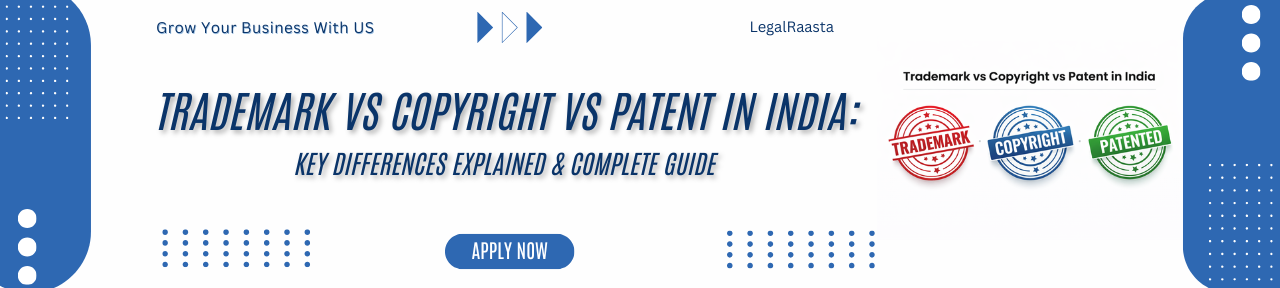
Trademark vs Copyright vs Patent in India: Key Differences Explained
In the fast-changing Indian economic environment of 2026, intellectual property shifted from a luxury of the boardroom to a basic business need. Since India became a global innovation centre, the market has become hyper-competitive due to the sheer number of startups and tech-focused organisations. Have you created an algorithm that will revolutionise software, written a potential bestseller, or launched a brand that is becoming viral? The Trademark vs Copyright vs Patent in India is the only way to protect your future income.
Intellectual Property (IP) rights are intangible assets that ensure that your hard work and innovativeness are not turned to profit by competitors. Your million-dollar idea is, in reality, a project in the public domain, and you are now exposed to imitation, online piracy, and dilution of your brand. Register your brand and idea now by reaching the IP registration experts at LegalRaasta to have your assets registered as per the current 2026 Indian compliance standards.
What is a Trademark in India? (The Brand Identity)
A trademark is a visual or sensory symbol that acts as a “source identifier.” It helps consumers distinguish your goods or services from those of your competitors. The Indian Trade Marks Registry has now widened its scope in 2026. In addition to mere logos, companies are now aggressively registering sound marks (as in the Netflix “ta-dum”) and smell marks, and even a particular 3D packaging shape.
- Meaning: It is a unique mark, a word, a logo, or a slogan that refers to the origin of a product.
- Purpose: To create brand equity, create goodwill, and eliminate confusion among consumers.
- Governing Law: The Trade Marks Act, 1999 (with 2025-26 digital filing amendments).
- Examples: The name “Jio”, a Nike logo (the Swoosh), or the very particular shape of a bottle of Coca-Cola.
The Four Pillars of Trademark
- Distinctiveness: It cannot be generic (e.g., you cannot put a trademark on “Apple” that you will use to sell apples).
- Non-Descriptiveness: It should not merely explain what the product is (e.g., Cold Water in the case of a beverage).
- Visual Representation: It should be capable of being represented graphically.
- Priority of Filing: India follows a “First to File” and “First to Use” hybrid system.
What is Copyright in India? (The Creative Expression)
Copyright is a legal protection that applies to the creators of original works. Importantly, copyright does not cover the idea but only guards the expression of an idea. If you have an idea for a movie about space, anyone can use that idea—but no one can copy your specific script. As per the Copyright Act, 1957, protection begins the moment the work is fixed in a tangible form.
- Meaning: Exclusive rights to reproduce, distribute, and perform creative and intellectual works.
- Protection Scope: * Literary: Books, blogs, computer software/code, and database schemas.
- Artistic: Paintings, architecture, drawings, and maps.
- Musical & Sound: Ringtones, lyrics, and melodies.
- Cinematograph Films: Movies and digital shorts.
- Validity: For individuals, it is the lifetime of the author plus 60 years. For companies, it is 60 years from publication.
Why Software is Copyrighted, Not Always Patented
In the Trademark vs Copyright vs Patent in India debate for tech, most developers rely on copyright. In India, software code is treated as a “literary work.” While specific functional algorithms can sometimes be patented, the literal code is protected by copyright the moment it is saved.
What is a Patent in India? (The Functional Invention)
A patent is the most powerful form of IP protection, granted for a “new invention.” It gives the inventor a total monopoly to make, use, or sell the invention for a limited period—typically 20 years—in exchange for full public disclosure. This is a “quid pro quo” with the government: you share your knowledge, and they give you a legal monopoly.
- Meaning: A legal right of an invention which is new and industrially workable.
- Governing Law: The Patents Act, 1970 (including latest 2025-26 amendments for Green-Tech).
- Protection Scope: New products, chemical compositions, pharmaceutical formulas, and technological processes.
The 5 Requirements of a Patent in India
- Novelty: The invention must not have been published or used anywhere in the world before.
- Inventive Step: It must not be obvious to a person skilled in the same field.
- Industrial Applicability: It should be able to be created or utilised in an industry.
- Non-Patentable Subject Matter: It should not be covered under Section 3 (e.g., a simple finding of some scientific law).
- Full Disclosure: The patent application should specify the invention to a level so that another person can duplicate it.
Trademark vs Copyright vs Patent: The Ultimate 2026 Comparison Table
The way to get the right protection is to sink into the differences. The table below gives a technical breakdown employed by the legal professionals in 2026.
Comparative Analysis of IP Rights in India
|
Feature |
Trademark |
Copyright |
Patent |
|
Object of Protection |
Brand Identity & Reputation |
Original Creative Expression |
Technical Inventions |
|
Legal Legislation |
Trade Marks Act, 1999 |
Copyright Act, 1957 |
Patents Act, 1970 |
|
Registration |
Strongly Recommended |
Automatic (Registration aids proof) |
Mandatory for Protection |
|
Term of Protection |
10 Years (Renewable Forever) |
Life + 60 Years |
20 Years (No Renewal) |
|
Standard of Review |
Comparison with existing marks |
Originality of work |
Novelty & Non-obviousness |
|
Cost of Filing |
Moderate |
Low |
High (Due to technical audits) |
|
Infringement Focus |
Consumer Confusion |
Substantial Copying |
Functional Duplication |
Examples & Overlaps: Protecting a Single Product
To know the Trademark vs Copyright vs Patent, we can take the example of a modern Electric Vehicle (EV) that was introduced in India in 2026:
- Trademark: The name of the car (e.g., “Thunderbolt”), the logo on the steering wheel, and the distinctive “hum” sound the engine makes.
- Copyright: The code for the autonomous driving system, the user interface (UI) design on the dashboard, and the advertising jingle.
- Patent: The specific solid-state battery chemistry, the aerodynamic suspension system, and the regenerative braking system.
Are Patents, Copyrights, and Trademarks Assets?
|
Asset Type |
Categorization |
Value Driver |
|
Trademark |
Intangible Asset |
Brand Recognition & Trust |
|
Copyright |
Intangible Asset |
Licensing & Royalty Streams |
|
Patent |
Intangible Asset |
Technology Monopoly & R&D Recovery |
Detailed Analysis: Intellectual Property as Business Assets
Many business owners ask: patents, copyrights and trademarks are what type of assets? These are categorised as Intangible Assets under Indian Accounting Standards.
1. Market Value & Goodwill
A registered trademark is the primary driver of “Goodwill.” If a company is sold, the brand name often carries a higher price tag than the physical machinery or office space. In 2026, global investors prioritise companies with a clean IP portfolio.
2. Licensing and Royalties
Copyrights and Patents allow you to “rent” your ideas. For example, a software company can license its copyrighted code to hundreds of other firms, creating a passive income stream through royalties.
3. Barriers to Entry
Patents create a 20-year wall around your business. If you hold a patent for a specific manufacturing process, no competitor can legally use that process in India, giving you a massive head start in market share.
How to Register: The 2026 Digital Workflow
In 2026, the Indian IP office switched to an AI-driven fast-track system. Here is how you navigate it:
The Trademark Process
- Search: Use the public search database to check for phonetic similarities.
- Filing: Submit Form TM-A. You can use the ™ symbol immediately.
- Examination: The government issues an “Examination Report.”
- Publication: It is advertised in the Trade Marks Journal over the course of 4 months.
- Registration: If no one opposes, the ® is granted to you.
The Patent Process
- Provisional Application: File this sooner to obtain your Priority Date as you perfect the invention.
- Complete Specification: Within 12 months, file the full technical details.
- Publication: The patent is published after 18 months.
- Request for Examination (RFE): You must actively ask the government to check your patent.
- Grant: After clearing objections, the patent is granted for 20 years.
The Role of Artificial Intelligence in IP Registration (2026 Update)
The Indian Patent Office and the Trademark Registry have made the AI and Intellectual Property intersection a much-needed point of focus in 2026. The question of Authorship has been of primary concern against the backdrop of a growing reliance by businesses on generative AI to create logos or write code.
AI-Generated Content vs. Human Authorship
Current Indian regulations under the Copyright Act and Patents Act still maintain a “human-centric” approach.
- For Trademarks: AI can be used to generate a logo, but the actual registration must be done under a recognised legal “Person” (An Individual or Corporation). AI cannot be a “Proprietor”.
- For Patents: In the situation where the invention is entirely/fully made by AI without any human intervention, meeting the Inventive Step requirement in India is a major challenge for such a patent scenario.
Using AI for “Freedom to Operate” (FTO) Analysis
In 2026, smart businesses are seeking Freedom to Operate searches prior to launching the products using AI-driven tools. This will avoid accidentally infringing on the existing patents or trademarks, which would save millions in litigation expenses.
Detailed Cost Breakdown: Statutory Fees for 2026
Budget planning requires an understanding of the financial commitment. To promote innovation, the Indian government subsidises the rates for Startups, MSMEs, and Individuals.
2026 Government Fee Structure (E-Filing)
|
Procedure |
Category: Individual / Startup / MSME |
Category: Large Entity / Company |
|
Trademark Filing (Per Class) |
Rs 4,500 |
Rs 9,000 |
|
Patent Filing (Up to 30 pages) |
Rs 1,600 |
Rs 8,000 |
|
Patent Request for Examination |
Rs 4,000 |
Rs 20,000 |
|
Expedited Patent Examination |
Rs 8,000 |
Rs 60,000 |
|
Copyright Filing (Literary/Artistic) |
Rs 500 |
Rs 500 |
|
Copyright Filing (Software/Films) |
Rs 400 – Rs 40,000 (Varies by type) |
Rs 400 – Rs 40,000 |
Note: These are official government fees only. Drafting, technical auditing, and objection management are also professional fees, but are necessary to pass the filing through the Examination phase.
Going Global: International IP Protection from India
A local registration will not do the job of Indian brands entering the US, Europe, or the UAE in 2026. You must leverage international treaties to protect your assets across borders.
1. The Madrid Protocol (Trademarks)
India is a signatory to the Madrid Protocol, by which you can submit one international application to any one of the Trademark offices in India to obtain protection in more than 130 countries.
- Requirement: You must have a “Basic Application” or registration in India first.
- Benefit: Under this centralised system management, you are able to renew or address changes to all countries with a single window.
2. The Patent Cooperation Treaty (PCT)
For inventors, the PCT provides a unified procedure for filing patent applications to protect inventions in each of its contracting states. Filing a PCT application buys you 30 months to decide which specific countries you want to enter, allowing you to test market viability before spending heavily on national phase entries.
IP Enforcement and Litigation Trends in 2026
With the rise of digital commerce, IP Infringement has become more sophisticated. Indian courts have responded by granting “Dynamic Injunctions” and “John Doe” orders.
- Dynamic Injunctions: Common to copyright (such as movie piracy), such an injunction permits the IP owner to block mirror sites and new URLs without a new suit each time.
- Cease and Desist Notices: A properly drafted legal notice from a firm such as LegalRaasta usually clears 90% of violations in Trademark disputes without going to court.
- Mediation: In 2026, the government of India mandated mediation as the compulsory way to settle a lot of Intellectual Property disputes. No doubt, mediation is a lot quicker and cheaper than the regular litigation process.
Summary Checklist: Which One Do You Need?
To simplify the Trademark vs Copyright vs Patent in India choice, use this quick-reference checklist:
- Do you have a unique Name or Logo? -> Get a Trademark.
- Do you have original Software Code, a Book, or Music? -> Get a Copyright.
- Do you have a new Machine, Chemical Formula, or Process? -> Get a Patent.
- Do you have a unique product Shape or Pattern (Aesthetics)? -> Get a Design Registration.
Common Filing Mistakes to Avoid in 2026
- Confusing the Categories: Trying to “patent” a brand name or “trademark” a book title.
- Public Disclosure Before Filing: In the case of patents, if you show your invention at a trade show before filing, you lose the “Novelty” requirement and cannot get a patent.
- Ignoring the Search Phase: Filing a trademark that is “too similar” to an existing one leads to years of legal litigation.
- DIY Filing without Experts: IP law is highly technical. A single error in a patent “claim” can make your entire 20-year protection useless.
Conclusion: The Hybrid IP Strategy
In 2026, successful Indian businesses do not select only one: they employ a Trademark vs Copyright vs Patent in India hybrid strategy. You patent your unique technical solutions, copyright your content/software, and trademark your brand. This creates a “multi-layered” shield that makes it nearly impossible for competitors to touch your business. Call the LegalRaasta professionals today, and you can have an IP audit done and have your Trademark, Copyright, or Patent registered with total accuracy and precision.
Frequently Asked Questions (FAQs)
- What is the difference between a copyright, trademark and patent?
The fundamental Trademark vs Copyright vs Patent difference is the protection being offered as being one of brand symbols/names, creative expression (art/music/code), and functional technical invention.
- What are the 4 types of intellectual property?
The four primary types are Trademarks, Copyrights, Patents, and Trade Secrets. Every business should compare Trademark vs Copyright vs Patent to see which fits their specific asset before filing.
- What are the 4 types of trademarks used in India?
In 2026, the four usual types include the Word Marks, the Service Mark, the Collective Mark, and the Certification Mark. Knowing an overview of Trademark vs Copyright vs Patent in India will assist you in not attempting to trademark a technical process.
- What are the 4 types of patents recognised by the Indian office?
Inventors often look at Utility Patents, Design Patents, Process Patents, and Product Patents. Each is used for different purposes in the larger Trademark vs Copyright vs Patent legal system.
- Is a patent better than a trademark for a tech startup?
A patent provides a stronger monopoly, but a trademark builds long-term brand value. In the Trademark vs Copyright vs Patent in India debate, tech startups usually need both to protect their code and their name.
- What are the 7 IP rights available in India?
These include Trademarks, Copyrights, Patents, Designs, Geographical Indications, Semiconductor Layouts, and Trade Secrets. Most litigation, however, centres on the Trademark vs Copyright vs Patent trio.
- How long does a patent last in India?
A patent lasts for 20 years from the filing date. Unlike a Trademark vs Copyright vs Patent alternative like trademarks, a patent cannot be renewed once it expires; it enters the public domain.
- Is Jio a trademark or a copyright?
“Jio” is a registered trademark of Reliance Industries. While the brand name is a trademark, the specific Trademark vs Copyright vs Patent protection for their app code would fall under copyright.
- What are the four pillars of trademark eligibility?
The pillars are distinctiveness, non-descriptiveness, visual representation, and lawfulness. These ensure your brand stays separate from others in the Trademark vs Copyright vs Patent comparison.
- What are the 5 requirements of a patent application?
An invention must be novel, involve an inventive step, have industrial application, be non-obvious, and be fully disclosed. These criteria distinguish it from a Trademark vs Copyright vs Patent creative work.

-
 Difference Between ™ and ® in India: Legal Meaning...
12-Mar-2026
Difference Between ™ and ® in India: Legal Meaning...
12-Mar-2026 -
 Generic Trademark Meaning in India: Causes, Legal ...
06-Feb-2026
Generic Trademark Meaning in India: Causes, Legal ...
06-Feb-2026 -
 India Sets New Record: Over 5.5 Lakh Trademark Reg...
03-Jan-2026
India Sets New Record: Over 5.5 Lakh Trademark Reg...
03-Jan-2026 -
 Expedited Trademark Registration: Fast-Track Your ...
11-Oct-2025
Expedited Trademark Registration: Fast-Track Your ...
11-Oct-2025 -
 Safeguard The Logo Of Your Business As A Trademark...
08-May-2025
Safeguard The Logo Of Your Business As A Trademark...
08-May-2025 -
 A Complete Procedure To Safeguard Your Brand In Th...
06-May-2025
A Complete Procedure To Safeguard Your Brand In Th...
06-May-2025 -
 Select An Attorney For Trademark Registration In I...
06-May-2025
Select An Attorney For Trademark Registration In I...
06-May-2025 -
 How Trademark Protection Enhance Brand Growth and ...
16-Jul-2025
How Trademark Protection Enhance Brand Growth and ...
16-Jul-2025 -
 How Trademark Registration Prevents Brand Infringe...
16-Jul-2025
How Trademark Registration Prevents Brand Infringe...
16-Jul-2025