
How to Start a Restaurant Business in India – Complete Registration, Licenses & Legal Guide
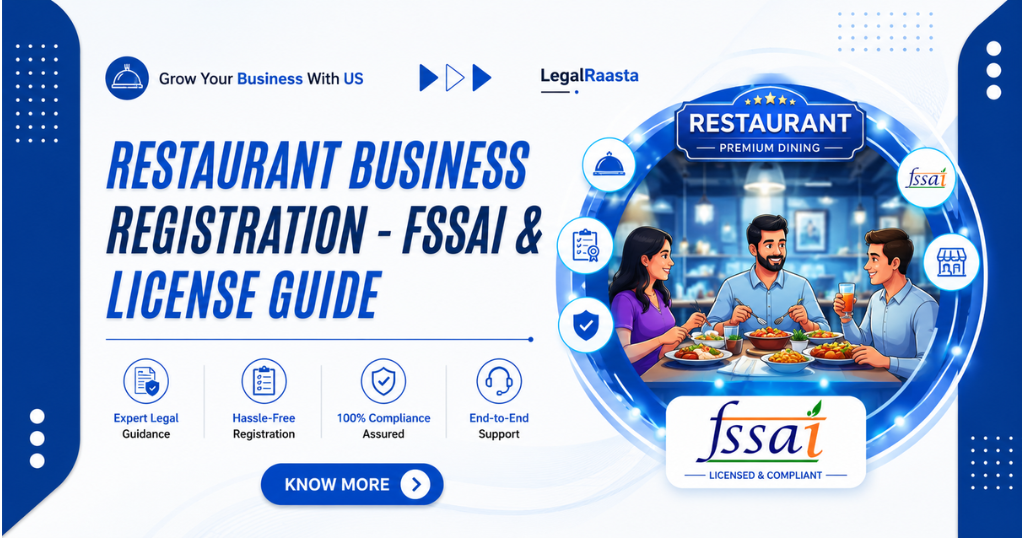
In 2026, the Indian restaurant Industry has proved to be one of the most profitable industries to invest in, with a compounded annual growth rate of 9% and an estimated market value of 5.99 lakh crore by 2026. The market is dynamic and ever-changing due to a cultural change towards restaurant consumption and a huge need for authentic regional foods. However, learning how to start a restaurant business registration in India is more than simply loving the food; one has to enter a model world of about 12 compulsory licenses and judicial compliance. Whether you choose to build a Quick Service Restaurant (QSR) or a delivery-only Cloud Kitchen, whether you choose the decision on the concept first or the exact requirements to obtain an FSSAI license for restaurants on the foundation first, it is a long-term viability step-by-step process that must be thoroughly planned.
To simplify your legal process, hire LegalRaasta to complete the legal tasks involved in filing your business and guiding your restaurant through the Indian regulatory laws.
Defining Your Restaurant Concept and Market Landscape
To understand how to start a restaurant business in India, the first thing that you must know is the idea that is going to be based on how much you have to invest and the eating patterns of the locals. The model selected will influence your restaurant licenses in India and the general overhead of operation.
- Quick Service Restaurants (QSRs)
QSRs are dedicated to fast foods and takeaways that have limited seating and quick turnover. These are best suited in high footfall locations such as metro stations, malls, university hubs, or other locations.
- Casual Dining
A casual dining facility is more relaxed, and the options available are mixed to provide a balance between a wide range of food and affordability. They form the foundation of the Indian family dining culture.
- Fine Dining
They are high-end restaurants with a focus on high-quality service, luxury atmosphere, and rich cuisine. They demand the largest capital investment and specific restaurant legal requirements on alcohol and luxury seating.
- Cloud Kitchens (Ghost Kitchens)
Delivery-only models enable entrepreneurs to face fewer initial setup costs because there is no physical dining area. They pay attention only to logistics and the quality of the food.
- Specialty Restaurants
Target regional or vegetarian cuisines, e.g., authentic South Indian food, or organic vegan restaurants. These involve specialized food business registration under the specific sub-categories.
Evaluating Restaurant Setup Costs and Budgeting
Understanding your investment upfront is critical to avoid financial surprises. Total setup costs for starting a restaurant business registration in India vary widely based on the model, city, and concept.
Estimated Restaurant Setup Costs in India (2025-2026)
|
Restaurant Type |
Investment Range |
Primary Cost Drivers |
|
Cloud Kitchen |
Rs 5 Lakhs – Rs 15 Lakhs |
Kitchen equipment, packaging, and digital marketing |
|
Quick Service (QSR) |
Rs 12 Lakhs – Rs 25 Lakhs |
Compact space, fast-turnover kitchen gear |
|
Casual Dining |
Rs 25 Lakhs – Rs 75 Lakhs |
Interiors, furniture, and a larger staff |
|
Fine Dining |
Rs 75 Lakhs – Rs 1.5 Crores |
High-end location, luxury interiors, skilled chefs |
Comprehensive Guide to FSSAI Licensing (Primary Requirement)
The FSSAI license for restaurants, provided by the Food Safety and Standards Authority of India, is the most important license needed for any restaurant in India. It is a legal document representing authority approval for producing and serving food, ensuring it meets safety standards.
FSSAI License Categories and Fees
Before you learn how to start a restaurant business in India, you first need to figure out the kind of license that will be suitable for you based on the annual turnover of the restaurant business.
FSSAI License Structure (Annual Turnover-Based)
|
Annual Turnover |
License Type |
Annual Fee (Approx. Govt. Fee) |
|
Below Rs 12 Lakhs |
Basic Registration |
Rs 100 |
|
Rs 12 Lakhs – Rs 20 Crores |
State License |
Rs 2,000 – Rs 5,000 |
|
Above Rs 20 Crores |
Central License |
Rs 7,500 |
Mandatory Conditions for FSSAI Compliance
These are the conditions that all Food Business Operators (FBOs) are supposed to follow always:
- Display: An original copy of the license should be displayed in a prominent area on the premises.
- Supervision: There should be at least one technical individual whose role is to supervise the production process. This individual should have a degree or diploma in Science, Food Technology, or Hotel Management.
- Reporting: Authorities must be informed of any activities or changes in the license that the company/individual has.
- Annual Returns: Apart from the periodical returns, annual returns have to be filed every year before May 31st.
- Hygiene Standards: The companies need to ensure that they comply with the requirements of Schedule 4 of the FSS Act regarding the cleanliness and hygienic standards of their establishments.
- Record Keeping: Daily records of raw material use and sales should be kept separately.
- Testing: It is mandatory to test the chemical and microbiological contaminants of the most concern at least once every six months in a lab accredited by NABL.
- Sourcing: Only licensed and registered suppliers can be used to purchase raw materials.
Other Essential Restaurant Licenses and Permits
In addition to the FSSAI license for restaurants, a number of other permits are necessary to operate legally. The following are the essential restaurant legal requirements in India.
- Eating House License
Obligatory to public restaurants where food/drink is taken. It is issued by the Licensing Police Commissioner of a centre city (such as Delhi Police or Mumbai Police).
- Health Trade License
Granted by the local Municipal Corporation (MCD, BMC, etc.), verifying that the business complies with the health and hygiene standards. The prices vary between Rs 5,000 and Rs 50,000 in accordance with the city and the number of seats.
- Shop and Establishment Act Registration
This is regulated by the State Labour Department and should be acquired within 30 days of the commencement of business. It controls working hours, holidays, and forbids child labour.
- GST Registration
The businesses that have revenue approaching or above Rs 20 Lakhs (Rs 10 Lakhs in certain states) are mandatory. You can still register even below the threshold in order to obtain the refund on part of the expenses as Input Tax Credit.
- Fire Safety NOC
Needed to demonstrate the premises comply with fire requirements; required in the case of Eating House licenses when the seating capacity exceeds 50. This includes a high level of inspection in extinguishers, exits, and sprinklers.
- Music License
Because of the Copyright Act of 1957, required for the playing of recorded music (PPL) is played or live performances (IPRS) do not. Failure to comply may result in hefty fines that are levied by copyright infringement.
- Environmental Clearance (DPCC/SPCB)
Strict requirements are designed to guarantee that restaurants manage waste materials and manage air pollution (exhaust system).
GST Rates and Rules for Restaurants
Restaurants under the GST regime are classified depending on their location and hotel room tariff at their new place of residence. Financial planning is one of the most important aspects of the process of starting a restaurant business in India.
GST Rates for Restaurant Services (2026)
|
Type of Restaurant |
GST Rate |
Input Tax Credit (ITC) |
|
Standalone Restaurants (Inc. Takeaways) |
5% |
No ITC available |
|
Restaurants in Hotels (Room < Rs 7,500) |
5% |
No ITC available |
|
Restaurants in Hotels (Room ≥ Rs 7,500) |
18% |
Full ITC available |
|
Outdoor Catering Services |
5% (Standalone) / 18% (Hotel) |
Full ITC available |
Important Exemption (2026): Certain staple products, such as packaged paneer, some varieties of Indian breads, have switched to a 0% GST to reduce the cost of inputs among the standalone owners.
Operational Standards & Technology Integration
A modern restaurant cannot survive on paper licenses alone. Digital integration is now a de facto restaurant legal requirement for tax reporting and food safety.
- POS Systems (Point of Sale)
Modern POS systems integrate order entry, inventory management, and financial reporting. They are essential for filing GST returns accurately and managing the 14-digit FSSAI number tracking on bills.
- Digital Compliance Calendars
Since most restaurant licenses in India expire annually, owners must maintain a digital calendar. For example, a Trade License renewal often falls between January 1st and March 31st. Failure to submit these dates is subject to 50% penalties to the license fee.
Conclusion
Knowing how to start a restaurant business in India successfully requires balancing culinary vision with a rigorous approach to legal compliance. Securing the FSSAI license for restaurants is the foundational pillar of food safety, but completing the full roster of 12 essential licenses is what guarantees long-term operational freedom. By carefully managing setup costs, leveraging modern POS technology, and understanding the nuances of Indian GST laws, aspiring restaurateurs can turn their startup dreams into a sustainable reality in one of the world’s fastest-growing food markets.
In order to remain in line with the current government regulations and to be able to track your FSSAI or GST submissions, call LegalRaasta today.
Frequently Asked Questions (FAQs)
- What is the minimum budget for starting a restaurant business in India?
The minimum budget is usually between Rs 5 Lakhs and Rs 15 Lakhs to start with a Cloud Kitchen. This model is the most affordable way to learn how to start a restaurant business in India because it eliminates high-street rent and front-of-house staffing costs.
- Which license is the most critical for starting a restaurant business in India?
The FSSAI license for restaurants is the most critical permit required. No food company is allowed to operate without this registration because they provide assurance that the facility complies with safety standards imposed by the Food Safety and Standards Authority of India.
- Is GST registration mandatory for everyone planning to start a restaurant business in India?
It is mandatory to register for GST when your overall turnover in one year is above the limit of 20 Lakhs (10 Lakhs in certain areas). Nonetheless, the majority of the entrepreneurs who study how to start a restaurant business in India do so voluntarily to enjoy the benefits and cooperate with corporate suppliers.
- How long does the legal process take when learning how to start a restaurant business in India?
It takes 8 to 12 weeks on average to get all the required restaurant licenses in India. This covers the FSSAI processing time, the municipal inspections on the health trade license, and the Fire NOC for any larger seating capacities.
- What are the FSSAI fee structures for starting a restaurant business in India?
The annual fee for an FSSAI license for restaurants depends on turnover: Rs 100 for Basic Registration (under Rs 12 Lakhs), Rs 2,000–Rs 5,000 for a State License, and Rs 7,500 for a Central License (above Rs 20 Crores).
- Do I need a Fire NOC to start a restaurant business in India?
A Fire Safety NOC is a necessary restaurant legal requirement that has a seating capacity of more than 50 individuals. It makes sure the premises have sufficient extinguishers and emergency exits to safeguard customers.
- Can I start a food business from home while learning how to start a restaurant business in India?
Yes, it is possible to run a home-based cloud kitchen. Nevertheless, even in the case of a home setup, you need to obtain an FSSAI license for restaurants and adhere to local municipal guidelines so that the business can be legally compliant.
- What are the common legal pitfalls in starting a restaurant business in India?
The most common errors are working without a valid Eating House license, the inability to renew the FSSAI permits every year, and the lack of music licenses. Such neglect may cause severe fines or direct shutdown by the local government.
- Why is a POS system recommended for starting a restaurant business in India?
A POS system is essential for starting a restaurant business in India due to automation of billing that must comply with GST, inventory management to prevent theft, and storage of electronic documents that must be FSSAI audited annually.
- How can I protect my brand name while researching how to start a restaurant business in India?
In addition to the required permits, it is strongly advised to get a Trademark Registration. This denies the possibility of your brand name or logos being utilised by other parties, an essential action in achieving success in knowing how to start a restaurant business in India.

Related Posts



Our Clients







Featured In