
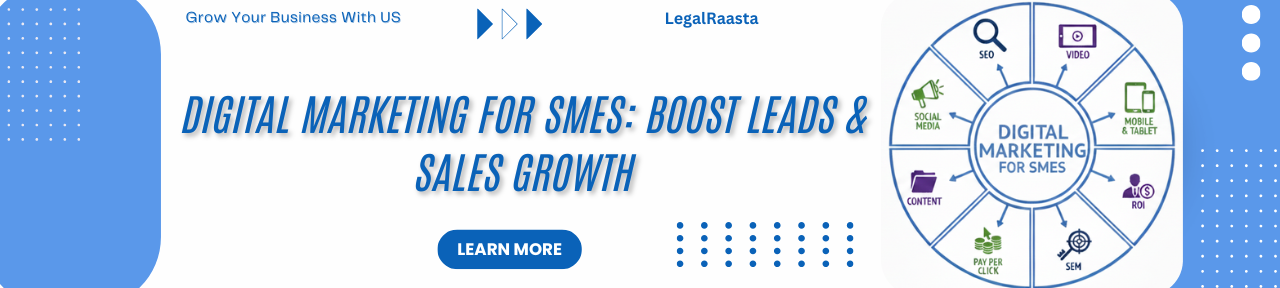
Digital Marketing Strategy for SMEs: Complete Guide to Boost Leads & Sales
The days are gone when businesses prioritize local signage, word-of-mouth, or newspaper ads to promote. But in 2026, the landscape of small and medium enterprises (SMEs) changed a lot. In today’s fast-growing business world, digital marketing is not left as only an option but has become one of the strongest tools for startups and SMEs. The recent data highlights that a strong online presence on digital platforms is becoming the baseline for businesses to attract customers. This guide will explore how small and medium enterprises are growing rapidly with digital marketing solutions in a competitive ecosystem.
1. The Complete Digital Shift: Customers Are Online First
The digital-first consumer mindset is the primary reason for the most profound changes influencing SMEs. It’s 2026, where customers do not directly interact with a business offline. But they prefer to first research, compare products or services with other businesses, and evaluate. The customer’s journey includes searching on Google, browsing social media, reading reviews, and watching videos before interacting with businesses offline. The industry insights graph determines that:
- Customers complete up to 70–80% of their buying decisions online before contacting a business.
- SMEs lose potential leads if they don’t show up in social feeds, search results, and reviews sections.
Although this sudden shift makes social engagement, search visibility, and online reputation much stronger and non-negotiable for survival.
2. Transformation from Digital Marketing to Traditional Marketing
In the past few years, the SMEs prioritized traditional marketing such as billboards, radio, flyers, print ads, and cold calling to promote their business. But, in the current digital era, these methods lost their identity: Here is why:
- High costs with limited tracking: The traditional ads are much more expensive than the digital method. Even traditional ads do not provide accurate performance metrics.
- No precise audience targeting: Small and medium enterprises can’t target quality leads by their behavior or intent in offline channels.
- One-way communication: No accurate way to get feedback.
2.2 Digital Marketing Benefits for SMEs
With the digital marketing methods, businesses can grow their small and medium-sized enterprise operations.
- Affordability & High ROI Ratio: Digital Marketing is far cheaper than traditional methods and allows limited budgets to create higher amounts of revenue with greater conversion rates.
- Target Audience Reach: SMEs are able to target particular demographics, interests, and behaviors, thus only spending their marketing budget on potential customers who are most interested in their products or services.
- Increasing Brand Presence: An active social media presence and optimized SEO will help SMEs develop a solid online reputation and acquire more visibility in their markets, making them appear larger & more credible than they really are.
- Real tracking time: The data allows campaign optimization to occur in real time, unlike traditional media, which is inferior because it does not allow real-time optimization to occur.
- Customer Engagement & Loyalty—Utilizing social media and personalizing content creates opportunities for direct interaction with your customers to build customer loyalty and establish trust in your brand name.
3. Types of Digital Marketing Strategies
Before the revolution of the digital marketing era, only those large brands with huge advertising budgets could service. But in 2026, businesses that have a strong social media presence are growing. By leveraging online channels, small and medium enterprises (SMEs) can enhance brand awareness, bring traffic, and generate leads. These are the key strategies:
Category |
Strategies |
|
Search Engine Optimization (SEO) |
Optimizing the website content, including its whole structure, helps to gain organic traffic and boost search results naturally. SEO is a comprehensive way to enhance visibility and attract targeted traffic. |
|
Content Marketing |
Creating and publishing valuable information in a format (blogs, videos, or infographics) to engage, inform, and boost trust with a specific audience. |
|
Social Media Marketing (SMM) |
The entire business hub is active on trending social media platforms like Instagram, Facebook, and LinkedIn to make real-time connections with customers. Furthermore, it increases brand awareness with potential leads and boosts sales. |
|
Pay-Per-Click Advertising |
Businesses pay to get the top placement on search engines or social media platforms. The most demanding is “Google Ads,” which pays Google for each click by customers. |
|
Email Marketing |
Sending targeted, personalized, or promotional messages to a certain audience via email helps to get direct interaction. This strategy is used to nurture connections with potential customers. |
|
Influencer Marketing |
It is another demanding marketing way to promote goods or services on a higher level. The small and medium enterprises (SMEs) collaborate with trusted individuals in a specific niche to expand brand reach and credibility. |
|
Affiliate Marketing |
It is a performance-based strategy. The SMEs adopt it where they earn commissions for promoting businesses’ products or services. |
|
Video Marketing |
Engages the targeted audience through visual storytelling on trending platforms like YouTube and other platforms, which often yields higher engagement rates. |
SMEs that invest strategically in digital marketing can significantly get tough competition with competitors who rely solely on brand recognition.
Digital Marketing Supports the Full Customer Journey
Digital marketing is not limited to attracting customers but also promotes at every stage of the buying lifecycle.
|
Stage |
Digital Strategy |
|
Awareness |
SEO, Social Media Content |
|
Consideration |
Short-form video, Reviews |
|
Conversion |
Paid Ads, Email Campaigns |
|
Retention |
Newsletters, Loyalty Programs |
|
Advocacy |
Referral Campaigns, UGC |
Local SMEs Need Digital Visibility More Than Ever
SMEs face much difficulty if they do not use the digital marketing features accurately. On the other hand, “open now,” “near me,” or “best in town” are the local searches that target mobile behavior in 2026. If your business hasn’t optimized with local SEO, you are greatly missing out on “ready-to-buy customers.” Optimizing for local visibility refers to:
- Consistent business listings
- Google Maps and local directories
- Local keyword targeting
- Mobile-optimized content
Your business’s local digital presence should be strong if you want to validate authenticity and drive foot traffic.
How Can SMEs Achieve Cost-Effective Growth?
Often, SMEs stay away from competitive markets due to budget constraints. But digital marketing strategies made it easier, even if you have a smaller budget. Key cost benefits include:
Adjustable spending
The small and medium-sized enterprises experience scaling up or down without wasting extra money.
Pay-for-performance models
Businesses don’t require you to pay every time, but only when you get the results. For example, on Google Ads, businesses only pay when the audience clicks and visits the website.
Precise targeting
Digital marketing only targets potential clients who need your services or goods. A small investment helps to bring accurate targeting leads.
Higher lifetime value
With retention via email and social campaigns, businesses can focus on keeping existing customers engaged, loyal, and purchasing again, rather than just acquiring new ones.
Compared to traditional advertising, digital is more measurable, flexible, and scalable.
Digital Strategies Build Long-Term Business Assets
Each sector of businesses in 2026 totally depended on digital marketing. Their investment in this field helps to grow their operations and open a wide range of opportunities. To stay ahead, many sectors are increasing their budgets and prioritizing digital strategies. In 2026, digital marketing strategies are not just an advantage but have become a survival tactic.
On the other hand, the offline ads only focus on one-time benefits, but digital marketing creates compounding assets.
- SEO rankings
- Email subscriber lists
- Blog and video content
- Social media communities
Over time, these assets grow, reduce future customer acquisition costs, and boost profitability.
Final Discussion: Grow your SMEs with Digital Marketing Strategies
In 2026, the digital marketing features become the assets for SMEs (small and medium enterprises). Adopting digital marketing strategies becomes a luxurious experiment that boosts brand visibility, connects to potential customers, and enhances trust, revenue generation, and long-term survival. From search engines to social platforms, from SEO to AI-powered automation, the digital ecosystem has become the primary arena. At this place, the customers discover, evaluate, and choose the right and trusted businesses. SMEs that embrace these strategies—and implement digital marketing—will survive long-term. By not adopting the digital marketing pathway, you are losing the opportunity to connect with customers faster. Digital marketing is the lifeline that connects SMEs to their customers, their growth potential, and their future success.
How does LegalRaasta Helps SMEs with Digital Marketing?
LegalRaasta helped thousands of businesses reach their potential customers. It further helps SMEs with digital marketing by providing structured and tech-enabled services. The assistance and support of LegalRaasta professionals help with:
- Helps SMEs to generate leads, increase sales, and boost online presence.
- Helps to arrange the necessary legal documents, such as FSSAI license, trademark registration, GST filings, and much more.
- Offers assistance to stay compliant with regulatory rules and regulations.
- To reach new clients, provide the training & assistance for technology-driven tools.
Frequently Asked Questions
- Why is digital marketing essential for SMEs in 2026?
Ans. In 2026, customers will search, compare, and buy online first. Therefore, listing your small and medium enterprises on social platforms can prove beneficial.
- How can small businesses compete with big brands in digital marketing?
Ans. Digital marketing differs across playing fields, targeting niche-specific audiences. It includes running hyper-local ads, using SEO, and optimizing website content. Digital marketing in 2026 helps to achieve high ROI with smaller budgets.
- How many digital marketing channels are there for SMEs?
Ans. The most effective digital marketing channels for SMEs include:
- Search Engine Optimization (SEO)
- Social Media Marketing (Instagram, LinkedIn, YouTube Shorts)
- Google & Meta Paid Ads
- Email & WhatsApp Marketing
- Content Marketing powered by AI tools
- Is digital marketing cost-effective for small and medium enterprises?
Ans. Yes, digital marketing features are cost-effective and beneficial for small and medium enterprises. Unlike print or TV ads, the SMEs are only required to pay for actual clicks, impressions, or conversions.
- What is the importance of AU in digital marketing?
Ans. In 2026, AI is another option in digital marketing, which helps to create content for websites, a guide for customer targeting, chatbots, predictive analytics, and ad optimization.
- How does digital marketing improve customer trust and brand credibility?
Ans. Digital marketing is one of the strongest tools. It boosts the trust of customers through online reviews, informative blogs, social videos, photos, and consistent brand messaging.
- What happens if SMEs do not adopt digital marketing in 2026?
Ans. If small and medium enterprises (SMEs) ignore digital marketing, they will lose visibility, customer trust, and market share. Without digital marketing, you are losing sales, minimizing brand recalls, and starting to face long-term sustainability issues.
- In how many days do digital marketing features show results?
Ans. How well digital marketing works is based on what type of strategy you use—there are different timelines for results. If you pay for ads, you’ll get leads immediately (within days)—if you use search engine optimization or content marketing, you should start seeing results 3-6 months after implementing strategies.
- Will local small and medium-sized enterprises take advantage of digital marketing after 2026?
Ans. Local small and medium-sized enterprises will continue to benefit from digital marketing, as it includes local search engine optimization; it includes optimizing your Google Business Profile; it provides Google advertising based on your location (geo-targeted ads); and it supplies information based on where you are.
- What does digital marketing look like beyond 2026 for small- to mid-sized enterprises?
Ans. Digital marketing will add more artificial intelligence personalization, voice-activated website searches (voice search), video-first content, zero clicks on Google searches, and automated products/services.

-
 Start Your Healthcare Business in India: Complete ...
16-Feb-2026
Start Your Healthcare Business in India: Complete ...
16-Feb-2026 -
 Pathology Lab Registration in India: Complete Step...
13-Feb-2026
Pathology Lab Registration in India: Complete Step...
13-Feb-2026 -
 Types of Business Licenses in India: Registration ...
11-Feb-2026
Types of Business Licenses in India: Registration ...
11-Feb-2026 -
 Business Licenses in India: Registration, Legal Re...
11-Feb-2026
Business Licenses in India: Registration, Legal Re...
11-Feb-2026 -
 India-US Trade Deal 2026: Key Highlights, Tariff C...
09-Feb-2026
India-US Trade Deal 2026: Key Highlights, Tariff C...
09-Feb-2026 -
 How to Start a Solar Panel Business in India in 20...
31-Jan-2026
How to Start a Solar Panel Business in India in 20...
31-Jan-2026 -
 BIS Registration for LED Lighting Chains Ensures S...
03-Sep-2025
BIS Registration for LED Lighting Chains Ensures S...
03-Sep-2025 -
 AD Code Registration Online Application in India
18-Sep-2025
AD Code Registration Online Application in India
18-Sep-2025 -
 BIS Certification for Electronic Video Games Ensur...
02-Sep-2025
BIS Certification for Electronic Video Games Ensur...
02-Sep-2025