
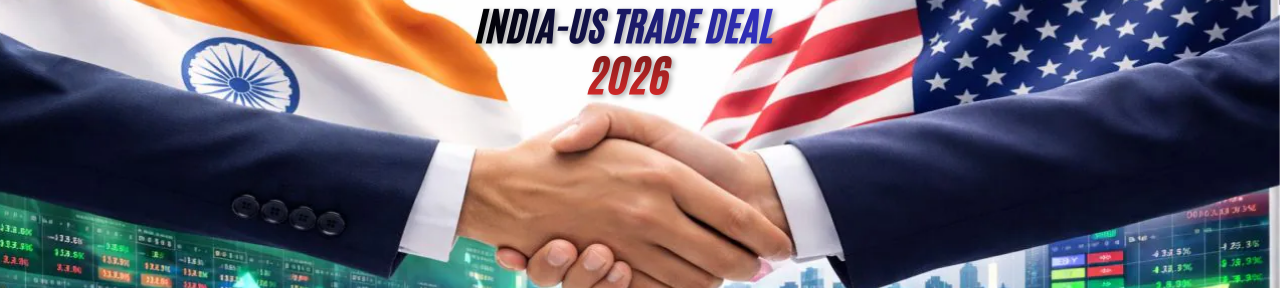
India-US Trade Deal 2026: Key Highlights, Tariff Changes & Impact on Indian Businesses
The watershed in the economic relations between the two largest democracies of the world is the officialization of the India-US Trade Deal 2026, which was announced on February 2, 2026. The economic reset implemented between Prime Minister Narendra Modi and President Donald Trump is an effective act of de-escalating a season of trade friction that had escalated to its height in late 2025. At its core, the treaty reduces the silent US tariffs on Indian goods by an appalling 50% to a concessional 18% on Indian products.
This 50% peak had once contained a 25% “reciprocal tariff” and another 25% punitive duty, which would come attached to purchases of Russian oil by India. The deal will help Indian exporters access a USD 30 trillion market with the removal of these barriers and help re-establish the price competitiveness of labor-intensive industries such as textiles, leather, and gems. Union Commerce Minister Piyush Goyal has described the framework as being fair, equitable, balanced, and a stepping stone to a full-fledged Bilateral Trade Agreement (BTA). With the global supply chains being in a state of reshaping, this agreement solidifies India as an important player against China in the Indo-Pacific region.
LegalRaasta will give you the best legal and compliance advice to ensure your business smoothly resolves regulatory complexities and documentation that could be necessitated by this new trade environment.
Key Points of the India-US Trade Deal 2026: A Summary Table
The following table outlines the core components of the interim framework and their immediate implications for the trade landscape.
|
Feature |
Details of the Agreement |
Direct Impact on Indian Businesses |
|
Tariff Reduction |
US effective tariffs cut from 50% to 18%; removal of 25% punitive duty on Russian oil imports. |
Massive cost savings and restored competitiveness for labor-intensive sectors. |
|
Zero-Duty Exports |
Select items like gems, diamonds, generic pharma, and smartphones to face zero tariffs. |
Increased profit margins and volume growth for key high-value export sectors. |
|
Import Concessions |
India to reduce/eliminate tariffs on US industrial goods and non-sensitive agri-products (e.g., tree nuts, wine). |
Lower input costs for manufacturers using US tech/machinery; increased competition in retail. |
|
Energy Pivot |
India to halt/reduce Russian oil buys; pivot to US energy and potentially Venezuela. |
Potential increase in energy costs; long-term supply chain alignment with the US. |
|
Purchase Pledges |
India intends to purchase USD 500 billion in US goods (energy, aircraft, tech) over 5 years. |
Massive procurement opportunities in aviation, energy, and defense infrastructure. |
|
Tech Cooperation |
Expansion in the trade of GPUs, data center equipment, and critical technologies. |
Positioning India as a global hub for AI and digital services; FDI boost from US tech giants. |
Implementation Timeline: When Provisions Take Effect
The India-US Trade Deal 2026 will be implemented in stages so that it will be easy to have free movement of mutual trade.
- Immediate Tariff Relief: US President Donald Trump signed an executive order removing the 25% punitive “extra duty” on Indian goods effective at 12:01 am Eastern Time on Saturday, February 7, 2026.
- Reciprocal Rate Adjustment: It is projected that the cut of the reciprocal tariff by 25% to 18% will be enforced in the shortage after the first breakthrough.
- Legal Formalization: The existing temporary structure will be transformed into an agreement that is a legally binding document, and the formality of its signing is scheduled in the mid of March 2026.
- Standards Review: The two countries have agreed upon a six-month window to identify the acceptability of American-developed standards or international standards and testing criteria between the time the agreement is realized in both countries.
Strategic Analysis: Impact on Key Indian Business Sectors
This in-depth sectoral analysis discusses the way the trade model is changing the industrial dynamics by providing a competitive advantage to the Indian exporter working within a complex market access environment.
- Boosting Manufacturing and MSMEs
It is projected that the India-US Trade Deal 2026 will transform the Indian economy for Micro, Small, and Medium Enterprises (MSMEs). By lowering the US reciprocal tariff to 18%, Indian goods now enjoy a rate more favorable than regional competitors like Vietnam (20%) and China (30-35%).
- Export Growth: Labor-intensive sectors such as textiles, apparel, leather, and footwear are anticipated to see an immediate revival in orders as their price competitiveness is restored in the American market.
- Job Creation: Minister Piyush Goyal emphasized that the projected increase in exports would provide millions of new jobs, especially among women and young people in rural and semi-urban India.
- Supply Chain Integration: The framework assists Indian MSMEs in becoming part of global value chains and reducing business costs by improved access to US industrial inputs.
- Transforming the Technology and Digital Landscape
An essential aspect of the deal is the growth of trade in technology and collaboration. This is in line with the Make in India program and the US-India Initiative on Critical and Emerging Technology (iCET).
- Data Center Dominance: India has also provided tax breaks to foreign firms establishing data centers, which also directly advantage American tech companies such as Google and Microsoft.
- Hardware and AI: The two countries are both committed to a major expansion in terms of trade in Graphics Processing Units (GPUs) and other specialized devices utilized in Data centers.
- Digital Leadership: Finance Minister Nirmala Sitharaman said the deal would boost Indian leadership in the digital services sector and make the country a center of AI and data services.
- Pharmaceutical and High-Value Gems Sectors
The agreement guarantees that generic drugs, gems, and diamonds will remain zero-tariff products in the US market.
- Pharma Advantage: The Indian pharmaceuticals that commercially export about USD 7 billion a year to the US will enjoy better growth prospects as the new US administration insists on the use of generics Prescriptions.
- Gems and Jewelry: This low-margin business will directly benefit from the elimination of earlier punitive obligations, ensuring it has a presence in one of its biggest export markets.
- Agriculture: Balancing Growth and Protection
The India-US Trade Deal 2026 is considered to approach the delicate issue of the agriculture sector with a careful touch, protecting local farmers while providing access to non-sensitive goods.
- Protected Items: India has managed to keep sensitive dairy and core crops out of the bargain. This covers rice, wheat, maize, soybean, sugar, poultry, and milk products, so that local farmers are not exposed to highly subsidized US imports.
- Export Opportunities: Indian farmers will have special privileges in accessing a vast US market with products such as spics, tea, coffee, coconut oil, and vegetable wax.
- Import Liberalization: On the other hand, India is to reduce duties on a small list of US goods, which includes tree nuts, soybean oil, and some fresh fruits (such as apples) with a specific minimum import price of Rs 80/kg to safeguard local interests.
Compliance and Regulatory Changes
Businesses should be ready to exploit the favorable rates through new regulatory frameworks:
- Rules of Origin: New regulations are being formulated so that the benefits of trade should go straight to the producers in India and America, and strict paperwork is required to show the origin of goods.
- Standards and Testing: India has also agreed to negotiate alignment on conformity assessment procedures. The exporters should expect the adoption of U.S.-developed or global standards in the identified industrial sectors.
- Digital Trade: New rules addressing the issue of “discriminatory or burdensome” practices on digital trade are under preparation, and will ultimately form a part of the overall BTA.
- Export Controls: There will be increased cooperation on inbound and outbound investment reviews and export controls to enhance supply chain security.
Support for MSMEs
While the deal is projected to unlock a USD 30 trillion market and create lakhs of jobs for MSMEs, specific support structures are being developed:
- Integration into Value Chains: The deal is specifically designed to help smaller businesses integrate into global value chains by lowering the costs of industrial inputs.
- Proposed Subsidies: It is proposed that the government should offer transition subsidies to ensure that the small businesses modernize their technology to be on par with U.S. imports.
- Tax Incentives: The Union Budget 2026-27 already includes tax holidays for foreign companies setting up data centers, which provides indirect opportunities for MSMEs in the digital services ecosystem.
Risk Mitigation Strategy
The changes in energy sources and possible interruptions in the supply chain pose a threat to Indian businesses:
- Infrastructure Upgrades: India needs to quickly modernize its LNG terminals and ports to be able to accommodate the committed USD 500 billion imports of U.S. energy and commodities within the next five years.
- Energy Diversification: To offset the loss of discounted Russian crude, businesses and the government are encouraged to accelerate the National Green Hydrogen Mission and expand civil nuclear energy, specifically Small Modular Reactors (SMRs).
- Diversified Market Access: To avoid over-dependence on the U.S. market, businesses should leverage India’s other recent trade successes, such as the pacts with the EU, UK, and Gulf nations.
Preparing for Full BTA Negotiations
The interim agreement is a “stepping stone” toward a full Bilateral Trade Agreement (BTA). Steps to prepare include:
- Harmonizing Standards: Businesses should begin aligning their production processes with U.S. norms now to attract long-term investment and secure future market access.
- Monitoring Technical Barriers: A bilateral committee is expected to monitor Sanitary and Phytosanitary (SPS) regulations to ensure they are not used as “backdoor protectionism” against Indian food and pharma exports.
- Engaging in Policy Dialogue: Industries should participate in high-level discussions regarding Intellectual Property Rights (IPR) and data localization, as these will be central to the full BTA negotiations.
Energy Commitments and Geopolitical Shifts
A critical, and somewhat controversial, aspect of the deal is India’s commitment to a major energy pivot. To secure the removal of the 25% punitive tariff, India has reportedly agreed to halt or significantly reduce its purchase of Russian crude oil.
- Russian Oil Halt: India has also reportedly agreed to considerably reduce or stop buying Russian crude oil. This is a significant strategic compromise considering that Russian oil had been a principal contributor to energy security in India.
- Strategic Sourcing: India will shift its procurement to the United States and possibly Venezuela.
- 500 Billion Commitment: India is planning to buy 500 billion worth of US goods over a period of five years, much of which will be in energy products, coking coal, and technology.
- Fiscal Impact: This brings India to Western parity on energy security but poses a challenge because Russian oil used to be bought at a discount. A change towards more expensive US or Venezuelan oil may possibly raise the bill of importation of India, as well as the Current Account deficit (CAD).
- Infrastructure Investment: To manage the promised USD 500 billion upsurge in US energy imports, India will need to expedite the standardization of LNG terminus and its port infrastructure.
Challenges and the Road to a Full BTA
Despite the economic optimism, the India-US Trade Deal 2026 has various challenges that companies and policy-makers need to keep an eye on:
- Import Bill Inflation: The replacement of discounted Russian oil with more expensive US or Venezuela oil would raise the import bill of India and affect the Current Account Deficit (CAD).
- Non-Tariff Barriers: With reduced tariffs, Indian exporters are confronted by invisible barriers such as stringent US Sanitary and Phytosanitary (SPS) quality standards, especially in the shrimp and fruit industries.
- Regulatory Alignment: The transaction can, at some point, lead to India aligning its Intellectual Property (IP) laws and data localization policies with US interests, which is a core issue with many local interests.
- Strategic Autonomy: The decline in Russian oil imports and the tightening of its relationship with Washington can put a strain on the historic strategic relationship between India and Moscow, which will continue to be a major provider of defense.
- Digital Trade Friction: Issues regarding data localization and the “free flow of data” remain sticking points as US tech giants seek alignment with their business models.
Conclusion
The India-US Trade Deal 2026 is not merely a cut in duties but rather a geopolitical realignment, as it is a trade concession of energy at the expense of making manufacturing survive. India has provided its core MSME/export sectors with a 18% tariff rate, allowing it to manage complicated global politics of power struggles. It is a “Strategic Window” that gives Indian businesses the stability to invest in deep manufacturing and transform themselves into a truly Atmanirbhar Bharat (Self-Reliant India). Whether this pact will succeed or not will hinge on the manner in which India will strike a balance between its national interests of farmers and its international trade goals with the impending Bilateral Trade Agreement talks.
Legalraasta has the experience to help you ensure that your business avoids running afoul of what has already happened with international trade laws and registration mandates in this deal.
Frequently Asked Questions (FAQs)
- What is the primary objective of the India-US Trade Deal 2026?
The India-US Trade Deal 2026 serves as a strategic economic reset designed to de-escalate trade tensions and provide Indian exporters a competitive edge by reducing effective US tariffs from roughly 50% down to 18%.
- Which Indian business sectors will see the most immediate benefits?
Labor-intensive industries such as textiles, apparel, leather, gems, and jewelry will gain immediate competitiveness. Additionally, high-value sectors like pharmaceuticals and smartphones benefit from continued zero-duty status under the India-US Trade Deal 2026.
- Does the India-US Trade Deal 2026 affect Indian farmers and the dairy industry?
Yes, but the government has been making provisions. Although the deal liberates some of the US products, such as tree nuts and wine, it fully shields sensitive areas such as dairy, rice, wheat, and soybeans to protect the local livelihoods.
- What are the key energy commitments made by India in this agreement?
Under the India-US Trade Deal 2026, India has supposedly vowed to lower or cease its purchases of Russian oil, instead swinging to the US and Venezuela to satisfy its energy demands as part of a 500 billion purchase plan.
- How does this deal compare to tariffs faced by India’s regional competitors?
India now has a more favourable tariff rate than some of its competitors, such as Vietnam (20%), Bangladesh (20%), and China (30-35), although certain GSP concessions still provide some countries with an advantage.
- How does the India-US Trade Deal 2026 benefit the technology sector specifically?
The deal substantially increases trade in technology products, especially Graphics Processing Units (GPUs) and other technology to be deployed in data centers, and it also broadens the cooperation in key emerging technologies.
- What is the significance of the USD 500 billion purchase pledge?
To help create a more balanced and reciprocal trade relationship, India plans to buy USD 500 billion of US energy products, aircraft, technology, and coking coal in a five-year period as part of the India-US Trade Deal 2026.
- How does the India-US Trade Deal 2026 tackle non-tariff barriers for businesses?
This agreement has a commitment to address historical obstacles in the key sectors of medical equipment and Information and Communication Technology (ICT) products, and has a roadmap to deliberate on harmonizing standards and testing demands within 6 months.
- What are the “Rules of Origin” established under this agreement?
India-US Trade Deal 2026 puts particular rules of origin in place so that the economic gains of the agreement accrue to Indian and American producers, to help tackle the non-market policies of third parties.
- Is this interim deal intended to be the final step in trade relations?
No, this framework will serve as an entry platform or stepping stone into a full-scale Bilateral Trade Agreement (BTA), which will later proceed to deeper market entry and yet more tariff cuts.

-
 How to Start a Solar Panel Business in India in 20...
31-Jan-2026
How to Start a Solar Panel Business in India in 20...
31-Jan-2026 -
 BIS Registration for LED Lighting Chains Ensures S...
03-Sep-2025
BIS Registration for LED Lighting Chains Ensures S...
03-Sep-2025 -
 AD Code Registration Online Application in India
18-Sep-2025
AD Code Registration Online Application in India
18-Sep-2025 -
 BIS Certification for Electronic Video Games Ensur...
02-Sep-2025
BIS Certification for Electronic Video Games Ensur...
02-Sep-2025 -
 BIS Registration for Automatic Data Processing Mac...
02-Sep-2025
BIS Registration for Automatic Data Processing Mac...
02-Sep-2025 -
 BIS Certification for Electronic Clocks Ensures Sa...
29-Aug-2025
BIS Certification for Electronic Clocks Ensures Sa...
29-Aug-2025 -
 Safety Certification for Handheld Blenders in Your...
27-Aug-2025
Safety Certification for Handheld Blenders in Your...
27-Aug-2025 -
 Hallmark Scheme for Silver Jewelry: Enhance Your B...
23-Aug-2025
Hallmark Scheme for Silver Jewelry: Enhance Your B...
23-Aug-2025 -
 BIS Certification Process for 2000W Amplifiers—Wha...
22-Aug-2025
BIS Certification Process for 2000W Amplifiers—Wha...
22-Aug-2025