Budget 2026 Income Tax Expectations: Will the Rs 12 Lakh Tax-Free Limit Rise?
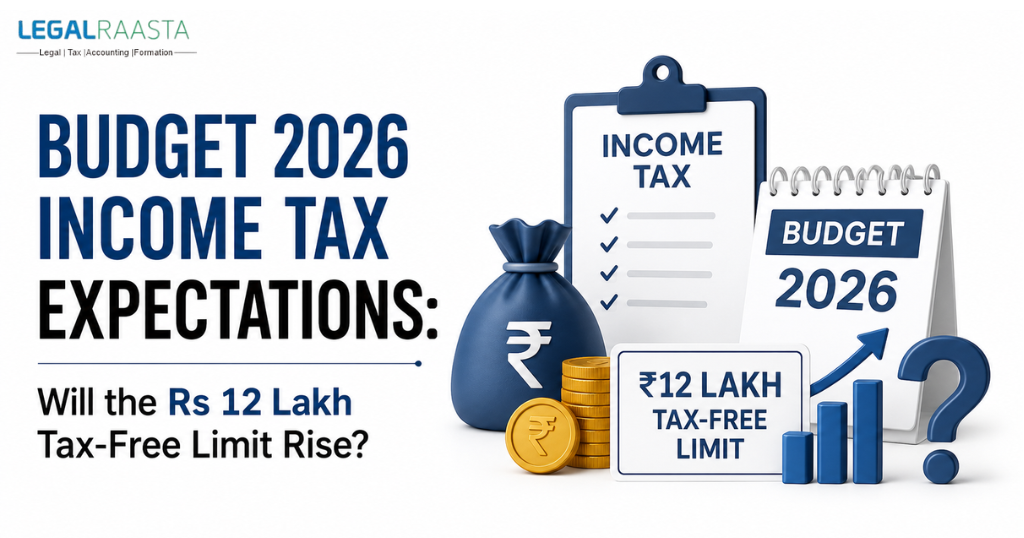
As we approach February 1, 2026, the countdown to the Union Budget has officially begun. The Indian middle class relates the annual budget not only as a fiscal statement but also as a guide to their own savings and living standards. Following the incremental reliefs in the past years, the income tax slab 2026-27 is going to be centralised based on a single question: Will the government possibly extend the practically tax-free threshold to Rs 12 Lakh under the New Tax Regime? As urban consumption is squeezed and the increase in prices of necessities such as education and medical costs begins to hit the average household, salaried workers are seeking to find a high amount of structural release with North Block. This is a dive into the tax changes and budget 2026 income tax expectations for salaried employees, MSMEs, and startups.
Consult with LegalRaasta Experts today and ensure you are ready for the 2026-27 financial year!
Also Read This – Union Budget 2026 Expectations: Income Tax, MSME, GST, and Startups
1. Income Tax Expectations: The Middle-Class “Big Win”?
The primary focus of Budget 2026 income tax expectations for salaried employees is the restructuring of the New Tax Regime to make it more attractive.
The Push for an Rs 1 Lakh Standard Deduction
The notable tax reform this year demanded by both industry groups and tax experts is the standard deduction increase in 2026. At the current amount of Rs 75,000, there is general agreement that it will increase to Rs 1,00,000. This increase matters because it puts immediate cash in the hands of millions of employees to offset rising costs.
Decoding the Rs 12 Lakh Tax-Free Vision via Section 87A
The actual magic is the Section 87A rebate hike, which makes a certain level of income effectively tax-free. In Budget 2026 Income Tax Expectations, the great expectation is that the government can extend this rebate to incomes of up to Rs 10 Lakh or even Rs 12 Lakh. Provided this is implemented, a good chunk of entry-level and mid-level workers would pay no income taxes at all, stimulating consumption.
Anticipated Income Tax Slab 2026-27 Changes
The “squeezed middle class” is hoping for a meaningful restructuring of the tax brackets. There is a persistent demand to move the 30% tax bracket start point to Rs 30 Lakh or higher, offering much-needed “breathing space” for mid-career professionals.
|
Income Slab (Current FY 2025-26) |
Current Tax Rate |
Income Slab (Expected FY 2026-27) |
Expected Tax Rate |
|
Up to Rs 3,00,000 |
Nil |
Up to Rs 4,00,000 |
Nil |
|
Rs 3,00,001 – Rs 6,00,000 |
5% |
Rs 4,00,001 – Rs 8,00,000 |
5% |
|
Rs 6,00,001 – Rs 9,00,000 |
10% |
Rs 8,00,001 – Rs 12,00,000 |
10% |
|
Rs 9,00,001 – Rs 12,00,000 |
15% |
Rs 12,00,001 – Rs 16,00,000 |
15% |
|
Rs 12,00,001 – Rs 15,00,000 |
20% |
Rs 16,00,001 – Rs 24,00,000 |
20% |
|
Above Rs 15,00,000 |
30% |
Above Rs 24,00,000 |
30% |
2. GST Expectations: Simpler Compliance & Rationalisation
In the upcoming cycle, the 2026-27 cycle, the GST council and the Ministry of Finance would be targeting ease of doing business and simplification of compliance.
- Rate Rationalisation: There is a possibility to merge the 12% and 18% slabs.
- Health Insurance Relief: A much-awaited proposal to exempt the 18% GST duty on health insurance premiums for senior citizens.
3. MSME Expectations: Credit and Payment Security
The Indian economy largely relies on MSMEs. Their liquidity and administrative issues are likely to be tackled by the budget 2026:
- Faster Payments: Enforcement increase in the regulations promoting the large companies to pay MSMEs within 45 days.
- Credit Support: Reduced rates of interest for holders of MSME Registration.
- Ease of Compliance: Increasing the minimum required to have an audit completed in tax auditing in order to lessen the administrative load of small business owners.
4. Startup Expectations: ESOPs and Funding Policy
As a strategy to retain India as a significant startup ecosystem, the 2026 Budget can introduce:
- ESOP Taxation Relief: Shifting the tax position of ESOPs from “exercise” to “sale” to allow employees manage cash flows in a more effective manner.
- Capital Gains Parity: Standardising the gap between listed and unlisted minority shareholding tax rates to promote local Company Registration and investment.
5. The What to Do Now Checklist: Compliance Readiness
Do not wait until the Budget speech to get your finances in order. This checklist can help you be proactive:
- Consolidate Documents: Gather your investment proofs, Form 16, and capital gain statements.
- Audit Your GST: Verify that the entire Input Tax Credit has been reconciled this financial year.
- Plan for Renewals: If you are a business owner, make sure that you renew your Trademark Registration or licenses before the new rules come into effect.
- Evaluate Tax Regimes: Compare the liability under the Old and what is expected in the New Tax Regime cases of the next ITR filing.
6. Conclusion
As the Tax Slabs may actually change and the New Tax Regime seems to get more and more complicated, it has never been more important to plan your finances. LegalRaasta can make the changes easy, whether you are an individual wanting to reduce your taxes or a business manager who needs to address payroll compliance. We take away the legal and financial challenges of the budget season, starting from filing Income Tax Return, through professional Tax Planning and GST consultancy.
7. FAQs
- What is the date and time for the Union Budget 2026?
The Finance Minister will present the Union Budget on 1st of February, 2026, at 11:00 AM.
- Will the Section 80C limit be increased in 2026?
There is a strong demand to increase the limit from Rs 1.5 Lakh to Rs 2.5 Lakh.
- How will the Rs 1 Lakh standard deduction help me?
A higher standard deduction reduces your taxable income directly, saving you thousands in taxes annually.
- Is the Old Tax Regime being scrapped in 2026?
As of now, the Old Regime exists, but the government is making the New Regime the “default” option.
- Can MSMEs expect any tax holidays?
Although this is unlikely to be a full holiday, MSMEs might have an increase in turnover limited by presumptive taxation under Section 44AD.
- Will GST on insurance premiums decrease?
The likelihood that the senior citizens will have their healthcare made more affordable is high.
- What are the expected changes in Corporate Tax for startups?
New businesses are encouraging an additional extension of the period of tax holiday eligibility of newly incorporated businesses.
- How does Section 43B(h) affect my business in 2026?
It requires that the expense be tax-deductible, meaning that it must be paid to MSMEs within 45 days.
- Will there be a hike in the Section 87A rebate?
Yes, there is every expectation that in the New Regime, the rebate will be raised to raise the income to Rs 10-12 Lakh without paying taxes.
- Where can I get expert help for my ITR and GST after the Budget?
LegalRaasta can provide end-to-end assistance on ITR, GST, and any other form of compliance that you require for your business.

Related Posts


Our Clients


Featured In