
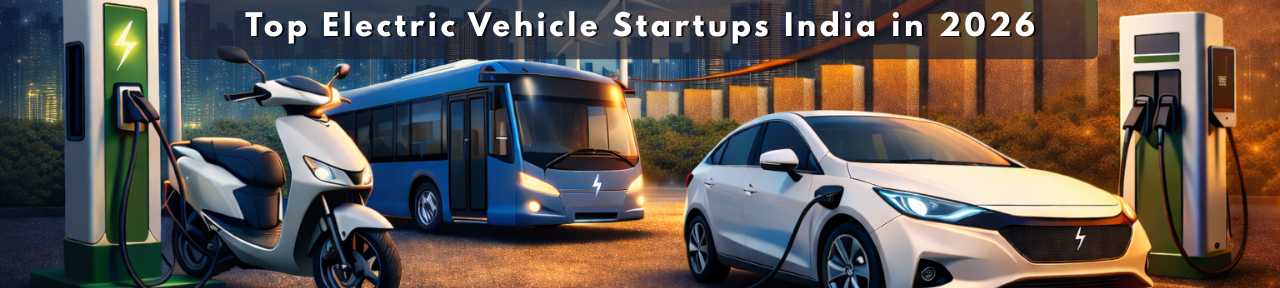
Top Electric Vehicle Startups in India in 2026: Complete List & Growth Insights
The Indian automotive ecosystem has been undergoing critical development. As we move into 2026, the noise of internal ignition engines will rapidly be replaced by the steady rise of electric powertrains. Fueled by enthusiastic government objectives, changeable consumer tastes, and a crushing rush of working capital, the EV industry is no longer the future; it is here and now. To top electric vehicle startups in India in 2026, looking to project into this high-development field, building a powerful, legitimate foundation is the beginning. Be it registering a company for a new manufacturing branch or trademark registration over a unique motor technology, LegalRaasta offers expert assistance to head into the complex pool of regulations governing the EV industry.
2026 EV Market Snapshot
|
Metric |
2026 Industry Status |
Impact on Consumers |
|
Average Range |
120–150 km per charge |
Reduced range anxiety for daily commutes |
|
Urban Penetration |
25% for Two-Wheelers |
Higher visibility and peer trust in cities |
|
Commercial Shift |
60% of new 3W registrations |
Lower delivery costs for e-commerce |
|
Upfront Cost |
40% reduction via BaaS |
EVs are now price-competitive with petrol |
Introduction to the 2026 EV Revolution
The mission of Green Mobility in India has reached a watershed moment in the year 2026. The shift between the early adopters phase and the mass-market penetration is finished. Engineered with the FAME III scheme now fully operational and the PM E-DRIVE initiative offering the country stable fiscal conditions, the top electric vehicle startups in India in 2026 have transitioned out of the prototyping phase and into an expansive scale of production.
In this guide, we provide a complete list of the titans of the industry and deep-dive insights into the growth mechanics that are making India a global EV powerhouse.
The Growth Insights: What is Driving the EV Boom in 2026?
It is important to identify the Growth Insights that have enabled these startups to thrive before enumerating the companies. The three pillars that characterise the 2026 market are:
1. Vertical Integration and Localization
The era of importing “CKD” (Completely Knocked Down) kits from overseas and simply assembling them in India is over. The top electric vehicle startups in India in 2026 are now vertically integrated. They develop their own Battery Management Systems (BMS), create their own motors, and develop the software code responsible for managing the brain of the vehicle. This localization is fuelled by the government’s Phased Manufacturing Program (PMP) that provides colossal tax incentives to those who procure 80% or more of their parts in the country.
2. The Rise of “Software-Defined Vehicles” (SDV)
An EV is no longer a machine in 2026; it can be discussed as a computer on wheels. The top electric vehicle startups in India in 2026 will be using AI to control battery wear, support over-the-air (OTA) performance enhancements, and autonomous safety.
3. Battery Swapping as a Mainstream Reality
For the commercial and gig-economy sectors, “charging time” was the biggest hurdle. In 2026, the standardization of battery swapping changed the game. Startups can now sell “Battery-less EVs,” where the consumer only pays for the vehicle shell and subscribes to a battery-swapping network, reducing the upfront cost by 40%.
Top Electric Vehicle Startups in India in 2026: The Comprehensive List
The following list represents the titans of the industry and emerging innovators reshaping the automotive landscape in 2026:
|
Startup Name |
Description |
Key Focus Areas |
|
Ola Electric |
The market behemoth has a massive ecosystem, including scooters and motorcycles. Ola Electric has moved to in-house cell manufacturing to bypass international supply chain issues from China. |
Vertical integration, Giga-factories, E2W, E4W |
|
Ather Energy |
The quality benchmark known for premium designs and “Ather Stack” software. Advanced software integration that manages autonomous safety and over-the-air (OTA) updates. |
Premium scooters, Ather Grid charging |
|
River |
The “Utility Specialist” with rugged designs like the Indie (SUV of scooters). |
High payload capacity, suburban mobility |
|
Ultraviolette |
High-performance electric bikes for speed enthusiasts and premium branding. |
Sports bikes, advanced thermal management |
|
Euler Motors |
The logistics legend dominates the commercial 3-wheeler segment. “HiLoad” rapid charging stack, which is critical for maintaining “maximum uptime” for delivery fleets. |
Last-mile delivery, high payload cargo |
|
BluSmart |
India’s first all-electric ride-hailing giant enabling zero-emission fleets. |
EV taxis, mobility-as-a-service |
|
Altigreen |
Pioneer in ground-up engineering for heavy-duty electric three-wheelers. |
Commercial cargo, extreme weather design |
|
Revolt Motors |
AI-enabled motorcycle company offering cost-efficient electric bikes. |
AI tech integration, budget performance |
|
Simple Energy |
Developer of high-performance scooters with industry-leading battery ranges. |
Long-range E2Ws, high-end design |
|
Olectra Greentech |
A leader in producing electric buses for Indian public transportation. |
Public sector EVs, e-buses |
|
Matter |
The gear-shift innovator known for India’s first manual geared electric bike. |
Traditionalist biker market, geared EVs |
|
Exponent Energy |
Fast-charging disruptor providing a 15-minute full-charge energy stack. |
Rapid charging, battery management |
|
Log9 Materials |
Specialist in advanced cell chemistry and fast-charging battery tech. |
Rapid-charging batteries, Graphene tech |
|
Bounce Infinity |
Provider of battery-swapping solutions and affordable e-scooters. |
Battery-as-a-service, swapping networks |
|
Yulu Bikes |
Micro-mobility expert using electric cycles for urban “first/last mile.” |
Shared mobility, lightweight EVs |
|
Pure EV |
Focused on performance scooters and high-quality lithium-ion battery R&D. |
Performance E2Ws, battery manufacturing |
|
Lithium Urban |
Specialized in electric fleet services for B2B corporate solutions. |
Corporate EV logistics, fleet management |
|
Emflux Motors |
Superbike manufacturing startup offering high-performance motorcycles. |
Luxury electric superbikes, high torque |
|
Strom Motors |
Compact, futuristic three-wheelers built for tight urban commuting. |
Personal 3-wheelers, urban micro-EVs |
|
eBikeGo |
Subscription-based rental services for urban commuters and delivery. |
Rental mobility, subscription EVs |
|
Mahindra Electric |
Leading the electric three-wheeler segment through its dedicated startup wing. |
E3W, last-mile urban mobility. |
|
Tata Motors EV |
A dominant player in the massive shift of public transport and state transport fleets. |
Public transport, electric passenger fleets. |
|
BYD India |
A key contributor to the large-scale transition of State Transport Units (STUs) to electric power. |
Public transport, electric bus fleets. |
|
Hero Electric |
An established market player focused on providing accessible and affordable urban mobility solutions. |
Budget-friendly E2Ws, daily urban commuting. |
|
Okinawa Autotech |
A homegrown company delivering a variety of reliable electric scooters tailored for urban transportation. |
Two-wheelers, urban fleet management. |
|
Bajaj Auto EV |
Known for revitalizing classic brands with eco-friendly technology and elegant designs. |
Electric scooters, heritage-brand EVs. |
|
Ampere Vehicles |
Offers innovative and budget-conscious EV designs specifically tailored for city driving. |
Affordable electric scooters, city mobility. |
Budget 2026 for EV: FAME III, PLI, and the Road Ahead
The government has proven sustainable mobility, which was affirmed by the announcement of the Union Budget 2026 on 1st February. Two key schemes that offer the financial support that would be needed to operate them are mainly which determines the immediate effect on the top electric vehicle startups in India in 2026: the FAME III scheme and the PLI scheme on Advanced Chemistry Cells (ACC).
The FAME III Scheme: A Long-Term Commitment
The FAME (Faster Adoption and Manufacturing of Hybrid and Electric Vehicles) III scheme is a successor program to the temporary PM E-DRIVE program, which will be phased away in March 2026. FAME III is a long-term scheme with a projected allocation of more than Rs 12,000 Crore.
- Impact on Startups: This consistency will be one of the factors why leading electric vehicle startups in India in 2026, and Ola and Ather will be able to plan their production schedules over the next 3-5 years, procurement, and getting the subsidy directly to the consumer, making the initial purchase price even more competitive. FAME III has also shifted the focus slightly to commercial vehicles (e-buses and e-trucks) instead of personal 2Ws to promote startups in the B2B logistics sector.
The PLI Scheme for ACC (Advanced Chemistry Cells)
The government provided a massive budget allocation of Rs 18,100 Crore to establish local cell manufacturing facilities in order to tackle the high cost of production caused by the volatility of the raw material (Lithium, Nickel).
- Impact on Startups: This will give a direct chance to the top electric vehicle startups in India in 2026 to leave the assembly of battery packs behind and ramp into manufacturing cells. Mastery of local cell production via the PLI scheme secures a crucial 20-25% cost reduction in the long term, reducing dependency on volatile international markets, particularly China and Korea.
EV Market Acceleration: What is Driving the EV Boom in 2026?
There are three technological and market pillars that drive the top electric vehicle startups in India in 2026:
1. Vertical Integration and Localization
The era of importing “CKD” (Completely Knocked Down) kits from overseas is over. The top electric vehicle startups in India in 2026 are now vertically integrated. They develop their own Battery Management Systems (BMS), create their own motors, and write the software code responsible for managing the vehicle’s “brain.” It is driven by the government Phased Manufacturing Program (PMP), which offers colossal tax breaks to purchasers of at least 80% of their parts domestically.
2. The Rise of “Software-Defined Vehicles” (SDV)
An EV is no longer just a machine; it is a “computer on wheels.” The top electric vehicle startups in India in 2026 apply AI in the management of battery wear, autonomously taking place in support of over-the-air (OTA) performance modification, and the provision of autonomous safety facilities.
3. Battery Swapping and BaaS
The game has changed with battery swapping being standardized. Startups are now offering Battery-less EVs to the market, in which the customer simply buys the vehicle shell and subscribes to a Battery-as-a-Service (BaaS) network, saving 40% on initial purchases.
Detailed Market Insights: The 2026 EV Segments
In order to effectively comprehend the top electric vehicle startups in India in 2026, we need to consider the segments that have reached maturity this year.
E2W Market Share and Valuation
As of Q4 2025, the E2W market saw a 45% YOY growth, with the listed startups capturing significant value.
|
Startup Name |
2025 Valuation (Est.) |
Q4 2025 Market Share (E2W) |
Primary Tech Focus |
|
Ola Electric |
$5.5 Billion |
~38% |
In-house Cell Tech |
|
Ather Energy |
$2.5 Billion |
~14% |
SDV, Charging Infra |
|
Simple Energy |
$800 Million |
~5% |
Battery Range |
|
Ultraviolette |
$450 Million |
Niche (Performance) |
Thermal Management |
The Electric Two-Wheeler (E2W) Segment
This is the most saturated but high-growth segment. As of 2026, E2Ws penetration in urban India was more than 25%. Startups are moving towards a new target of what could be called Micro-mobility, introducing lightweight scooters to travel short distances, with no license needed. By Q4 2025, the E2W market had expanded by 45% on a YOY basis, with Ola Electric taking a market share of 38 percent all by itself. The latest valuation of Ather Energy after the funding was $2.5 billion, which points to high investor trust in the top electric vehicle startups in India in 2026.
The Electric Three-Wheeler (E3W) Segment
This segment has seen the most rapid transition. Driven by the “Green Urban Mobility” initiative, almost 60% of new three-wheeler registrations in 2026 are electric. Startups like Mahindra Electric (via its startup wing) and Piaggio-backed startups are leading here. In the E3W segment, Altigreen and Euler Motors collectively account for over 45,000 unit sales per quarter, highlighting the rapid transition of the last-mile logistics sector to electric mobility.
The Commercial EV (CEV) Segment
The “Silent Revolution” in logistics. FMCG companies and e-commerce companies have also undertaken to go fully electric in delivering their products by 2030. This has brought about a waiting list of vehicles with startups such as Euler and Altigreen.
Segment-Wise Insights (2026 Market Data)
|
Segment |
Market Status in 2026 |
Leading Players |
|
Two-Wheelers (E2W) |
25% Urban Penetration; high-performance and micro-mobility focus. |
Ola, Ather, River, Ultraviolette |
|
Three-Wheelers (E3W) |
60% of new registrations; primary mode for last-mile logistics. |
Euler, Altigreen, Mahindra Electric |
|
Public Transport |
Massive shift in STUs (State Transport) towards electric fleets. |
Olectra, Tata Motors EV, BYD |
|
Fleet Mobility |
Corporate B2B and ride-hailing hubs transitioning to 100% electric. |
BluSmart, Lithium Urban, eBikeGo |
Market Leaders: Euler Motors and Altigreen recorded a combined total of more than 45,000 unit sales in the E3W segment within a quarter.
Challenges and Opportunities for Indian EV Startups
Although the top electric vehicle startups in India in 2026 have huge potential, they have numerous challenges that require innovative solutions and growth.
Key Challenges
- Charging Infrastructure: As it advances, mass adoption is constrained by insufficient networks in the Tier 3 cities. This has generated a huge market in Micro-mobility solutions (Yulu) and battery swapping networks (Bounce Infinity, Exponent Energy) that demand less infrastructure investment.
- High Production Costs: Unstable prices of the raw material (Lithium, Nickel) increase battery costs. The PLI scheme offers an incentive for local cell manufacturing, which benefits the vertically integrated players by securing a cost reduction opportunity.
- Policy Variation: Poor policy alignment by the states in EV may create conflicts across pan-India expansion. To an extent, startups that emphasize B2B logistics (Euler Motors, Altigreen), in which the cost-reduction operational aspect is more evident, are easier to navigate this complexity than B2C competitors.
- Consumer Awareness: There is still a lack of intention towards resale value and the expenses of battery life replacement. Long warranties (5-8 years) and data-driven maintenance applications are being suggested by top electric vehicle startups in India in 2026 to build confidence.
Key Opportunities
- Government Incentives: Schemes such as FAME III and PLI of Advanced Chemistry Cells (ACC) are specified to make it profitable to manufacture.
- Export Potential: Indian startups are setting their sights on global markets like Southeast Asia and Africa, where their low-cost and well-engineered products for rough road conditions can compete effectively.
- Tech Integration: They are using advanced technology like IoT-based maintenance and V2G (Vehicle-to-Grid) to open up new ways of making money.
Innovative Solutions: Advanced Technologies Driving Top EV Startups
The top electric vehicle startups in India in 2026 will not only be assemblers; they will be technology providers with deep engineering that bypasses the hidden, needless challenges of EV adoption and user-friendly experience.
Battery Innovations: Solid-State and Graphene
Mass adoption continues to be hampered mainly by the issue of range anxiety and safety. Companies such as Log9 Materials are also specializing in the Graphene-based rapid-charging battery tech, which can be charged in under 15 minutes. The ultimate goal for 2026 is the commercial viability of solid-state batteries, which promise better safety, doubled range, and improved efficiency.
V2G (Vehicle-to-Grid) Software
This would enable EVs to serve as large-scale power banks to the national grid. The top electric vehicle startups in India in 2026 are investing heavily in V2G software stacks that allow a parked EV owner to sell power back to the grid during peak hours, creating a new revenue stream and reducing the strain on state electricity discoms.
Regulatory and Legal Compliance for EV Startups
The legal race to establish one of the top electric vehicle startups in India in 2026 is a marathon. The regulatory framework surrounding the creation of an EV includes several governmental agencies:
- AIS-156 Standards: All batteries should be incorporated to this high safety standard in order to avoid thermal runaway.
- FAME III / PM E-DRIVE Certification: The startups have to be audited heavily on the localized supply chain in order to be able to handle subsidies up to the customer level.
- HUID and Battery Tracking: All battery packs are equipped with a special digital ID to trace their lifecycle and recycle them in the correct manner, like the HUID in other sectors.
- IP Protection: Most crucial to these startups is Trademark Registration and Patent filing, given the high amount of R&D.
The Role of Venture Capital and “Deep Tech”
In 2026, the “Funding Winter” has thawed for startups with strong unit economics. Investors are no longer looking for “customer acquisition” at any cost; they are looking for “Deep Tech.” This includes startups working on:
- Solid-State Batteries: The holy grail of the EV industry.
- Induction Motors: Reducing the reliance on “Rare Earth Magnets” (Neodymium).
- V2G (Vehicle-to-Grid) Software: This would enable EVs to serve as large-scale power banks to the national grid.
Comparison Table: Top 5 EV Startups (2026 Estimates)
|
Startup Name |
Core Segment |
Market Strength |
Key Technology |
|
Ola Electric |
E2W / E4W |
Mass Market Scale |
In-house Cell Production |
|
Ather Energy |
Premium E2W |
Tech & Infrastructure |
Ather Stack Software |
|
Euler Motors |
Commercial 3W |
Payload & Durability |
HiLoad Rapid Charging |
|
Ultraviolette |
Sports E2W |
Performance & Luxury |
Liquid Cooled Battery |
|
BluSmart |
Ride-Hailing |
Service Data |
AI Fleet Management |
Why 2026 is the “Golden Year” for New Entrants
The opportunity is massive if you are an entrepreneur who is interested in being listed among the top electric vehicle startups in India in 2026.
- Secondary Market: EVs have finally reached maturity in the second-hand market, offering them a higher resale value and financing.
- Component Ecosystem: You no longer need to build everything. A robust ecosystem of Indian component manufacturers now exists to support smaller EV startups.
- Rural Adoption: It is expected that in 2026, EVs will finally trickle into rural India, at least under the e-tractor and e-moped segments.
The Challenges Ahead: The “Battery Recycling” Crisis
This will mark the first large-scale battery of “End-of-Life” EV batteries in India, which will be in the year 2026. The top electric vehicle startups in India in 2026 are now investing in “Urban Mining”—the process of recovering Lithium, Cobalt, and Nickel from old batteries. Startups that master this will be the leaders of the 2030 market.
The 2026 Sustainability Mandate: Urban Mining
- Urban Mining: Top startups are now recovering Lithium, Cobalt, and Nickel from old batteries.
- Lifecycle Tracking: Mention that all batteries now use a Digital ID (HUID) to track their lifecycle from first use to final recycling.
- Cost Efficiency: Mastering recycling is expected to provide these startups with a 20-25% cost reduction in the long term.
Conclusion
This is only the start of embarking on the quest for energy independence through the story of the top electric vehicle startups in India in 2026. They are not only transforming the way we transport ourselves, but these firms are also transforming the way we think about energy, environment, and engineering. The journey to leading the market is, however, fraught with regulatory challenges.
Whether it is the process of MSME Registration and getting government grants, or getting your ISO Certification on international quality standards, the technicalities are daunting. At LegalRaasta, we take pride in being the silent engine in several of these mobility giants. We are taking care of the formalities of GST Registration and corporate compliance in order to enable you to put together the next global change in powertrain.
To set up the next entry into the list of top electric vehicle startups in India in 2026, one needs a partner who controls the legal heartbeat in the industry. Reach out to LegalRaasta, and we will help to transform your idea into a reality!
FAQs
- Which is the most successful electric vehicle startup in India in 2026?
Based on sales numbers and market capitalization, Ola Electric is a clear winner. Still, the list of top electric vehicle startups in India in 2026 is quite varied, with Ather being the frontrunner in the field of technology and Euler being the trendsetter in the commercial 3-wheeler logistics segment through their focused engineering.
- How do electric vehicle startups benefit from FAME III?
FAME III will directly subsidise consumers, and the cars offered by the top electric vehicle startups in India in 2026 will be price-competitive with those supplied by the petrol market. It also provides incentives to startups that have high rates of domestic components localization in their production process.
- What are the battery safety standards for electric vehicles?
The standards of AIS-156 must be obeyed in all electric vehicles. These rules make sure that the electric vehicles offer battery packs that will resist fire, water, and extreme temperatures in India.
- Are electric vehicle startups making their own battery cells?
Yes, several top electric vehicle startups, led by Ola Electric, have started domestic cell production. This allows the top electric vehicle startups in India in 2026 to reduce costs and decrease dependency on international cell suppliers from China and Korea.
- Which of the top electric vehicle startups is best for delivery businesses?
The two most favored options are Euler Motors and Altigreen. These are the top electric vehicle startups in India in 2026 that design vehicles with excellent payload abilities and fast-charge technology, to ensure maximum uptime for e-commerce delivery fleets in the major cities of India.
- Can I get an EV loan for vehicles from electric vehicle startups?
Absolutely. Most of the large banks and NBFCs have allocated a Green Loan structure to the top electric vehicle startups in India in 2026. These loans offer lower interest rates and longer tenures compared to traditional petrol vehicle financing.
- Do electric vehicle startups offer battery swapping?
Many do. Startups like Sun Mobility have partnered with the top electric vehicle startups in India in 2026 to provide interoperable swapping stations. This allows riders of electric vehicles to swap a drained battery for a full one in under 2 minutes.
- What is the lifespan of batteries from the top electric vehicle startups?
In 2026, batteries provided by the leading electric vehicle startups will also range between 1,50,000 km and 2,00,000 km. The majority of top electric vehicle startups in India in 2026 have warranties of 5 to 8 years, based on the fact that this year has seen better chemistry and thermal management systems.
- How do I start my own company among the top electric vehicle startups?
Target a specific technological developed niche, such as thermal management or motor controllers. And be sure to have your Company Registration and IP patents in order. By consulting LegalRaasta, you can follow the same route as the top electric vehicle startups in India in 2026.
- What is the average range of electric scooters?
The average system coverage in the real world has expanded to 120-150 km/charge in 2026. Increased energy density cells and more effective regenerative braking systems built into their motor controllers have allowed the top electric vehicle startups in India in 2026 to achieve this.

-
 Top 10 Government Schemes for Startups in India 20...
14-Mar-2026
Top 10 Government Schemes for Startups in India 20...
14-Mar-2026 -
 Why Startups in MedTech Are Prioritizing CDSCO Con...
18-Aug-2025
Why Startups in MedTech Are Prioritizing CDSCO Con...
18-Aug-2025 -
 ESOPs and it’s benefits to startups
26-Oct-2018
ESOPs and it’s benefits to startups
26-Oct-2018 -
 A Comprehensive Guide to start a BPO in India
25-Oct-2018
A Comprehensive Guide to start a BPO in India
25-Oct-2018 -
SPICe – Simplified Proforma for Incorporatin... 25-Oct-2018
-
 Sole Proprietorship Startups
25-Oct-2018
Sole Proprietorship Startups
25-Oct-2018 -
 How to avail benefits under the startup india scheme?
22-Oct-2018
How to avail benefits under the startup india scheme?
22-Oct-2018 -
 Know about Proprietorship Firm in India
16-Mar-2020
Know about Proprietorship Firm in India
16-Mar-2020 -
 What all procedures are required to open a restaur...
16-Mar-2020
What all procedures are required to open a restaur...
16-Mar-2020