
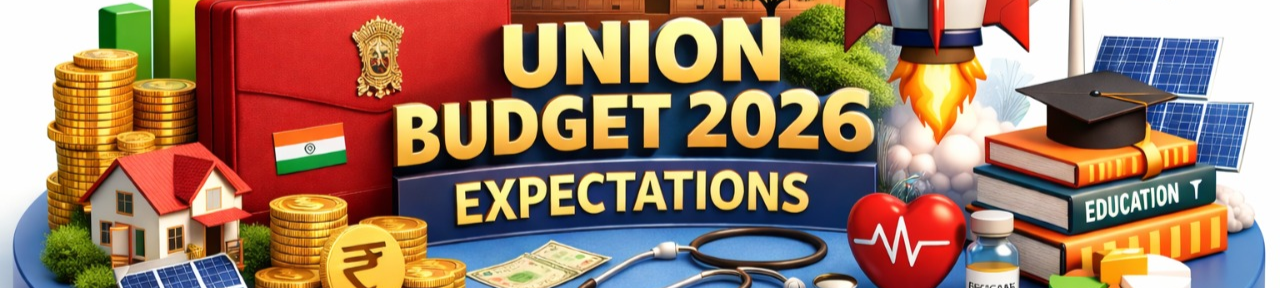
Union Budget 2026 Expectations: Income Tax, GST, MSME & Startups
The whole finance and other sectors in India are eagerly waiting for the presentation of “Union Budget 2026,” announced by Finance Minister Nirmala Sitharaman. This year’s budget will play a major role in shaping India’s post-pandemic economic recovery. The new budget significantly boosts investors’ confidence and focuses on the key sectors in India, including MSMEs, startups, and the digital economy. The debate of the Union Budget 2026 further highlights the focus on the tax landscape, fiscal deficit, and revenue vs. capital expenditure. Let’s take a look at the recent update associated with the “Union Budget 2026 expectations,” which will be responsible for a revolution in India for enhanced tax policies, driven growth, and investments.
What is the Union Budget in India?
The Union Budget of India, also known as the Annual Financial Statement, is governed under Article 112 of the Indian Constitution. It is the country’s annual financial plan, prepared by the Ministry of Finance. On the other hand, the last Union Budget of India was announced on February 1, 2025, under which the government collected Rs 1.38 trillion in direct taxes from April to January. It is remarked as one of the strongest revenue growths in India in 2025-2026. In detail:
- The budget highlights the changes to tax requirements in every financial year for businesses, startups, and individuals.
- Determines how the government spends the collected amount on social welfare, infrastructure, and development programs.
- Enhances the surroundings of businesses, governance, and economic efficiency.
- Implements policies for the major sectors in India, like education and defense, health, and technology.
The Union Budget of India is considered to be the annual financial report of the Government of India. It outlines the estimated revenues and planned expenditures for the upcoming fiscal year (April 1 – March 31).
Common Dates Associated with Union Budget 2026 (Latest Update)
Before the start of the financial year, the budget follows a well-structured timeline, which typically includes:
- 28 January 2026 – Budget Session begins
- 29 January 2026 – Pre-Budget discussions
- 31 January 2026 – Economic Survey tabled
- 1 February 2026 – Union Budget presentation
- 13 February 2026 – End of first session phase
- 9 March – 2 April 2026 – Second session phase and conclusion
Union Budget 2026 Key Announcements (What can be expected?)
The Union Budget 2026 expectations is going to set the example of economic growth that majorly influences taxation, investments, and business planning in India.
1. Taxation & Income Tax Reforms
The income tax regime is one of the most awaited Union Budget 2026 expectations key announcements for many individuals and businesses, which is discussed on 29th January 2026. It is expected that the finance sector of the Indian government is likely to continue the discussion with the introduction of the “New Tax Regime.” However, there is a possible chance that the Budget 2026 tax reforms may go a step further to simplify the regime. It majorly reduces the number of tax slabs. The Indian government significantly focused on the taxation process to make it more taxpayer-friendly for individuals or businesses. The expectations are high for the new union budget 2026 announcements that minimize the compliance challenges and offer relief and peace of mind to the middle-class population. Some of the key expectations include:
- Individuals with middle-income levels can enjoy the higher exemptions in the new tax regime.
- Announcement of tax deductions for expenditures associated with health insurance premiums and education.
- Restructuring, simplification, and optimization of business tax systems to make them more logical, coherent, and efficient
2. Income Tax Slab Review for Salaried Individuals
Salaried taxpayers face a lot of rising inflation rates and economic burdens. But changes may take place in the tax slab for the salaried class with the announcement of the “Union Budget 2026 expectations.” “It introduces the restructuring of tax brackets for the salaried class. The 2026 budget focuses on rationalizing the tax slabs, ensuring that the tax burden on middle-income earners is minimized. Expectations are high for improvement in disposable income e by offering tax advantages for salaried taxpayers.
Don’t Miss This – Budget 2026: Is the ₹12 Lakh Income Tax-Free Limit Likely to Increase?
3. GST Reforms in Budget 2026: A Modernized Tax System
The GST reform budget 2026 is another hot discussion topic among businesses and individuals. The system of Goods and Services Tax (GST) has evolved a lot over the years, but there is a vacant space for complete improvement. The Union budget for 2026 could bring major changes in this area.
4. Tax Simplification and Digitalization of GST
GST reform budget 2026 may focus on simplification of GST processes for small and medium-sized businesses. Focus on:
- To ease the burden of compliance, it may limit the number of tax rates.
- To reduce the manual labor and significant errors in tax filings, introduce an automated GST filing system for SMEs.
- GST refunds will be faster for businesses and exporters who face potential delays.
With the introduction of an enhanced compliance mechanism, encourage the businesses to comply with GST norms effectively. This will be part of the discussion to improve revenue vs. capital expenditure in 2026 to ensure sustainable growth and tax revenue generation.
5. MSME & Startup Support in Budget 2026
The MSME sector contributes significantly to boosting the growth of India’s economy. By focusing on employment generation, exports, and innovation, MSME represents India in international markets. But the expectations are high after the announcement of “Union Budget 2026” that the MSME sector will be a major part of increased government spending. The new announcements address the following.
- Credit Access: Often, MSMEs face the challenge of getting loans easily. Meanwhile, the new Union Budget could highlight points to enhance access to credit guarantees and subsidized interest rates.
- Tax Benefits: MSMEs could enjoy tax incentives to encourage tax growth and innovation. The expectations are high for tax deductions in businesses that directly invest in technology, green energy, or modernizing operations.
Pressure is high for the consistent implementation of digitalization within MSMEs. But businesses can expect incentives like grants or subsidies under the annual financial statement. Through this, MSMEs will focus on integrating e-commerce, digital payment systems, or other tech-driven innovations.
6. Startup Ecosystem to Fostering Innovation
In recent years, exponential growth has been seen in India’s startup ecosystem. Startups are another growing sector in India, where the government is making a major contribution. The early-stage startups may enjoy the tax exemptions during the initial years of operation. It allows the registered startups to reinvest profits into business growth. From the new budget, businesses can expect a substantial increase in venture capital funding, especially for tech startups. For the broader economic strategy, the government may introduce innovation clusters, and startup incubators are expected to emerge as part of the broader economic strategy.
7. Capital Expenditure 2026: Investment in Infrastructure and Growth
The Finance Ministry may face a significant challenge in managing India’s fiscal deficit in 2026 with the announcement of the budget. The government is likely to manage the balance between capital expenditure in 2026 and creating returns. It helps to ensure that economic growth is not compromised. While infrastructure investments are a part of the discussion that is prioritized by the government.
- India will witness a significant increase in capital expenditure for infrastructure development, including roads, highways, and railways. To make the rural area a smart city, the government may provide funding.
- Discussion is also ongoing toward sustainable infrastructure and clean energy projects. It is expected that the government will invest more in solar energy, electric vehicles, and waste-to-energy projects.
- Public transport systems are also part of rapid infrastructure development. The government increases the number of metro rails, sustainable urban mobility, and logistics infrastructure. These are expected to be key highlights of the capital expenditure in 2026.
8. Boosting Growth and Job Creation
With the investment in capital expenditure, the Union Budget 2026 will further add to the topic of employment creation. The focus on expanding infrastructure will do more to directly create jobs. It further boosts local manufacturing and eases logistics bottlenecks. Such an expectation will fuel economic growth and work as a source of employment in India. Investing in infrastructure and employment creation is a major part of the broader economic plan, the budget 2026.
Note: The above-mentioned topics and their explanation are predictive in nature and based on policy trends. The actual announcements on these topics may vary in the “Union Budget 2026.”
Final Discussion: What to Expect from the Union Budget 2026
The new Union Budget 2026 is going to be introduced with much-needed rules and regulations for the nation’s economic revival. The Budget 2026 will also focus on providing tax reform, infrastructure development, and increasing the number of Indian startups/MSMEs by providing an economic roadmap, leading to the creation of new, innovative, and economically prosperous businesses in India.
Frequently Asked Questions
- What is the Union Budget of India?
Ans. The Union Budget of India is the government’s annual financial statement. It highlights the detailed estimated revenues and planned expenditure for the upcoming fiscal year (April 1st to March 31st).
- Who prepares the Union Budget, and when?
Ans. The Budget Division of the Department of Economic Affairs (DEA) in the Ministry of Finance prepares the Union Budget of India, operated by the Finance Minister. The preparation of the next annual financial budget starts around August-September, which is presented to Parliament on 1st February.
- What is meant by the financial blueprint for the Union budget of India?
Ans. The annual financial statement serves as a guide to government policy, economic development, and how public resources will be used. The financial statement provides a comprehensive overview of government finances, including tax and non-tax revenue as well as spending across a range of categories.
- What are the two main parts of the Union budget?
Ans. There are two major elements of the Union Budget in India:
- Revenue Budget: The revenue budget details the day-to-day functioning and spending of the government. It contains the receipts (revenue) and expenditures (revenue).
- Capital Budget—The capital budget accounts for ongoing investment by the government in major infrastructure projects (roads, buildings, power plants, etc.).
- How will the Union Budget 2026 impact the operation of small businesses?
Ans. To shift from resilience to growth, the new annual financial statement is expected to focus on MSMEs to improve credit access, minimize compliance burden, and complete digitization. The small businesses, like the MSME sector, will greatly transform into a robust driver of the national economy and global exports.
- Who is going to present the Union Budget 2026?
Ans. The Union Finance Minister, Nirmala Sitharaman, prepares to present her 9th consecutive Union Budget of India on 1st February, 2026. It will shape the 2026 budget and work as an Indian policy roadmap.
- What’s the impact of the new Union Budget on the GST compliance of startup companies?
Ans. According to information available in the press, the union has promised to simplify GST compliance for start-ups and any other small businesses in India. As such, they will have the ability to take advantage of an easy-to-use GST framework, receive ITS refunds within 15 days of applying, and implement an Artificial Intelligence (AI)-based invoice reconciliation model.
- Will the Union Budget 2026 affect the lifestyle of the general public?
Ans. According to preliminary statistics and expert opinions on the Union Budget for 2026-2027 (to be announced on February 1, 2026), the budget is expected to directly impact the standard of living for the general public. The budget will focus on lowering the cost of living, increasing disposable income for the middle class, and enhancing infrastructure in urban/rural areas.
- What will be the change in the technology sector after the Union Budget 2026 of India?
Ans. As per the expert expectations, the government also encourages innovation in the technology sector. Startups and MSMEs will greatly enjoy the tax rebates and sector-specific funding.
- Do international companies that operate in India also experience the Indian budget of 2026?
Ans. The effects of the Indian budget on international corporations operating in India are similar to those experienced by domestically registered firms. As a result of changes in tax rates, additional compliance requirements, tax incentives for investment, etc. The effects of this budget are felt by both the parent corporation and its subsidiaries operating in India.

-
 Budget 2026 Explained: Income Tax Changes, GST Upd...
02-Feb-2026
Budget 2026 Explained: Income Tax Changes, GST Upd...
02-Feb-2026 -
 How To Do The Business Setup In Dubai Of Tourism I...
06-Oct-2023
How To Do The Business Setup In Dubai Of Tourism I...
06-Oct-2023 -
 Budget 2021’s Impact on the Companies Act of...
17-Jun-2021
Budget 2021’s Impact on the Companies Act of...
17-Jun-2021 -
 Custom Duty: Changes Done In It Through Budget 2021
10-Feb-2021
Custom Duty: Changes Done In It Through Budget 2021
10-Feb-2021 -
 What Is there for you in this Budget -2021?- All Y...
10-Feb-2021
What Is there for you in this Budget -2021?- All Y...
10-Feb-2021