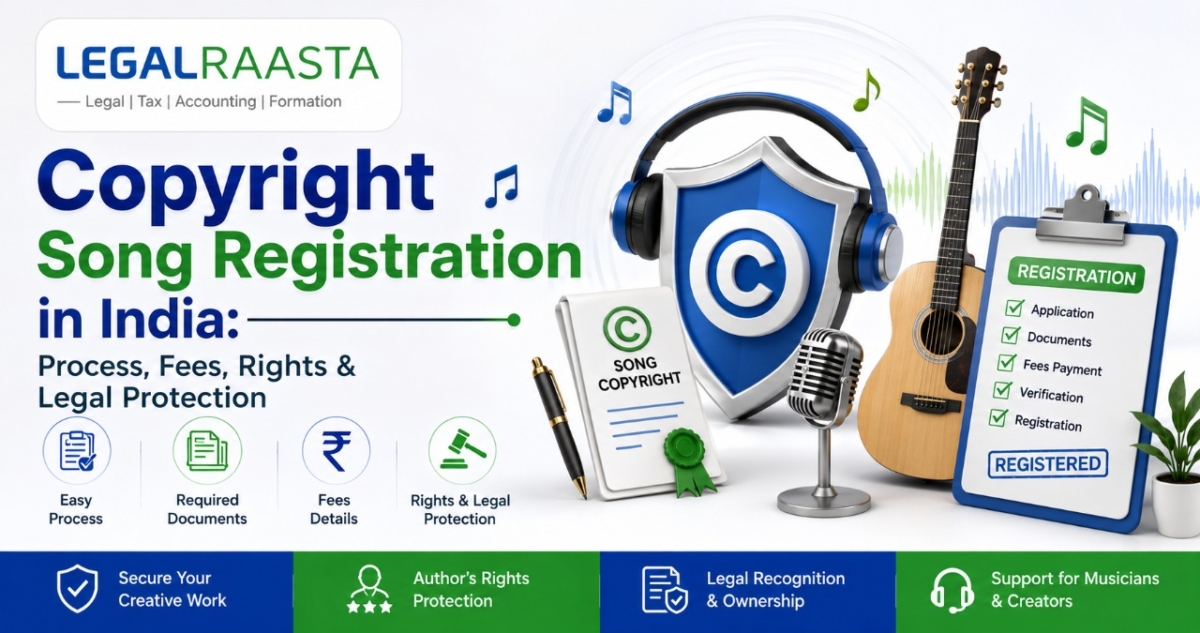
Copyright Song Registration in India: Process, Fees, Rights & Legal Protection
Creating a new track takes time, emotion, and hard work. However, unauthorized copies or stolen melodies can ruin your revenue and hard work quickly. You need solid legal protection to stop people from copying your creative work. Completing your Copyright Song Registration in India gives you official proof of ownership that holds firm in Indian courts. Accelerate your growth and protect your operational future effortlessly with LegalRaasta.
Quick Answer / At a Glance for Copyright Song Registration in India
|
Requirement Parameter |
Details & Official Guidelines |
|
Registration Authority |
Copyright Office India (Department for Promotion of Industry and Internal Trade) |
|
Application Portal |
Official e-filing copyright portal (https://ipindia.gov.in/manual-blocks/e-filing-services) |
|
Government Fees |
₹500 for Lyrics / Melody; ₹2,000 for Sound Recording |
|
Processing Time |
2 to 6 months (includes mandatory 30-day objection period) |
|
Governing Law |
Copyright Act 1957 and Copyright Rules 2013 |
|
Validity Period |
Lifetime of creator + 60 years (Lyrics/Melody); 60 years from release (Sound Recording) |
What Is Copyright Song Registration in India?
Copyright Song Registration is the formal process of recording your original music with the Indian Copyright Office. When you compose a tune or write lyrics, you own the creative output automatically. But verbal claims do not stop music theft. Official registration gives you a government certificate that proves your ownership date.
This legal seal lets you license your music to record labels, film producers, and streaming platforms safely. Because music generates huge revenue today, having legal protection ensures you get paid your royalties on time.
Is Copyright Registration Mandatory for a Song in India?
No, registration is not mandatory under Indian law. Under the Copyright Act 1957, protection starts the moment you write or record your track.
However, proving original ownership without an official document is very hard in court. If someone re-uploads your song on Spotify or YouTube, platforms demand an official copyright certificate for song verification to remove stolen content. Therefore, voluntary filing is necessary for every serious artist.
What Parts of a Song Can Be Copyrighted?
A single song contains three separate creative elements that require independent legal registration.
Lyrics and Literary Work
The written words of a song fall under Literary Work copyright. The lyricist owns these words because text is treated as a literary creation. You must submit written lyric sheets to protect the words.
Musical Composition
The melody, chord progression, and harmony form the composition. These elements fall under Musical Work copyright. The music composer or director owns this part even without audio lyrics.
Sound Recording
The final mixed audio track is protected under Sound Recording copyright. This includes the singer’s voice and instrumental beats combined together. Producers or record labels usually hold this specific right.
Who Can Register Copyright for a Song?
Any creator or entity involved in creating music can apply for official rights.
- Lyricists: Writers who compose the written words.
- Music Composers: People who create the main melody.
- Music Producers: Individuals or companies who fund and produce the final audio track.
- Band Members: Joint creators who write and perform tracks together.
- Record Labels: Entities that purchase music rights through legal contracts.
Documents Required for Copyright Song Registration in India
Filing an accurate application requires specific documents to verify your identity and creative work.
|
Category |
Required Document List |
Purpose of Document |
|
Applicant Proof |
PAN Card, Aadhaar Card, or Passport |
Verifies the identity of the creator or company |
|
Work Sample |
Written lyric copies or audio files (MP3/WAV) |
Proves the original creation details |
|
NOC Forms |
No Objection Certificates from collaborators |
Shows consent from singers or lyricists |
|
Legal Power |
Signed Power of Attorney (Form XIV) |
Allows an advocate to file on your behalf |
|
Publication Info |
Release date and publisher details |
Sets the copyright protection timeline |
Copyright Song Registration Process in India
Following the official registration steps ensures your application moves forward without legal delays.
Step 1: Prepare the Copyright Application
Create a user account on the e-filing copyright portal. Choose Form XIV and select the correct category for your work. Fill in details about the author, title, and release status carefully.
Step 2: Submit the Application and Documents
Upload soft copies of your lyrics or audio tracks. Pay the official government fee online. After payment, you get a unique Diary Number to track your file status.
Step 3: Examination and Objection Period
The Copyright Office holds your file for a mandatory 30-day waiting period. This allows third parties to raise objections if they claim ownership. If no objections arrive, an examiner reviews your application details.
Step 4: Respond to Objections, If Any
If the examiner finds mistakes or if someone objects, you get a written letter. You must file a legal reply within 30 days. Clearing these queries quickly avoids rejection.
Step 5: Registration and Certificate
When the examiner approves your claim, details are entered into the Register of Copyrights. You can download the official registration certificate online immediately.
Copyright Song Registration Fees in India
The government fee depends on which part of the song you register.
|
Category of Work |
Official Government Fee |
Protection Tenure |
|
Lyrics (Literary Work) |
₹500 per work |
Author’s Lifetime + 60 Years |
|
Melody (Musical Work) |
₹500 per work |
Author’s Lifetime + 60 Years |
|
Sound Recording |
₹2,000 per work |
60 Years from the publication year |
|
Complete Track (All 3) |
₹3,000 combined fee |
Combined rights protection |
Rights of a Copyright Owner of a Song
Owning a copyright gives you exclusive economic and legal rights under Section 14 of the Act.
- Reproduction Right: You control who can make copies of your music.
- Public Performance: Venues must pay you royalties to play your track live.
- Adaptation Right: No one can remix or translate your song without permission.
- Distribution Right: You decide which platforms sell or stream your audio files.
- Synchronization Right: You can license your music for movies, TV shows, and ads.
Copyright Ownership of a Song: Who Owns the Rights?
Understanding ownership rules prevents future disputes between music creators.
|
Creator Role |
Default Ownership Rule |
Contract Exception |
|
Lyricist |
First owner of written lyrics |
Label owns if written under employment |
|
Composer |
First owner of music notes |
Film producer owns if hired for movie score |
|
Producer |
First owner of sound recording |
Royalty sharing depends on custom contracts |
Recent 2026 Updates in Indian Music Copyright Rules
The Copyright Office India updated its digital e-filing system recently. Independent artists can now upload high-quality audio files directly through the portal without submitting physical CDs.
In addition, digital hearing features allow creators to resolve objections online. These changes reduced total processing times from 9 months down to 60–90 days for clean applications.
What If Someone Uses or Copies Your Song Without Permission?
Using music without permission is a punishable crime under Section 63 of the law. You can take immediate legal steps to stop the theft:
- Send a legal cease and desist notice to the infringer.
- Issue copyright takedown requests on YouTube, Spotify, and Instagram.
- File a police complaint for criminal copyright infringement.
- Claim damages and monetary compensation in commercial courts.
Penalties include imprisonment from 6 months to 3 years plus fines up to ₹2,00,000. Repeat offenders face up to 3 years in jail and ₹2,00,000 fines.
Common Mistakes to Avoid in Song Copyright Registration
Many artists make simple errors that delay or ruin their applications.
- Filing under the wrong category (e.g., selecting sound recording for lyrics).
- Forgetting NOCs from co-writers or singers.
- Submitting incomplete audio samples or unclear lyric sheets.
- Ignoring objection notices sent by the Copyright Office.
- Assuming a trademark covers your song content.
DIY Filing vs LegalRaasta Assistance
Handling legal portals alone can feel confusing when facing complex queries.
|
Feature Comparison |
DIY Filing |
LegalRaasta Expert Support |
|
Category Selection |
High risk of errors |
Expert review of all categories |
|
Document Drafting |
Manual preparation |
Flawless preparation of Form XIV & NOCs |
|
Objection Support |
Must handle alone |
Experienced legal response drafting |
|
Tracking Updates |
Manual portal checks |
Regular status alerts until approval |
Conclusion
Copyright Song Registration in India protects your music, earnings, creative identity, and long-term future. While copyright protection exists automatically, having an official certificate gives you ironclad proof when fighting legal battles. Getting your paperwork right today guarantees peace of mind for all your future releases. Accelerate your growth and protect your operational future effortlessly with LegalRaasta.
Frequently Asked Questions
1. How can an independent artist start Copyright Song Registration in India?
You can start by creating a personal account on the e-filing copyright portal. Next, fill Form XIV, upload your original audio files or lyrics, and pay the fee. Once submitted, you get a diary number to track your application progress online easily without hassle.
2. What are the official song copyright fees for Indian music creators?
The government charges ₹500 for protecting written lyrics or melody sheets. If you want to protect the full mixed audio track, the government fee is ₹2,000. Completing Copyright Song Registration online ensures your payment goes through the official Bharatkosh portal safely without middleman costs.
3. How long does the music copyright process take from start to finish?
The complete timeline usually takes between 2 and 6 months in total. This period includes a mandatory 30-day waiting window for public objections. If no one objects and your paperwork is clean, your Copyright Song Registration in India gets approved by the examiner without major delays.
4. Can I get a copyright certificate for song before releasing it on YouTube?
Yes, you can easily register unpublished tracks. Applying for Copyright Song Registration before putting your track on YouTube, Instagram, or Spotify protects your work from theft. This gives you solid legal ownership proof even before the public ever hears your new music.
5. Which law governs Copyright Song Registration for Indian artists?
All music rights in India fall under the Copyright Act 1957 and Copyright Rules 2013. This federal law gives original creators strong legal protection, exclusive distribution power, and the right to collect royalties whenever their tracks get played publicly or commercially.
6. Who gets the Literary Work copyright when writing song lyrics?
The original lyricist who writes the words owns this specific right. By completing Copyright Song Registration in India, lyricists protect their written lines from being copied or reused by other singers without permission. This keeps your creative songwriting fully safe under current Indian legal standards.
7. Do music directors need a separate application for Musical Work copyright?
Yes, composing original tunes requires its own category filing. When you perform Copyright Song Registration for the melody, you lock down your musical structure. This stops unauthorized people from stealing your background beats, chord progressions, or instrumentals for their own commercial video projects.
8. Who holds the Sound Recording copyright for a studio-recorded track?
The producer or record label funding the recording session usually holds this right. However, completing a proper Copyright Song Registration helps define clear royalty splits between singers, composers, and studio owners so nobody gets cheated out of money after the track becomes popular.
9. How does the Copyright Office India check for song ownership claims?
Examiners at the office carefully review your uploaded audio samples, written lyric sheets, and identity papers. They publish application details online for 30 days. If no objections arise, your Copyright Song Registration gets formally approved and entered into the master government database.
10. What is the main benefit of protecting copyright music in India?
Protecting your tracks gives you complete legal authority over your creative work. With an official Copyright Song Registration in India, you can issue swift takedown notices on social media, license your tracks to movies, and sue anyone who copies your melody for heavy financial compensation.

Related Posts

Our Clients





Featured In