Difference Between FSSAI State License and Central License in India
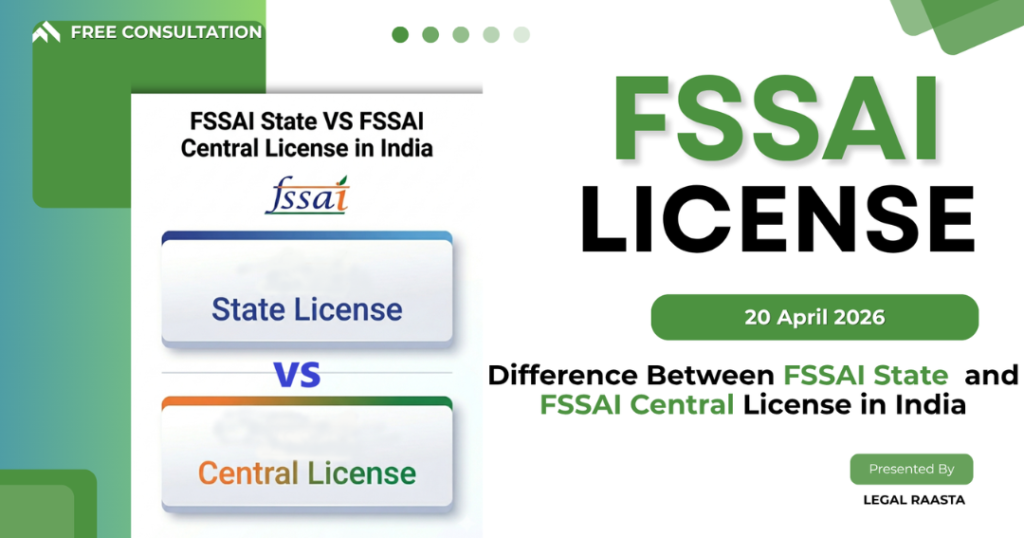
Beginning April 1, 2026, the Food Safety and Standards Authority of India (FSSAI) will have a historic transformation of turnover limits, which will radically alter the food business operator (FBO) terrain. The middle level of ₹20 Crore loss has long been a challenge faced by mid-sized businesses, with a recent FSSAI State License vs Central License debate now centering around a much bigger number of 50 Crores.
You are a local cloud kitchen, a nationwide-growing food producer, or an international importer, but are confused about what FSSAI license level you are in. It is no longer a matter of compliance but a matter of operational efficiency and saving costs. This is a deep-dive guide to the most recent 2026 rules to guide you on what you need to navigate each of these levels.
Get your food business approved and legally in business within the shortest time possible by entrusting your FSSAI State and Central licensing to professionals at LegalRaasta.
The 2026 Turnover Revolution: State vs. Central
The FSSAI Order as of March 13, 2026, amended the turnover categories in a big relief to the small and medium enterprises (SMEs) by making them fewer and lessening the compliance burden.
FSSAI Turnover Threshold Table (Post-April 2026)
| FSSAI Category | 2025 Threshold | 2026 New Threshold | Primary Issuing Authority |
| Basic Registration | Up to ₹12 Lakh | Up to ₹1.5 Crore | District Food Safety Officer |
| State License | ₹12 Lakh – ₹20 Crore | ₹1.5 Crore – ₹50 Crore | State Licensing Authority |
| Central License | Above ₹20 Crore | Above ₹50 Crore | Central FSSAI Authority |
Key Differences: FSSAI State License vs Central License
The difference between the FSSAI state and central license is not restricted to the turnover numbers. It also entails geography, the nature of business, and intricateness of documentation.
1. Scope of Operations
- FSSAI State License: The license is intended to be received by medium-sized enterprises that are based within the framework of a single state. Assuming that you had five outlets all in Maharashtra, then you also would be classified as a State License (unless you exceed ₹50Cr on turnover).
- Central License: This is a requirement for businesses operating more than one unit in more than one state. It also encompasses large-scale manufacturers, airports, seaports, and railways.
2. Nature of Business (Mandatory Central Criteria)
Irrespective of the turnover, the following entities are required to be licensed with a Central License:
- Importers and Exporters: The importing and exporting of any food product across the country or region needs a Central License.
- E-commerce Operators: These platforms (Zomato, Swiggy, and Blinkit) are to have a Central License.
- Nutraceuticals: Companies that sell functional foods or supplements.
- 5-Star Hotels: luxurious hospitality departments are centrally controlled.
Fee Structure & Validity (2026 Update)
The fee for the FSSAI state license and central license difference is also realized in the government fee and the time of processing.
FSSAI Fee Comparison Table
| Feature | State License | Central License |
| Annual Govt Fee | ₹2,000 – ₹5,000 | ₹7,500 (+ GST) |
| Processing Time | 15 – 30 Days | 25 – 45 Days |
| Modification Fee | One-year license fee | ₹7,500 |
| Validity | 1 to 5 Years (Perpetual Option) | 1 to 5 Years (Perpetual Option) |
How to Convert FSSAI State License to Central License
If your business expands, you will most likely need to convert your FSSAI state license to a central license. This is typical of those businesses venturing into the second stage or those with turnover exceeding ₹50 Crore.
- Eligibility Check: Make sure that your turnover has passed the threshold or that you have added a unit in a different state.
- FoSCoS Portal: Log in to the official FSSAI portal.
- Modification Request: Select the “Modification” tab for your existing license.
- Upload Documents: You will have a renewed FSMS plan, turnover evidence (CA Certificate), and location information for the new units.
- Pay Difference Fee: Pay the fee required to upgrade the FSSAI state license to a central license.
Documentation: What Sets Them Apart?
Whereas basic identity documentation (Aadhaar, PAN, Rent Agreement) is similar, FSSAI State License vs Central License documentation varies in technical details:
- To grant a State License: This will need a rudimentary list of food items and a general layout plan of the processing unit.
- In the case of a Central License, It will need a detailed Food Safety Management System (FSMS) plan, water/product independent lab test results, and a special recall plan in case of food safety emergencies.
Which is Better: State or Central?
When asking FSSAI state license vs central license, which is better, the answer will be according to your strategies of development:
- Choose State if: You are a local brand that targets market penetration in a single area. It is also less expensive and has fewer frequent central audits.
- Choose Central if: You are experiencing pan-India ambitions. With institutional buyers, exporters, and up-market retail chains, a Central License will be more impactful. It creates a greater trust among contemporary customers.
The 2026 “Perpetual Validity” Rule
One of the significant developments in 2026 will be the introduction of Perpetual Validity. You do not have to renew every year manually anymore, but your license will stay in effect as long as you submit your annual returns and successfully undergo the periodic computations of risk assessments. This applies to both State and Central licenses.
Structured Technical Elements for Ranking
The Pre-Application Decision Matrix
✅ Turnover < ₹1.5 Cr? Go for Basic Registration.
✅ Turnover ₹1.5 Cr – ₹50 Cr in one state? Go for the State License.
✅ Operating in 2+ States? Go for the Central License.
✅ Exporting or Importing? Go for the Central License.
✅ Running a 5-Star Hotel? Go for the Central License.
The “Kind of Business” (KoB) Matrix: When Turnover Doesn’t Matter
Among the most sophisticated things in the FSSAI State License vs Central License option is the fact that the nature of activity commonly prevails over your turnover. Even when your revenue is zero, in 2026, some of the “Kinds of Business” will be fixed at particular levels.
1. Mandatory State License (Minimum Requirement)
Starting April 2026, the following companies will not be allowed to have a Basic Registration, regardless of the amount of turnover (less than ₹1.5 Crore):
- Caterers: All catering services, including but not limited to event/ private party catering.
- Mid-Day Meal Caterers: A subcategory of food preparation businesses that prepare food as part of government-funded nutritional programmes.
- Grain and Cereal Milling: Small-sized mills are now put under the jurisdiction of the states so as to provide them with a guarantee of aflatoxin and pest-free products.
2. Mandatory Central License (The “Non-Negotiable” List)
This is applicable whether you are earning ₹1 or ₹100 crore; you must always select the FSSAI Central License:
- Proprietary Food Manufacturers: In case your product lacks an authoritative definition of FSSAI (e.g., a special health mix or specialty drink), you are governed on a central basis.
- 100% Export Oriented Units (EOUs): A facility that aims at targeting only foreign markets.
- Multi-State Head Offices: When you have two or more states with outlets, you can only have a Central License in your Head Office to coordinate the “Chain of Custody.”
Annual Returns & Compliance Reporting (2026 Rules)
The major FSSAI state license and central license difference is most pronounced in the annual filing season. By 2026, the FoSCoS portal was incorporated with “Real-Time Production Tracking.”
1. Form D1: The Manufacturers’ Mandate
All manufacturers and importers, with or without an FSSAI State or Central license, are expected to submit by the 31st of May every year Form D1.
- Penalties: Late filing is punishable with a penalty amounting to ₹100 a day, with a limit of five times the fee of the license.
- State vs Central Data: The data files submitted by the holders of Central licenses will have to be more detailed, with the required data being a batch-by-batch volume production and ingredient-by-ingredient procurement information to enable risk analysis.
2. Form D2: The Dairy & Meat Specialty
In the case of members of the dairy industry (where the limit stipulated under FSSAI State License vs Central License is also ₹50 Cr), a half-yearly Form D2 is required.
- Period 1 (H1): Due October 31st.
- Period 2 (H2): Due April 30th.
- Requirement: This will entail reporting on the source of raw milk to avoid adulteration in the supply chain.
The Risk-Based Inspection Framework (2026 Protocol)
Since April 1, 2026, FSSAI no longer has a Calendar Inspections model, instead a Risk-Based model. The difference between the FSSAI state and central license found here is that there is one on your doorstep.
- State Inspections: This is carried out by the Food Safety Officer (FSO). They tend to be set in motion by consumer complaints or seasonal peaks (e.g., festival sweets).
- Central Audits: The audit is going to be provided by Central Food Safety Officers (CFSOs) or Third Party Auditing Agencies. They are much stricter, and they include verification of FSMS (Food Safety Management System) documentation and staff health records, as well as sophisticated water tests.
Risk Categorization Table
| Risk Level | Typical Business | Inspection Frequency |
| High Risk | Dairy, Meat Processing, Infant Food | Once every 6 months |
| Medium Risk | Bakeries, Snacks, Beverages | Once every 12 months |
| Low Risk | Storage, Retail, Wholesalers | Once every 24 months |
How to Convert FSSAI State License to Central License (Technical Steps)
When you either open a branch in another state or hit the mark of ₹50 Crores turnover, you have to convert the FSSAI state license to a central license to avoid the penalty of ₹5 Lakhs for an invalid license.
- Modification Type: Select an option of Change in Category in the FoSCoS dashboard.
- Turnover Validation: Provide a certificate from a Chartered Accountant (CA) or an audited balance sheet of the last financial year.
- Premises Mapping: Be sure you are up to Central standards in your state-level factory layout, both in fire exits and in a specialized storage of raw materials.
- Fee Adjustment: How much you pay in excess of the State fee (₹2,000-₹5,000) and the Central fee (₹7,500) will be the sum you pay to extend the validity period.
Conclusion
The advanced navigation of the difference between FSSAI State and Central licenses is the secret of a successful food business in India. Under the 2026 reforms, FSSAI has made it much easier to do business as an SME with the State License limit increased to ₹50 Crore, but with the risk-based model of inspection, it has increased the screws on the high-risk categories. With the right license and in the case of being digitally compliant, you safeguard your brand against severe fines and establish long-term, strong relationships with your customers.
The new 2026 turnover thresholds shouldn’t muddle your compliance approach. Partner with LegalRaasta today, and get your FSSAI State License vs Central License at 100% accuracy and speed!
FAQs
-
How to differentiate between state and central FSSAI license numbers for my restaurant?
The FSSAI State License vs Central License could be differentiated with the help of the first digit; the Central license is generally ruled by the first number, which is 1 in general, but the State is generally ruled by the second number, which is generally 2.
-
Can I have both a central and state FSSAI license at the same time for one unit?
No, each food premise can only be linked to a single document; the FSSAI State License vs Central License ruling depends on the results of the particular FoSCoS eligibility tool.
-
How to convert the state FSSAI license to a central license after opening a branch in Delhi?
Bringing a unit to a different state will cause you to be a multi-state operator, whereby you have to convert the FSSAI state license to the central license of your Head Office, through a modification application.
-
Which is better, the central or state government for high-volume exports?
Export is subject to a Central License, and the FSSAI State License vs Central License debate is enough to leave all those targeting the international market with their food products in no doubt.
-
What is the difference between the FSSAI central license and the state license in terms of auditing?
The main difference between FSSAI state and central licenses lies in audit rigor; Central licenses are not completely free of audit: Central officers or accredited third-party agencies conduct high-frequency audits.
-
How to upgrade the FSSAI state license to a central license if my turnover reaches ₹51 Crore?
The only way to upgrade the FSSAI state license to a central license is to comply with FoSCoS by submitting a “Modification of License” on FoSCoS after you have passed the 2026 threshold of ₹50 Crore.
-
How to check if a FSSAI license is state or central using the 14-digit code?
A FSSAI State License vs Central License check may be performed on the FoSCoS portal; Central licenses are granted by the Central licensing authority, but not the state food department.
-
Is FSSAI central or state for a company importing olive oil?
Any food importer would have to receive a Central License since the regulations on FSSAI State License vs Central License require that all products crossing the Indian border would be under the central supervision.
-
What is the FSSAI State License vs Central License fee for a large bakery?
Whenever the bakery achieves a profit of ₹1.5 Cr to ₹50 Cr, then the FSSAI State License vs Central License is normally ₹5000, and the central one is ₹7500.
-
What is the FSSAI State License vs Central License turnover limit for 2026?
The new FSSAI State License vs Central License limit has been modified as of 2026 to ₹50 Crore, and this is a huge upgrade over the initial limit of 20 Crore.
Related Posts
 CDSCO
CDSCO
How to Protect Your AI Healthcare Product in India: Trademark, Copyright & Patent Guide
Read More → CDSCO
CDSCO
AI-Driven Medical Device Registration in India: CDSCO Process, Fees & Requirements
Read More →
Our Clients



Featured In