Difference Between ™ and ® in India: Legal Meaning & Usage Explained
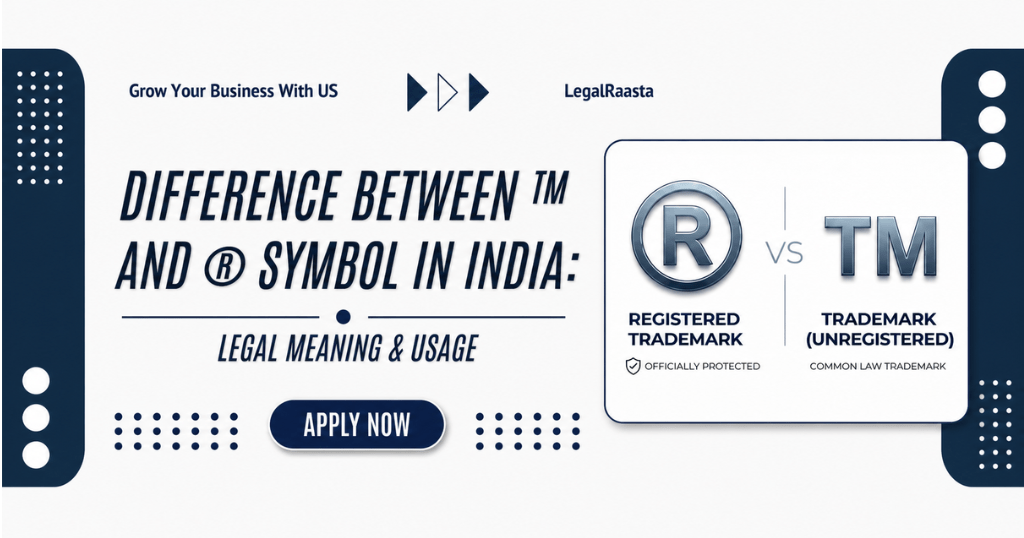
Understanding the differences between the ™ (trademark) and ® (registered) symbols is fundamental for any business. Both symbols look like small superscript additions to a logo; they showcase different stages of legal protection under the Trade Marks Act, 1999. In this comprehensive guide, you will learn the core differences between TM and R, their uses, and their legal features.
What is Trademark ™ Registration?
Trademark registration is a mandatory legal process under the Trade Mark Act, 1999, for individuals who want to protect their brand name or any unique symbol. Trademark filing under this act provides the exclusive rights to businesses or individuals who seek to safeguard their brand name, logo, or slogan from unauthorized use. A trademark is a mark or symbol used to set one product or service apart from another. It could be a word, a phrase, a color combination, the product’s shape, or a three-dimensional image. A trademark (TM) is essential to provide a unique brand identity and acts as an important asset for businesses or individuals.
Features of Trademark ™
- Legal Protection Against Infringement
Owners can sue for damages and can take action against unauthorized use of their brand name or logo.
- Exclusive Rights
Through the filing of a trademark application for trademark protection, the applicant (business or owner) will acquire the exclusive right to use the trademark (TM) symbol for the goods and/or services in all of the classes applied for within that trademark application. It significantly prevents competitors from using similar, confusing marks.
- Boost Brand Credibility
A registered trademark builds trust, reputation, and goodwill, making it easier for customers to choose the right products from rivals.
- Intangible Asset Creation
For businesses, a trademark is an asset that can be sold, assigned, franchised, or commercially contracted.
- Validity
The trademark registration certificate is valid for 10 years from the date of registration and may be renewed indefinitely. Thus, the trademark provides certain long-term security for a trademarked business for the life of its trademark.
- MSME Benefits
In most cases, Micro Small and medium enterprises (“MSMEs”) and startups registered as companies may be entitled to a reduced fee and to have their trademark applications processed on a priority basis.
Importance of Trademark Registration in India
Here is why trademark filing in Maharashtra is important:
- Growing Economy State: Maharashtra is also known as India’s financial powerhouse. Beyond Delhi and other smart cities, Maharashtra is recognized for its strong economic activity and wide range of business opportunities. In rapidly growing Maharashtra markets, securing the brand’s name is crucial to standing out.
- Tourism Sector State: Every year, millions of national and international tourists visit Maharashtra for its beauty and historic significance. Due to the rise in tourism every year in Maharashtra, the demand for branded hotels, travel services, and other major services increases significantly. In such a situation, the local and branded businesses can safeguard their identity through trademark registration.
- Business Expansion: Several businesses in Maharashtra operate digitally to sell goods or services. But a registered trademark business significantly protects its digital brand identity on online platforms
The ® Symbol: The “Owner.”
The symbol ® stands for registered. This symbol is recognized as the “gold standard” in India for businesses that have their own brand names. But the businesses can only use this ® symbol when the Trade Marks Registry has formally granted their registration and issued a Registration Certificate.
Features of ®
- Status
The symbol determines that the mark is officially listed in the Register of Trademarks.
- ·Usage
The businesses cannot use the mark ® until it is registered legally by the Trade Marks Registry. Otherwise, doing the same can result in a heavy penalty.
- Legal Protection
It offers statutory protection. The businesses are liable to file a suit for infringement if an unauthorized person uses the registered mark without permission.
Core Difference Between TM and R Symbols: Comparison at a Glance
Features |
™ (Trademark Symbol) |
® (Registered Symbol) |
|
Meaning |
Claim of use/pending application |
Formally registered with the government. |
|
When to use |
From day one of establishing the business/filing |
Only after getting the official certificate |
|
Legal Basis |
Common Law (Passing off) |
Trade Marks Act, 1999 (Infringement) |
|
Validity |
Depends on continuous use |
10 years (trademark renewal indefinitely) |
|
Complexity of Suit |
High (Must prove reputation) |
Low (must prove registration) |
Understanding “™” vs “®”: Proper Use of Trademark Symbols
Indian entrepreneurs will benefit from understanding the application of the ™ (unregistered trademark) and the ® (registered trademark). Here are some examples of when you might see the two symbols in use in practice.
1) Using the ™ (Unregistered Trademark—Before Registration)
You can use the ™ symbol as an indication of your claims to have the rights to a mark before registration.
– New Businesses / Start-Ups: Should display the ™ symbol on product packaging logos and names, even before registering.
– Testing the Market: Use the “™” symbol to indicate that you have taken the steps to attempt to protect your trade name or brand, and as a means of monitoring how much your potential customers like your brand name.
– Marketing Material and Materials Advertising the Products: You should use the ™ symbol on your website, any social media channels, and in brochures and advertisements. Such acts will make clear that you have ownership rights to the brand.
2) Using the ® (Registered Trademark—After Registration)
Once your trademark is registered with the Controller General of Patents, Designs and Trade Marks (CGPDTM), you may use the ® symbol; this symbol indicates that your name and/or trademark is now entitled to full legal protection.
– After Registration: The use of the ® symbol will show that the trademark has been officially registered, and under Indian law, you will have protection.
– Enforcement of Copyright: The use of the ® symbol provides prima facie evidence of ownership, and therefore, it may serve to substantiate the plaintiff’s position regarding infringement.
– Sale: Displaying the ® symbol on products, packaging, marketing material, websites, and/or agreements establishes the existence of nationwide protection of the mark.
Documents Required for Trademark Registration in India
The online processing of trademarks has made getting a trademark faster and easier because everything is done through the Mumbai office of the Registry. The main documentation you will need to provide includes:
– All applicant information (PAN Card, Aadhaar Card, Passport) is used for identification and to prove address.
– Information about the brand (wordmark, trademark, logo) (submitted as JPEG format).
– Proof of business registration (incorporation certificate, partnership deed, certificate of sponsorship, GST/MSME certificate, etc.).
– If you are utilizing the services of an agent or attorney to file your trademark application, you will need to complete Form TM-48 and have that form signed by the agent or attorney.
The applicant’s affidavit, supported with evidence (such as invoices and advertisements), states that they have used the proposed trademark previously.
The best way to get more information about your products and services is by using the Nice Classification system.
The Registration Journey in India
With the shift from (™) to (®), businesses that have their own brand must navigate the trademark registration process. The general timeline of registration is 6 to 12 months (if no objections are raised).
Search
Research the public trademark search database to ensure that the mark is unique.
Filing
Submitting the application is the primary requirement. At this stage, you switch from no symbol to (™).
Examination
Whether the mark is descriptive, offensive, or similar to an existing mark, as ensured by a government examiner.
Publication
Once all these processes are completed, the mark is advertised in the Trade Marks Journal for 4 months to allow the public to oppose it.
Registration
If no objection or opposition issue comes up (or you win the opposition), the mark is registered, and you can finally use ®.
Trademark Consultant: Choose LegalRaasta
Confused about whether to use ™ or ® for your brand? We are the leading trademark registration service provider in India when it comes to registered trademarks. LegalRaasta has simplified the entire franchise application process for registered franchise owners by offering an online option for franchise registration across India.
The key trademark registration services by this firm include:
- Search & Analysis
- Application Filing
- Objection Management
- Expedited Services
- Comprehensive Support
Frequently Asked Questions
- How do trademarks differ from registered trademarks in India?
In India, a trademark is any mark users associate with a business, whereas a registered trademark is protected under the Trade Marks Act of 1999 and provides the owner with legal rights that are enforceable through court action (as well as protection against competitors using a mark that is similar to theirs).
- Is it lawful to use the ® symbol without having formally obtained a registered trademark registration?
The use of the ® symbol in India, before obtaining an officially registered trademark, can generate liability for confusion in the marketplace and legal claims against you for misrepresentation. You should use the “™” symbol until you have completed your registration process.
- How long does it take to receive a registered trademark registration in India?
The average length of time it takes to secure a registered trademark registration in India is 12 to 18 months, assuming that there are no objections and/or oppositions as part of the process. The time taken to receive a registered trademark involves three main steps: examination, publication in the Trademark Journal, and responding to examination reports.
- What are the consequences if I use an unregistered trademark?
If someone uses your unregistered trademark without authorization, you can initiate passing-off litigation in Indian courts to halt the misuse. To establish a passing-off claim, you will need to demonstrate prior usage, curated goodwill, and that consumer confusion with the infringing mark is probable.

Related Posts
 Copyright Registration
Can You Trademark an AI-Generated Logo in India? Legal & Copyright Guide
Read More → Trademark
Trademark Class 99 in India (2026): Meaning, Uses, Registration & Applicability
Read More → Trademark
Why Every Artist Needs a Trademark: A Complete Guide to Protecting Your Creative Identity in India (2026)
Read More → Trademark
Trademark Class 5 in India (2026): Pharmaceuticals, Veterinary Medicines, Pesticides & Registration Guide
Read More →
Our Clients


Featured In