
How to Respond to an Income Tax Notice: A Complete Step-by-Step Guide
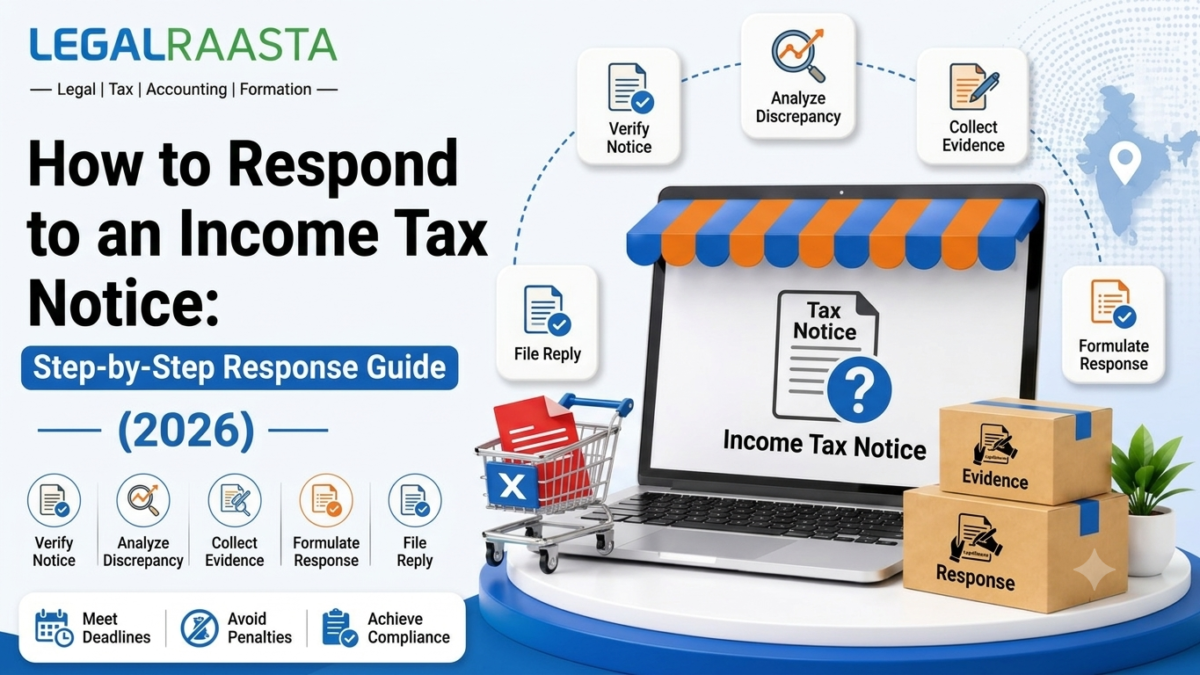
Getting an income tax notice does not mean you cheated on your taxes. It does not mean the department is coming after you. It is a communication. Sometimes it is as simple as your employer deducting less TDS than required. Sometimes it is a mismatch in numbers that takes ten minutes to explain. But when you ignore it, a small issue turns into a penalty, a demand, or worse.
This guide tells you exactly what to do the moment an income tax notice lands in your inbox, step by step, without the panic and without the jargon. LegalRaasta connects you with experienced CAs who handle income tax notices every day so yours gets resolved correctly and on time.
Why Did You Get This Notice?
Before anything else, you need to understand why the department sent it. An income tax notice can arrive for many reasons, and most of them are not what you think. The most common reasons people receive one:
- You did not file your ITR for a year where income was taxable
- There is a mismatch between what you declared and what shows in your Form 26AS or Annual Information Statement (AIS)
- You made a big transaction, bought property, deposited large cash amounts, or redeemed mutual funds, and it needs to be explained
- Your ITR was selected for routine scrutiny
- TDS deducted by your employer or bank does not match your declared income
- You claimed deductions the department wants proof for
- There is a simple error in your return that needs fixing
Knowing the actual reason tells you what documents to pull out and what your reply needs to say. Without reading the notice properly, any response you send could be wrong.
Types of Income Tax Notices in India
Not every income tax notice works the same way. The section number on the notice tells you everything about what is being asked and how urgently you need to act.
|
Notice Section |
What It Actually Means |
Time to Respond |
|
Section 139(9) |
Your ITR has an error or is incomplete |
15 days from notice date |
|
Section 143(1) |
Processing intimation, could show demand or refund |
No response needed unless you disagree |
|
Section 143(2) |
Your return is under detailed scrutiny |
Must respond within the time given |
|
Section 148 |
Income that was not declared has come to their notice |
Must file ITR or respond with explanation |
|
Section 156 |
Tax demand notice: you owe money |
Pay or dispute within 30 days |
|
Section 245 |
Old demand being adjusted against your current refund |
Agree or disagree within 30 days |
|
Section 131 |
Documents needed or personal appearance required |
Respond with documents or appear |
Find the section number on your notice. That one detail tells you what kind of situation you are actually in.
Step-by-Step: How to Respond to an Income Tax Notice
This six-step guide explains responding to Indian income tax notices, covering verification, document gathering, online submission, and downloading acknowledgements.
Step 1: Read It Fully Before You Do Anything Else
Sit down and read the notice from start to finish. Note down:
- The section it is issued under
- Which assessment year it relates to
- The exact date by which you must respond
- What the department is specifically asking for
Most people skim the notice and miss the deadline date buried in paragraph three. That deadline is the most important number in the entire document.
Step 2: Confirm It Is a Real Notice
Fake income tax notices exist. Before you gather documents or respond to anything, verify the notice is genuine.
Log in to incometax.gov.in with your PAN credentials. Go to Pending Actions and then e-Proceedings. Every legitimate notice the department sends appears there. If the notice in your email or inbox is not showing up on the portal, do not act on it. Contact the income tax helpline or your Assessing Officer first.
Step 3: Pull Together Every Document You Need
Based on what the notice is asking about, collect the right proof:
Income mismatch notices:
- Form 26AS for the financial year in question
- Annual Information Statement from the portal
- Bank statements for the full year
- Form 16 or Form 16A from your employer or deductor
Scrutiny notices:
- All income proofs including salary slips, rental agreements, business receipts
- All deduction proofs including home loan certificates, insurance premium receipts, 80C investment statements
- Previous years’ ITR copies if relevant
Transaction-related notices:
- Sale or purchase agreement for property
- Capital gains statement from your broker for shares or mutual funds
- Bank statement showing the source of funds used
Organise these before you open the portal to respond. Going in without documents ready wastes time and increases the chance of submitting an incomplete reply.
Step 4: Log In and Go to e-Proceedings
All income tax notice responses in India go through the official portal. There is no other way.
Log in at incometax.gov.in, go to Pending Actions, click e-Proceedings, find your specific notice, and click Submit Response. The portal gives you a structured form. Fill it clearly and upload your supporting documents in the format the portal specifies.
Step 5: Write a Clear and Factual Response
Your written explanation should:
- Address every point the notice raises separately
- Stay factual. Only state what you can back up with documents
- Point to the exact part of your ITR where disputed income or deductions are declared
- Do not volunteer information the department has not asked for
- Avoid being defensive or emotional in tone
If the notice says your income from a particular source is not matching, explain that income line by line and attach the document that proves your declared figure. Simple and direct works better than long explanations.
Step 6: Submit and Download the Acknowledgement
After submitting on the portal, download your acknowledgement immediately. This is your legal proof that you responded before the deadline. Keep it with your tax papers for that assessment year.
What Happens If You Do Not Respond
This is where most people make the problem much worse. Silence is not safe with an income tax notice.
|
What You Do |
What the Department Does |
Financial Impact |
|
Ignore Section 143(2) scrutiny |
Completes assessment without your side |
Unexplained income added, great demand raised |
|
Misses Section 148 deadline |
Issues ex-parte assessment |
Full tax demand plus 1% monthly interest |
|
Ignore Section 156 demand |
Starts recovery proceedings |
Bank account attachment, property attachment |
|
No response to Section 131 |
Treats you as non-cooperative |
Penalty up to Rs 10,000 per instance under Section 272A |
|
Repeated non-compliance |
Files criminal complaint |
Prosecution under Section 276C for wilful evasion |
None of these outcomes require you to have done anything wrong originally. They happen purely because you did not respond. The department does not give the benefit of the doubt to silence.
Common Mistakes People Make
People who handle their own income tax notice responses often make the same mistakes:
- Sending a response to the wrong email address instead of through the portal
- Uploading the wrong year’s Form 26AS when the notice is about a different assessment year
- Writing an emotional letter explaining their personal situation instead of addressing the specific query
- Admitting to income they cannot actually prove they received, creating a fresh tax demand
- Not reconciling their AIS with their ITR before responding and missing items the department already has data on
- Assuming that paying the demand ends the scrutiny, when sometimes it does not
- Not keeping a copy of the submitted response and acknowledgement
DIY vs Getting Professional Help
|
Type of Notice |
Handle Yourself |
Get Professional Help |
|
Section 143(1) small processing demand |
Yes, if the amount is small and clear |
Optional |
|
Section 139(9) defective return |
Yes, if the error is simple |
Recommended for complex ITRs |
|
Section 143(2) full scrutiny |
Rarely |
Always recommended |
|
Section 148 reopening of assessment |
No |
Yes, immediately |
|
Large tax demand you dispute |
Only if you fully understand the numbers |
Yes |
|
Criminal proceedings or prosecution |
No |
Yes, urgently |
How LegalRaasta Helps With Income Tax Notices
LegalRaasta’s tax team handles income tax notices across all sections every single day:
- They read your notice, identify the exact issue, and explain what is actually being asked
- They pull your AIS and Form 26AS and reconcile it with your ITR to find every mismatch
- They draft a factual, legally sound written response
- They upload everything on the income tax portal on your behalf
- For scrutiny cases, they handle the entire correspondence with the Assessing Officer
- For personal hearings, they can accompany or represent you
- For great disputed demands, they handle the appeal process if needed
Conclusion
An income tax notice is not a punishment. It is a question. The department has data that does not match what you declared, or they want proof of something, or your return has an error. These are all things that can be answered.
What makes an income tax notice a real problem is not the notice itself. It is when you read it, feel anxious, and close the email hoping it disappears. It does not disappear. The deadline moves closer every day, and the penalties stack up the moment it passes. Read it. Verify it. Gather your documents. Respond on the portal before the deadline. That is the entire process.
Connect with LegalRaasta today and get your income tax notice handled by a qualified CA who will read it correctly, respond accurately, and make sure you are not paying a single rupee more than you legally owe.
Frequently Asked Questions
-
What should I do immediately after getting an income tax notice?
Read the full income tax notice, note the section and deadline, then verify it at incometax.gov.in under e-Proceedings. Do not respond until you confirm it is genuine. Fake notices exist, and sharing financial documents with fraudsters can cause serious damage to your finances.
-
Does every income tax notice mean I did something wrong?
No. An income tax notice can be sent for routine reasons like a minor ITR error or a data mismatch in AIS. Section 143(1) intimations are often just processing confirmations. Only scrutiny notices under Section 143(2) or reopening notices under Section 148 indicate deeper review by the department.
-
How do I respond to an income tax notice online?
Log in at incometax.gov.in, go to Pending Actions, click e-Proceedings, find your income tax notice, and use the Submit Response option. Upload your supporting documents through the structured portal form. Download and save your submission acknowledgement as proof that you responded on time.
-
What documents do I typically need to respond?
For an income tax notice about income mismatch, gather your AIS, Form 26AS, bank statements, and Form 16. For scrutiny, collect all income proof and deduction documents for that year. Always reconcile your AIS with your ITR before drafting your response to avoid leaving gaps.
-
What happens if I miss the response deadline?
Missing the deadline on an income tax notice can lead to the Assessing Officer completing the assessment without your input and raising a demand based only on department data. Penalties under Section 272A of Rs 10,000 per instance may also apply along with monthly interest on any tax demand that results.
-
Is a Section 143(1) intimation the same as a notice?
A Section 143(1) intimation is a processing result rather than a full income tax notice requiring a response. If it shows no demand, no action is needed. If it shows a demand you disagree with, file a rectification request under Section 154 within the allowed time to correct the discrepancy on the portal.
-
Can I handle a scrutiny notice myself?
Technically yes, but it is not advisable. A scrutiny income tax notice under Section 143(2) means an officer is reviewing your entire income and deductions. One wrong answer or missing document can result in additions to your taxable income. Getting a CA to handle it is almost always worth the cost.
-
How do I know if a notice is fake?
Check every income tax notice on incometax.gov.in before doing anything. Real notices appear in your e-Proceedings under your PAN. Any communication asking you to pay money directly to a personal account, share OTPs, or call a private number is fraudulent. Report it at cybercrime.gov.in immediately.
-
What is a Section 148 notice and is it serious?
Yes, very. A Section 148 income tax notice means the department believes income escaped assessment in a previous year. You must either file an ITR for that year or respond with a detailed explanation. Always take professional help for this type because the consequences of a wrong response are severe.
-
How does LegalRaasta help when I receive an income tax notice?
LegalRaasta assigns a qualified CA to read your income tax notice, reconcile your AIS and ITR, draft a factual and legally sound response, and submit it on the portal on your behalf. For scrutiny or large demand cases, they handle full correspondence and hearings with the Assessing Officer.

Related Posts



Our Clients








Featured In