
What Happens If You Don’t File Your ITR? Penalties, Notices & Legal Consequences
Anil ran a small import business in Surat. Good turnover, decent margins, no complaints. He skipped filing his ITR for three years because business was busy and he kept telling himself he would do it next month. Next month never came.
When the Income Tax Department finally caught up with him, they had already pulled his bank statements, checked his GST filings, and tracked a property purchase he made in 2022. The demand notice that arrived was for Rs 4.8 lakh in back taxes, interest, and penalties combined. He paid more than twice what he would have owed had he just filed on time.
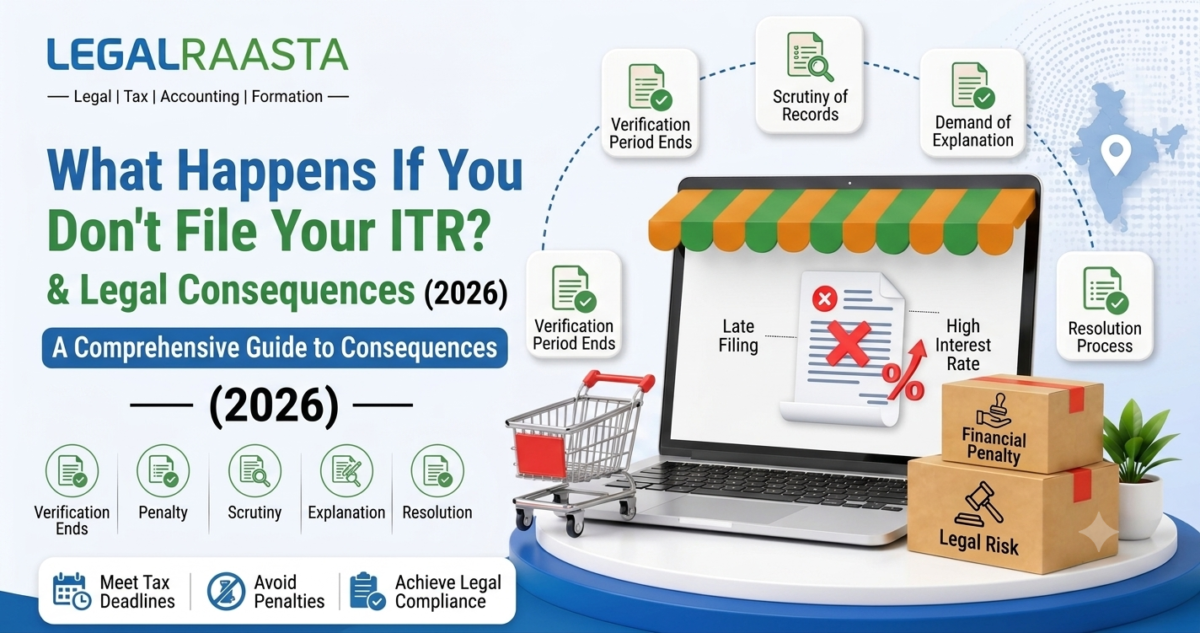
Not filing ITR is not a harmless mistake you can fix quietly later. The department today has access to your bank data, UPI transactions, property registrations, stock redemptions, and employer filings. They know about income you never declared. And when they eventually connect those dots, the bill they send is always bigger than what filing on time would have cost.
This guide tells you exactly what happens when you skip filing, year by year, notice by notice, penalty by penalty. LegalRaasta helps you file pending ITRs, respond to notices, and get your tax compliance sorted before things get worse.
Who Has to File an ITR in India?
A lot of people assume they do not need to file if their employer already deducts TDS. That assumption is wrong. You must file your ITR if any of these apply:
- Total income before deductions is above Rs 2.5 lakh per year
- You are above 60 years old, and income crosses Rs 3 lakh
- You are above 80 years old, and income crosses Rs 5 lakh
- You have a tax refund due from excess TDS
- You have foreign income or foreign assets of any value
- You want to carry forward capital losses to future years
- You deposited over Rs 1 crore in bank accounts during the year
- You spent more than Rs 2 lakh on foreign travel
- Your electricity bills crossed Rs 1 lakh in the year
- You are a company or firm regardless of profit or loss
If any of these describe you and you did not file, here is what is already happening in the background.
The Direct Penalty for Not Filing on Time
The moment you miss the July 31 deadline, Section 234F kicks in automatically. No notice required. No warning.
|
When You File |
Late Fee |
|
On or before July 31 |
Zero |
|
August 1 to December 31 |
Rs 5,000 |
|
After December 31 |
Rs 10,000 |
|
Income below Rs 5 lakh |
Maximum Rs 1,000 |
That penalty is just the starting point. The interest that builds on unpaid tax is usually a much bigger number.
Interest That Keeps Building Every Month
This is the part most people do not think about when they delay filing. Three separate interest provisions apply simultaneously once you miss the deadline.
- Section 234A charges 1% per month on whatever tax you owed but did not pay, starting from the original due date until the day you actually file. Six months of delay on Rs 80,000 in dues means Rs 4,800 in interest before anything else.
- Section 234B applies when you did not pay at least 90% of your tax liability as advance tax during the year. Again, 1% per month from April 1 of the assessment year until you file.
- Section 234C adds interest on each missed advance tax instalment during the year itself. If you were supposed to pay advance tax in June, September, December, and March and skipped all of them, four separate interest charges apply.
All three can run at the same time. Someone with Rs 1 lakh in tax dues who files two years late can easily end up paying Rs 1.24 lakh or more by the time interest alone is calculated.
The Notices: What Comes and When
The Income Tax Department does not sit idle while you skip filing. They are collecting information about you from multiple sources every single year.
Section 139(9) – Defective Return
- Gets sent when your return has errors or incomplete information. You get 15 days to correct and refile. If you do not, the department treats it as though you never filed at all.
Section 143(1) – Processing Intimation
- Comes after your return is processed. Shows either a refund, a demand, or no change. A demand here needs to be paid or disputed within the given time.
Section 143(2) – Scrutiny Notice
- This one means business. Your return has been picked for a detailed examination. The department wants supporting documents, income proofs, and explanations for every deduction you claimed. Miss this or respond poorly and a big demand follows.
Section 148 – Income Escaping Assessment
- This is what happens when the department has data showing income existed, but no return was filed. They can go back 3 years normally. If the suspected income is above Rs 50 lakh, they can go back up to 10 years. You are required to either file a return for that year or give a very convincing written explanation.
Section 156 – Demand Notice
- A formal bill from the department. Pay within 30 days or file an appeal. Ignore it and recovery starts.
What Happens When You Ignore Notices
People sometimes think ignoring a notice buys them time. It does the opposite.
|
Notice Ignored |
What the Department Does |
|
Section 143(2) scrutiny |
Finishes assessment without you, adds unexplained income, raises demand |
|
Section 148 |
Issues ex-parte order, calculates tax on their estimate of your income |
|
Section 156 demand |
Moves to recovery: bank attachment, salary attachment, property seizure |
|
Repeated non-filing |
Refers case for criminal prosecution |
Bank attachment is more common than most people realise. The department writes directly to your bank. Your account gets frozen. You find out when a payment fails or your card declines at a petrol pump.
Can Not Filing ITR Land You in Jail?
Under Section 276CC of the Income Tax Act, wilfully not filing an ITR when tax is owed above Rs 25,000 is a criminal offence. The punishment:
- Rs 25 lakh or less in evaded tax: 3 months to 2 years imprisonment
- Above Rs 25 lakh in evaded tax: 6 months to 7 years imprisonment
Prosecution under 276CC is not aimed at someone who genuinely forgot to file once. It targets people who had clear taxable income, skipped filing year after year, and have evidence of that income in bank and property records. But once the department has that evidence and you have ignored multiple notices, the line between forgetting and wilful evasion is not something you want to argue in front of a judge.
How LegalRaasta Helps
LegalRaasta’s tax team deals with not filing ITR situations every day:
- Calculate exact dues for each pending year under the correct sections
- File belated and updated returns accurately to avoid triggering fresh scrutiny
- Draft legally sound responses to Section 148, 143(2), and 156 notices
- Handle appeals under Section 246A when demands are disputed
- Represent you in hearings with the Assessing Officer
- Set up advance tax schedules so this does not happen again next year
Conclusion
Not filing ITR is one of those problems that feels manageable right up until it suddenly is not. The department is patient. They collect data quietly for months or years. And then one morning a notice arrives, and the number on it is nothing like what you imagined.
The cheapest time to fix a pending ITR situation is always right now, before a notice, before interest builds another month, before the updated return window closes for an older year.
Do not wait for the department to file on your terms. Connect with LegalRaasta today and get every pending ITR sorted correctly, completely, and before the Income Tax Department makes the decision for you.
Frequently Asked Questions
-
What is the penalty for not filing ITR in India in 2026?
Not filing ITR on time attracts a late fee of Rs 5,000 under Section 234F if you file before December 31. After December 31, the fee goes to Rs 10,000. If your income is below Rs 5 lakh, the maximum fee is Rs 1,000. Interest under Sections 234A, 234B, and 234C applies separately on unpaid tax dues.
-
How far back can the Income Tax Department go for not filing ITR?
For regular cases of not filing ITR, the department can reopen assessments up to 3 years back. If the suspected undeclared income is above Rs 50 lakh, the window extends to 10 years under Section 148. No year is truly safe until formally assessed and closed by the department.
-
Can I go to jail for not filing ITR in India?
Yes. Under Section 276CC, not filing ITR wilfully when tax owed is above Rs 25,000 is a criminal offence. Imprisonment ranges from 3 months to 7 years depending on how much tax was evaded. This applies when the department has clear evidence of income that was deliberately hidden across multiple years.
-
What is the updated ITR and can it help with not filing ITR for past years?
The updated ITR under Section 139(8A) lets you fix not filing ITR for up to two previous assessment years even after all deadlines pass. You pay your normal tax plus 25% extra if filed within 12 months of the assessment year end, or 50% extra between 12 and 24 months. It is expensive but far cheaper than facing assessment proceedings.
-
What happens if I ignore an income tax notice for not filing ITR?
Ignoring notices related to not filing ITR leads to ex parte assessment where the department calculates your income without your input and raises a demand. After that comes bank account attachment, salary attachment, or property seizure. Criminal prosecution under Section 276CC is possible in serious repeat cases.
-
Does TDS deducted by my employer mean I do not need to worry about not filing ITR?
No. TDS is only an advance payment of tax. Not filing ITR is still a violation even if your employer deducted the correct amount. You still need to file to reconcile total income, claim refunds if excess was deducted, and declare other income sources like interest, rent, or capital gains from investments.
-
What is the interest charged for not filing ITR on time?
Not filing ITR on time triggers three interest sections simultaneously. Section 234A charges 1% per month on unpaid tax from the due date. Section 234B charges 1% per month if advance tax paid was below 90% of dues. Section 234C charges interest on each missed advance tax instalment. All three can apply together.
-
Can I file ITR for multiple missed years at once?
Yes. If not filing ITR has been an issue for several years, you can file belated or updated returns for each year separately. Calculate dues carefully for each year, including interest before filing. If notices have arrived for any year, handle those responses first since they affect what gets declared in the return.
-
What is a Section 148 notice and how is it connected to not filing ITR?
A Section 148 notice is what the department sends when they have evidence of income that was never declared due to not filing ITR. They can assess that income, add interest, and raise a demand. Always get professional help for Section 148, as responding incorrectly can result in a much greater demand than the original issue.
-
How does LegalRaasta help people with not filing ITR problems?
LegalRaasta assigns qualified CAs to calculate exact dues for each year of not filing ITR, file belated and updated returns correctly, respond to all pending notices, and handle appeals if demands are disputed. They also set up future advance tax compliance so the same problem does not repeat next year.

Related Posts


Our Clients








Featured In