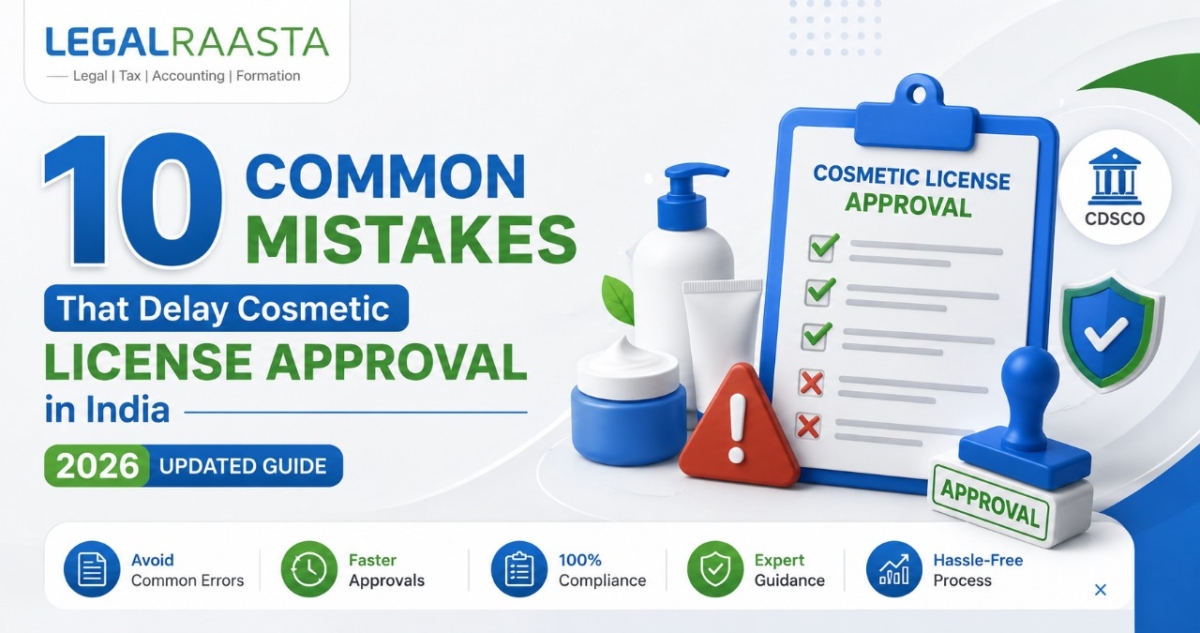
10 Common Mistakes That Delay Cosmetic License Approval in India: 2026 Updated Guide
A skincare brand in Noida spent four months waiting for their cosmetic manufacturing license. The State Licensing Authority had sent three queries. Each one was about something that could have been fixed before submission. Wrong facility layout. Missing test reports. One ingredient listed differently across two forms. Four months of delay. No production. Distributors waiting. The mistakes that delay cosmetic license approval in India are almost always preventable.
But because cosmetic licensing under the Drugs and Cosmetics Act, 1940 involves both central and state authorities, multiple forms, lab test requirements, and facility inspections, small errors at any stage create compounding delays. This guide covers the 10 most damaging mistakes that delay cosmetic license approval, what each one looks like in practice, and how to fix it before submission. LegalRaasta helps cosmetic brands prepare and file complete, accurate applications so your license clears without unnecessary back and forth.
What Is a Cosmetic License in India?
In India, cosmetics are regulated under the Drugs and Cosmetics Act, 1940, and the Cosmetics Rules, 2020. Any business that manufactures cosmetics must hold a valid cosmetic manufacturing license from the State Licensing Authority. Importers need a separate import registration from CDSCO.
|
License Type |
Who Needs It |
Issuing Authority |
|
Cosmetic Manufacturing License |
Domestic manufacturers |
State Licensing Authority (SLA) |
|
Cosmetic Import Registration |
Importers of cosmetics |
CDSCO |
|
Loan License (Form 31) |
Brands outsourcing manufacturing |
State Licensing Authority |
|
Multi-Level Marketing Registration |
MLM cosmetic brands |
CDSCO |
The SUGAM portal handles most central submissions. State applications go through state drug control portals or physical offices depending on the state. Getting either of these wrong from the start is itself one of the most common mistakes that delay cosmetic license approval.
10 Common Mistakes That Delay Cosmetic License Approval
Every mistake below has caused real delays for real brands. These are not theoretical. They come directly from what licensing authorities flag in queries.
1. Incorrect Product Classification
Not everything that sits on a beauty shelf is a cosmetic under Indian law. Some products fall under drugs instead. Sunscreens above SPF 30, anti-dandruff shampoos with certain actives, and teeth whitening products with specific ingredients can get classified as drugs. Filing them under cosmetics leads to automatic rejection.
Before applying, verify the exact regulatory category for each product. The Cosmetics Rules, 2020 and relevant CDSCO guidance documents list what qualifies as a cosmetic versus a drug.
2. Incomplete or Incorrect Documentation
This is the single biggest cause of mistakes that delay cosmetic license approval. Missing pages, unsigned forms, outdated certificates, and wrong entity names across different documents all create query letters.
|
Common Document Error |
What Gets Rejected |
|
Name mismatch between GST and application form |
Entire application held |
|
Missing Director / Partner signatures on Form 31 |
Application incomplete |
|
Expired pollution NOC attached |
SLA cannot proceed |
|
Factory plan without dimensions |
Facility inspection not scheduled |
|
Qualification certificates missing for Technical Staff |
Application incomplete |
Check every document against the checklist before submission. A single missing page in a 40-page application still stops the whole thing.
3. Errors in Product Formulation Details
The formulation declaration is where most brands get technical rejections. Common problems include:
- Ingredient names not matching INCI nomenclature (International Nomenclature of Cosmetic Ingredients)
- Concentration percentages that exceed permissible limits under Schedule Q of the Drugs and Cosmetics Act
- Restricted ingredients listed without proper justification or within limits
- Preservatives not conforming to the approved list
The SLA and CDSCO reviewers check formulations against the approved ingredient lists. Any mismatch triggers a query that adds weeks to the process.
4. Non-Compliant Labels and Packaging
Label compliance under the Cosmetics Rules, 2020 is specific. These mistakes that delay cosmetic license approval often happen because brands copy international packaging without checking Indian requirements.
Mandatory label elements under Indian rules:
- Name and address of manufacturer
- Batch number and manufacturing date
- Best before date
- Net content (weight or volume)
- List of ingredients in INCI order
- Directions for use if required
- Warnings where applicable
- CDSCO registration number for imported products
Missing even one of these means the label needs to be redesigned and resubmitted. That costs both time and money.
5. Gaps in Testing and Safety Documentation
Test reports must come from NABL-accredited or CDSCO-approved laboratories. Reports from unapproved labs are not accepted regardless of the test results inside them.
Beyond lab accreditation, the tests must cover:
- Microbial limits as per Schedule Q
- pH stability testing
- Heavy metals where required for the product category
- Preservative efficacy testing
Reports dated more than six months before submission are also rejected in many states. If your test reports are old, get fresh ones before applying.
6. Incorrect Manufacturing Facility Details
The facility layout submitted must match the actual premises the SLA inspector will visit. Sending an old floor plan, omitting certain areas, or having dimensions that do not add up are among the mistakes that delay cosmetic license approval that almost always surface during the inspection stage rather than the paper review.
Things inspectors check against your submitted documents:
- Segregation between manufacturing, quality control, and storage areas
- Presence of required equipment for the product categories applied for
- Clean room or controlled area requirements for certain product types
- Drainage, ventilation, and pest control as per Schedule M
If the inspector finds discrepancies, the application goes back for amendment. That typically adds two to three months.
7. Applying Under the Wrong License Category
Brands manufacturing under someone else’s facility often do not know whether they need a full manufacturing license or a loan license under Form 31. Applying under the wrong category means the wrong form, wrong fee, and wrong supporting documents.
Similarly, brands that both manufacture and import sometimes file only one application when two separate registrations are required.
8. Inconsistencies Across the Application
The SLA reviews the complete application as a package. When the product list in Form 31 differs from the product list in the formulation declaration, which differs from the products mentioned in the label drafts, reviewers flag all three sections. Fixing inconsistencies requires resubmitting multiple documents simultaneously.
Cross-check every mention of product names, ingredient names, concentrations, and facility details across all sections before submitting anything.
9. Slow or Incomplete Responses to Regulatory Queries
Even a well-prepared application sometimes gets a query. What damages timelines most is not the query itself but slow or partial responses. State licensing authorities have their own internal timelines. If you take six weeks to respond and submit incomplete answers, another query follows.
Respond within 15 working days of receiving any query. Submit all requested documents in the same response. A second query on the same issue signals that you did not address the first one properly.
10. Not Checking for Recent Regulatory Updates
CDSCO and state drug controllers release notifications and circulars that change specific requirements. Brands that filed cosmetic applications six months ago may have used templates based on older rules. In 2025-26, there have been updates related to import registration procedures and ingredient approval lists.
Always verify the current version of the Cosmetics Rules 2020 and any relevant CDSCO circulars before submitting. Using outdated forms is itself one of the common mistakes that delay cosmetic license approval.
How to Avoid Cosmetic License Approval Delays
The fix for most of these problems is preparation before submission, not correction after rejection.
- Get a regulatory consultant to review your product classification before filing anything
- Use INCI names from the start in formulation declarations
- Check test report validity and lab accreditation status before including them
- Visit the State Drug Control website for the latest version of all required forms
- Match every document with every other document for consistency before submission
- Respond to any SLA query within 15 working days with complete information
Cosmetic License Application Pre-Submission Checklist
Go through every item before you submit:
|
Category |
Checklist Item |
|
Entity documents |
GST, PAN, COI all match application form name |
|
Facility |
Floor plan with dimensions, current and accurate |
|
Facility |
NOC from pollution control board, valid and current |
|
Technical staff |
Qualification certificates for production and QC heads |
|
Formulation |
INCI names used throughout |
|
Formulation |
All ingredients within Schedule Q limits |
|
Testing |
Lab reports from NABL or CDSCO-approved lab |
|
Testing |
Reports dated within the last 6 months |
|
Labels |
All mandatory elements present per Cosmetics Rules 2020 |
|
Application |
Product list consistent across all sections |
|
Forms |
Correct form used for correct license category |
|
Fees |
Correct fee paid as per current schedule |
How LegalRaasta Helps With Cosmetic Licensing
LegalRaasta works with cosmetic brands across India to prevent the mistakes that delay cosmetic license approval before they happen.
- Product classification review to confirm cosmetic vs drug status
- Complete document checklist and review before submission
- Formulation check against Schedule Q and INCI standards
- Coordination with NABL-accredited labs for required testing
- Form 31 and Form 42 preparation and filing on SUGAM and state portals
- Query response drafting and submission within timelines
- Import registration with CDSCO for importers
Conclusion
The mistakes that delay cosmetic license approval in India are predictable. Wrong classification, missing documents, formulation errors, label gaps, inconsistencies across sections. None of these are unavoidable. All of them show up in the same pattern across hundreds of applications every year.
The difference between a 6-week approval and a 6-month delay is almost always preparation. Fix the problems before submission. Do not wait for an SLA query to discover them. Connect with LegalRaasta today and get your cosmetic license application reviewed before submission so your approval comes through without delays.
Frequently Asked Questions
1. What are the most common mistakes that delay cosmetic license approval in India?
The most common mistakes that delay cosmetic license approval include wrong product classification, missing or mismatched documents, INCI nomenclature errors in formulations, non-compliant labels, expired test reports, and slow responses to SLA queries during the review process.
2. How long does cosmetic license approval take in India?
With complete and correct documents, a cosmetic manufacturing license typically takes 60 to 90 days. However, mistakes that delay cosmetic license approval, like document gaps or query responses, push this to 4 to 6 months or longer depending on the State Licensing Authority’s workload.
3. What documents are required to avoid mistakes that delay cosmetic license approval?
Core documents include entity registration certificates, facility floor plan with dimensions, pollution NOC, technical staff qualifications, formulation details with INCI names, NABL-approved lab test reports, and label drafts. Mistakes that delay cosmetic license approval most often come from missing or inconsistent versions of these.
4. Why does INCI nomenclature matter in cosmetic license applications?
Using incorrect ingredient names instead of INCI standard names is one of the common mistakes that delay cosmetic license approval because SLA and CDSCO reviewers verify ingredients against approved lists using INCI names. Non-standard names lead to formulation rejection and query letters requiring resubmission.
5. Can wrong product classification delay cosmetic license approval?
Yes. Submitting a product that qualifies as a drug under a cosmetic license application is one of the most serious mistakes that delays cosmetic license approval. Products like high-SPF sunscreens or anti-dandruff formulations with specific actives may need drug registration, not cosmetic licensing.
6. What happens if I respond slowly to an SLA query?
Delayed responses to queries are among the mistakes that delay cosmetic license approval that applicants directly control. State Licensing Authorities have internal timelines. Slow or incomplete responses trigger additional queries. Always respond within 15 working days with all requested documents in a single submission.
7. Do test reports need to come from specific labs to avoid cosmetic license delays?
Yes. Test reports must come from NABL-accredited or CDSCO-approved laboratories. Using unapproved labs is one of the mistakes that delay cosmetic license approval because the SLA rejects such reports regardless of results. Also check that reports are dated within 6 months of submission.
8. Is a loan license different from a manufacturing license for cosmetics?
Yes. Applying under the wrong category is one of the mistakes that delay cosmetic license approval. Brands outsourcing production need a loan license under Form 31. Own-facility manufacturers need a full manufacturing license. Filing the wrong form means wrong documents and wrong fees, requiring a fresh application.
9. How do label errors cause cosmetic license approval delays?
Non-compliant labels are common mistakes that delay cosmetic license approval because SLA reviewers check labels against the Cosmetics Rules 2020. Missing the manufacturer address, batch number format, ingredient list in INCI order, or required warnings means the label must be redesigned and resubmitted before the application proceeds.
10. How does LegalRaasta help avoid mistakes that delay cosmetic license approval?
LegalRaasta reviews your application for all common mistakes that delay cosmetic license approval before submission, including product classification, formulation compliance, document consistency, label review, and lab coordination. Query responses are drafted and submitted on time to prevent secondary delays from the State Licensing Authority.

Related Posts

Our Clients



Featured In