
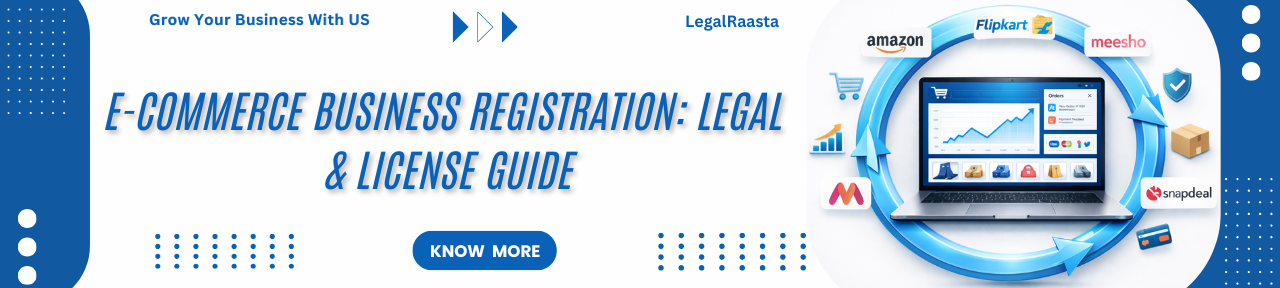
E-commerce Business Registration in India: Licenses, GST, Legal Compliance & Complete Process
In 2026, the e-commerce platforms have taken a significant place in the daily life of online customers. With the increase in online products or services, a significant development is seen in the e-commerce sector. Each month, startups are launching Indian online shopping services. However, before commencing this operation, startups need to understand the legal framework for setting up and operating an e-commerce business registration in India. Listing products and taking orders is not the only requirement for launching a store, but you must also register your business legally in India and secure the required licenses. Adherence to ongoing compliance requirements is important to avoid legal penalties like hefty fines. Through this guide, you will come to know how you can register your e-commerce business and license, including documentation and compliance management.
1. Importance of Legal Registration for E-commerce Businesses
Many online e-commerce businesses operate at a small level, operating without getting formal authorization. However, even your small e-commerce business can get much credibility with legal registration, which provides access to a bank account and tax compliance management. Well, operating any business in India without legal registration can raise several consequences, such as:
- Penalties and legal notices
- GST demands with interest
- Blocked input tax credits
- Problems opening business bank accounts
- Marketplace blocking or suspension
- Lost opportunities with banks, partners, and investors
To build a strong foundation for your business’s long-term success, you must start selling by understanding and completing the right registration.
2. Step-by-Step E-commerce Business Registration in India
Follow this complete registration process to start your e-commerce business with full legal authorization.
A. Choose Your Business Structure
Before registering any business type, one must ensure under which business structure they want to register. The common business structure includes:
- Sole Proprietorship
- Partnership Firm
- Limited Liability Partnership (LLP)
- Private Limited Company
- One Person Company (OPC)
Registering your entity with a business structure is beneficial, as it provides limited liability protection and scalability. If you are operating a small or side hustle e-commerce business. Meanwhile, the company registration certificate is issued by the Ministry of Corporate Affairs. Once registered, you will get the business’s legal identity.
B. Obtain PAN and TAN
Regardless of business registration, the businesses are required to secure the e-commerce business PAN (Permanent Account Number) for tax purposes. For tax collection or deduction, you must apply for a TAN (Tax Deduction and Collection Account Number). Both are required during business bank account opening and GST registration.
C. Apply for MSME Registration
Not mandatory but recommended, apply for MSME registration, now implemented through the “Udyam Registration” portal. Once registered, you will get the “MSME registration certificate.” MSME registration is beneficial for businesses for many reasons:
- Priority sector loans from banks
- Lower interest rates
- Government subsidies
- Easier participation in tenders
- Credit facilitation and other schemes for small businesses
Presenting your e-commerce business as a micro, small, or medium business helps with financial and credibility support. Want to apply? The registration process is as follows:
- Log in to the Udyam Registration government portal.
- Enter the basic details like Aadhaar, PAN, business name, and other basic details.
- Complete the online self-declaration.
- After approval, download the e-certificate online.
D. Compulsory GST Registration
Securing the GST registration certificate in 2026 is one of the most important and mandatory steps. Even if your turnover is below the usual threshold, the GST registration is compulsory. Under GST laws, e-commerce businesses must display their GSTIN on invoices and their website. Without a GST number, the marketplaces may not allow product listings.
Process for GST Registration
1st Step: Navigate the GST portal (gst.gov.in).
2nd Step: Fill out the Form GST REG-07
3rd Step: For identity proof, use PAN, business address, and bank account details.
4th Step: Once registered, you will get the GST certificate (GST REG-06).
E. Choose E-Commerce Business Model
Select what type of e-commerce business you want to operate. The exact structure depends on products and the niche of your operation. Consider these business models:
- Business-to-Consumers (B2C): If your connection is direct to consumers, then leverage B2C online platforms like Flipkart and Amazon.
- Business-to-Business (B2B): Indiamart and Alibaba are the top-recognized B2B business platforms where products or services are sold to other businesses.
- Consumer-to-Business (C2B): Consumers give services to platforms, including freelancing platforms like Upwork and Fiverr.
- Consumer-to-Consumer (C2C): Used products are sold by consumers to other needy people via online platforms like OLX, eBay, and Quickr.
- Dropshipping: This business model is used by both businesses and consumers. Alibaba and Shopify are considered top platforms for dropshipping services.
F. Online Store Set-up & Product Source
To set your e-commerce business online, you must leverage the platforms that provide balanced features with technical capabilities. Choose a Shopify or a custom-built website. To get the products, one must contact reliable suppliers. You can directly contact local manufacturers or wholesalers.
G. Apply for Mandatory Registration
If you want to register your e-commerce business in India under specific Indian laws and guidelines, apply for essential licenses. As per the business niche, apply to obtain the FSSAI license (for food items), BIS certification (to ensure quality and safety standards), drug license (mandatory if selling medical products), and trademark registration (to protect business identity).
H. Focus on Marketing Strategy
Using the digital marketing features in 2026 for your e-commerce business can prove beneficial. The digital marketing channels include:
- Search Engine Optimization (SEO) to gain organic traffic
- Google Ads and social media advertising for faster business visibility and targeted reach.
- Post blogs and videos as content marketing
- Email marketing for direct communication with customers
- Influencer partnership and affiliate marketing
3. Licenses & Approvals for E-commerce Business
Several other registrations or licenses are required, depending on your business model and products.
|
Registration/License |
Regulatory Authority |
Requirement |
|
Import Export Code (IEC) |
Directorate General of Foreign Trade (DGFT) |
Required when importing products to sell online or exporting from India. It is valid for a lifetime and important during customs clearance and receiving foreign payments. |
|
FSSAI License |
Food Safety and Standards Authority of India (FSSAI) |
An FSSAI food license is important when your e-commerce business manages food products, beverages, dietary supplements, or related consumables. To comply with the regulation, sellers must display the license on the platform and on food packaging. Type of food: FSSAI license, depends on the business size, and sales include:
|
|
Shop & Establishment / Trade License |
State Labour Department or local Municipal Corporation Authority |
For any commercial establishment (warehouse, office, or shop), securing the shop & establishment license or trade license is mandatory. The purpose of the registrations is to regulate working conditions, employee rights, and compliance with local laws. |
|
Trademark Registration |
Controller General of Patents, Designs & Trade Marks (CGPDTM) |
Registering your e-commerce brand’s trademark in India gives you exclusive legal ownership and protection against counterfeiting or competition related to that trademark. |
4. What Documents Are Required for Major Registrations?
For every different registration, whether it is for GST or a company incorporation certificate, various documents are required. Here are the major documents that you should attach to applications:
|
Documents for Company Registration Certificate |
|
|
GST Registration Documents |
|
|
MSME Registration Documents |
|
|
Trademark Registration Documents |
|
5. What Compliance Requirements Are After Registration
Registering your e-commerce business and securing the important license is not enough to operate lawfully. In 2026, you are further required to follow the essential compliances to operate freely.
- The e-commerce businesses must file GST returns either monthly or quarterly.
- Must file income tax returns.
- If you registered as a company, annual ROC filings are essential.
- Renewal of FSSAI and trade license on time
- If changes occur, also update GST and business changes.
Avoiding a single compliance requirement can result in serious penalties like hefty fines or suspension of registration.
6. Launching Your E-commerce Business After Registration
Establishing your e-commerce business legally is not only a requirement, but you are also required to comply with post-registration requirements. Once registration is complete, you must follow these conditions:
- For the business name, open the current bank account for separate transaction management.
- For better security and customer support, integrate with payment gateways (e.g., Razorpay, PayU, CCAvenue, and Instamojo).
- Register as a seller on e-commerce platforms like Flipkart, Meesho, Amazon, etc.
- Must ensure that the tax, logistics, logistics tracking, and returns policies are in place.
7. Final Discussion | Establish a Compliant E-Commerce Business Online
E-retailers, both large and small, must comply with Indian law regardless of where they operate, including e-commerce. E-commerce in India is subject to complex and constantly changing legislation in response to the ongoing digital evolution of India and its many forms of e-commerce. Each e-commerce operator must register for business registration and obtain the right license to operate risk-free in 2026. Still feeling challenged and wondering where to start your e-commerce business operation? Consult with LegalRaasta experts, who assist you throughout your business registration process. For more queries, visit the LegalRaasta.com website.
8. Frequently Asked Questions
- Which e-commerce business model is ideal in 2026?
Ans. In 2026, businesses are majorly focusing on recurring revenue, low inventory risks, and personalization. The subscription-based models, print-on-demand (POD) & dropshipping, including D2C, are considered the best e-commerce business models.
- How much investment is required to start an e-commerce business in Delhi?
Ans. The exact cost depends on business models. If you are starting a dropshipping e-commerce, then the initial cost ranges between Rs 25,000 and Rs 50,000 to over Rs 10 lakhs for holding inventory and building a brand.
- Is GST registration mandatory for an e-commerce business?
Ans. Yes, if you are operating your e-commerce business online in India, then the GST registration is mandatory.
- Which type of product can I choose for my e-commerce business?
Ans. The apparel, eletronics and health-focused products are in most demand on e-commerce platforms.
- Is e-commerce business registration mandatory?
Ans. Yes, registering your e-commerce business with the right business structure is crucial; choose sole proprietorship, LLP, or private limited.

-
 Foreign Companies to Start Business in India: Corp...
03-Apr-2026
Foreign Companies to Start Business in India: Corp...
03-Apr-2026 -
 How to Start an Agriculture Business in India: Reg...
03-Apr-2026
How to Start an Agriculture Business in India: Reg...
03-Apr-2026 -
 10 Most Profitable Agriculture Business Ideas in I...
03-Apr-2026
10 Most Profitable Agriculture Business Ideas in I...
03-Apr-2026 -
 How to Start a Business for Women in India (2026):...
03-Apr-2026
How to Start a Business for Women in India (2026):...
03-Apr-2026 -
 Start a Dairy Farm Business in India – Registratio...
03-Apr-2026
Start a Dairy Farm Business in India – Registratio...
03-Apr-2026 -
 How to Start a School in India: Registration, Affi...
03-Apr-2026
How to Start a School in India: Registration, Affi...
03-Apr-2026 -
 AI Summit 2026 and India’s $200 Billion AI Investm...
03-Apr-2026
AI Summit 2026 and India’s $200 Billion AI Investm...
03-Apr-2026 -
 Start a Transportation Business in India – Registr...
03-Apr-2026
Start a Transportation Business in India – Registr...
03-Apr-2026 -
 Start a Hotel Business in India – Registration, Li...
03-Apr-2026
Start a Hotel Business in India – Registration, Li...
03-Apr-2026