
Jeweller Authenticity License That Defines Who’s Real and Who’s Not!
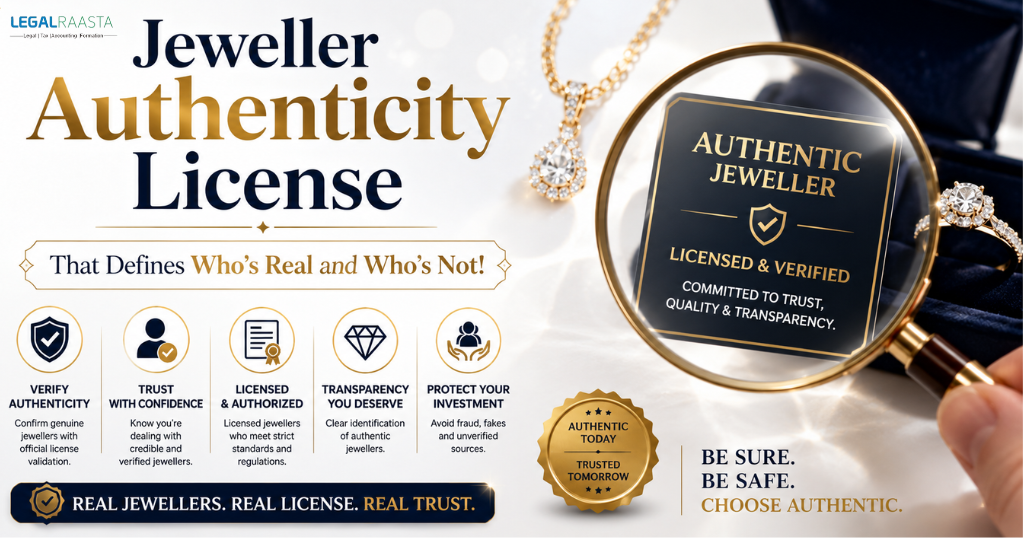
In this wide market, identifying who is real and who is not becomes a very tough task for many customers. During the time of purchasing products, many consumers don’t know which products are genuine and which are not. So, in this case, the authentic jeweller certification helps them in identifying the jewellery that suits their taste, in terms of purity and quality. Thus, in this blog, you will learn about how jeweller authenticity license helps many customers in identifying who’s real and who’s not.
Mainly, there are many types of jewellery in the market. Some are purer in purity, and some are not. So for those pieces of jewellery that are great in quality, a certified jeweler license them with a mark of its logo. Due to which consumers easily see which jewellery products are good and which are not. In order to identify low-quality jewellery, you can check for specific signs in the material, craftsmanship, and accompanying documentation.
Thus, you can easily check the quality of your jewellery piece. If any consumer pays a price for a jewellery item, then they surely believe that they get a good product. Because jewellery items are not only metal, they are pieces that are connected to customers’ emotional feelings.
1. Spot Fake Jewellery Using a Jeweller Authenticity License
Now, learn about some methods by which you can easily identify a good jewellery product and a bad one.
In order to identify the quality of a jewellery product, you can check some signs on your jewellery item, which easily tell you about its quality. Those signs include such material, craftsmanship, and accompanying documentation. By the material of your jewellery item, you can check whether it is made of good material or not. By craftsmanship, you can easily check about its making.
Thus, through these things, you can easily identify your jewellery item. Take a look at some more brief points by which you can become able to identify your jewellery item:
- Material & Finish
- In order to check your jewellery item, you can check its quality marks, such as 10K, 14K, 18K, etc. And in the case of absence of a proper stamp or due to the presence of terms like “GP” and “GF”, it means that your jewellery piece is made up of base metal.
- That jewellery with good quality just feels heavy and dense because of its precious metal feel. And if the jewellery piece feels surprisingly light or hollow, then it means that it is cheaper and of low quality.
- The precious metals like gold, silver, and platinum are not magnetic. And hold a strong magnet to the main body of the piece, but if your jewellery item attracts strongly, it is likely a low-quality metal or plated.
- You can also examine the edges, corners, and areas of high friction for those with different colored metal. Due to which it indicates that thin plating is wearing off, and some patchy plating is an indication of poor quality.
- Additionally, you can assess the quality of your metal by rubbing it and if it becomes slightly warm and then smelling it. If your jewellery piece provides a strong metallic or “penny” smell usually indicates a base material such as brass or copper.
- If your licensed jewellery professional’s product starts causing green marks, rashes, or skin irritation. Then it indicates that it might contain allergens like nickel or copper, common in cheap alloys.
- Seller & Documentation
- When you purchase a jewellery product from a reputable brand. It always provides you with a certificate of authenticity for valuable items, detailing the metal purity, weight, and gemstone specifics. And if the seller hesitates in providing documents, then it means it is a red flag.
- Always try to purchase jewellery items from authorised retailers or trusted jewellers with good customer reviews and a clear, fair return policy. And don’t forget to get an itemised receipt that explicitly states the metal purity.
- Craftsmanship & Design
- Good quality jewellery always holds a smooth, uniform polish and seamless finish. So, you have to look for rough spots, sharp edges, visible glue marks around stones, or poor soldering at joints.
- Instead of using glue, high-quality pieces use secure settings like hooks or bezels. The stones should be symmetrical, of uniform size, and free of air bubbles, scratches, and cloudiness.
2. What Things Distinguish Hallmark Jewellery?
What are those signs by which you can identify BIS hallmark license jewellery? Mainly, to check whether your jewellery item is hallmarked or not, you have to check for some marks and logos of hallmark registration.
A jeweller’s authenticity license provides an official guarantee of purity and quality through the use of stamped marks. Due to which buyers peace of mind that they get the quality paid for, preventing fraud, as well as fostering customer confidence. Also, it allows consumers to easily verify via unique codes like India’s HUID, making it an emblem of sincerity and openness.
Now, take a look at those marks that help you identify your hallmarked jewellery item:
- Fineness and Integrity – Those jewellery products with the mark “22K” (91.6%) or “750” (18K) confirm that the gold in jewellery items is pure and genuine.
- BIS Logo (India) – In terms of identifying hallmarked jewellery, you can check for the Bureau of the Indian Standards (BIS) emblem. That ensures jeweler authenticity license certification by a recognised authority.
- Hallmarking Centre Mark – You can also identify the assaying test centre mark of the jewellery piece.
- Jeweller’s Mark – Also, for checking that your jewellery items are pure, you have to identify a unique mark of the licensed jeweller.
- HUID Number – Each item has a distinct 6-digit alphanumeric identifier that enables online confirmation of its purity and authenticity.
3. Some Steps by Which Hallmarking Centres Identify Poor Jewellery
Learn about those methods by which the authorised centres of jeweller authenticity license identify the low-quality jewellery item.
Mainly, in terms of checking the quality of a jewellery item. The assaying centres use an independent method by which they determine the exact quality of a jewellery item.
Thus, learn about those steps more briefly with the points given below:
- Submission and Sampling – Many jewellery companies submit their jewellery item to an AHC. Where a sample is selected from the batch for testing.
- Purity Testing – Then, the assaying centre starts checking the quality of your jewellery item by using advanced techniques to precisely measure the amount of pure metal.
- Verification and Marking – Then, if the jewellery item meets the specific declared purity standards, such as 91.6% pure for 22K gold, indicated as “916”. Then it is permanently marked with the official jeweller’s authenticity license symbols.
- Identification of Low Quality – If in that case, when the jewellery piece’s content is lower than the quality claimed by the manufacturer/jeweller. The item is marked as low-quality or adulterated. And in many cases, the AHC rejects the product.
4. LegalRaasta’s Hallmarking Makes It Simple to Identify Your Jewellery!
Operating a business is a challenging task, with BIS Hallmark Certificate, ESIC compliance, GST filing and numerous other compliance requirements that are often very time-consuming and complex. Our aims to help its clients stay compliant and mitigate their risk. And utilise their time efficiently so that they can focus on growing their business.
Why Choose LegalRaasta?
- Our employees are only highly trained professionals who understand the laws governing Indian businesses.
- We offer complete, end-to-end solutions to meet all your jeweller authenticity license, ESIC, GST, NBFC Certification, etc., needs.
- We have created a digital platform that provides you with quick, reliable, and paperless compliance.
Take charge of your company’s compliance today! Partnering with us will ensure your business adheres to all laws and continues to grow rapidly and profitably.

Related Posts


Our Clients







Featured In