How to Start a Scrap Business in India: Registration, Investment, Licenses & Profit
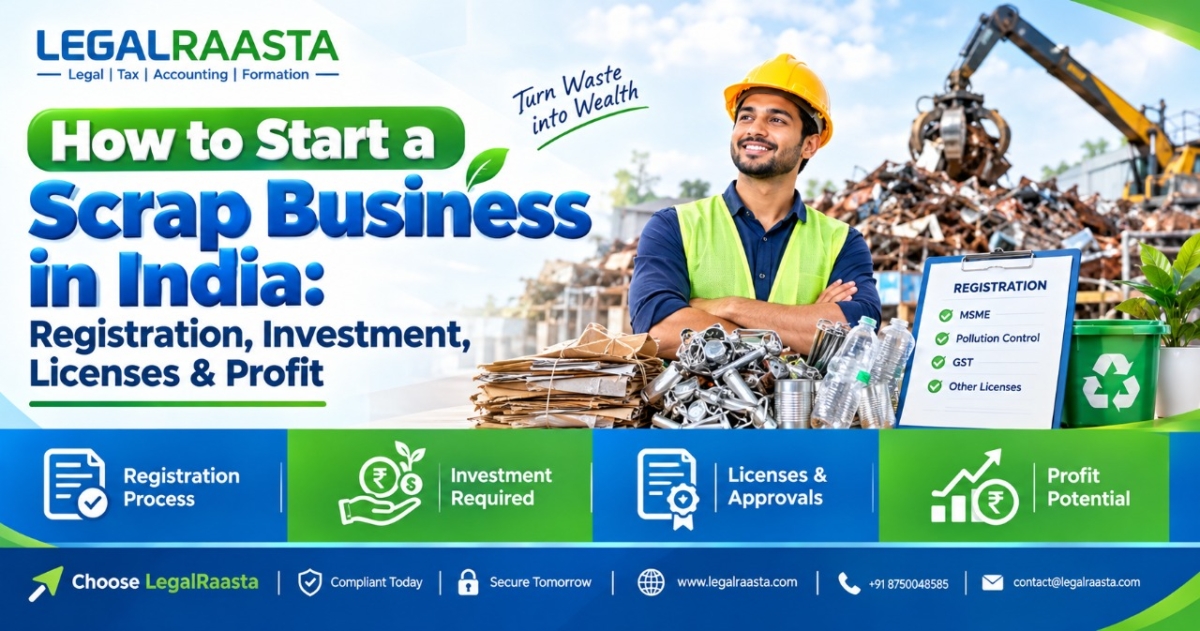
People throw things away every single day. Because of this endless waste, recycling generates massive profits. You can build a Scrap Business in India easily. It requires physical effort. It also demands smart planning. Metal recycling actively saves the earth. Therefore, the Central Pollution Control Board (CPCB) monitors it closely. You must follow their strict environmental guidelines. Ignoring these rules brings heavy fines. Starting out feels slightly complicated at first. Multiple licenses apply to different waste types. However, our team simplifies this entire legal process. Accelerate your growth and protect your operational future effortlessly with LegalRaasta.
Quick Answer / At a Glance
|
Requirement |
Details |
|
Registration Authority |
Local Municipality & State Pollution Boards |
|
Application Portal |
State online portals & CPCB dashboard |
|
Key Documents |
PAN, Owner ID Proof, Rent Agreement, GSTIN |
|
Fees |
Varies widely by state and yard size |
|
Processing Time |
Usually 15 to 30 working days |
|
Eligibility |
Any Indian citizen over 18 years old |
Is the Scrap Business in India Profitable?
Understanding market demand proves why this recycling sector creates massive wealth today.
Metal Scrap Margins
Metals never lose their core value. You can melt iron endlessly. Because of this, scrap metal holds immense financial worth. A scrap dealer business model in India relies heavily on metal. You buy discarded iron from local collectors. Then, you sell it to large smelters. Therefore, your profit depends on daily weight volume. High volume means high cash returns. Aluminum and copper fetch premium market prices. Factories constantly demand cheap raw materials.
Electronic E-Waste Profitability
Computers die quickly these days. Smartphones become outdated every year. This electronic waste contains real gold. It also contains silver and copper. Because these metals are precious, e-waste pays exceptionally well. Many people ask how to start a scrap metal business in India safely. This niche requires deep technical knowledge. You cannot smash batteries openly. Toxic chemicals destroy local groundwater instantly. Therefore, strict government laws restrict random e-waste dismantling. You must operate responsibly.
|
Methodology |
Implementation Time |
Operational Risk |
Resource Efficiency |
|
Metal Scrap |
Quick |
Low |
High |
|
Plastic Recycling |
Medium |
Medium |
Very High |
|
E-Waste Processing |
Slow |
High |
Moderate |
|
Paper Baling |
Fast |
Low |
Low |
Legal Requirements and SPCB/CPCB Authorisation
Securing proper paperwork keeps your recycling yard completely safe from sudden closures.
State Pollution Control Board (SPCB) NOC
Pollution boards hate illegal dump yards. Because untreated waste destroys urban neighborhoods. Therefore, you need a State Pollution Control Board (SPCB) NOC immediately. This certificate proves your operations are safe. You must apply for Consent to Establish first. This allows you to build the yard. Later, you secure Consent to Operate. This lets you actually start sorting waste. Inspectors check your drainage systems thoroughly.
Hazardous Waste Authorization
Car batteries contain dangerous acid. Old fridges leak harmful cooling gases. Because of these dangers, normal licenses fail here. You must obtain specific Hazardous Waste Authorization. This permit allows you to store toxic items safely. The application requires detailed floor plans. You must show proper safety equipment. Therefore, do not skip this crucial environmental step.
EPR (Extended Producer Responsibility) Portal registration
Plastic waste chokes our rivers daily. Because of this crisis, central tracking is mandatory. You must complete EPR registration online. This central dashboard monitors your recycling volume. You log your daily collection numbers here. Honest reporting keeps your license active. Therefore, proper digital registration makes your business perfectly legitimate.
Tax and Trade Licenses for Scrap Dealers
Managing your financial compliance ensures smooth trading across state borders.
GST Registration for scrap dealers
Taxes confuse many new business owners initially. However, you absolutely need GST registration. Recent government changes target scrap sales specifically. You must understand the reverse charge mechanism. Because unregistered purchases now trigger strict tax rules. Buyers must pay a 2% TDS on metal scrap. Therefore, having a valid tax number protects you. It prevents heavy fines during surprise audits.
Local Municipal Trade License
City councils control local commercial activities strictly. You need a municipal trade license to open your gates. Because neighbors often complain about loud metal noises. This license legalizes your physical location. You must submit your rental agreement for this. The local health inspector signs off on it. Therefore, visit your municipal office early.
Shop and Establishment Act Registration
Your workers need basic legal protection. Physical labor involves daily risks. You must secure Shop and Establishment Act Registration quickly. This law dictates standard working hours. It mandates proper wages for your sorting staff. State labor inspectors demand this document. Therefore, display it clearly in your office.
How to Participate in a Government Scrap Auction
Bidding on bulk state materials provides massive inventory for ambitious dealers.
Obtaining an MSTC License for scrap auction
The government scraps old vehicles constantly. Indian Railways discards tons of steel tracks. Because these volumes are huge, they use auctions. Every major government scrap auction in India happens online now. You must acquire an MSTC buyer account. This portal handles all federal waste sales. Registration costs exactly 10,000 rupees plus taxes. You upload your PAN and business details online. Therefore, only verified buyers can enter.
|
Operational Phase |
Expected Duration |
Primary Bottleneck |
Mitigation Strategy |
|
Local Approvals |
15 Days |
Municipal delays |
Apply online early |
|
Tax Registration |
7 Days |
Document errors |
Verify PAN details |
|
Pollution NOC |
30 Days |
Site inspections |
Maintain clean drainage |
|
MSTC Setup |
10 Days |
Fee verification |
Pay via exact NEFT |
Setup, Investment, and Business Registration
Calculating initial expenses helps you plan your financial runway accurately.
Capital Allocation Breakdown
Starting a scrap shop business in India requires minimal cash. You only need basic hand tools. A good weighing scale is your biggest expense. Renting an empty plot costs very little. Drafting a solid scrap yard business plan in India guarantees safety. A proper plan prevents early cash flow problems. However, buying a transport truck increases your budget. Therefore, start small and scale up slowly. You can begin with 50,000 rupees.
Company Formation
Many scrap dealers operate as simple individuals. However, registering a formal company protects you. A private limited structure shields your personal savings. Because business debts stay within the company. Company registration also attracts large factory clients. Factories prefer paying corporate bank accounts. Therefore, formalize your legal structure early.
Udyam MSME Registration
The government supports small business growth. Because small enterprises create thousands of jobs. You should get Udyam MSME Registration immediately. This free certificate unlocks cheap bank loans. It also provides electricity bill subsidies. The online process takes only ten minutes. Therefore, you have no excuse to skip it.
Finding Scrap Buyers and Suppliers
Building a strong network guarantees steady inventory and fast cash flow.
Sourcing Materials
Scrap comes from many different places. Local street collectors bring small daily loads. You pay them instant cash for their goods. Immediate payment ensures they return tomorrow. Additionally, factories generate bulk metal offcuts. Therefore, talk to local factory managers directly. Secure weekly pickup contracts with them.
Selling to Recyclers
You do not melt the metal yourself. Because smelting requires massive industrial furnaces. Your job involves sorting and cleaning the waste. You separate copper from cheap iron. Then, you ship bulk loads to major recyclers. Smelters pay different rates every single day. Because global metal prices fluctuate constantly. You must monitor the daily market rates.
Challenges in Running a Scrap Business
Overcoming daily operational hurdles separates successful yards from failed attempts.
Labor Management
Sorting waste is physically demanding work. Finding reliable workers proves very difficult. Many laborers quit after just one week. Therefore, paying fair daily wages keeps your team loyal. Providing clean drinking water helps immensely. Safety gear like thick gloves is mandatory. Buying strong steel boots protects your staff.
Quality Control Issues
Sellers often mix dirt with heavy metals. They do this to increase the total weight. Because of this trick, you lose money instantly. Therefore, inspecting every single bag is mandatory. Deduct weight for visible dirt or water. Clean scrap fetches much higher market prices. Dirty scrap gets rejected entirely. Your reputation determines your long-term success.
Recent 2026 Policy Updates for Scrap Businesses
Adapting to new government regulations keeps your operations completely penalty-free.
Reverse Charge Mechanism Rules
Tax policies shifted heavily recently. These exact rules apply strongly throughout 2026. The reverse charge mechanism targets unregistered scrap sales. Because the government wants total financial transparency. Registered buyers face a mandatory 2% TDS. Therefore, you must maintain perfect accounting records. Consult a tax expert immediately.
E-Waste Portal Upgrades
The central government updated its tracking dashboard. Now, battery and tyre waste face severe quotas. You cannot fake your daily recycling numbers. Advanced digital audits catch discrepancies instantly. Therefore, honest and timely reporting is mandatory. Protect your license by logging data accurately.
|
Risk Category |
Primary Vulnerability |
Mandatory Control |
Audit Frequency |
|
Structural Risks |
Fire hazards |
Install extinguishers |
Weekly |
|
Compliance Risks |
Expired NOCs |
Track renewal dates |
Monthly |
|
Financial Risks |
Unpaid TDS |
Hire an accountant |
Quarterly |
Conclusion
Starting a Scrap Business in India brings tremendous financial opportunities. Urban areas generate massive waste volumes daily. Scrap recycling actively saves our planet. However, you must secure your legal foundation first. Proper licenses eliminate operational anxiety completely. We handle these complicated registrations for you. You can focus entirely on growing your yard. Looking for a powerful online presence? We also offer elite website development, SEO, and digital marketing services at cloudgeta.com. Accelerate your growth and protect your operational future effortlessly with LegalRaasta.
Frequently Asked Questions About Scrap Business
Answering common queries clears up any remaining operational confusion quickly.
1. How much money do I need for a Scrap Business in India?
A proper scrap yard business plan in India requires minimal setup funds. Because basic hand tools and open land are your only expenses. You can start very small.
2. How to start a scrap metal business in India legally?
A Scrap Business in India needs basic local paperwork. Municipal authorities strictly monitor all neighborhood metal collection activities. You must obtain formal permission before opening your gates.
3. Is scrap business profitable in India right now?
Opening a Scrap Business in India yields excellent profit margins. Because factory demand for recycled metal remains incredibly high everywhere. They constantly buy sorted raw materials.
4. What permits govern a Scrap Business in India?
You must secure a State Pollution Control Board (SPCB) NOC immediately. Otherwise, regulators will quickly shut down your collection yard. Environmental compliance is absolutely non-negotiable today.
5. Does a Scrap Business in India need tax registration?
You absolutely need GST Registration for scrap dealers. Because recent reverse charge rules apply to all metal scrap purchases. The government tracks these specific transactions closely.
6. Can I join a government scrap auction in India easily?
You can enter these bulk auctions for your Scrap Business in India. However, buyers must clear mandatory security checks first. Only verified businesses participate in these bids.
7. Why is an MSTC License for scrap auction necessary?
This license lets your Scrap Business in India buy railway materials. Because only authorized bidders access these exclusive government items. It acts as your official entry pass.
8. Does a Scrap Business in India handle toxic batteries?
You must hold Hazardous Waste Authorization for toxic items. Because processing batteries without permission violates strict environmental protection laws. You must store them very carefully.
9. What is the most successful scrap dealer business model in India?
Supplying factories directly works best for a Scrap Business in India. Because B2B sales guarantee heavy volume and steady revenue. You avoid unpredictable retail market fluctuations completely.
10. Can I open a Scrap Business in India without informing authorities?
You must get Shop and Establishment Act Registration immediately. Because local inspectors heavily fine unregistered commercial yards without hesitation. Operating illegally ruins your long-term growth chances.
Related Posts



Our Clients





Featured In