Drone Registration in India 2026: eGCA UIN Process, Documents, Fees & Rules
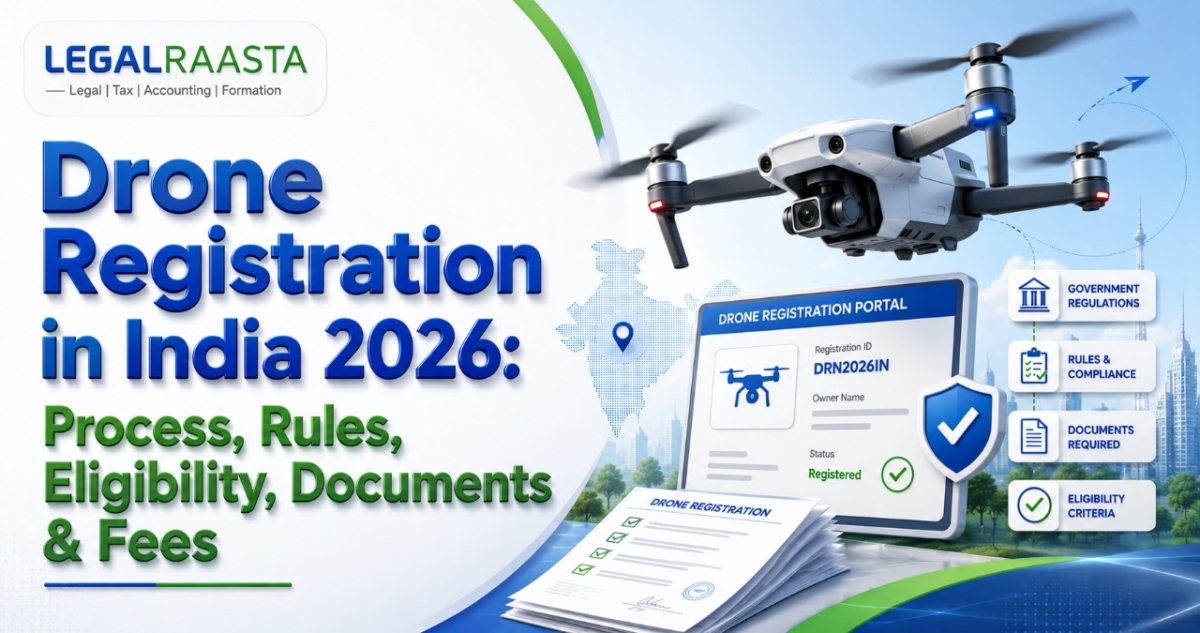
Drones aren’t just toys anymore. They map farm plots in Punjab, inspect power grids in Maharashtra, and shoot commercial films in Mumbai. Flying one without official clearance gets your gear seized under the Bharatiya Vayuyan Adhiniyam 2024 and Drone Rules 2021. If you operate an unmanned aircraft in India this year, getting drone registration in India isn’t optional. Civil aviation authorities monitor local airspace tightly, and LegalRaasta helps operators navigate the government paperwork without project delays.
Quick Answer: Drone Registration at a Glance
|
Compliance Parameter |
Official Requirement / Standard |
|
Registration Authority |
|
|
Primary Registration Portal |
eGCA Portal (https://www.dgca.gov.in/digigov-portal/jsp/dgca/common/login.jsp) |
|
Airspace Permission Portal |
DigitalSky Platform (digitalsky.dgca.gov.in) |
|
Official Identification |
15-digit Unique Identification Number (UIN) |
|
Statutory Government Fee |
₹100 per drone (payable via Bharatkosh) |
|
Average Processing Time |
1 to 3 working days |
|
Code Validity |
Lifetime (until ownership transfer or deregistration) |
|
Mandatory Verification Documents |
Aadhaar Card, PAN Card, Purchase Invoice, Chassis Tag Photo |
What Is Drone Registration in India?
Drone registration assigns a mandatory 15-digit Unique Identification Number (UIN) to your drone frame via DGCA’s eGCA portal. Think of it as a digital license plate. It links the physical hardware directly to your legal identity or company profile so law enforcement can identify who’s in the sky. Operating an unregistered drone anywhere in India is illegal.
Is Drone Registration Mandatory in India?
Yes, for almost everyone. If your drone weighs more than 250 grams, you need a UIN before spinning its propellers outdoors.
The only exception is Nano drones under 250 grams flown purely for fun inside Green Zones. The minute you slap a camera on that same Nano drone to shoot a paid wedding or commercial ad, the exemption vanishes, and you need a UIN immediately.
Latest Drone Registration Updates in India – 2026
India updated its aviation laws by replacing the old Aircraft Act 1934 with the Bharatiya Vayuyan Adhiniyam 2024.
Along with this legislative shift, DGCA migrated all administrative filings—Forms D-1 through D-5, including UIN issuance (Form D-2) and Remote Pilot Certificates (Form D-3)—entirely onto the eGCA portal. DigitalSky isn’t where you apply for registration anymore. It now functions solely as the operational map for airspace clearances.
eGCA vs DigitalSky Platform for Drone Services
Mixing up eGCA and DigitalSky is the easiest way to waste an afternoon. eGCA handles administrative paperwork and approvals; DigitalSky handles live flight permissions and maps.
|
Feature / Service |
eGCA Portal (https://www.dgca.gov.in/digigov-portal/jsp/dgca/common/login.jsp) |
DigitalSky Platform (digitalsky.dgca.gov.in) |
|
Primary Function |
Administrative licensing, UIN issuance & profile audits |
Airspace zone mapping & operational permissions |
|
UIN Application (Form D-2) |
Active Portal (Filing, fee payment & certificate download) |
Retired (Redirects to eGCA) |
|
Type Certification (Form D-1) |
Active Portal (Manufacturer & importer registration) |
Retired |
|
Pilot Certification (Form D-3) |
Active Portal (RPC generation & RPTO listings) |
Retired |
|
Airspace Operations |
Profile repository |
Interactive Green, Yellow, and Red Zone map |
|
NPNT Verification |
Hardware serial synchronization |
Real-time digital permission request processing |
Drone Categories and Classification in India
DGCA splits drones into five categories based on Maximum All-Up Weight (MAUW). Your weight tier dictates whether you need a pilot certificate, where you can fly, and how high you can go.
|
Drone Category |
Weight Limit |
UIN Mandatory? |
Remote Pilot Certificate? |
Max Permitted Altitude |
|
Nano |
Up to 250g |
Exempt (Recreational only) |
Not required |
50 feet |
|
Micro |
250g to 2kg |
Mandatory |
Mandatory for commercial |
200 feet |
|
Small |
2kg to 25kg |
Mandatory |
Mandatory |
400 feet |
|
Medium |
25kg to 150kg |
Mandatory |
Mandatory |
400 feet |
|
Large |
Above 150kg |
Mandatory |
Mandatory |
400 feet |
Who Needs to Register a Drone in India?
If you fit into any of these buckets, you need a UIN on eGCA before taking off:
- Individual Hobbyists: Anyone flying a Micro drone or larger in open spaces.
- Commercial Photographers: Wedding filmmakers, real estate videographers, and news crews.
- Agricultural Operators: Teams running crop-spraying or field-mapping setups.
- Survey & Inspection Firms: Mining, highway, and real estate assessment teams.
- Logistics & Delivery Testers: Transport firms running trial deliveries under experimental permits.
- R&D Labs: University teams and tech startups testing hardware prototypes.
- Importers & Manufacturers: Businesses selling drone hardware in India.
Why Compliance is Complex
Registering a drone sounds simple until you hit the backend details. Matching chassis serial numbers to tax invoices, getting manufacturer Type Certificates for imported gear, and navigating eGCA’s e-KYC integration trip up dozens of applicants weekly. One minor typo on your Flight Control Module serial string will trigger a complete portal rejection.
Documents Required for Drone Registration
Gather these files in PDF format before opening the eGCA portal:
- Identity Proof: Aadhaar Card, PAN Card, or Passport (for individual owners or corporate directors).
- Address Proof: Voter ID, electricity bill, or registered rent agreement.
- Purchase Invoice: Original tax invoice showing the seller’s GST details and purchase date.
- Hardware Serials: Clear record of serial numbers for the chassis, Flight Control Module (FCM), and Remote Pilot Station (RPS).
- Chassis Photo: Close-up photo showing the serial number permanently stamped on the frame.
- Technical Spec Sheet: Document listing Maximum All-Up Weight (MAUW) and battery parameters.
- Business Proof: Certificate of Incorporation, Board Resolution (for company filings), and GST Registration.
- Type Certificate: Copy of Form D-1 approval issued to the manufacturer (required for commercial Micro, Small, Medium, and Large models).
Step-by-Step Drone Registration Process on eGCA
Here is the exact portal workflow from start to finish:
Step 1: Portal Access
Head to https://www.dgca.gov.in/digigov-portal/jsp/dgca/common/login.jsp.
Step 2: Account Creation
Click “Get eGCA ID” and select your profile type (Individual or Operator Entity).
Step 3: Identity Verification
Run e-KYC using Aadhaar OTP or company PAN/MCA database validation.
Step 4: Open Form D-2
Go to “Drone Services” on your dashboard and select “Application for UIN (Form D-2)”.
Step 5: Fill in Hardware Specs
Enter manufacturer name, model, chassis serial, FCM serial number, and weight specs.
Step 6: Document Upload
Attach PDF scans of your invoice, chassis photo, and ID proofs.
Step 7: Pay Fee
Pay the ₹100 government fee through the integrated Bharatkosh portal.
Step 8: Download UIN
Once DGCA verifies the filing (takes 1 to 3 business days), download your 15-digit UIN certificate.
|
Application Phase |
Operational Step |
Expected Duration |
Common Bottleneck |
Recommended Solution |
|
Profile Creation |
eGCA Registration & KYC |
1 Day |
Aadhaar Name mismatch |
Ensure eGCA profile name matches Aadhaar exactly |
|
Data Filing |
Form D-2 Submission on eGCA |
1 Day |
Serial number typos |
Cross-check FCM and chassis numbers with invoice |
|
Fee Payment |
Bharatkosh Gateway Transaction |
Same Day |
Session timeout during payment |
Use verified net banking or UPI accounts |
|
Approval |
DGCA Portal Audit |
1 to 3 Days |
Missing Type Certificate link |
Verify the drone model is on the DGCA-approved list before buying |
DIY vs Expert Registration Comparison
|
Parameter |
DIY Registration |
LegalRaasta Expert Support |
|
Document Verification |
Self-checked (High risk of serial typos) |
Audited by aviation legal team before upload |
|
Portal Navigation |
Manual trial & error on eGCA |
End-to-end management by dedicated expert |
|
Rejection Handling |
User must resubmit and re-file |
Zero-rejection workflow with pre-vetted data |
|
Turnaround Time |
5 to 10 days (if corrections needed) |
1 to 3 working days |
Unique Identification Number (UIN) Explained
Your UIN acts as a digital identity tag tied directly to that single drone chassis. You must engrave or print the 15-digit code onto a fire-resistant plate and fix it securely to the main frame before flying. If you sell the drone, crash it beyond repair, or lose it, you have 30 days to update eGCA via Form D-2 to transfer or cancel the record.
What Happens If You Don’t Comply?
Flying without a UIN isn’t just an administrative slip—it’s a law enforcement trigger. Local police departments cross-check drone serials on-site using central database access. If caught, your drone gets impounded immediately, your eGCA profile gets blacklisted, and you face fines up to ₹1,00,000 under the Drone Rules 2021.
Drone Registration Fees and Government Charges
Government statutory fees are minimal:
|
Service Category |
Relevant eGCA Form |
Statutory Government Fee |
Professional Support Fee |
Code Validity |
|
UIN Registration |
Form D-2 |
₹100 |
Varies by consultancy |
Lifetime |
|
Type Certification |
Form D-1 |
₹100 |
Custom enterprise quote |
Permanent per model |
|
Remote Pilot Certificate |
Form D-3 |
₹100 |
N/A (Training school fee separate) |
10 Years |
|
UIN Transfer / Cancellation |
Form D-2 |
₹100 |
Varies by service scope |
One-time execution |
Drone Registration for Commercial Use in India
Flying for money adds extra compliance layers. You must hold a Remote Pilot Certificate (RPC) issued via eGCA, buy third-party liability insurance covering property damage and injury, and log every mission. Before taking off, check DigitalSky for airspace clearance. Registered commercial businesses can also obtain MSME Registration to tap into government drone technology subsidies.
Drone Registration vs Drone License vs RPC vs Type Certificate
People throw these terms around interchangeably, but aviation law treats them as completely different approvals:
|
Compliance Term |
Focus Area |
Issued To |
Purpose & Key Role |
|
Drone Registration (UIN) |
Equipment Tagging |
Specific Drone Chassis |
Links physical hardware to its legal owner via eGCA |
|
Remote Pilot Certificate (RPC) |
Operator Competency |
Individual Pilot |
Validates flight skills and safety training via approved RPTO |
|
Type Certificate (TC) |
Hardware Design |
Manufacturer / Importer |
Confirms model design meets DGCA airworthiness standards |
|
Drone License |
Informal Term |
General Operator |
Everyday phrase referring to an RPC or UIN |
Drone Flying Rules and Airspace Restrictions in India
Green, Yellow, and Red Airspace Zones
DigitalSky splits Indian airspace into three clear operational zones:
- Green Zone: Uncontrolled airspace up to 400 feet. Registered drones under 500kg fly here without prior flight permissions.
- Yellow Zone: Controlled airspace near airports and sensitive sites. Flying here requires Air Traffic Control permission via DigitalSky.
- Red Zone: Strictly off-limits airspace around military bases and international borders. Takes defense ministry clearance to enter.
No-Permission-No-Takeoff (NPNT) Requirements
NPNT is built straight into compliant drone firmware. Before the motors arm in restricted zones, the drone checks DigitalSky for a digital permission artifact. No permission? Motors won’t spin.
Common Filing Mistakes
Rejections usually happen because of small, avoidable errors:
- Mismatching chassis or FCM serial numbers with tax invoice numbers.
- Registering eGCA profiles with names that don’t match Aadhaar records word-for-word.
- Uploading blurry or cropped photos of chassis serial tags.
- Trying to register imported drones that lack a DGCA Type Certificate.
- Forgetting corporate board resolutions for company accounts.
Penalties for Non-Compliance and Unregistered Flying
Aviation authorities enforce strict financial and legal penalties against unauthorized drone flights under the Bharatiya Vayuyan Adhiniyam 2024 and Drone Rules 2021.
|
Violation Category |
Governing Law / Regulation |
Statutory Fine |
Additional Legal Penalties |
|
Unregistered Flight (No UIN) |
Drone Rules 2021 |
Up to ₹1,00,000 |
Immediate equipment confiscation |
|
Unauthorized Red Zone Flight |
Bharatiya Vayuyan Adhiniyam 2024 |
Up to ₹1,00,000 |
Imprisonment for up to 2 years |
|
Flying Without RPC Certificate |
Drone Rules 2021 |
Up to ₹50,000 |
Suspension of operator eGCA profile |
|
Bypassing NPNT Firmware |
Bharatiya Vayuyan Adhiniyam 2024 |
Up to ₹1,00,000 |
Permanent ban & criminal prosecution |
How to Transfer Ownership or Update Drone UIN Records
Selling your drone? Log in to eGCA, open Form D-2, and start a transfer request. The buyer has 30 days to accept it on their eGCA dashboard. If your drone gets destroyed or lost, submit a deregistration request on eGCA immediately—otherwise, you remain legally responsible for anything done with that hardware serial.
How LegalRaasta Can Help With Drone Registration
Filing government forms shouldn’t stall your business. LegalRaasta manages your entire drone compliance setup from eGCA account verification to Form D-2 filing and final UIN delivery. Our legal team also assists drone companies with Private Limited Company Incorporation, Import Export Code Compliance, Trademark Registration, and GST compliance.
Conclusion
Maintaining regulatory compliance keeps your equipment in the air and out of police impound lots. Securing your official identification number on eGCA protects your business from costly statutory penalties and operational halts. LegalRaasta makes the entire process fast, accurate, and completely hassle-free.
Frequently Asked Questions
1. Is Drone Registration in India mandatory for all operators?
Yes, any drone weighing over 250 grams requires registration on the eGCA portal before flying outdoors in Indian airspace.
2. How do I apply for a Unique Identification Number online?
Create an eGCA ID at dgca.gov.in/digigov-portal, submit Form D-2 with your hardware details, and pay ₹100 via Bharatkosh.
3. What documents are needed for Drone Registration in India?
You need identity proof, address proof, tax purchase invoice, and clear photographs of the chassis serial number for Form D-2 processing on eGCA.
4. What is the official government fee for Drone Registration in India?
The government charges a statutory fee of ₹100 per drone, payable online via Bharatkosh during eGCA filing.
5. Do Nano drones require Drone Registration in India?
Recreational Nano drones are exempt. Commercial Nano drones require registration along with a valid Type Certificate approval on eGCA.
6. How do I apply for a Remote Pilot Certificate online?
Register on eGCA, complete training at a DGCA-authorized flight school, pass tests, and download your RPC directly from the eGCA portal.
7. What is the penalty for flying without completing Drone Registration in India?
Flying an unregistered drone leads to fines up to ₹1,00,000 under DGCA Drone Rules, along with potential equipment confiscation.
8. How do I verify airspace restrictions for Green Zone flying?
Check the interactive airspace map on the DigitalSky platform after finishing registration to view current flight boundaries.
9. Can foreign nationals complete Drone Registration in India directly?
Foreign nationals cannot register directly. They must operate through an Indian business entity registered on eGCA.
10. Where can commercial operators complete Drone Registration in India?
Enterprise users submit fleet applications (Form D-2) on the eGCA portal after completing corporate background verification.
11. What software protocol is required for No-Permission-No-Takeoff compliance?
Registered drone firmware automatically connects with DigitalSky to request digital flight permissions before arming motors in restricted zones.
12. How long does Drone Registration in India take to complete?
Portal verification and Form D-2 approval on eGCA usually take 1 to 3 working days after uploading verified documents.

Related Posts




Our Clients




Featured In