
Internal Audit vs Statutory Audit in India (2026): Key Differences & Compliance
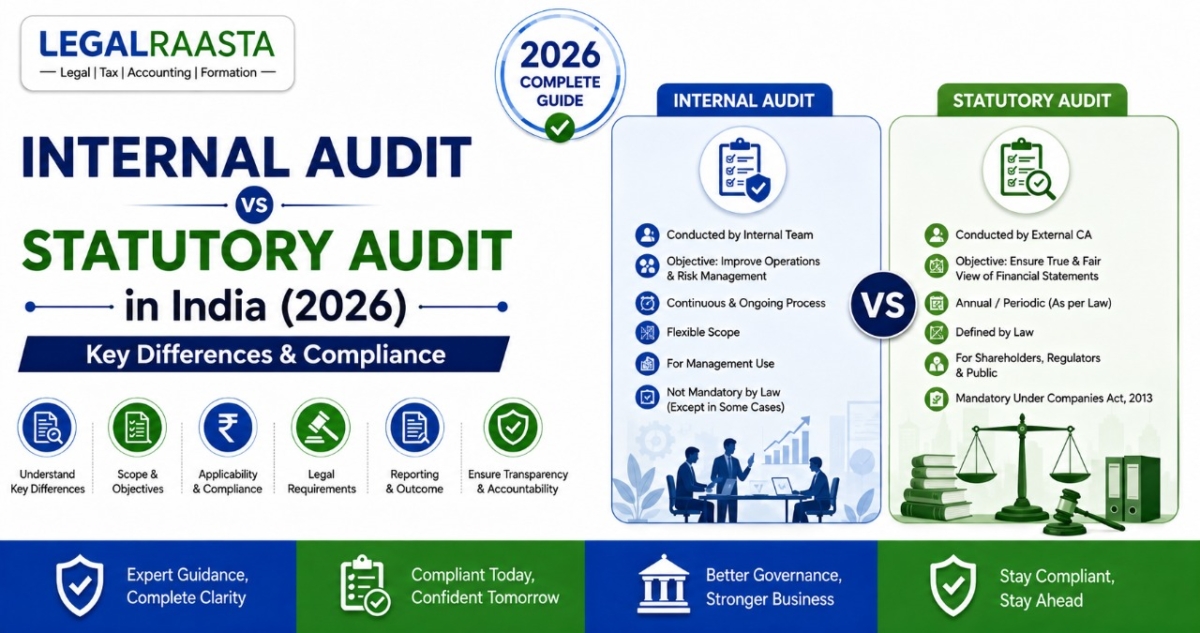
Business owners constantly confuse basic financial checkups. You run a company in India. Eventually, you need to verify your accounts. Two major reviews come to mind immediately. People debate Internal Audit vs Statutory Audit constantly. Which one actually applies to your specific setup? Some firms need both immediately. Others just need one to survive. Missing these basic deadlines triggers heavy fines today. The Ministry of Corporate Affairs (MCA) tracks defaults extremely closely in 2026. Therefore, you must understand your exact compliance burden right now. An internal review improves your daily operations from the inside.
Meanwhile, a statutory check proves your legal standing to the government. We will break down exactly what you need. Because confusing these two can freeze your bank accounts overnight. Startups often ignore this reality completely. They assume their CA handles everything automatically behind the scenes. This assumption destroys businesses fast. As a director, you are personally liable. Stop guessing about financial compliance. Let the experts at LegalRaasta handle your corporate auditing needs effortlessly.
Quick Answer: Internal Audit vs Statutory Audit Compliance At a Glance (2026)
Knowing the basic rules helps you avoid sudden notices.
|
Requirement |
Internal Review |
Statutory Review |
|
Governing Law |
Section 138, Companies Act |
Section 139, Companies Act |
|
Primary Goal |
Improve operational efficiency |
Verify financial accuracy |
|
Who Conducts |
Internal team or external CA |
External independent CA only |
|
Report Goes To |
Company Management |
Shareholders and MCA |
|
Frequency |
Continuous or Quarterly |
Annually |
|
Portal Used |
Internal company servers |
MCA V3 Portal (AOC-4) |
What Is an Internal Audit?
Understanding your internal controls helps prevent massive operational failures.
Objectives and Daily Scope
Management often starts this voluntarily. Sometimes the law forces it. Either way, it finds flaws in your workflows fast. The reviewer checks your internal controls closely. They flag fraud risks before money disappears. The board gets actionable insights directly from the floor. The scope depends entirely on management needs. You dictate what they examine today. They might check your factory inventory. They might review your new payroll software. Nothing is off-limits here.
Core Areas Checked Internally
Your management decides where to point the magnifying glass.
|
Department |
Common Checks |
Risk Mitigated |
|
HR & Payroll |
Ghost employees, overtime fraud |
Financial leakage |
|
Inventory |
Stock mismatch, theft, damage |
Asset loss |
|
IT Systems |
Software access, data backups |
Cyber threats |
|
Procurement |
Vendor pricing, fake invoices |
Bribery and overpayment |
Who Conducts the Internal Review?
The law provides massive flexibility here. You can literally hire an internal employee. You can hire an external consulting firm. They do not even need to be a Chartered Accountant. Cost accountants can do this job perfectly. Even seasoned operational managers qualify for this role. The board decides who fits best. They look at raw industry experience. They look at analytical skills over degrees.
2026 Applicability in India
Unlisted companies face specific thresholds today. Does your turnover cross ₹200 crore? You must conduct one immediately. Paid-up capital over ₹50 crore triggers this too. Outstanding loans exceeding ₹100 crore mandate an internal auditor. You cannot ignore these limits. The government tracks your bank exposure.
What Is a Statutory Audit?
Proving your financial honesty to the government requires strict external verification.
Core Legal Requirements
The law demands this yearly check without exception. You cannot skip it ever. An independent Chartered Accountant must review your books. They ensure strict legal compliance. They check if your balance sheet reflects reality. Investors trust your numbers purely because of this. The public relies on this exact report. Banks ask for it before approving loans.
Mandatory Verification Documents
The external checker demands specific paperwork before starting.
|
Document Type |
Purpose for Verification |
|
Bank Statements |
Prove cash balances and match transactions |
|
Vendor Invoices |
Verify expense claims and GST credits |
|
Board Minutes |
Confirm management decisions legally |
|
Asset Register |
Calculate accurate depreciation values |
Who Conducts the Statutory Review?
The rules are extremely strict here. Only a practicing Chartered Accountant qualifies. They must hold a valid certificate of practice actively, they cannot be your employee, they cannot hold shares in your company. Independence is absolutely mandatory. This prevents biased financial reporting. The auditor must remain neutral.
Applicability for Private Companies
Every single registered company needs this process. Private limited companies must comply. One Person Companies (OPCs) must comply too. Turnover does not matter here. Profitability does not matter at all. If you incorporate it, you audit it. Zero revenue still requires a formal audit.
Internal Audit vs Statutory Audit: Core Differences
Comparing these two processes reveals completely different end goals.
Business leaders must look at the legal weight of both.
|
Feature |
Internal Setup |
Statutory Setup |
|
Appointment |
By Board of Directors |
By Shareholders in AGM |
|
Auditor Type |
Employee or External CA |
Strictly External CA |
|
Scope Output |
Defined by Management |
Defined by Law |
|
Format |
Flexible suggestions |
Strict statutory format |
|
Submission |
Board of Directors |
MCA Portal |
Legal Applicability Matrix for Indian Companies (2026)
Knowing your exact financial thresholds prevents sudden regulatory notices. You must track your revenue numbers daily. Crossing specific limits changes your compliance burden instantly.
|
Company Type |
Internal Review |
Statutory Requirement |
|
Listed Companies |
Always Mandatory |
Always Mandatory |
|
Unlisted Public |
Turnover > ₹200 Cr |
Always Mandatory |
|
Loans > ₹100 Cr |
Always Mandatory |
|
|
Not Mandatory |
Turnover > ₹40 Lakhs |
Recent Regulatory Updates for Internal Audit vs Statutory Audit 2026
The government constantly tweaks how companies report their data online.
The MCA V3 portal rollout changed everything. Older manual processes no longer exist. The government now uses AI to cross-check your filings automatically. If your GST returns do not match your audited balance sheet, the system flags you. The portal generates automated notices now. Also, audit trails in accounting software are strictly mandatory for 2026. You cannot delete old ledger entries without leaving a digital footprint. External reviewers check this software log first.
Internal Audit vs Statutory Audit: Report Structures
Different audiences need completely different data formats. Auditors write reports differently based on the end user.
|
Report Section |
Internal Findings |
Statutory Report |
|
Executive Summary |
Focuses on operational risks |
Focuses on financial truth |
|
Format Style |
Bullet points and graphs |
Standard ICAI paragraphs |
|
Action Plan |
Mandatory for management |
Not required by law |
|
Risk Rating |
High, Medium, Low flags |
Pass or Fail opinion |
Roles and Responsibilities Compared
The people conducting these checks carry very different burdens. Knowing who does what stops internal fighting during compliance season.
|
Task Category |
Internal Reviewer Duty |
Statutory Reviewer Duty |
|
Fraud Catching |
Actively hunt for employee theft |
Report material fraud if found |
|
Policy Checking |
See if staff follow company rules |
See if the firm follows tax laws |
|
Future Planning |
Suggest better business processes |
Only review past historical data |
|
Tax Verification |
Check internal GST calculations |
Verify final tax payouts |
The Practical Filing Workflow
Submitting your final reports involves strict portal navigation.
Step-by-Step Filing Process for Internal Audit vs Statutory Audit
You cannot just email a PDF to the government anymore. You must follow the digital path.
- Hold a board meeting to recommend an external CA.
- Get written consent from the chosen CA.
- Appoint the auditor using Form ADT-1 within 15 days.
- The auditor verifies all financial vouchers.
- They generate the independent report.
- Management signs the financial statements.
- Upload Form AOC-4 to the MCA portal.
- Do this within 30 days of the AGM.
Expected Processing Timelines
Planning your dates prevents last-minute portal crashes.
|
Stage |
Expected Duration |
Primary Bottleneck |
|
Data Gathering |
10 to 15 Days |
Missing vendor invoices |
|
CA Verification |
7 to 10 Days |
Unreconciled bank entries |
|
Report Drafting |
3 to 5 Days |
Waiting for director signatures |
|
MCA Uploading |
1 Day |
V3 portal server glitches |
Government Processing Time
You submit the forms online. The MCA portal generates a receipt immediately. Straight Through Processing approves standard filings instantly. Non-STP forms take much longer. Manual verification takes 15 to 30 days. Complex cases might take three months. Track your SRN number daily. Respond to MCA queries within 15 days. Common rejection reasons include mismatched DIN numbers. Invalid digital signatures cause instant failure too.
Common Challenges and Compliance Risks
Data collection usually breaks down right before the deadline.
Founders struggle to find old bills. They forget to record small cash payments. The CA demands proof for every single transaction. This creates massive friction between the business owner and the auditor. Reconciling vendor ledgers takes weeks if you ignored it all year. Missing MSME payment details is a huge trap in 2026. If you pay small vendors late, the auditor reports it. The government disallows that expense for tax purposes.
Risk Mitigation Strategy
Fixing problems early stops the CA from issuing a negative report.
|
Risk Category |
Primary Vulnerability |
Mitigation Action |
|
Missing Data |
Lost physical bills |
Switch to cloud accounting |
|
Late Filing |
Waiting till September |
Start data prep in April |
|
Signature Fail |
Expired DSC tokens |
Renew tokens in advance |
Why Compliance is Complex & Common Mistakes
Navigating financial regulations often traps inexperienced founders.
Business owners make simple mistakes daily. They mix personal and business expenses constantly. Auditors flag these transactions immediately. Companies forget to depreciate assets correctly. They delay the formal appointment entirely. You must file ADT-1 quickly. Delaying this invites daily late fees. Founders think paying the CA solves the problem. But if you give the CA garbage data, you get a garbage report.
Penalties for Default
Ignoring these rules destroys your business fast. The government blocks your company from functioning.
|
Violation |
Penalty Amount |
Consequence |
|
No Annual Check |
₹1 Lakh to ₹5 Lakhs |
Director disqualification |
|
Late Form Filing |
₹100 per day |
MCA portal block |
|
Fraud Reporting |
3x the fraud amount |
Jail up to 10 years |
|
Ignoring Limits |
Up to ₹10,000 daily |
Bank account freeze |
DIY vs Expert Compliance Help
Handling strict government forms alone often leads to disastrous technical rejections. Founders try saving money initially. They do the paperwork themselves. They try navigating the MCA portal. This backfires quickly.
|
Feature |
DIY Filing |
LegalRaasta Experts |
|
Accuracy |
High risk of errors |
100% compliant |
|
Time Spent |
Weeks of research |
Done in days |
|
Penalty Risk |
Extremely high |
Zero late fees |
|
Portal Work |
Confusing MCA glitches |
Handled smoothly |
How LegalRaasta Helps with Audits
Partnering with professionals removes the stress of government deadlines.
You should not handle MCA portals alone. We simplify the entire compliance journey. LegalRaasta provides completely end-to-end solutions. We handle the paperwork. We track the deadlines automatically. You focus on growing your actual business. Our experts understand every single nuance of Internal Audit vs Statutory Audit perfectly. We prevent costly daily penalties, we assign a dedicated manager to collect your data, we coordinate with the CA directly, we clear the technical hurdles so your filing gets approved the very first time.
Conclusion
Staying compliant requires constant vigilance today. Indian corporate laws change very frequently. You must track your turnover closely. You must watch your loan limits. Understanding Internal Audit vs Statutory Audit protects your hard-earned revenue. Missing these government deadlines causes immense stress. The MCA portal does not forgive late filings. Therefore, proactive financial hygiene is your only real defense against fines. A good internal check fixes your daily flaws. A solid external report builds massive trust with investors.
Do not wait for a sudden regulatory notice to act. Build a compliant business foundation right now. Protect your startup from forced closure. Keep your directors completely out of legal trouble. Accelerate your growth and protect your operational future effortlessly with LegalRaasta.
Frequently Asked Questions (FAQs)
1. What is the main point of Internal Audit vs Statutory Audit?
The former fixes daily operations and finds fraud early. The latter ensures strict government compliance and accuracy. You must follow the Companies Act 2013 audit rules for external checks. This protects your investors and avoids heavy penalties from regulatory bodies.
2. How does statutory audit applicability 2026 affect new startups?
Every single registered private company must undergo this yearly external check regardless of revenue. When looking at Internal Audit vs Statutory Audit, tiny startups usually only need the external one. Internal checks only trigger at high turnover limits.
3. Do we need a specific company auditor appointment for both reviews?
Yes, you appoint them formally using entirely different procedures. For Internal Audit vs Statutory Audit, your board of directors picks the internal reviewer. However, your company shareholders must officially approve the external reviewer during the Annual General Meeting.
4. What happens if I ignore the Internal Audit vs Statutory Audit rules?
You face severe financial hits directly from the government. The penalty for non-compliance with audit requirements includes brutal fines up to ₹5 Lakhs. Directors might even face personal jail time for serious financial misreporting or ignoring MCA deadlines.
5. How do I maintain good financial compliance India status yearly?
You must file your AOC-4 forms on time without errors. Understanding Internal Audit vs Statutory Audit helps you prepare data early. Hire professionals to track your specific revenue thresholds so you never accidentally miss a newly triggered requirement.
6. Does the MCA V3 portal handle Internal Audit vs Statutory Audit filings?
The portal strictly handles the external reporting side. You must upload Form AOC-4 and ADT-1 there. Internal reviews stay within your company servers. The government does not require you to upload internal management findings to their public database.
7. Can the same Chartered Accountant perform both tasks?
No, the law forbids this completely. Evaluating Internal Audit vs Statutory Audit shows a massive conflict of interest. An independent professional must handle the external portion to ensure total transparency. Your internal reviewer cannot grade their own work.
8. Does CARO 2026 applicability change how we view these reviews?
Yes, the recent order adds extra mandatory reporting layers. It changes the Internal Audit vs Statutory Audit dynamic significantly. The external reviewer must now report on inventory, bank loans, and specific government dues much more rigorously than before.
9. Which process requires formal AOC-4 filing?
Only the external process requires this specific government form. When comparing Internal Audit vs Statutory Audit, the external check concludes with uploading your balance sheet to the government portal. Internal findings simply go to your local board members.
10. Are internal audit requirements in India the same for everyone?
No, they only apply to larger corporate entities. You must check Internal Audit vs Statutory Audit limits closely. Private companies need internal checks only if their turnover crosses ₹200 crore or outstanding bank loans exceed ₹100 crore today.

Related Posts




Our Clients








Featured In