
GOBARdhan Scheme 2026: Complete Guide to CBG, Biogas, Benefits & Government Support
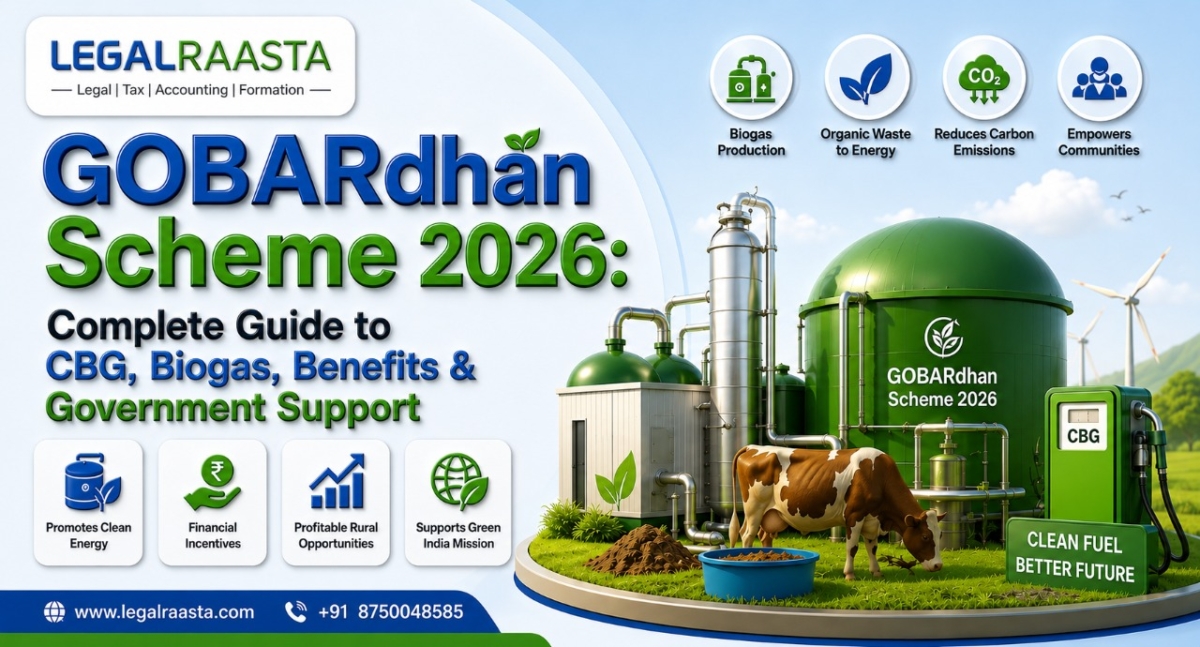
On August 6, 2026, the Union Cabinet approved the biggest biogas investment India has ever seen. The GOBARdhan Scheme, now formally the National Circular Bioenergy Scheme, received a total outlay of Rs 23,731 crore. The scheme runs from FY 2026-27 to FY 2035-36. Its target is to grow India’s Compressed Biogas production nearly ten times from where it stands today. GOBARdhan stands for Galvanising Organic Bio-Agro Resources Dhan. The idea is straightforward: India generates enormous volumes of cattle dung, agricultural residue, crop stubble, municipal organic waste, and press mud. All of that currently goes to waste or causes pollution. The GOBARdhan Scheme converts it into clean fuel, organic fertilizer, and rural income.
Earlier, the CBG ecosystem was scattered across four different ministries. The August 2026 approval consolidated everything under the Ministry of Petroleum and Natural Gas with one unified framework covering demand, pricing, capital support, pipeline, credit, and ecosystem development. LegalRaasta helps farmers, MSMEs, entrepreneurs, and cooperatives navigate the registration, licensing, and compliance steps needed to participate in the GOBARdhan Scheme and set up CBG or biogas projects legally.
What Is the GOBARdhan Scheme and What Changed in 2026?
The GOBARdhan Scheme was originally launched in 2018 under Swachh Bharat Mission (Grameen) as part of Solid and Liquid Waste Management. Back then, it focused on village-level biogas plants for cleanliness and waste management. Small scale. Fragmented.
The 2026 version is a completely different animal. The August 2026 Cabinet approval turned GOBARdhan into a national-scale CBG industry development programme. Six components now work together under one framework:
|
Component |
What It Does |
|
Assured CBG Offtake |
City Gas Distribution entities must buy CBG under a dedicated framework |
|
Stable CBG Pricing |
Administered price of Rs 2,110 per MMBTU, guaranteed for a minimum of 10 years |
|
Capital Assistance |
Up to Rs 2 crore per tonne per day (TPD) for eligible greenfield projects |
|
Pipeline Infrastructure |
Cluster-based and standalone pipelines connecting CBG plants to CGD networks |
|
Credit Guarantee |
Up to 85% coverage on eligible loans for MSME-based CBG projects |
|
CBG Ecosystem Challenge Fund |
District-level planning, feedstock mapping, technology adoption, capacity building |
Each component solves a problem that killed earlier CBG projects. No guaranteed buyer, no predictable price, no access to bank loans, no pipeline to move the gas. The 2026 GOBARdhan Scheme addresses all of these at once.
GOBARdhan CBG Blending Obligation: The Guaranteed Market
This is the part that makes the economics work for producers. The GOBARdhan Scheme establishes a dedicated CBG Offtake Assurance framework providing a reliable and predictable market for producers. Procurement by City Gas Distribution entities will support achievement of the notified CBG Obligation trajectory of 3 per cent in FY 2026-27, 4 per cent in FY 2027-28 and 5 per cent from FY 2028-29 onwards in the CNG (transport) and PNG (domestic) segments.
What this means for project developers: the government has turned the blending obligation into a guaranteed long-term demand signal. City Gas Distribution companies are legally required to buy CBG. Project bankability improves immediately because lenders can see a committed buyer. Combined with the administered price of Rs 2,110 per MMBTU backed by a minimum 10-year pricing framework, CBG plant developers now have both confirmed demand and price visibility. That combination is what has been missing since SATAT launched in 2018.
Capital Assistance and Financial Support Under GOBARdhan
The financial support under the GOBARdhan Scheme is direct and substantial for eligible projects.
|
Project Type |
Capital Assistance Available |
|
Greenfield CBG projects |
Up to Rs 2 crore per tonne per day (TPD) of installed CBG capacity |
|
Brownfield CBG capacity expansion |
Eligible for support (quantum to be notified) |
|
MSME-based CBG projects |
Credit guarantee up to 85% on eligible institutional loans |
|
Women entrepreneurs and first-time developers |
Targeted widening of participation through credit support |
The capital assistance for greenfield projects extends beyond core plant machinery. It covers feedstock aggregation infrastructure, organic manure processing, and value addition facilities. So a developer building a 5 TPD CBG plant can receive up to Rs 10 crore in capital support just for the plant capacity component, before counting feedstock and manure processing support.
For MSME developers who cannot access institutional finance, the 85% credit guarantee mechanism changes the equation entirely. Banks take the risk on the remaining 15% while the government backs the rest.
Who Can Benefit From the GOBARdhan Scheme?
The GOBARdhan Scheme is deliberately designed to include a wide range of participants beyond large corporations.
Eligible participants include:
- Farmers with access to cattle dung and agricultural residue
- Farmer producer organisations and cooperatives
- Feedstock aggregators who collect and supply organic waste
- MSMEs setting up CBG production plants
- Rural entrepreneurs building village-level or district-level projects
- Women entrepreneurs who qualify for additional widening of credit access
- Private developers with greenfield or brownfield CBG projects
- Municipal bodies converting urban organic waste into CBG
- Sugar mills and distilleries using press mud as feedstock
The GOBARdhan Scheme specifically targets 1.5 lakh new jobs across collection, transportation, plant operation, and organic manure production and distribution. Most of these jobs are rural and semi-skilled, fitting the feedstock collection and logistics side of the value chain.
Organic Fertilizer Benefits: Market Development Assistance (MDA)
The bio-slurry and fermented organic manure produced at GOBARdhan plants is not just a by-product. It has commercial value, and the government supports its sale through Market Development Assistance.
MDA of Rs 1,500 per metric tonne is available for:
- Fermented Organic Manure (FOM)
- Liquid Fermented Organic Manure (LFOM)
- Phosphate Rich Organic Manure (PROM)
To qualify for MDA, the plant must be registered on the unified GOBARdhan portal, and the organic fertilizer must comply with Fertilizer Control Order (FCO) specifications. Both are prerequisites. Skip one and the MDA eligibility disappears.
This turns what was previously a waste disposal problem into a second revenue stream for plant operators, alongside the CBG gas revenue.
GOBARdhan vs SATAT: Key Difference
Many people confuse the two because both involve CBG. They are not the same.
|
Feature |
GOBARdhan Scheme (2026) |
SATAT (Sustainable Alternative Towards Affordable Transportation) |
|
Launch |
2018, restructured August 2026 |
October 2018 |
|
Scope |
National integrated framework for entire CBG value chain |
Oil marketing companies procuring CBG from producers |
|
Implementing body |
Ministry of Petroleum and Natural Gas |
IOCL, BPCL, HPCL as offtakers |
|
Capital assistance |
Yes, up to Rs 2 crore per TPD |
No direct capital assistance |
|
Pricing framework |
Administered price Rs 2,110 per MMBTU, 10-year minimum |
OMC-negotiated purchase price |
|
Credit guarantee |
Yes, 85% for MSMEs |
No |
|
Registration portal |
Unified GOBARdhan portal |
Separate applications to OMCs |
|
Organic manure support |
MDA of Rs 1,500 per MT |
Not included |
SATAT created the initial market. The 2026 GOBARdhan Scheme builds the comprehensive ecosystem around it with pricing certainty, capital, credit, and pipeline infrastructure that SATAT alone could never provide.
How to Register on the GOBARdhan Portal
The GOBARdhan portal is the unified registration point for biogas and CBG plants wanting to access scheme benefits, including MDA for organic fertilizers.
Step 1: Access the Portal
Go to gobardhan.sbm.gov.in. The portal handles both biogas plant and CBG plant registration under a single framework.
Step 2: Create Your Project Account
Register your entity with basic details including entity type, location, contact person, and business registration proof.
Step 3: Enter Plant Details
Provide complete plant specifications: feedstock type and source, installed capacity in TPD for CBG or cubic metres per day for biogas, technology used, and location details.
Step 4: Upload Required Documents
Submit entity registration documents, land ownership or lease, project report, technology details, and proof of FCO-compliant organic fertilizer production if claiming MDA.
Step 5: Apply for MDA or Capital Assistance
Once the plant is registered and verified, apply separately for MDA under the Department of Fertilizers and for capital assistance under the Ministry of Petroleum and Natural Gas as applicable.
Documents Required to Participate in GOBARdhan Scheme
The exact documents vary by benefit applied for, but these are common across most applications:
|
Document |
Purpose |
|
Entity identity verification |
|
|
Tax identification |
|
|
For commercial CBG sale |
|
|
Land ownership deed or lease agreement |
Plant location verification |
|
Detailed Project Report |
Technical and financial project assessment |
|
Bank account and solvency certificate |
For capital assistance disbursement |
|
FCO compliance certificate for organic manure |
For MDA eligibility |
|
MSME registration (Udyam) |
For credit guarantee mechanism |
|
Technology provider agreement |
Technical validation of plant |
|
Environmental clearance (for larger plants) |
Regulatory compliance |
MSME registration through Udyam is especially important. Without it, CBG developers miss the 85% credit guarantee mechanism entirely. Udyam registration is free and takes one working day.
Challenges in Setting Up GOBARdhan Projects
The GOBARdhan Scheme addresses most structural barriers. But real challenges remain on the ground.
- Feedstock availability and consistency: CBG plants need reliable feedstock supply year-round. Agricultural residue is seasonal. Building feedstock aggregation networks in rural areas takes time and local relationships.
- Land acquisition: Suitable land near feedstock sources and with pipeline or road connectivity is competitive in many districts.
- Multiple regulatory clearances: A CBG plant needs entity registration, GST registration, environmental clearance (for plants above threshold capacity), Petroleum and Explosives Safety Organisation (PESO) approvals for compressed gas, and state-level pollution control board consent before operations start.
- Technical capacity: First-time developers often underestimate the technical requirements for plant design, feedstock pre-treatment, gas purification, and compression.
- Organic manure offtake: FCO compliance for organic fertilizers requires lab testing, packaging standards, and marketing channels that many small operators have not built.
How LegalRaasta Helps With GOBARdhan Projects
Setting up a project under the GOBARdhan Scheme involves legal entity registration, multiple regulatory approvals, and ongoing compliance. LegalRaasta handles the compliance stack so developers focus on the plant, not the paperwork.
- Company or LLP incorporation for the project entity
- Udyam MSME registration to unlock the 85% credit guarantee
- GST registration for commercial biogas and CBG sale
- GOBARdhan portal registration support and documentation
- Pollution Control Board consent (CTE and CTO) for the plant
- FSSAI and FCO compliance for organic fertilizer sale under MDA
- Environmental clearance guidance for projects requiring it
- Annual compliance management including GST returns, ROC filings, and income tax filing for the project company
Conclusion
The GOBARdhan Scheme approved in August 2026 is a serious policy commitment, not a pilot programme. Rs 23,731 crore over ten years, administered CBG pricing with a 10-year floor, 85% credit guarantees for MSMEs, assured offtake by CGD entities, and a structured Ecosystem Challenge Fund for district-level development. Each piece connects to the others.
For farmers, rural entrepreneurs, MSMEs, and private developers, the opportunity is real but time-sensitive. Projects developed early in the 2026-27 to 2028-29 window benefit from the growing blending obligation, the administered pricing floor, and capital assistance before the ecosystem matures.
The regulatory setup takes time. Entity registration, environmental clearances, portal registration, FCO compliance for manure. Getting these right from day one prevents delays that cost months of revenue.
Connect with LegalRaasta today and get every registration and compliance step sorted for your GOBARdhan Scheme project so your plant goes live without regulatory setbacks.
Frequently Asked Questions
1. What is the GOBARdhan Scheme and when was it approved?
The GOBARdhan Scheme, formally the National Circular Bioenergy Scheme, was approved by the Union Cabinet on August 6, 2026, with a total outlay of Rs 23,731 crore. It runs from FY 2026-27 to FY 2035-36 and targets nearly ten-fold growth in Compressed Biogas production.
2. What is the capital assistance available under the GOBARdhan Scheme for CBG projects?
Eligible greenfield projects under the GOBARdhan Scheme receive up to Rs 2 crore per tonne per day of installed CBG capacity. Brownfield projects expanding production capacity also qualify. The support covers feedstock aggregation and organic manure processing infrastructure beyond core plant machinery.
3. What is the administered CBG price under the GOBARdhan Scheme?
The GOBARdhan Scheme sets an administered CBG price of Rs 2,110 per MMBTU backed by a government pricing framework with a minimum 10-year horizon. This stable pricing gives long-term revenue certainty to producers and improves project bankability for institutional lenders.
4. Who is eligible to participate in the GOBARdhan Scheme as a producer?
Farmers, cooperatives, MSMEs, private developers, women entrepreneurs, municipal bodies, and rural entrepreneurs can participate in the GOBARdhan Scheme. MSME-based CBG projects specifically qualify for a dedicated credit guarantee mechanism covering up to 85% of eligible institutional loans.
5. What is the CBG blending obligation under the GOBARdhan Scheme?
Under the GOBARdhan Scheme, City Gas Distribution entities must procure CBG to meet blending obligations of 3% in FY 2026-27, 4% in FY 2027-28, and 5% from FY 2028-29 onwards in the CNG transport and PNG domestic segments, creating an assured long-term market for producers.
6. What is the Market Development Assistance available under the GOBARdhan Scheme for organic manure?
The GOBARdhan Scheme supports MDA of Rs 1,500 per metric tonne for Fermented Organic Manure, Liquid Fermented Organic Manure, and Phosphate Rich Organic Manure produced at registered plants. Registration on the GOBARdhan portal and FCO compliance for organic fertilizers are prerequisites for MDA eligibility.
7. How is the GOBARdhan Scheme different from SATAT?
The GOBARdhan Scheme is a comprehensive national framework covering assured offtake, administered pricing, capital assistance, pipeline infrastructure, and credit guarantees. SATAT focuses on OMC-based CBG procurement without direct capital assistance, pricing guarantees, or MSME credit support, making GOBARdhan far broader in scope.
8. What MSME credit guarantee coverage does the GOBARdhan Scheme provide?
The GOBARdhan Scheme provides a dedicated credit guarantee mechanism covering up to 85% of eligible loans for MSME-based CBG projects. This is designed to widen participation by MSMEs, women entrepreneurs, and first-time developers who cannot access institutional finance without strong collateral.
9. What is the CBG Ecosystem Challenge Fund under the GOBARdhan Scheme?
The GOBARdhan Scheme establishes a CBG Ecosystem Challenge Fund for district-level implementation covering feedstock resource mapping, aggregation infrastructure, district development planning, technology adoption, organic manure value addition, capacity building, and stakeholder awareness across local CBG value chains.
10. How can LegalRaasta help with GOBARdhan Scheme project registration?
LegalRaasta handles complete compliance for GOBARdhan Scheme participants, including company incorporation, Udyam MSME registration for credit guarantee eligibility, GST registration, GOBARdhan portal registration support, Pollution Control Board consent, FCO compliance for organic fertilizer MDA, and ongoing annual compliance filing.

Related Posts


Our Clients




Featured In