
How to Start a Chocolate Business from Home in India (2026): Complete Guide
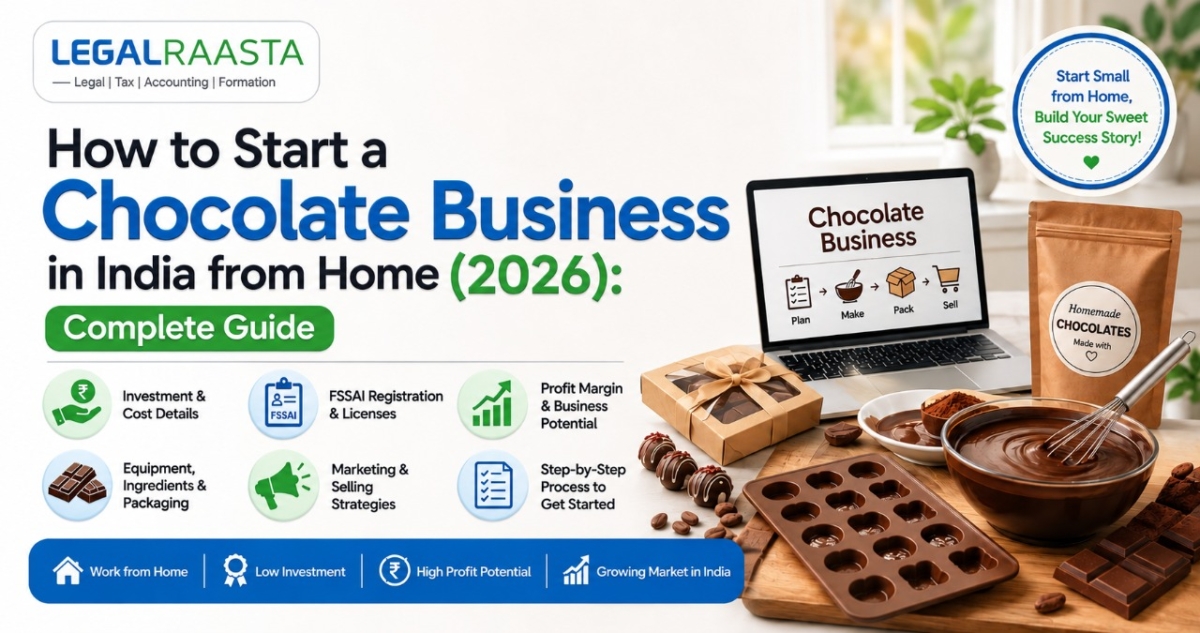
India’s chocolate market crossed Rs 24,000 crore in 2024. It is still growing. And the interesting thing is that most of that growth is not coming from Cadbury or Nestle. It is coming from gifting culture, from people wanting something handmade, something with a story, something local. That gap is where a chocolate business from home actually has a shot.
You do not need a factory. You do not need ten lakhs upfront. Some of the best homegrown chocolate brands in the country started in a Bengaluru kitchen or a Pune flat with under Rs 30,000. What they did have was FSSAI registration sorted on day one, a clear product focus, and a real pricing strategy.
This guide covers the actual numbers most guides skip. Investment ranges, FSSAI specifics, how to price, and where to sell in 2026. LegalRaasta helps chocolate businesses from home get their FSSAI registration, GST, and business setup done correctly so your brand operates legally from the first sale.
Is a Chocolate Business from Home in India Actually Profitable?
Yes. But only in the right segment.
If you are trying to compete with Rs 50 Dairy Milk bars, forget it. That is not a winnable fight from a home kitchen. But the premium gifting segment? Corporate bulk orders? Artisan truffles for Diwali? That is where a chocolate business from home makes real money.
|
Product Type |
Production Cost (per box) |
Selling Price |
Gross Margin |
|
Standard moulded chocolates 500g |
Rs 150 to Rs 200 |
Rs 350 to Rs 500 |
55 to 65% |
|
Truffle or ganache boxes |
Rs 250 to Rs 350 |
Rs 700 to Rs 1,200 |
55 to 70% |
|
Corporate gifting hampers |
Rs 400 to Rs 600 |
Rs 1,200 to Rs 2,500 |
60 to 75% |
|
Sugar-free or vegan range |
Rs 300 to Rs 400 |
Rs 800 to Rs 1,500 |
60 to 70% |
Small-scale home operations earn Rs 30,000 to Rs 1 lakh monthly in profit once they find consistent buyers. The difference between those two numbers is almost entirely about whether you cracked the corporate gifting channel or not.
Which Business Model Should You Pick?
Choosing before you buy equipment saves a lot of wasted money. The chocolate business from home has several real entry points, and each needs different gear and capital.
|
Model |
What It Involves |
Starting Investment |
|
Moulded chocolates |
Bars and figures using moulds |
Rs 15,000 to Rs 40,000 |
|
Truffles and ganaches |
Hand-rolled centres, coated |
Rs 25,000 to Rs 60,000 |
|
Chocolate-coated products |
Nuts, fruits, biscuits |
Rs 20,000 to Rs 50,000 |
|
Bean-to-bar |
Processing from raw cacao |
Rs 3 lakh to Rs 15 lakh |
|
Corporate gifting specialist |
Custom packaging, bulk only |
Rs 30,000 to Rs 80,000 |
|
Sugar-free or vegan chocolate |
Specialty ingredients |
Rs 35,000 to Rs 70,000 |
Most founders starting from home go with moulded chocolates or truffles. Low entry cost, clear gifting demand, and strong seasonal spikes around Diwali, Valentine’s, and Christmas.
Licenses and Registrations You Cannot Skip
Every food business in India needs FSSAI before selling commercially. Not after you hit a certain number of orders. Before the first order of your chocolate business from home.
|
License |
When Required |
Authority |
Cost |
|
FSSAI Basic Registration |
Turnover under Rs 12 lakh per year |
FSSAI |
Rs 100 per year |
|
FSSAI State License |
Turnover Rs 12 lakh to Rs 20 crore |
State Food Safety Department |
Rs 2,000 to Rs 5,000 per year |
|
Turnover crosses Rs 20 lakh |
GST Council |
Free |
|
|
Optional but strongly recommended |
Ministry of MSME |
Free |
|
|
Once you have a brand worth protecting |
Trade Marks Registry |
Rs 4,500 for individuals |
|
|
If operating from commercial space |
State Labour Department |
Varies |
Apply for FSSAI Basic Registration at foscos.fssai.gov.in. Takes 7 to 30 days. Costs Rs 100. There is genuinely no reason to delay this step.
FSSAI Requirements Specific to Chocolate
FSSAI puts chocolate under Food Category 5.0 (Confectionery). Sub-categories 5.1.1 and 5.1.4 cover cacao-based and compound chocolate products, respectively.
A chocolate business from home needs to meet these hygiene conditions before applying:
- Dedicated production area, kept separate from personal cooking
- No pets anywhere near production or storage
- Food-grade water for all production
- Pest control in storage areas
- Food-grade containers for ingredients
- A refrigerator used only for chocolate production and storage
On labeling, every package must show your FSSAI registration or license number, full ingredient list, net weight, manufacturing date, best before date, and batch number. Not one of these is optional. Missing any of them is a compliance violation that can get your products pulled.
Equipment and Ingredients: What You Actually Need
Equipment
|
Item |
Purpose |
Approx Cost |
|
Tempering machine or marble slab |
Correct chocolate crystallisation |
Rs 8,000 to Rs 35,000 for machine; free if using marble |
|
Polycarbonate moulds |
Shaping bars, boxes, figures |
Rs 200 to Rs 800 per mould |
|
Digital thermometer |
Temperature control during tempering |
Rs 500 to Rs 1,500 |
|
Dedicated refrigerator |
Storage and setting chocolates |
Rs 8,000 to Rs 15,000 used |
|
Double boiler or microwave |
Melting |
Rs 500 to Rs 2,000 |
|
Heat sealer |
Packaging |
Rs 1,500 to Rs 4,000 |
|
Food-grade containers |
Ingredient storage |
Rs 1,000 to Rs 3,000 |
You do not need a tempering machine on day one. The seeding or tabling method works fine for small batches. Buy the machine when volume actually needs it.
Ingredients
Two choices for chocolate: compound or couverture.
Compounds cost Rs 150 to Rs 250 per kg. Easier to work with, no tempering needed, but the finish looks slightly dull, and the taste is noticeably different. Fine for mid-range pricing.
Couverture costs Rs 700 to Rs 1,100 per kg. Callebaut 811 and premium Morde ranges are both widely available from bakery distributors. Better taste, better finish, and if you are charging premium prices, this is non-negotiable. Buyers notice.
Investment Breakdown for a Chocolate Business from Home
|
Expense |
Beginner |
Intermediate |
|
Equipment (moulds, thermometer, boiler) |
Rs 5,000 to Rs 15,000 |
Rs 20,000 to Rs 50,000 |
|
Tempering machine |
Not required |
Rs 8,000 to Rs 35,000 |
|
Dedicated refrigerator |
Rs 8,000 to Rs 15,000 |
Rs 15,000 to Rs 25,000 |
|
Initial raw materials |
Rs 5,000 to Rs 10,000 |
Rs 15,000 to Rs 30,000 |
|
Packaging materials |
Rs 3,000 to Rs 8,000 |
Rs 8,000 to Rs 20,000 |
|
FSSAI registration |
Rs 100 |
Rs 2,000 to Rs 5,000 |
|
Branding and labels |
Rs 2,000 to Rs 5,000 |
Rs 5,000 to Rs 15,000 |
|
Total |
Rs 23,000 to Rs 53,000 |
Rs 71,000 to Rs 1,80,000 |
Start in the beginner range. Reinvest profits into better equipment once you understand your actual volume and which products are selling.
How to Price Chocolates Without Destroying Your Margins
Most home founders underprice. They charge Rs 300 for something that costs Rs 210 to make, think that is good money, and then realise they paid themselves nothing for three hours of work.
Use this formula:
Selling Price = (Material + Labour + Overhead) × 3 to 4
Real example for a 200g truffle box:
- Materials: Rs 90
- Labour at 1.5 hours, Rs 60 per hour: Rs 90
- Overhead including packaging, electricity, platform fees: Rs 30
- Total cost: Rs 210
- At 3x markup: Rs 630
Rs 630 for a premium 200g truffle box is the right market position in 2026. Charging Rs 300 for the same box means working for less than minimum wage. Stop doing that.
Where to Sell Chocolates from Your Home Business
|
Channel |
Best For |
Cost to Start |
|
Instagram and WhatsApp |
Direct to consumer, festive orders |
Nearly free |
|
Swiggy Instamart and Blinkit |
Local quick commerce reach |
Commission-based |
|
Amazon and Flipkart |
Pan-India reach |
GST mandatory, category approval needed |
|
Etsy India |
Handmade and gifting segment |
Low listing fees |
|
Corporate gifting companies |
Bulk orders, stable revenue |
Samples and direct pitching |
|
Local gift shops and bakeries |
Consistent local volume |
Margin sharing |
|
Farmer markets and pop-ups |
Brand building, direct feedback |
Stall fees |
Corporate gifting is the highest-value channel by a wide margin. One Diwali corporate order can mean thousands of boxes. Approach HR teams and gifting agencies three months before the festive season with samples and a pricing sheet ready.
Step-by-Step Process to Start Your Chocolate Business in India
This guide outlines the process for starting a chocolate business from home, detailing niche selection, critical FSSAI licensing benchmarks, statutory business registration structures, operational space compliance, and phased market-testing strategies.
Step 1: Choose Your Niche
Pick one product range and go deep, not wide. Test three to five recipes. Get honest feedback. Fix the problems before you print labels.
Step 2: Apply for FSSAI
Go to foscos.fssai.gov.in. Basic Registration for home-based production under Rs 12 lakh annual turnover. Rs 100 per year. Do this first, before anything else.
Step 3: Register Your Business
Sole proprietorship requires no formal registration beyond FSSAI and GST. Get Udyam MSME registration free for scheme access. If scaling is the plan, incorporate as an LLP or Private Limited from the start.
Step 4: Set Up Production Space
Separate the kitchen area. Dedicated fridge. No pets. Clean surfaces. Pest control in place. These are FSSAI requirements, not suggestions.
Step 5: Source Materials and Packaging
Trial order from a local bakery distributor for chocolate. Food-grade packaging from IndiaMART or local printers. Your FSSAI number goes on every single label.
Step 6: Start Selling Small
Instagram first. WhatsApp groups second. Take small orders, fulfill them well, and get reviews. Do not buy six months of raw material before you understand your repeat buyer rate.
Step 7: GST When Needed
Mandatory at Rs 20 lakh turnover. Register voluntarily earlier if you want Amazon or Flipkart listings; both require it from day one of selling on their platforms.
Common Mistakes to Avoid in a Chocolate Business from Home
These mistakes come from real patterns across home-based food businesses in India.
- Not getting FSSAI before selling is the one that ends businesses, literally. Inspectors can shut operations and confiscate stock over this.
- Using compound chocolate while charging couverture prices erodes trust fast. Customers who know chocolate notice immediately.
- Making fifteen different products at launch is how you build nothing well. Start with three. Master those. Then expand.
- Ignoring temperature in Indian summers destroys delivery orders above 35 degrees. Insulated packaging and ice packs are not optional once you scale beyond WhatsApp.
- Not filing a trademark for your brand name is a gamble that costs far more to fix later if someone else files first.
How LegalRaasta Helps Chocolate Business Founders
Setting up a chocolate business from home in India legally from day one means fewer problems at every stage after.
LegalRaasta handles FSSAI Basic Registration and State License applications, Udyam MSME registration, GST registration when you hit the threshold, trademark filing under Class 30 for your brand name, Limited Liability Partnership (LLP) or Private Limited Company incorporation when you are ready to scale, and all annual compliance filings that keep the business in good standing.
Conclusion
The chocolate business from home in 2026 is a real business opportunity, not just a hobby that might pay. Rs 24,000 crore market. Growing gifting culture. Demand for premium handmade products that large manufacturers cannot serve. The technical side is learnable. The legal side is straightforward if done properly from the start. The pricing and channel decisions are where most founders either win or quietly give up after six months.
Get FSSAI sorted first. Choose a niche. Price correctly. Go after corporate clients before the first festive season. Connect with LegalRaasta today and get your FSSAI, GST, and brand trademark done correctly so your chocolate business from home operates legally from the very first order.
Frequently Asked Questions
1. What licenses are needed to start a chocolate business from home in India?
FSSAI Basic Registration (Rs 100 per year for turnover up to Rs 12 lakh) is compulsory before the first sale for any chocolate business from home. Once the turnover exceeds Rs 20 lakh, the registration is compulsory. Udyam MSME registration is completely free, and access to the scheme is made simple on the condition at the same time.
2. Is a chocolate business in India actually profitable for home sellers?
A chocolate business from home idea within the niche area of giving and premium products fetches a gross margin between 55 to 75%. A monthly profit of Rs 30,000 to Rs 1 lakh is feasible after landing client businesses from corporate businesses and gifting clients on Instagram & WhatsApp, in addition to contacting them directly to HR teams.
3. How much investment does a chocolate business from home actually need?
A beginner chocolate business from home costs Rs 23,000 to Rs 53,000, covering moulds, a refrigerator, raw materials, packaging, and FSSAI. Intermediate setups with a tempering machine run Rs 71,000 to Rs 1,80,000. Bean-to-bar production is a different category needing Rs 3 lakh to Rs 15 lakh.
4. What does FSSAI require specifically for a homemade chocolate business?
Every chocolate business from home, whether manufacturing or trading units involved in commercial activity, must be FSSAI registered before the first sale. Food-grade storage, dedicated production, a refrigerator, no pets around production, and pest control are required by FSSAI. All packages must show the FSSAI number, ingredients, weight, and dates.
5. Should I use compound or couverture chocolate for my home business?
Couverture is the right choice for a premium chocolate business in India because the taste and finish are noticeably better. Compound works at mid-range price points. Callebaut and premium Morde are available from bakery distributors. If charging premium prices, using compound will lose you repeat buyers quickly.
6. How do I price homemade chocolates without undercharging?
For any chocolate business in India, add material, labour, and overhead costs, then multiply by 3 to 4. A 200g truffle box costing Rs 210 to produce should sell at a minimum of Rs 630. Underpricing means working for free. Gifting and premium segments support correct pricing when product quality matches.
7. Where can I sell chocolates from a home business in India?
Instagram, WhatsApp, Amazon, Flipkart, Swiggy Instamart, Blinkit, and Etsy India are the various platforms through which a chocolate business from home can sell. GST registration is mandatory for Amazon and Flipkart irrespective of turnover. The best reliable sources for regular bulk volume are corporate gifting companies and local gift shops.
8. Do I need GST registration for a small chocolate business from home?
GST becomes mandatory for a chocolate business from home at Rs 20 lakh annual turnover. Register earlier if selling on Amazon or Flipkart since both platforms require GST from the very first product listing. Registration itself is free and done online through the GST portal.
9. Can I start a chocolate business from home without a tempering machine?
Yes. A chocolate business from home can start using the seeding or tabling method for tempering. A machine (Rs 8,000 to Rs 35,000) improves consistency and speed at higher volumes but is not needed for small-batch early production. Buy it when sales volume actually justifies the investment.
10. How does LegalRaasta help start a chocolate business from home legally?
LegalRaasta handles FSSAI registration, GST registration, Udyam MSME registration, trademark filing under Class 30 for brand protection, and company incorporation for a chocolate business from home, so every compliance step is done correctly from the first sale through to business growth.

Related Posts


Our Clients






Featured In