
Latest FSSAI Labelling & Packaging Rules Changes in 2026: Complete Guide
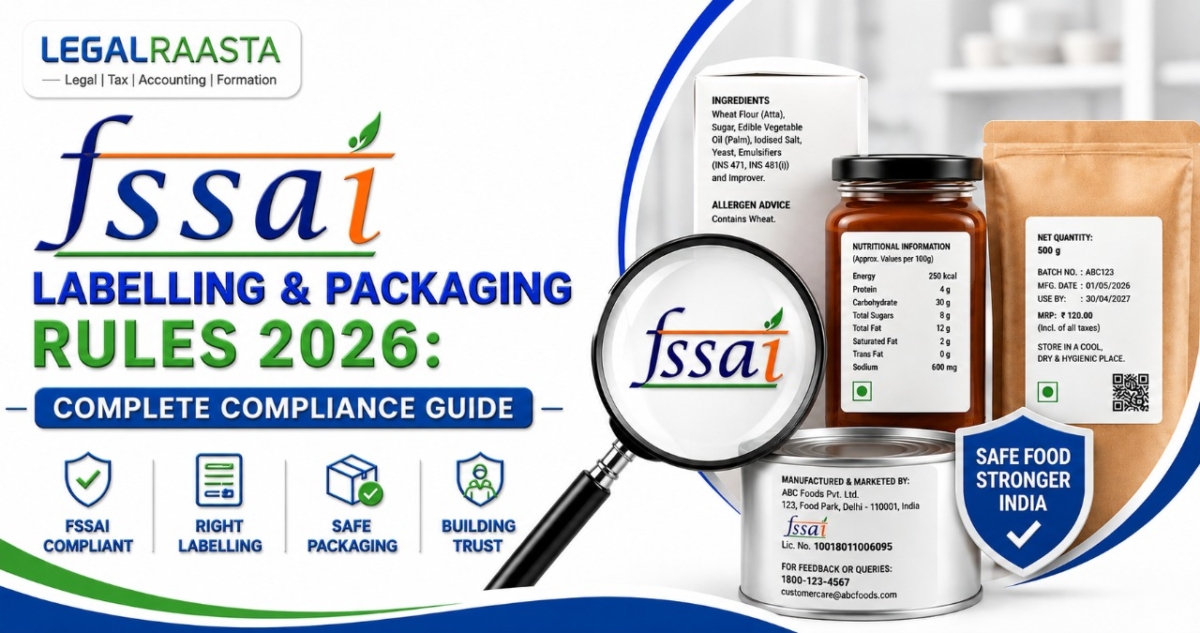
Food safety laws in India are changing rapidly to protect consumers and improve food quality. Because of these updates, every food business operator must stay compliant with the latest regulatory changes. FSSAI officially notified the Food Safety and Standards (Labelling and Display) First Amendment Regulations on March 24, 2026, with enforcement set for July 1, 2027. FSSAI labelling & packaging rules give food manufacturers, packers, and importers a clear window to adjust their package designs. Meeting these statutory standards requires accurate ingredient declarations, clear allergen disclosures, and verified food-grade packaging materials. If you ignore these regulations, your business risks heavy fines, product recalls, or FSSAI license cancellation. Accelerate your growth and protect your operational future effortlessly with LegalRaasta.
Understanding FSSAI Labelling & Packaging Rules
This section explains the legal framework governing food display and container safety standards across India.
FSSAI enforces strict display rules under the Food Safety and Standards Act, 2006. The regulator updated old rules to integrate packaging safety directly into labeling norms. Because of this, businesses must follow two primary legal frameworks together.
|
Regulation Framework |
Official Year |
Primary Regulatory Scope |
|
Packaging Regulations |
2018 |
Governs food-grade material safety, chemical leaching, and outer containers. |
|
Labelling and Display Regulations |
2020 |
Regulates retail declarations, nutritional facts panels, and logo placements. |
|
Labelling & Display First Amendment |
2026 |
Updates rules for small packs, B2B bulk boxes, and infant nutrition. |
Key Updates to FSSAI Labelling & Packaging Rules in 2026
This section highlights the major amendments introduced by FSSAI in 2026 to improve market transparency.
The 2026 amendment cleans up packaging rules for small items and bulk supply chains. Therefore, food businesses must update their printing practices before the 2027 enforcement deadline.
|
Amendment Domain |
Old Rule Standard |
Updated 2026 Rule Requirement |
|
Small Package Exemption |
Mandatory FSSAI logo on all pack sizes. |
Packages under 100 sq cm can omit logo on inner wrappers. |
|
Infant Foods |
Mandatory RDA % per serve and serving counts. |
Removes mandatory RDA % per serve and total serving counts. |
|
Non-Retail Containers |
Basic labels with minimal B2B disclosures. |
Must carry full details or linked digital documents. |
|
Minimally Processed Foods |
Unclear definition of raw foods. |
Defines allowed actions like cleaning, grinding, and chilling. |
|
Fortified Foods |
Standard fortification statement. |
Must state “Fortified with [Nutrient Name]” alongside official logo. |
Food Businesses Required to Comply with FSSAI Labelling & Packaging Rules
This section outlines the specific commercial entities that must comply with India’s food packaging guidelines.
Every business operator handling packaged food items in India must follow these legal rules:
- Food Manufacturers: Companies that produce and package finished consumer food products.
- Importers: Businesses bringing foreign packaged foods into Indian customs territories.
- B2B Wholesalers: Traders moving bulk raw materials in non-retail containers.
- E-Commerce Sellers: Online platforms delivering packaged groceries to customers.
- Cloud Kitchens: Commercial kitchens packing ready-to-eat meals for delivery.
Mandatory Information That Must Appear on Food Labels
This section covers compulsory declarations required on every consumer-facing retail package.
Retail food packs must show specific data points so consumers know what they purchase.
|
Mandatory Label Declaration |
Regulatory Requirement |
|
Food Name & Category |
Clear title stating the true nature and classification of the food. |
|
List of Ingredients |
Ingredients listed in descending order of incoming weight. |
|
Nutritional Panel |
Calorie breakdown, protein, total sugars, added sugars, fats, and sodium. |
|
FSSAI License Display |
14-digit FSSAI license number and logo on front display area. |
|
Net Quantity |
Accurate weight or volume excluding outer packaging weight. |
General Labelling Requirements Under FSSAI
This section details fundamental legibility and printing rules for all packaged food products.
Labels must remain clean, durable, and easily visible during storage and handling.
- Text must be in English or Hindi using Devanagari script.
- Inks must be waterproof, non-smudging, and durable.
- Key details must sit on the principal display panel.
- Labels must attach securely to prevent accidental detachment.
Packaging Standards Prescribed by FSSAI
This section reviews statutory material standards enforced under food packaging compliance India rules.
Packaging materials must protect food items without leaking toxic chemicals into them.
|
Material Type |
Statutory Usage Condition |
Applicable Indian Standard |
|
Plastics |
Virgin food-grade plastic only; recycled plastic is banned. |
IS 10146 / IS 10142 |
|
Glass |
Heavy-metal-free containers for beverages and sauces. |
IS 13824 |
|
Paperboard |
Fresh paper only; printed newspaper contact is banned. |
IS 1060 |
|
Tin & Metal |
Internal tin lining required to prevent rusting and corrosion. |
IS 5837 |
Front-of-Pack (FoP) Labelling Requirements
This section covers display rules for front-of-pack labels to improve consumer awareness.
The front panel gives shoppers immediate access to essential health markers.
- FSSAI Front of Pack Labelling: Must display warning markers if sugar, salt, or fat levels exceed safe thresholds.
- Veg / Non-Veg Logo: Placed near the product brand name on the front face.
- FSSAI Logo & License Number: Printed in contrasting colors for quick identification.
- Net Weight: Clear declaration of product volume or net weight.
Nutrition Information Panel Requirements
This section outlines required nutrients listed on the nutritional information panel.
Every retail label must include a structured nutritional breakdown per 100g or per serve.
|
Nutrient Category |
Required Declaration Unit |
|
Energy Value |
Kilocalories (kcal) per 100 g or per serve. |
|
Proteins & Carbohydrates |
Grams (g) per 100 g or per serve. |
|
Total & Added Sugars |
Grams (g) declared separately per 100g. |
|
Fats & Trans Fats |
Total fat, saturated fat, and trans fat in grams (g). |
|
Sodium |
Milligrams (mg) per 100 g or per serve. |
Allergen Declaration Requirements
This section explains mandatory allergen disclosure rules for packaged food manufacturers.
Food allergens can trigger serious health issues, so clear labels are mandatory.
- Primary Allergens: Wheat (gluten), milk, egg, fish, peanuts, tree nuts, soy, and sulfites.
- Label Placement: Allergens must print in bold letters right under the ingredient list.
- Cross-Contamination Warnings: Facilities using shared machinery must state “May contain traces of [Allergen]”.
Ingredient Listing and Additive Declaration Guidelines
This section details guidelines for listing raw ingredients and food additives accurately.
Ingredients must be listed in descending order based on weight at production time.
- Additive Codes: Food additives require official INS numbers or chemical names.
- Flavoring Agents: Labels must specify whether flavors are natural, nature-identical, or artificial.
- Artificial Sweeteners: Products with artificial sweeteners must display mandatory warnings for children and pregnant women.
Date Marking Requirements: Manufacturing Date, Best Before, and Use By
This section explains date formatting requirements for different food product shelf lives.
Clear date markings prevent buyers from consuming expired or unsafe food.
|
Product Shelf Life |
Required Date Format |
Mandatory Display Term |
|
Under 3 Months |
DD/MM/YYYY |
“Use By” or “Expiry Date”. |
|
Over 3 Months |
MM/YYYY or DD/MM/YYYY |
“Best Before”. |
|
Perishable Foods |
Exact date and time of packing. |
“Use By” only. |
FSSAI Rules for Veg and Non-Veg Symbols
This section defines geometry, color specs, and veg/non-veg symbol size rules for Indian food labels.
Dietary symbols must sit on the front panel so buyers identify food types instantly.
|
Symbol Type |
Graphic Shape |
Color Code |
|
Vegetarian |
Green filled circle in a green square. |
Green (RGB: 0, 146, 63) |
|
Non-Vegetarian |
Brown filled triangle in a brown square. |
Brown (RGB: 121, 51, 3) |
|
Exempt Items |
No symbol required. |
Raw agricultural produce. |
Font Size, Legibility, and Display Requirements
This section outlines minimum font heights based on the surface area of the package.
Font sizes must scale proportionally so labels remain easy to read without tools.
|
Principal Area Size |
Minimum Letter Height |
Net Weight Font Height |
|
Up to 100 sq cm |
1.0 mm |
2.0 mm |
|
100 to 500 sq cm |
1.5 mm |
3.0 mm |
|
Above 500 sq cm |
2.0 mm |
4.0 mm |
QR Code and Digital Information Requirements
This section covers rules for adding QR codes and digital links on packaging.
FSSAI encourages dynamic QR codes on food packages to improve accessibility.
- Visually impaired consumers can scan QR codes to hear product details aloud.
- Digital links can provide detailed batch analysis reports for non-retail container labelling.
- Physical packaging must still print all mandatory core declarations directly on the label.
Country of Origin and Import Labelling Requirements
This section explains mandatory import declarations for foreign food products entering India.
Imported foods must clear customs with accurate labels attached before retail distribution.
- Origin Details: Labels must explicitly state “Product of [Country Name]”.
- Importer Info: Must show the name, address, and FSSAI license of the Indian importer.
- Custom Stickers: Importers can attach custom stickers for FSSAI logos and veg/non-veg symbols before clearance.
Packaging Material Safety Requirements
This section covers physical safety checks required for food packaging materials.
Packaging materials must pass migration testing before commercial use.
- Containers must not release heavy metals or toxic dyes into food items.
- Ink used on outer wrappers must never touch edible portions directly.
- Multi-layer pouches must maintain structural integrity under high heat and pressure.
Common FSSAI Labelling & Packaging Rules Mistakes to Avoid
This section highlights common label errors that trigger regulatory penalties or product rejections.
Avoiding these common errors keeps your products compliant and on retail shelves.
|
Common Label Mistake |
Correct Compliance Action |
|
Missing License Number |
Print 14-digit license number and logo on front display. |
|
Using Banned Terms |
Avoid terms like “health drink” or “100% natural” without proof. |
|
Wrong Font Size |
Match letter height directly to total package surface area. |
|
Unlisted Allergens |
Highlight common allergens in bold right below ingredients. |
Penalties for Non-Compliance with FSSAI Labelling & Packaging Rules
This section lists statutory fines and legal actions for non-compliant food packaging in India.
FSSAI enforces strict penalties for selling misbranded or unsafe packaged foods.
|
Offence Classification |
Maximum Fine / Legal Penalty |
|
Misbranded Food Product |
Penalty up to ₹3 Lakhs. |
|
Misleading Advertisements / Claims |
Penalty up to ₹10 Lakhs. |
|
Unsafe Packaging Leaching |
Fine up to ₹5 Lakhs plus imprisonment up to 6 months. |
|
Operating Without FSSAI License |
Fine up to ₹5 Lakhs and up to 6 months’ jail. |
Step-by-Step Action Plan for FSSAI Labelling & Packaging Compliance
This section provides a practical step-by-step guide to help food manufacturers and packers update their labels before the enforcement deadline.
Food businesses must start updating their product designs now to avoid last-minute delays or print waste. Follow these five key operational steps to ensure full compliance:
- Audit Packaging Artwork: Review all existing label files for correct font sizes, contrasting background colors, and principal display placement.
- Verify Allergen and Ingredient Data: Print common allergens in bold text directly below ingredients. Update INS numbers for all food additives.
- Run Material Safety Tests: Ensure plastic packaging uses virgin food-grade polymer. Obtain migration test certificates from accredited labs.
- Update B2B Outer Boxes: Add clear product declarations or dynamic QR codes on all non-retail containers and shipping boxes.
- Seek Legal Review: Get an expert review on product health claims to avoid heavy misbranding fines.
|
Compliance Phase |
Key Action Required |
Primary Goal |
Target Timeline |
|
Phase 1: Label Audit |
Review front panel font sizes and FSSAI logo display. |
Identify outdated label errors. |
Month 1 – 2 |
|
Phase 2: Material Testing |
Complete packaging material chemical migration tests. |
Prove food-grade safety. |
Month 3 – 4 |
|
Phase 3: Design Update |
Update artwork with FSSAI Labelling & Packaging rules. |
Send updated files to printers. |
Month 5 – 6 |
|
Phase 4: Final Launch |
Replace old packaging stock across retail networks. |
Achieve 100% legal compliance. |
Before July 2027 |
Conclusion
Food safety compliance requires careful attention to changing labeling and packaging standards across India. The latest updates notified by FSSAI bring major operational changes that every food business must follow. Since these regulations become strictly mandatory from July 1, 2027, you have a clear transition period to update package prints. Businesses must audit current labels, fix font sizes, and list allergens clearly in bold text. Bulk B2B shipments also need proper digital or physical documentation. Furthermore, using verified food-grade packaging materials prevents toxic chemical leaching into food items. Updating your product packaging early prevents heavy fines, product recalls, and business license cancellation while giving your brand a solid market advantage. Accelerate your growth and protect your operational future effortlessly with LegalRaasta.
Frequently Asked Questions (FAQs)
1. What is the main objective of the new FSSAI Labelling & Packaging regulations?
The main goal is to protect consumers and improve food safety across India. These new changes strengthen supply chain traceability and enforce updated FSSAI labelling rules 2026 across all commercial food categories. As a result, companies must stop using misleading health claims on their retail product packages.
2. How do the new food packaging compliance India guidelines impact small pouches?
Small food packages having a total surface area under 100 square centimeters can omit the FSSAI logo on inner packaging layers. However, outer wholesale boxes containing multiple small units must fully comply with FSSAI Labelling & Packaging rules by printing complete licensing and manufacturer details clearly.
3. Are B2B bulk containers exempt from FSSAI Labelling & Packaging rules?
No, bulk supply chain units are not exempt from compliance. Operators must follow strict non-retail container labelling rules by putting essential batch details directly on outer shipping boxes or providing linked digital documents. This requirement helps food inspectors track raw ingredients easily across wholesale trade channels.
4. What are the FSSAI front of pack labelling requirements for high-fat items?
If packaged food contains high levels of sugar, sodium, or saturated fats beyond permissible limits, red warning symbols must be printed on the principal display panel. These visual alerts fall under mandatory FSSAI Labelling & Packaging regulations to help everyday consumers make healthier dietary choices.
5. Must infant food carry an RDA percentage exemption on the label?
Yes, infant food products have been granted an exemption regarding recommended daily allowance displays. Under updated FSSAI Labelling & Packaging rules, manufacturers no longer need to print per-serve RDA percentages or total serving counts on infant milk or formula packets, simplifying panel design for producers.
6. Which mandatory food label requirements apply to all packaged items?
All packaged foods sold in India must display the product title, complete ingredient list, nutritional facts panel, batch number, manufacturing date, expiry date, net weight, and complete manufacturer address. These disclosures are compulsory under FSSAI Labelling & Packaging regulations to ensure full consumer transparency at retail.
7. Where should FSSAI license display rules be implemented on a package?
The 14-digit license number and official authority logo must be printed on the principal display area of the packaging. According to FSSAI Labelling & Packaging rules, these numbers must feature contrasting colors against the background color so buyers and inspecting officials can read them easily.
8. Does a nutritional information panel need to show added sugars?
Yes, the nutrition table must explicitly break down total sugars and added sugars per serving or per 100 grams. Statutory FSSAI Labelling & Packaging rules also mandate clear declarations of total energy, protein, carbohydrates, saturated fat, trans fat, and sodium content to inform health-conscious customers.
9. What are the allergen declaration rules for packaged snacks in India?
Food manufacturers must clearly list common ingredients like wheat, milk, egg, fish, peanuts, tree nuts, and soy in bold letters right under the ingredient list. Following these FSSAI Labelling & Packaging regulations steps prevents severe allergic reactions and ensures sensitive consumers stay completely safe.
10. How do minimally processed food rules affect raw agricultural produce?
These guidelines state that simple operations like cleaning, sorting, grinding, or chilling raw crops do not change their essential nature. However, once packaged for retail sale, these items must carry standard FSSAI Labelling & Packaging details such as net weight, packing date, and supplier registration.

Related Posts
 FSSAI License
FSSAI Basic vs State vs Central License in India (2026): Key Differences, Benefits & Which to Choose
Read More →
 FSSAI License
How to Start a Bottled Water Business in India: Cost, Licenses & Setup Guide (2026)
Read More → FSSAI License
FSSAI License for Home-Based Food Business 2026: Documents Checklist & Guide
Read More →

Our Clients








Featured In