
Franchise Business in India: Registration Process, Documents, Legal Requirements & Cost
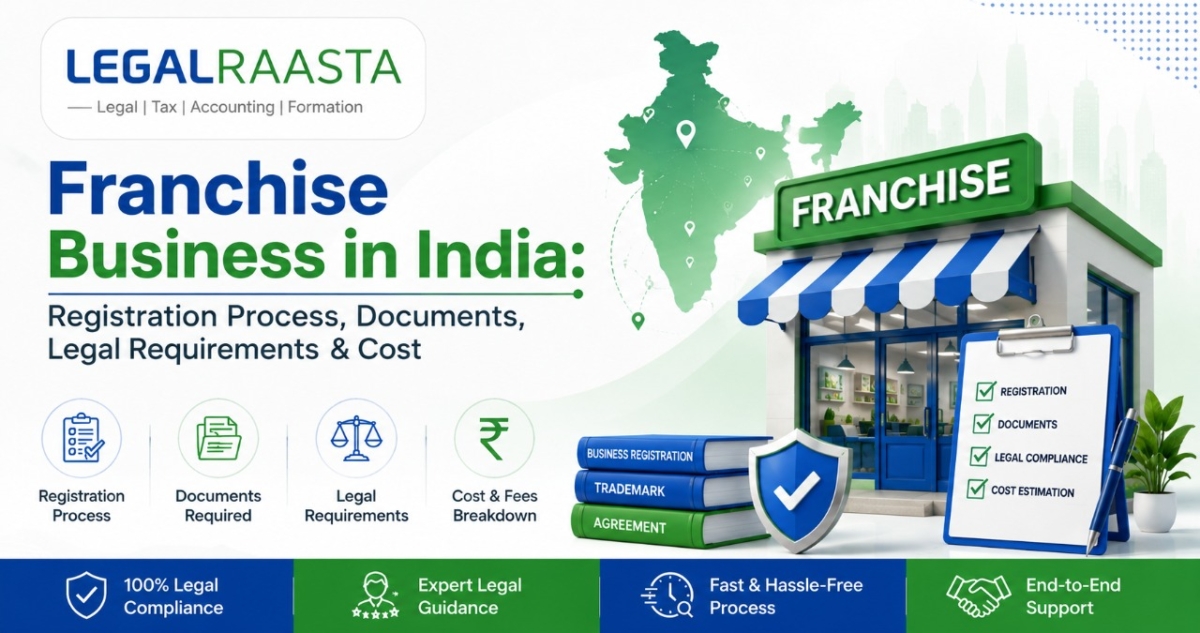
A franchise lets an entrepreneur run a proven business under an established brand name. India is currently one of the fastest-growing markets for brand expansion across food, retail, education, and healthcare. However, setting up a franchise business in India requires strict adherence to legal contracts, corporate filings, intellectual property rules, and tax regulations. Because India does not have one single overarching franchise law, compliance depends on multiple statutory acts. Understanding the setup steps prevents costly legal disputes and operational halts. Accelerate your growth and protect your operational future effortlessly with LegalRaasta.
What Is a Franchise Business in India?
A franchise is a commercial setup where a brand owner grants operational rights to an independent business operator. The brand owner is called the franchisor, while the local business operator is called the franchisee. Because the franchisee uses the brand’s name, logo, systems, and products, they pay an upfront fee along with an ongoing royalty. This model allows established brands to expand quickly into new cities without investing their own capital in every new outlet. Meanwhile, local operators get a ready-made business model with built-in customer trust. Therefore, franchising reduces startup risks for new entrepreneurs across Indian markets.
Is Franchise Registration Mandatory in India? (2026 – 2027 Policy Update)
India does not have a dedicated single law titled the Franchise Act, but registering your business entity and underlying contracts is legally mandatory. In 2026, government regulations tightened data privacy standards, consumer disclosure norms, and digital payment compliance for all franchise chains. Because of these updates, franchisors must now maintain verified GST records, registered trademarks, and transparent disclosure documents before selling regional licenses. Operating a Franchise Business in India without registering your business structure or tax accounts leads to immediate fines and operational shutdown by local municipal authorities.
Legal Requirements for Starting a Franchise Business in India
This section explains the core legal frameworks, statutory acts, and regulatory standards that govern franchise arrangements across India.
Indian Contract Act and Franchise Disclosure Standards
The Indian Contract Act of 1872 forms the legal backbone of every franchise relationship. Every agreement must clearly define operating terms, payment schedules, territory rights, and termination rules. Because verbal promises hold no weight in court, both parties must sign a legally binding written contract on proper non-judicial stamp paper.
Consumer Protection and Competition Act Compliance
The Consumer Protection Act of 2019 holds both franchisors and franchisees accountable for product quality and misleading advertisements. In addition, the Competition Act of 2002 prevents unfair trade practices like forced tie-in sales or total price fixing that harm market competition.
Types of Franchise Businesses in India
This section breaks down the primary operational structures and investment formats available to franchise operators in India.
FOFO, FOCO, FISO, and COCO Models
Franchise setups differ based on who invests capital and who handles day-to-day operations:
- FOFO (Franchisee Owned, Franchisee Operated): The franchisee invests capital and manages daily store operations directly.
- FOCO (Franchisee Owned, Company Operated): The franchisee invests capital in real estate and setup, but the main brand manages operations.
- FISO (Franchisee Invested, System Operated): The franchisee finances assets, while automated brand systems control operations.
- COCO (Company Owned, Company Operated): The core brand owns the outlet completely and manages operations through paid staff.
Master Franchise and Unit Franchise Formats
A unit franchise grants rights to open one single outlet in a specific locality. In contrast, a master franchise grants exclusive rights over an entire state or region, allowing the master franchisee to sell sub-franchises to other local investors.
Franchise vs Dealership vs Distributorship
Understanding the differences between a franchise, a dealership, and a distributorship helps investors choose the right commercial path for their business goals.
|
Feature |
Franchise Business |
Dealership |
Distributorship |
|
Brand Control |
Very high operational control |
Moderate product control |
Low operational control |
|
Royalty Fees |
Monthly percentage charged |
No royalty fees |
No royalty fees |
|
Operating Model |
Strictly follows franchisor SOP |
Semi-independent sales |
Independent bulk distribution |
|
IP Protection |
Licensed trademark usage |
Display brand logo only |
Resell packaged goods |
|
Setup Cost |
Moderate to high |
High inventory cost |
Moderate inventory cost |
Documents Required for Franchise Business Registration
Collecting proper verification files is necessary before launching any commercial franchise operation in India:
- Identity Proof: Aadhaar Card, PAN Card, or Passport of directors or partners.
- Address Proof: Electricity bill, rent agreement, or property ownership deed for the business site.
- Business Entity Registration: Certificate of Incorporation, Partnership Deed, or UDYAM MSME registration certificate.
- Tax Accounts: GST Registration Certificate and PAN card issued in the company name.
- Brand Protection: Trademark Registration Certificate or pending application receipt.
- Industry Permits: FSSAI license for food outlets, fire safety NOC, and shop and establishment license.
Franchise Business Registration Process in India
This section outlines the step-by-step roadmap required to legally register and launch a franchise network in India.
Phase 1: Business Structure and Brand Protection
First, register your business as a Private Limited Company, LLP, or Partnership firm. Next, file trademark applications for your brand name and logo to secure intellectual property rights across Indian states.
Phase 2: Drafting the Franchise Agreement
Hire legal professionals to draft a comprehensive disclosure document and legal contract. Ensure all royalty percentages, territory boundaries, quality standards, and dispute rules are clearly defined.
Phase 3: Tax Registrations and Industry Licenses
Apply for GST registration on the central tax portal. Secure local municipal trade licenses, shop establishment permits, and health NOCs based on your specific business sector.
Phase 4: Operational Onboarding and Launch
Execute the signed agreement on non-judicial stamp paper with notarization. Train local staff, set up inventory software, and complete formal site inspection before opening the outlet to the public.
|
Operational Phase |
Expected Duration |
Key Requirement |
Mitigation Strategy |
|
Phase 1: Entity & IP |
3 to 7 Days |
Name approval & TM filing |
Pre-check trademark availability |
|
Phase 2: Contract Drafting |
2 to 4 Days |
Custom legal agreement |
Avoid generic online contract templates |
|
Phase 3: Tax & Licenses |
3 to 7 Days |
Portal filings & site check |
File local shop permits simultaneously |
|
Phase 4: Onboarding |
2 to 5 Days |
Stamp execution & launch |
Verify non-judicial stamp duty values |
Franchise Agreement in India and Essential Clauses
A franchise contract is the primary legal document protecting both franchisor and franchisee interests:
- Territory Grant: Defines the exact geographical area where no competing branch can open.
- Fee and Royalty Structure: Outlines initial franchise fees, monthly royalty percentages, and marketing fund contributions.
- Operational Guidelines: Specifies strict quality standards, mandatory suppliers, and uniform codes.
- Intellectual Property Rights: Controls how the franchisee can display brand logos and trademarks.
- Termination Terms: Lists breach conditions, cure notice periods, and post-termination restrictions.
Trademark Registration for Franchise Business Security
Registering your trademark under the Trademarks Act of 1999 is vital before expanding your brand network. Without a registered trademark, unauthorized third parties can copy your brand identity, damage your market reputation, or claim ownership of your logo. The franchisor retains sole trademark ownership and grants a limited, non-exclusive license to the franchisee during the contract tenure.
GST and Taxation for Franchise Businesses
Tax compliance is critical for smooth franchise operations across Indian states. Initial franchise fees and ongoing monthly royalty payments attract 18% GST under Indian service tax categories. The franchisor charges GST on invoices, while the franchisee can claim Input Tax Credit on eligible business expenses. In addition, income tax rules mandate Tax Deducted at Source on royalty payments under Section 194J of the Income Tax Act.
Franchise Business Registration Cost in India
The initial cost of legally setting up a franchise includes government filing fees, professional charges, and licensing fees across departments.
|
Setup Expense Category |
Government Fee (Approx) |
Legal / Professional Fee |
Total Estimated Cost |
|
Rs 1,000 to Rs 3,000 |
Rs 3,000 to Rs 7,000 |
Rs 4,000 to Rs 10,000 |
|
|
Trademark Application |
Rs 4,500 per class |
Rs 2,000 to Rs 4,000 |
Rs 6,500 to Rs 8,500 |
|
Agreement Drafting |
Nil |
Rs 5,000 to Rs 15,000 |
Rs 5,000 to Rs 15,000 |
|
GST & Local Licenses |
Rs 500 to Rs 3,000 |
Rs 2,000 to Rs 5,000 |
Rs 2,500 to Rs 8,000 |
|
Total Professional Setup |
Rs 6,000 to Rs 10,500 |
Rs 12,000 to Rs 31,000 |
Rs 18,000 to Rs 41,500 |
State-Wise and Industry-Specific Franchise Compliance
Different states and industries enforce additional regulatory conditions on local business outlets:
- Food & Beverage: Requires mandatory FSSAI state or central license, eating house permit, and fire safety clearance.
- Education & Coaching: Requires local municipal permits, commercial building compliance, and safety NOCs.
- Retail & Healthcare: Requires Shop and Establishment registration, drug licenses for pharmacies, and waste disposal permits.
Common Mistakes to Avoid When Starting a Franchise
Many entrepreneurs make avoidable legal errors during initial franchise expansion:
- Signing generic or templated contracts without customized legal protection.
- Expanding outlets before securing official trademark registration receipts.
- Failing to define clear territorial boundaries for regional franchisees.
- Ignoring local shop establishment laws and municipal trade permits.
- Neglecting to outline clear exit strategies and dispute resolution rules.
What Happens If You Do Not Comply? Penalties and Consequences
Ignoring statutory registration rules results in severe legal and financial penalties for both franchisors and franchisees.
|
Compliance Area |
Violation Type |
Statutory Penalty |
Operational Impact |
|
GST Registration |
Operating without GST |
100% of the tax amount due or Rs 10,000 |
Impounding of business goods |
|
FSSAI Licensing |
Unlicensed food outlet |
Fine up to Rs 5,000,000 & jail |
Immediate store sealing |
|
Trademark Usage |
Infringing unregistered logo |
Injunction lawsuit & damages |
Forced rebranding of store |
|
Municipal Trade |
No shop license |
Daily penalty fine |
Notice of closure by municipality |
Franchise Business Registration Checklist
Follow this quick checklist to ensure total compliance before accepting your first franchise payment:
- Incorporate a Private Limited Company or LLP entity.
- File a trademark application for the brand logo and name.
- Obtain GST registration and company PAN card.
- Draft a comprehensive Franchise Agreement with legal experts.
- Secure sector-specific trade, FSSAI, and shop licenses.
- Open a dedicated corporate bank account.
How LegalRaasta Can Help With Franchise Business Registration
LegalRaasta provides end-to-end legal support for franchisors and franchisees across India. Our team of experienced corporate lawyers handles procedures such as company incorporation, trademark registration, GST filings, and custom agreement drafting. We ensure your franchise network complies with all state and central laws so you can scale safely.
|
Compliance Aspect |
DIY Setup |
LegalRaasta Support |
|
Contract Drafting |
High risk of missing critical clauses |
Custom legal drafting by experts |
|
Trademark Protection |
Incorrect class selection risks |
Complete IP filing & management |
|
Filing Turnaround |
Frequent government query delays |
Fast-track registration support |
|
Overall Legal Risk |
High risk of future disputes |
Complete compliance protection |
Conclusion: Building a Scalable Franchise Network in India
Starting a franchise network offers immense potential for business expansion across Indian cities. However, long-term success depends on strong legal foundations, protected brand assets, and strict tax compliance. Taking time to register your entity and draft clear contracts protects your capital and brand reputation. Accelerate your growth and protect your operational future effortlessly with LegalRaasta.
Frequently Asked Questions (FAQs)
1. Is formal registration mandatory for a Franchise Business in India?
India has no single franchise law, but you must register your business entity, obtain an FSSAI license for food outlets, and complete tax filings to operate legally.
2. What is the primary contract needed for a Franchise Business in India?
The primary legal document is the Franchise Agreement in India, which clearly sets royalty rates, territory boundaries, operational standards, and dispute terms between both parties.
3. How much does the Franchise Business Registration Cost typically run?
Setting up a legal Franchise Business in India costs between Rs 15,000 and Rs 50,000 for government filings, trademark applications, GST registration, and custom contract drafting.
4. Why is Trademark Registration for Franchise brand security necessary?
Securing your brand trademark prevents competitors from copying your identity while expanding a Franchise Business in India across new regional cities and commercial centers.
5. How long does the complete Franchise Registration Process take?
Incorporating your business entity and finalizing legal contracts for a Franchise Business in India takes 7 to 15 working days, depending on official verification.
6. Do franchisors need to provide a disclosure document before signing?
Yes, providing a detailed disclosure document builds trust and prevents future legal disputes when launching a Franchise Business in India with potential investors.
7. How is royalty taxed for a Franchise Business in India?
You must collect 18% GST on every brand royalty fee paid by the regional franchisee under standard Indian tax regulations.
8. What is the advantage of a master franchise model for expansion?
It grants exclusive regional rights to a master unit owner who sub-franchises a Franchise Business in India across an entire state or territory.
9. Is a commercial lease agreement required before launching an outlet?
Yes, securing a valid commercial lease agreement is required before registering a physical shop location for a Franchise Business in India.
10. Which statutes regulate franchise disclosure standards in operations?
The Indian Contract Act, Consumer Protection Act, and Competition Act collectively govern franchise disclosure standards for every Franchise Business in India.

Related Posts




Our Clients







Featured In