
Poultry Farm Business Plan in India (2026): Investment, Cost, Profit & Registration Guide
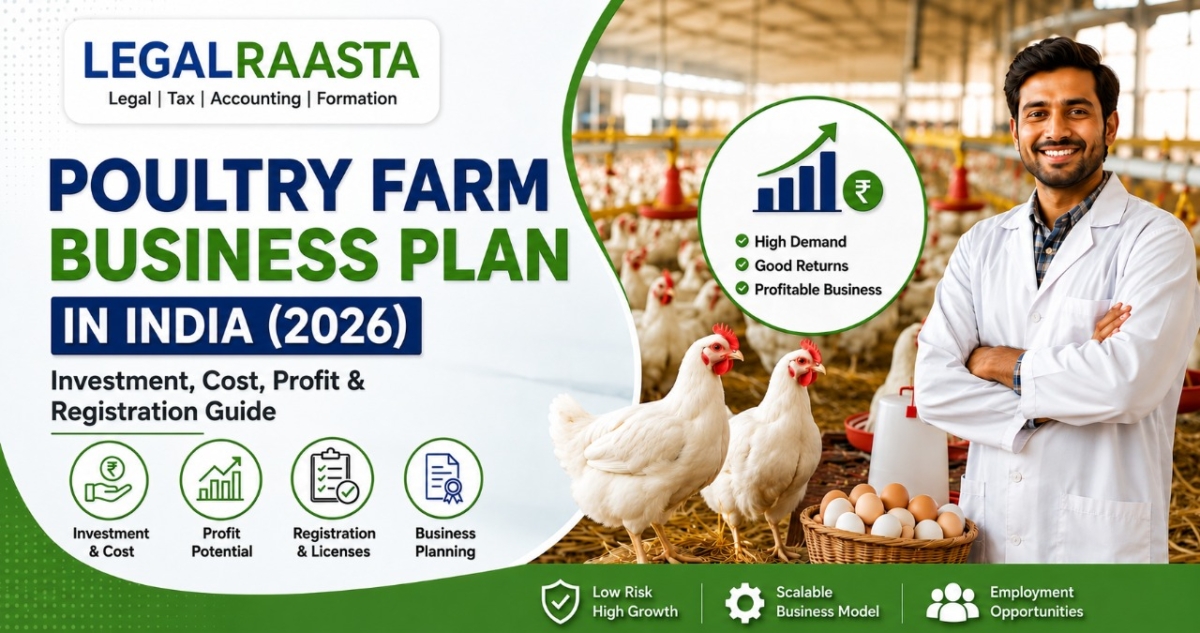
A farmer from Namakkal in Tamil Nadu started with 500 broiler chicks in a small shed on his family land in 2019. No bank loan, no investor, no fancy business plan. Seven years later, he runs three sheds with 15,000 birds per cycle and supplies to four processing units in the district. His monthly net income crosses Rs 1.2 lakh consistently. He did not start big. He started right.
Poultry farming is one of the few businesses in India where a person with limited land, limited capital, and no prior business experience can build a genuinely profitable operation within the first year itself. India is the world’s third-largest egg producer and the fourth-largest broiler producer. Demand is not going anywhere. In fact, per capita poultry consumption in India has been rising every single year for the past decade.
But starting without a proper poultry farm business plan is where most people go wrong. They buy chicks before they have a shed, and they build a shed before they have arranged water. But they forget licenses and do not calculate feed costs against sale prices. And they wonder why the business is not working three cycles in.
This guide gives you a complete poultry farm business plan for 2026, covering investment, costs, profit, breeds, and every legal registration you need before your first bird arrives. LegalRaasta helps poultry entrepreneurs get all required licenses and registrations sorted quickly so your farm is legal, protected, and ready to operate.
Why Poultry Farming Makes Sense in India Right Now
Before you put money in, understand why the numbers work. India produces over 130 billion eggs and more than 4 million tonnes of poultry meat every year. Demand is driven by a growing middle class, rising protein awareness, and the simple fact that chicken is the most affordable non-vegetarian protein available to most Indian families.
The business has short production cycles. Broiler birds are ready for sale in 42 to 45 days. Layer hens start laying at around 18 to 20 weeks. Capital turns over fast compared to most agricultural businesses. Contract farming arrangements with integrators like Suguna, Venkateshwara Hatcheries, and Srinivasa Farms reduce the risk for new farmers by providing chicks, feed, medicines, and guaranteed buyback. You provide the shed and labour.
Types of Poultry Farming in India
Before writing your poultry farm business plan, decide which type suits your capital and land situation.
|
Type |
Birds |
Production Cycle |
Ideal For |
|
Broiler Farming |
Meat birds |
42 to 45 days per cycle |
Fast returns, contract farming |
|
Layer Farming |
Egg-laying hens |
72 weeks laying period |
Steady monthly income |
|
Desi or Country Chicken |
Native breeds |
12 to 16 weeks |
Premium market, less competition |
|
Turkey Farming |
Turkeys |
16 to 20 weeks |
Niche, festive season demand |
|
Duck Farming |
Ducks |
Eggs and meat |
Coastal and eastern India markets |
For most first-time entrepreneurs, broiler farming under a contract arrangement is the lowest-risk entry point. Layer farming gives more predictable monthly cash flow but needs more upfront investment and a longer wait before income begins.
Poultry Farm Business Plan: Investment and Setup Costs
This is where most guides give vague numbers. Here are realistic 2026 figures for a small to medium broiler farm in a Tier 2 or Tier 3 Indian town.
For a 5,000-bird broiler shed:
|
Cost Item |
Approximate Cost |
|
Land (1 acre, leased) |
Rs 20,000 to Rs 50,000 per year |
|
Shed construction (1,500 sq ft) |
Rs 4,00,000 to Rs 6,00,000 |
|
Equipment (feeders, drinkers, fans, heaters) |
Rs 1,50,000 to Rs 2,50,000 |
|
First batch of chicks (5,000 at Rs 35 each) |
Rs 1,75,000 |
|
Feed for one cycle (5,000 birds, 42 days) |
Rs 3,50,000 to Rs 4,00,000 |
|
Medicines and vaccines |
Rs 25,000 to Rs 40,000 |
|
Labour (2 workers for 45 days) |
Rs 30,000 |
|
Electricity and water |
Rs 20,000 per cycle |
|
Miscellaneous contingency |
Rs 50,000 |
|
Total First Cycle Investment |
Rs 12,00,000 to Rs 15,00,000 |
If you are doing contract farming, the integrator provides chicks, feed, and medicine. Your fixed capital requirement drops to roughly Rs 5,00,000 to Rs 7,00,000 for shed and equipment only.
Profit Calculation for a 5,000 Bird Broiler Farm
|
Item |
Numbers |
|
Birds placed |
5,000 |
|
Mortality rate (5%) |
250 birds lost |
|
Birds sold |
4,750 |
|
Average weight at sale |
2 kg per bird |
|
Total weight sold |
9,500 kg |
|
Sale price per kg (2026 average) |
Rs 90 to Rs 115 |
|
Gross Revenue |
Rs 8,55,000 to Rs 10,92,500 |
|
Total production cost per cycle |
Rs 7,50,000 to Rs 8,50,000 |
|
Net Profit per Cycle |
Rs 1,00,000 to Rs 2,50,000 |
With 7 to 8 cycles per year, annual net profit from one 5,000-bird shed ranges from Rs 7 lakh to Rs 18 lakh depending on feed prices, sale prices, mortality, and management quality. Layer farm profitability works differently. A 5,000-bird layer farm produces roughly 4,500 eggs per day at peak. At Rs 5 to Rs 6 per egg, that is Rs 22,500 to Rs 27,000 daily revenue. Monthly gross crosses Rs 6.5 lakh. After feed, labour, and overhead costs of Rs 4 to Rs 4.5 lakh per month, net monthly income is Rs 2 to Rs 2.5 lakh from one unit.
Key Success Factors in a Poultry Farm Business Plan
- Breed selection matters more than most people think: For broilers, Cobb 400 and Ross 308 are the most widely used commercial breeds in India with the best feed conversion ratios. For layers, BV-380 and HH-260 are popular. For desi chicken, Kadaknath, Aseel, and Gramapriya are the high-value options.
- Feed cost is your biggest variable: Feed accounts for 65 to 70% of total production cost in broiler farming. Your profit is directly tied to how efficiently your birds convert feed into body weight. A poorly managed batch with a high feed conversion ratio (FCR) eats into your entire margin.
- Biosecurity is not optional: One disease outbreak can wipe out an entire batch. Foot dips at shed entry, visitor control, proper litter management, and vaccination schedules are not extra costs. They are what protect your investment.
- Water quality is underrated: Bad water causes gut health issues, reduces growth rates, and increases medicine costs. Test your water source before starting and treat it if needed.
- Location planning affects everything: Your farm should be at least 500 metres from residential areas (required by most state pollution control boards), close to a reliable water source, accessible by road for feed trucks and live bird vehicles, and away from other poultry farms to reduce cross-infection risk.
Licenses and Registrations for a Poultry Farm in India
This is the part most people skip until it causes a problem. Here is every license your poultry farm business plan must account for before you place your first batch.
|
Registration / License |
Issuing Authority |
Why You Need It |
|
Ministry of MSME |
Access to subsidies, bank loans, government schemes |
|
|
Food Safety and Standards Authority of India |
Mandatory if you process, sell, or supply poultry products |
|
|
Pollution Control Board Consent |
State PCB (CTE and CTO) |
Required for farms above 5,000 birds in most states |
|
Panchayat or Municipal NOC |
Local body |
Required before construction and operation |
|
Veterinary Department Registration |
State Animal Husbandry Department |
Monitoring and disease control compliance |
|
GSIT portal |
Required if annual turnover crosses Rs 20 lakh |
|
|
State Labour Department |
For any commercial poultry processing or retail operation |
For contract farms under integrators, the company usually helps navigate some of these. For independent farms, getting these in place before starting prevents raids, closures, and loan rejections later.
Government Schemes for Poultry Farming in India (2026)
Do not miss these before you spend your own money:
- NABARD Poultry Venture Capital Fund: Provides back-ended subsidy of 25% (33% for SC/ST) on project costs for setting up poultry farms through commercial banks.
- National Livestock Mission: Central government scheme supporting poultry entrepreneurship with grants and subsidies for breed improvement and infrastructure.
- State-level schemes: Most states, including Andhra Pradesh, Maharashtra, Rajasthan, and Uttar Pradesh, have their own poultry development schemes through the State Animal Husbandry Department with varying subsidy percentages.
- Kisan Credit Card: Available to poultry farmers for working capital needs with lower interest rates than commercial business loans.
Apply for Udyam registration first. It is free and makes you eligible for most of these schemes immediately.
How LegalRaasta Helps Poultry Entrepreneurs
Starting a poultry farm involves more government paperwork than most people expect. LegalRaasta handles all of it:
- Udyam MSME registration for subsidy and loan access
- FSSAI license for poultry product businesses
- GST registration and return filing
- Pollution Control Board consent applications
- Shop and Establishment registration
- Company or LLP registration if you want to scale and bring in partners or investors
Conclusion
A solid poultry farm business plan is what separates the farmer who builds a real business from the one who loses money after two cycles and quits. The opportunity is genuinely large. Demand is consistent. Government support exists. And the entry barriers are lower than almost any other food business of comparable scale.
But the numbers only work when you plan properly. Know your costs before your birds arrive. Get your licenses before your first batch. Choose your breed based on your market, not just what is cheapest at the hatchery. And keep your biosecurity tight from day one.
The Namakkal farmer did not succeed because he was lucky. He succeeded because he knew his numbers, respected the birds, and ran a clean operation. Connect with LegalRaasta today and get all your poultry farm licenses and registrations handled quickly so your farm is legal, compliant, and ready to start making money.
Frequently Asked Questions
-
How much does it cost to start a poultry farm in India in 2026?
A small poultry farm business plan for 5,000 broiler birds requires Rs 12 lakh to Rs 15 lakh for the first cycle, including shed construction, equipment, chicks, feed, and medicines. Under contract farming arrangements with integrators, your fixed capital drops to Rs 5 lakh to Rs 7 lakh as the company provides chicks, feed, and medicines.
-
Is poultry farming profitable in India?
Yes. A well-managed 5,000-bird broiler poultry farm business plan generates Rs 1 lakh to Rs 2.5 lakh net profit per cycle. With 7 to 8 cycles per year, annual earnings from one shed range from Rs 7 lakh to Rs 18 lakh. Layer farms generate more predictable monthly income of Rs 2 to Rs 2.5 lakh per month per 5,000-bird unit.
-
Which is better for beginners, broiler or layer farming?
Broiler farming is better for beginners in a poultry farm business plan because the production cycle is only 42 to 45 days, capital turns over fast, and contract arrangements with integrators reduce risk significantly. Layer farming has higher setup costs and a longer wait for income to begin but provides steadier monthly cash flow once production starts.
-
What licenses are required for a poultry farm in India?
A complete poultry farm business plan needs Udyam registration, Pollution Control Board consent for farms above 5,000 birds, local Panchayat or municipal NOC, Veterinary Department registration, and FSSAI license if you process or sell poultry products. GST registration is needed once annual turnover crosses Rs 20 lakh.
-
What government subsidies are available for poultry farming in India?
NABARD’s Poultry Venture Capital Fund offers 25% back-ended subsidy on poultry farm business plan project costs through commercial banks, with 33% for SC/ST applicants. The National Livestock Mission provides additional grants. Most states also have their own poultry development schemes through the State Animal Husbandry Department.
-
How many birds should a beginner start with?
A beginner’s poultry farm business plan should start with 1,000 to 2,000 broiler birds for the first cycle to learn management without large financial risk. Once mortality rates, feed conversion, and cycle management are understood, scaling to 5,000 or 10,000 birds in subsequent cycles becomes much safer and more predictable.
-
What is the feed conversion ratio and why does it matter?
FCR measures how many kilograms of feed it takes to produce one kilogram of body weight. In a good poultry farm business plan, broiler FCR should be between 1.7 and 1.9. A higher FCR means more feed cost per kg of bird produced, which directly reduces your profit margin since feed is 65 to 70% of total production cost.
-
Can I get a bank loan for starting a poultry farm?
Yes. Banks including SBI, Bank of Baroda, and most PSU banks offer agricultural loans for poultry farm business plan projects under priority sector lending norms. Udyam registration and a properly prepared project report including cost estimates and projected income are required. NABARD-backed loans come with subsidy benefits attached.
-
What is the minimum land required for a poultry farm in India?
A 5,000-bird broiler unit in your poultry farm business plan needs approximately 1,500 square feet of shed space. The farm should be located on at least half an acre of land and must be at least 500 metres from residential areas in most states per Pollution Control Board guidelines. Check your specific state’s distance norms before selecting land.
-
How does LegalRaasta help with poultry farm registration?
LegalRaasta handles all registrations in your poultry farm business plan, including Udyam MSME registration, FSSAI license, GST registration, Pollution Control Board consent applications, and LLP or company registration if you plan to scale your poultry business with partners or external investors.

Related Posts




Our Clients






Featured In