
How to Start a Cloud Kitchen Business in India: Complete Legal & Licensing Guide (2026)
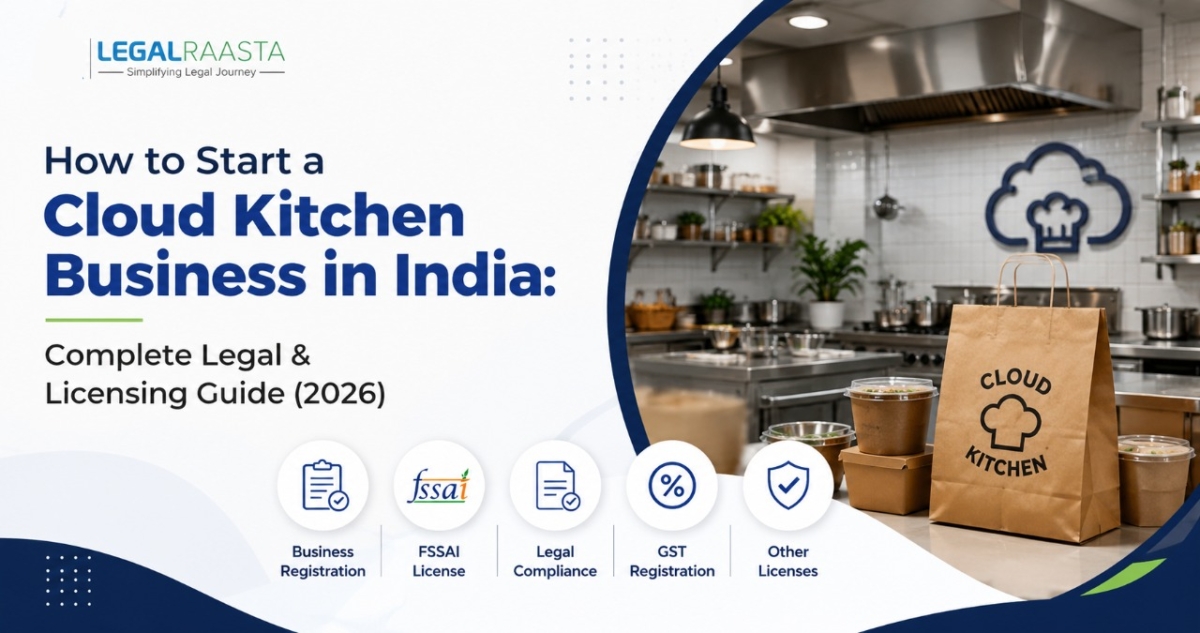
The delivery-only restaurant concept, also called a cloud kitchen, ghost kitchen, or dark kitchen, has revolutionized the food tech landscape in India. Cloud kitchens represent a very profitable route for culinary businesses, especially given their relatively low overhead.
But working on a food brand without proper legal frameworks can bring a halt to your operations, Municipal Agencies enforcing fines, and even blacklisting your name from major food delivery aggregators.
Successful implementation of a cloud kitchen involves problem-solving and systematic application of corporate zoning, food-based, and tax regulations. This thorough guide provides you with the detailed steps, legal, licensing, and compliance framework needed to start your cloud kitchen business in India successfully.
Choosing the Right Corporate Structure
You need to be recognised as a legal business entity before making an application for commercial connections or a food product licence. If liability issues come up, there is a high risk of a significant financial situation affecting your personal assets.
- Private Limited Company: This is the more traditional organizational structure for cloud kitchen apps that would like to go for a venture-capital round, launch in various states, or provide equity to co-founders.
- Limited Liability Partnership (LLP): Suitable for smaller, co-owned kitchens that would benefit from having limited liability protection but are not burdened by the annual compliance costs of a private limited company.
- Sole Proprietorship: For very small, home-based, single-city operation culinary businesses. There is no asset protection, and a limited ability to join national aggregators.
Mandatory Licensing Framework for Indian Cloud Kitchens
Your kitchen must obtain a pile of the required municipal and federal licenses to run the business legally, and pass the rigorous verification process required by delivery firms.
The Core Licensing Sequence
- Incorporate Your Business Entity: 7 to 10 Days.
Apply for registration of the business structure (Private Limited or LLP) on the MCA Portal to get back your Corporate PAN, Certificate of Incorporation, and TAN.
- Secure an FSSAI Food License: 15 to 30 Days.
Apply via the government’s FoSCoS portal. If the Annual turnover in the kitchen is less than Rs 12 Lakhs, then a basic registration is enough. Kitchens with more than this level require a State or Central FSSAI License, depending on their intended capacity and location.
- Obtain the Municipal Health Trade License: 15 to 45 Days.
Submit an application to your local municipal corporation or health department. This confirms that your kitchen area meets local public health, hygiene, and waste disposal regulations.
- Register Under the Shop and Establishment Act: 3 to 5 Days.
Register with the state’s labour department within 30 days of operation. The registration is a compulsory one and is used for managing employee working hours, wage payments, and formal employment terms.
Comparing Cloud Kitchen Business Models
Your long-term capital allocation, real estate needs, and local municipal compliance strategy will all depend on the Operational Model you select.
|
Basis of Comparison |
Independent Cloud Kitchen |
Multi-Brand Kitchen Model |
Shared Kitchen Space (Co-Working) |
|
Operational Blueprint |
Single-brand operating from a single dedicated kitchen space. |
Multiple internal brands are preparing different cuisines in one hub. |
Renting a pre-equipped cooking slot inside a third-party facility. |
|
FSSAI Licensing Depth |
Requires a single standard FSSAI license, mapping one cuisine type. |
Requires multiple brand additions under a single master FSSAI license. |
Each independent tenant must secure a distinct FSSAI license for the same address. |
|
Real Estate Capex |
Moderate; requires independent location sourcing and structural build. |
High initial setup cost, but optimized across multiple revenue streams. |
Extremely low; zero upfront equipment or structural buildout capital required. |
|
Aggregator Integration |
Single merchant profile setup on Swiggy and Zomato portals. |
Multiple distinct virtual storefronts linked to one corporate payout account. |
Independent merchant profiles with localized delivery geofencing. |
Tax and Intellectual Property Infrastructure
GST Registration for Restaurants
GST registration is required for all cloud kitchens that are planning to run their operations and sell food online. The government has set a direction for food delivery platforms to deduct Tax Collected at Source (TCS) on every order made. In the existing tax structure, a standalone cloud kitchen would be subject to the existing 5% flat GST rate, with no Input Tax Credit (ITC) benefit. By choosing 18% GST, your company will be eligible for ITC on raw materials, commercial rent, and machinery for the industrial kitchen.
Brand Trademark Protection
Your brand name, logo, and creative packaging are your biggest form of IP. All customer loyalty resides within your digital brand identity; cloud kitchens don’t have a location where it can be expressed. Your trademark will provide a degree of protection from competitors if they think they can replicate your menu or deceive your digital audience.
Operational Risk Mitigation Checklist
- Fire Department NOC: If electric fryers are heavy-duty or you are using commercial LPG cylinders or commercial chimneys in your kitchen, ensure you obtain a No Objection Certificate (NOC) from the local fire department to avoid unexpected structural damage.
- Exhaust and Waste Management: Use efficient commercial chimney hoods & oil-grease traps. Commercial kitchen waste that is dumped into municipal drains without processing results in huge Environment Board fines.
- Water Quality Testing: All water used in the preparation of food must meet FSSAI safety standards and is subject to microbiological testing annually. Make copies of the certified laboratory documentation readily available onsite.
Conclusion
Starting a cloud kitchen business in India requires a balance of culinary skills and regulatory knowledge. By locking your brand assets in the virtual world with the trademark registration, your kitchen is insured against operational interruptions, as well as against verification issues by local municipal health authorities.
Practice and concentration will go towards the menu and optimizing your kitchen throughput. Enlist LegalRaasta for enterprise enrollment and meals licensing to push your business launch and guarantee a flawless online storefront.
Frequently Asked Questions (FAQs)
-
What is the estimated FSSAI food license cost for an independent cloud kitchen?
The official government fee for an FSSAI state licence ranges from ₹2,000 to ₹5,000 per year, depending on the production capacity of your kitchen. Consultation fees are estimated and carried out by professionals, and are not included as part of the cost of the product.
-
Can I operate a cloud kitchen legally from a residential kitchen?
The operation of commercial food delivery services from residential areas is limited in most urban areas in India. A commercial location is necessary for municipal corporations to obtain the mandatory Health Trade License and commercial electricity meters.
-
Is a Fire NOC mandatory for every single cloud kitchen setup?
A Fire NOC is required if your kitchen has a certain volume of seating, a certain square footage, or a large commercial gas manifold in use. Local municipal regulations may still specify the need for minimum fire safety requirements and local clearance for small cloud kitchens.
-
How does GST registration for restaurants apply when selling via food delivery apps?
Without having a valid GSTIN, any e-commerce platform cannot register a food business legally. The aggregator collects and deposits the applicable GST directly with the government on the kitchen’s behalf every time a kitchen places an order online.
-
What happens if a competitor launches a virtual kitchen with a name similar to mine?
If you protected your brand name early on, you can send a cease and desist notice to give the competitor the “threat of second opinion” to call their virtual storefront by a different name, thereby preserving your digital brand equity.
-
Do I need separate licenses for each brand operating inside a multi-brand cloud kitchen?
Don’t worry, it’s not entirely separate licenses for each sub-brand. You can register your core business and several trading names or virtual brands with the same FSSAI and GST registration number.
-
What is the validity period of a municipal health trade license?
Municipal health trade licenses are usually issued for one financial year, and have to be renewed every year with the renewal fee, after routine health inspector checks.
-
Why do delivery aggregators reject cloud kitchen onboarding applications?
Generally, onboarding rejections occur if there is a mismatch in your FSSAI certificate and GSTIN, or due to uploading of poor resolution and non-compliant menu artwork.
-
Can an LLP structure be used for a cloud kitchen aiming for venture capital?
An LLP helps safeguard your personal assets, and personal investors—even institutional ones—preferably invest in Private Limited companies because share allotment and equity dilution are a breeze.
-
What are the legal penalties for running a cloud kitchen without an FSSAI license?
Penalty up to ₹5 Lakhs and imprisonment up to 6 months under the FSS Act may be imposed for running an unapproved food business.
Related Posts
Our Clients



Featured In