
Start a Food Truck Business in India – FSSAI License, GST & Registration Guide
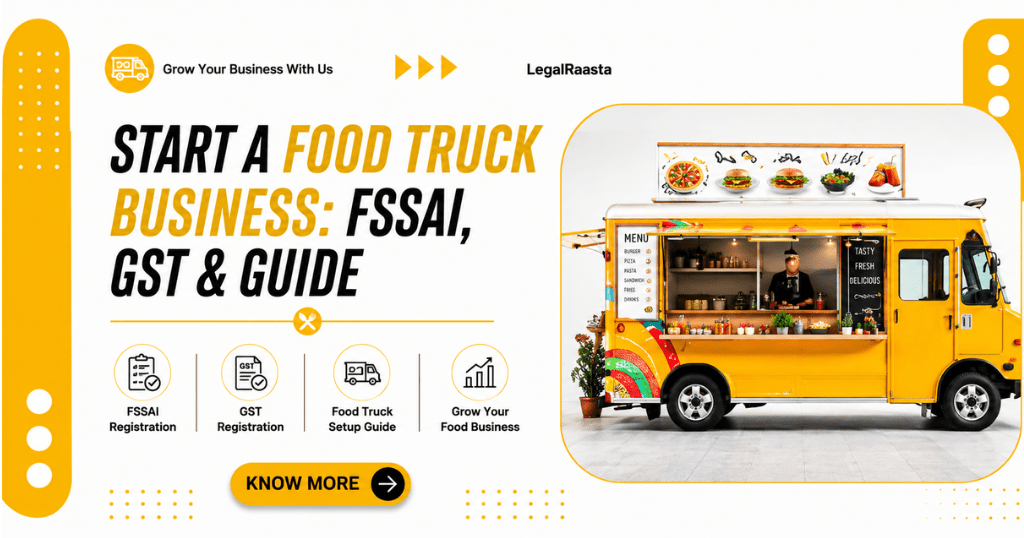
In recent years, the food truck business has experienced rapid growth. The demand for street food increased a lot, encouraging new entrepreneurs to create growth opportunities in the food business. Online food truck businesses offer a wide range of opportunities, with low-cost entry into the food industry. Planning to start your own food truck business in India? Starting a food business in India is an exciting adventure, but it requires careful planning, a complete structure, and compliance with regulations. That’s where food businesses require the FSSAI food license to operate legally. In this comprehensive guide, we will go through the process to know how you can start your own food truck business in India, including legal permits, FSSAI registration, and operational tips for successful establishment.
Why Choose a Food Truck Business in India?
Before commencing the food truck business plan in India, your first doubt will be why only this food startup? Well, starting the food business in India means low investment with high growth. Choosing this sector is advantageous due to significantly lower setup and rental costs. Here are the key reasons to choose a food truck business in India:
Lower Initial Investment
The cost of commercial space, such as for a restaurant, is much higher in India. But a food truck requires less investment, with lower capital. Even this business can be operated by buying a used vehicle.
High Mobility & Strategic Location
The food truck business operates on a specific vehicle, which means it can move anywhere, according to customers’ needs. A food truck can be run near corporate parks, colleges, or busy markets.
Lower Cost for Operating
Unlike restaurants, there is only a lower cost with a minimum of 2-3 staff to manage it.
Increase Priority of Hygienic Food
The current generation, millennials, and Gen Zs mostly prefer hygienic, high-quality, and unique food options.
Quick Growth
The demand in urban areas is higher where food trucks offer quick ROI and higher profit potential, often growing at over 8% annually.
Step-by-Step Process: Start a Food Truck Business in India
Step 1: Make a Food Truck Business Plan
To start a food truck business in India, the primary step is to define the niche. What will be the food item type in your food business menu (e.g fast-casual, artisanal, or specialized snacks)? Include the key objectives, like the launch date and specific, measurable, achievable, and time-bound goals. The menu must add at least 5-7 profitable items. Select a location that makes sense (office parks, breweries, or festivals). To start it, you further require specialized gear and equipment like a fryer, a generator, a POS system, etc. In the market analysis step, one must identify targeted customers, analyze competitors, and look at what food is trending in the targeted location. In the end, the financial projection includes startup costs, operating costs, revenue projection, and break-even analysis.
Step 2: Choose a Business Structure
Registering your food truck with the right business model is beneficial to gain a legal identity with tax benefits. In the current time, the LLP (Limited Liability Company) business structure is the most selected. Here is a breakdown of the best business structure for your food business:
- Limited Liability Company (LLP) (Recommended): Ideal to safeguard personal assets from business debts or lawsuits.
- Sole Proprietorship: No formal filing is required, as it is the easiest, cheapest, and fastest way to start a food truck business.
- Partnership: If you are planning to launch the food business with any other member, a partnership is the ideal option.
Step 3: License/Registrations Required
To start a food truck business in India, businesses are required to fulfill the food truck licensing requirements. Multiple government, state, and municipal permits are required before starting the process. The major licenses and registrations include:
|
License/Registration |
Requirement |
Issuing Authority |
Timeline to Obtain |
|
Udyam Registration |
It is mandatory to access the government benefits as a micro, small, or medium enterprise (MSME). |
Ministry of Micro, Small, and Medium Enterprises (MSME), Government of India. |
1–4 business days after verification. |
|
Shop & Establishment Registration |
Required to legally operate any commercial establishment |
State Labour Department or Local Municipal Corporation |
7 to 15 working days to receive the certificate |
|
FSSAI Registration |
Ensure compliance with hygiene and safety standards |
Food Safety and Standards Authority of India |
|
|
GST Registration |
Mandatory if the annual turnover exceeds ₹20 Lakhs (or ₹10 Lakhs in special category states). For online food delivery, GST registration is compulsory regardless of turnover. |
Goods and Services Tax (GST) Department |
7 working days without site verification and 8-10 working days with site verification |
|
Trade License |
Legal permission to operate in a specific locality |
Local Municipal Corporation (e.g., MCD in Delhi, BMC in Mumbai) |
15 to 30 days to receive the trade license |
|
Fire Safety NOC |
Safety clearance for LPG/electric cooking |
Local Fire Department |
15 to 45 working days in India |
|
Vehicle Registration (Commercial) |
Registration of the truck as a commercial vehicle |
Regional Transport Office (RTO) |
7 to 15 working days |
|
Pollution NOC (if applicable) |
Food processing and cooking activities are often classified under the “Orange” or “Green” category |
State Pollution Control Board (SPCB) of the respective state |
15 to 45 working days. |
Step 4: Apply for the FSSAI License for a Food Truck
The FSSAI Food License is one of the most frequently used legal documents for operating any food establishment within India. Operating a food truck without this license can leave you subject to severe penalties, including legal action from the food safety authority.
Type of FSSAI License
- Basic FSSI Registration: Basic FSSAI Registration—Required for very small food businesses (annual turnover limit—Rs. 12 lakhs)
- FSSAI State License: Medium-sized food businesses with yearly sales between Rs 12 lakh and Rs 20 crore
- FSSAI Central License: Required for larger food businesses (annual turnover items greater than Rs. 20 crores).
Required Documents
- Address and identity proof of the applicant
- Vehicle registration certificate (RC)
- NOC from the local municipality/traffic department
- Complete layout of a food truck
- Water testing report
- Food Safety Management System (FSMS) plan
Application Process
- Visit the FoSCoS portal: Access the site (go to FSSAI.gov.in)
- Fill Form A/B: Depending on the type of food establishment, business details, and the type of FSSAI License applicable to your business, based on your business turnover.
- Attach Documents: Along with your application, please provide supportive documentation and include a copy of your Food Safety Management Plan.
- Pay Government Fees: Pay the required fees online (Rs. 100 for a Basic FSSAI Registration and between Rs. 2,500 and Rs. 5,000 for an FSSAI Central License), depending on your business size.
- Inspection & Approval: The food inspector will schedule an appointment to inspect your food truck. License issued after satisfaction.
Note: Must display the 14-digit FSSAI number on the food truck.
Step 5: Choosing Vehicle & Equipment
It’s crucial to choose the appropriate vehicle for your food truck business, along with the necessary accessories. Here is everything you should know:
Vehicle Options & Customization
Tata 407 is considered the most selected, and others include Mahindra & Mahindra or Ashok Leyland vehicles. The size of trucks should be medium (12-20 ft) to large (20-30 ft). The cost of a new truck is Rs 5-8 lakh, but a used truck can cost 50-60% less. To modify the truck, the cost can be Rs 1-3 lakh (fabrication, stainless steel panelling, aluminium flooring, and paint).
Equipment & Infrastructure
- Kitchen Equipment: Gas stove/burner, refrigerator, deep freezer, exhaust hood, stainless steel worktops, and storage cabinets. The minimum cost is ₹1–2 lakh.
- Power Supply: The cost of a silent generator can range up to ₹1.4 lakh, and inverters, which cost nearly ₹24k, are crucial for uninterrupted power.
- Plumbing/Gas: Water tank (water system) and proper LPG cylinder connections (approx. ₹20k).
Step 6: Start-Up Costs for a Food Truck in India
Starting a food truck in India typically costs between Rs. 10 lakhs and Rs. 25 lakhs. Other major expenses are listed below:
- Vehicle & Customization: Rs. 5 lakhs to Rs. 15 lakhs
- Kitchen Equipment & Setup: Traditional equipment will generally range from Rs. 1 lakh to Rs. 2 lakhs, while specialized/high-end equipment will generally range from Rs. 2 lakhs to Rs. 3 lakhs.
- Raw Materials: The original inventory of food products (inventory for resale), packaging materials, and disposable materials typically costs between Rs. 20,000 and Rs. 40,000, depending on the quantity of food being sold.
- Staff Hiring & Salary: A typical food truck in India will hire 2-3 cooks/helpers, and their salaries will vary from Rs. 35,000 to Rs. 60,000 per month.
- Marketing & Launch: It generally costs around Rs. 30,000 quarterly to market your food truck business through social media.
Step 7: Documents Required for Food Truck Businesses in India:
The key documents you are required to provide include:
|
FSSAI License Certificate |
Ensures that you comply with specific food safety and hygiene benchmarks. |
|
RTO NOC & Vehicle Registration |
Registering a truck as a commercial vehicle is mandatory |
|
Fire Safety Certificate (NOC) |
It is issued by the local fire department. |
|
Local Municipal Authority NOC |
Get permission from your local municipality to operate in a particular area. |
|
GST registration certificate |
Compulsory if the total turnover exceeds the threshold. |
|
Identity & Address Proof |
Provide any one of them: PAN card, Aadhaar card, voter ID card, or passport. |
|
Insurance policy documents |
Vehicle insurance & kitchen equipment insurance. |
|
Medical Certificate |
Required of the employee to ensure that they are free from contagious diseases. |
|
Water Test Report |
Mandatory if using water for preparation. |
Step 8: Best Locations to Run a Food Truck Business
One of the most important steps is selecting the right location for your food business. The high-footfall metro cities like Mumbai, Delhi NCR, Bengaluru, Pune, and Hyderabad are ideal cities to operate food truck businesses. These cities are popularly known for targeting corporate hubs, famous markets, and university campuses. The best operational spots are:
- Corporate & Business Tech Parks: High demand for lunch options.
- Educational Institutes & Hostels: Good Location To Serve Immediate Low-Cost Snacks
- Residential Areas & Gated Colonies: You can inform your community about when you are at your location by sending them a message via WhatsApp on a daily basis or on specific days of the week.
- Malls & Popular Market Areas: Areas with large numbers of people passing through.
- Event Venues: Concerts, festivals, or Food Truck carnivals
Step 9: Operate Food Truck Legally
After completing all steps outlined above, you’ll now legally be able to start and operate a food truck within the area that has been specified. It is mandatory to maintain the standards throughout operation and keep the area clean and hygienic. Must comply with all safety and standards of FSSAI.
What are Common Challenges & How to Overcome Them?
The food business in India is profitable, but like any business, it comes with operational and legal challenges. But solving these issues early can help to minimize risks and enhance long-term success.
- Challenge: Local Authority & Municipal Restriction
Solution: Must obtain the municipal permission early and apply for all applicable trade licenses for your food truck business. Always operate from the location that is on your registration with the appropriate municipality (or other local authorities), and stay informed about the policies of the local corporation. Always operate from the location that is on your registration with the appropriate municipality (or other local authorities), and stay informed about the policies of the local corporation.
- Challenge: FSSAI and Compliance Problems
Solution: When opening a restaurant, the proper FSSAI food licensing is needed (i.e., basic / state / central), and you need to ensure your kitchen and other areas meet the safe food handling guidelines established by the FSSAI at the same time. Also, to maintain good hygiene in your operation, you need to be exacting in your food licensing requirements for renewing your license prior to the expiration date.
- Challenge: GST and Tax-Related Confusion
Solution: GST registration is needed for businesses with more than 20 lakh in revenue. In order to successfully bill clients and provide them with timely delivery, you need to utilize a good point of sale system (POS) and maintain a complete accounting system with the assistance of a qualified tax professional to ensure proper filing of GST returns on time.
- Challenge: Parking and Location Concerns
Solution: Develop appropriate communication with private property owners. For successful expansion, you must make sure to participate in food festivals and events (including identifying the food traffic at potential locations for legal/illegal usage).
- Challenge: Seasonal & Weather Impact
Solution: Leverage online orders & deliveries. During the monsoon, prefer to shift to indoor events and use seasonal menu strategies.
Final Discussion | Grow Faster with LegalRaasta Assistance
In essence, the guide explains that the food truck business in India is one of the most profitable, cost-effective, and scalable food ventures in today’s market. By leverging to a right business plan, registrations, and expert help, you can start your own food truck business without legal headaches. To streamline the business registration process and comply with legal laws, you must prefer LegalRaasta as your best companion for consultation. For more queries, visit www.legalraasta.com.
Frequently Asked Questions
- Is an FSSAI license compulsory for a food truck business?
Ans. Yes, the FSSAI license for food truck businesses is one of the most common certificates. Any business preparng, sellinr or distributing food with an FSSAI license must obtain the basic or state FSSAI license.
- What is the minimum investment required to start a food truck business in India?
Ans. The initial investment cost for a food truck business in India typically ranges between Rs 8 lakhs and Rs 15 lakhs.
- Is GST registration mandatory for food truck businesses?
Ans. If the annual turnover of the food truck business exceeds Rs 20 lakh (Rs 10 lakh in specific states), then GST registration is mandatory.
- Which license is necessary for a food truck business?
Ans. To lawfully operate the food business, required
- FSSAI license
- GST registration
- Trade license from the local municipality
- Commercial vehicle registration & insurance
- Fore Safety NOC
- Shop & Establishment registration
- Is the food truck business profitable in India?
Ans. Yes, a food truck business is most profitable if it is managed accurately and within regulatory guidelines.

Related Posts
 FSSAI License
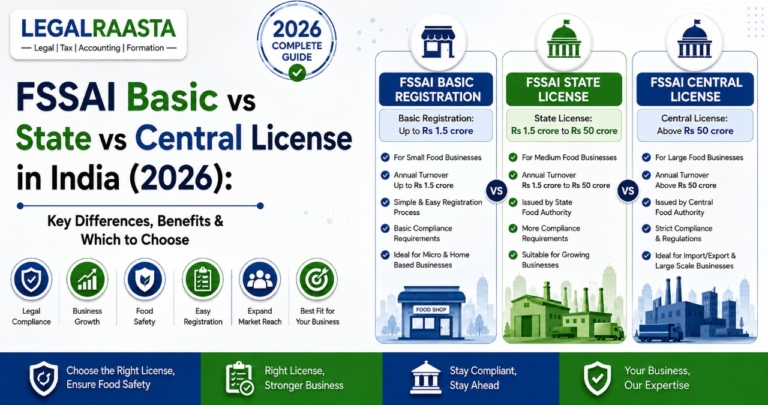
FSSAI Basic vs State vs Central License in India (2026): Key Differences, Benefits & Which to Choose
Read More →
 FSSAI License
How to Start a Bottled Water Business in India: Cost, Licenses & Setup Guide (2026)
Read More →
Our Clients








Featured In