
Advance Tax Deadline for FY 2025-26: Crucial 4th Instalment Guide
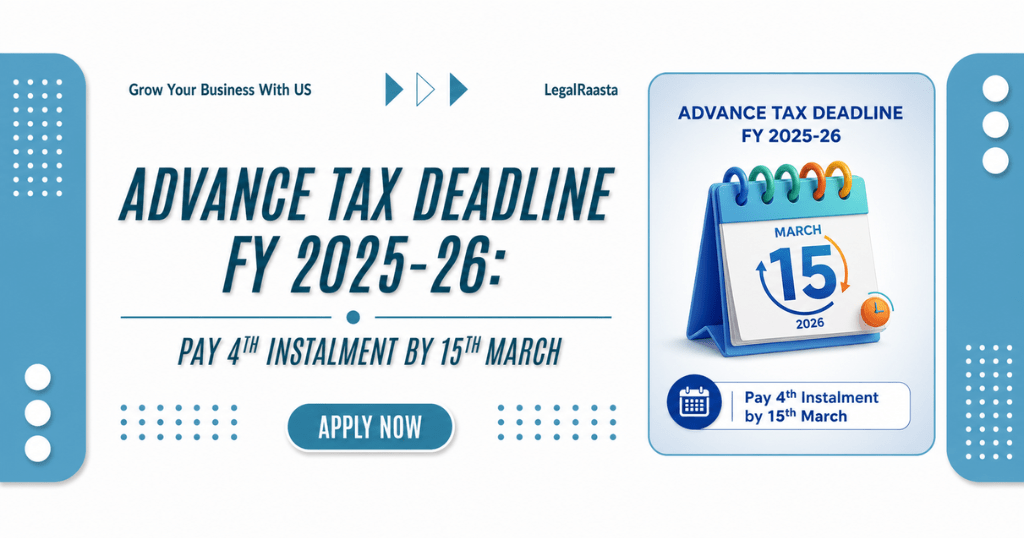
The Indian taxation landscape operates on a “Pay-as-you-Earn” scheme, ensuring that the government receives a steady flow of revenue throughout the financial year rather than a lump sum at the end. The Advance Tax Deadline of March 15, 2026, is the most important day in the calendar of the taxpayers, as we approach the end of the financial year (FY) 2025-26. It is the fourth and final installment day on which the taxpayers are expected to have paid off a 100% of their estimated tax payment for the year.
Missing this deadline is not a simple affair of paperwork; it sets the example of compulsory interest fees that can easily increase your overall tax liability. As a professional with a side income or a business owner, either with a salary or as a freelancer, it is important to understand the dynamics of this last window to stay financially healthy. Make sure your business remains legal and tax-free by seeking advice on matters of tax with the LegalRaasta experts today.
Understanding Advance Tax: Who Must Pay?
Advance tax is not a “special” tax but rather a method of paying your regular income tax in quarterly installments. The law mandates that if your total tax liability for the year, after accounting for Tax Deducted at Source (TDS) and Tax Collected at Source (TCS), is Rs 10,000 or more, you must comply with the Advance Tax Deadline schedule.
Applicability Across Profiles
- Salaried Individuals: Although the employers deduct TDS on salary, most of the individuals obtain extra income from house property (rent), capital gains on stocks/mutual funds, or in the form of interest on fixed deposits. When such other incomes drive the net tax payable in excess of Rs 10,000, advance tax is compulsory.
- Freelancers & Professionals: Writers, consultants, physicians, and lawyers who do not receive a uniform tax payment to one employer per month will have to estimate their income and pay taxes every three months.
- Business Entities: In addition to paying the advance amount of tax, all firms that are corporations and partnerships are obliged to pay advance tax, irrespective of the volume of income.
Advance Tax Liability Criteria by Taxpayer Category
|
Category |
Liability Condition |
Mandatory Action |
|
Individual (Regular) |
Net tax after TDS > Rs 10,000 |
Pay in 4 instalments |
|
Senior Citizens (60+) |
No income from Business/Profession |
Exempt from Advance Tax |
|
Freelancers (44ADA) |
Gross receipts up to Rs 75 Lakhs |
Pay 100% by March 15 |
|
Small Businesses (44AD) |
Turnover up to Rs 3 Crores |
Pay 100% by March 15 |
|
Corporate Entities |
Any taxable profit |
Pay in 4 instalments |
The 4th Instalment & Advance Tax Due Date AY 2026-27
The fourth instalment is unique because it requires 100% cumulative payment. Though the installment payments can be made in partial amounts (15%, 45%, and 75%, respectively), the Advance Tax Deadline of 15th March, 2026, is the ultimate deadline to be paid in full.
Presumptive Taxation: The Single Instalment Rule
In the case of those who choose the Presumptive Taxation Scheme at Section 44AD (businesses) or 44ADA (professionals), the regulations are not very complicated but very stringent. The first three installments are not necessary to be paid. But you are not allowed to pay the balance of 100% of your tax; you must pay it once and only at or before the deadline of March 15.
Official Advance Tax Schedule for FY 2025-26
|
Instalment No. |
Due Date |
Cumulative Percentage of Tax Liability |
|
1st Instalment |
15th June 2025 |
15% of estimated tax |
|
2nd Instalment |
15th September 2025 |
45% of estimated tax |
|
3rd Instalment |
15th December 2025 |
75% of the estimated tax |
|
4th Instalment |
15th March 2026 |
100% of estimated tax |
How to Calculate Advance Tax for FY 2025-26
To determine your liability, it is important that you estimate your annual earnings perfectly well. The final installment due date is the Advance Tax Deadline near the middle of March, so you should have a very clear vision of your annual income by this time.
Step-by-Step Workflow
- Estimate Gross Total Income: Sum up your salary, business profits, rental income, capital gains, and “Income from Other Sources” (interest, dividends).
- Apply Deductions: Each of those needs to claim deductions with regard to Section 80C (PPF, LIC, ELSS), 80D (Health Insurance), and so on. Note: If you have opted for the New Tax Regime, most of these deductions are not available.
- Apply Slab Rates: For FY 2025-26 (AY 2026-27), the New Tax Regime is the default. Under this regime, income up to Rs 4 Lakh is exempt, and there is a 5% rate for Rs 4-8 Lakh, 10% for Rs 8-12 Lakh, and so on.
- Subtract TDS/TCS: Check your Form 26AS or Annual Information Statement (AIS) to see how much tax has already been credited to your PAN.
- Final Net Tax: You are required to go to the portal for advance tax payment online instantly as long as the remaining amount is more than Rs 10,000.
These steps can be automated using an advanced tax calculator that is offered by the Income Tax Department or by professional online portals to make sure that you do not overlook any cess or surcharge that may apply to the high-income brackets.
Step-by-Step: Advance Tax Payment Online Process
The modern e-filing portal has made tax compliance significantly easier. You no longer need to visit a bank with physical slips; the advance tax payment online system is available 24/7.
The Digital Workflow
- Visit the Portal: Go to incometax.gov.in and click on the “e-Pay Tax” quick link.
- Verification: Type in PAN with a valid mobile number till verification when you get an OTP and tap OK to verify.
- Selection: After verification, select “Income Tax” and choose the Assessment Year 2026-27 (for FY 2025-26).
- Type of Payment: Select Advance Tax (100) as the “Minor Head.”
- Payment: Choose your preferred mode—Net Banking, Debit Card, or the Payment Gateway (which supports UPI and Credit Cards).
After the payment is successful, the Challan ITNS 280 or the receipt can be downloaded. Make sure that you keep the BSR Code and Challan Serial Number because you need them in the later part of the year when filing ITR.
The Cost of Delay: Penalties under Section 234B and 234C
Missing the Advance Tax Deadline is an expensive mistake. The Income Tax Department levies “interest,” which effectively acts as a penalty for using the government’s money for longer than allowed.
- Section 234C (Deferment Interest): This applies if you fail to pay the specific percentages by the quarterly due dates. The interest is 1% per month for the period of the shortfall. For the March 15 instalment, even a one-day delay results in a 1% interest charge for that month.
- Section 234B (Default Interest): This kicks in if you have not paid at least 90% of your total “Assessed Tax” by the end of the financial year (March 31). Interest is charged at 1% per month starting from April 1 of the Assessment Year until the date of payment.
‘What Happens If You Don’t Comply’
Beyond the 1% monthly interest, consistent non-compliance can lead to higher scrutiny of your tax returns. In severe instances of willful tax evasion, the department can start to prosecute, but only very large amounts and fraudulent filings are normally subject to this.
Common Filing Mistakes to Avoid
Some taxpayers have until the last minute of the Advance Tax Deadline, which causes avoidable mistakes:
- Wrong Assessment Year: One of the mistakes selected is the AY 2025-26. The right Assessment Year of 2026-27 is applied to the income earned between April 2025 and March 2026.
- Ignoring Capital Gains: Many forget to pay advance tax on the sale of property or shares. In the event that the gain accrued before March 15, it should be subject to the final instalment.
- AIS Mismatch: Always reconcile your estimates with your Annual Information Statement (AIS). If the government has a record of income you haven’t accounted for, your advance tax calculator results will be incorrect.
Exemptions: Who Can Skip the Deadline?
The Advance Tax Deadline is mandatory in most cases; the law offers some relief to some populations at a disadvantage:
- Senior Citizens: Resident individuals (60 years or older) who have no Profits and Gains of Business or Profession are exempt. They only pay taxes on the final return by using the income from their pension, rent, or interest.
- Below Threshold: If your net tax liability (Total Tax – TDS) is less than Rs 10,000, you are not a “defaulting” taxpayer and can pay the balance as Self-Assessment Tax during ITR filing.
Why Compliance is Complex (The LegalRaasta Advantage)
It is difficult to estimate an annual income in a volatile economy. In the case of business, to compute the application of the advance tax slab in different heads of income, a technical skill is required so that you do not pay less (penalties) or pay excessively (freeze up your operating timeline).
DIY Tax Management vs. LegalRaasta Expert Assistance
|
Feature |
DIY Approach |
LegalRaasta Advantage |
|
Accuracy |
High risk of missing new 2026 slab updates |
100% accuracy with the latest tax amendments |
|
Calculation |
Manual or basic online tools |
Comprehensive tax planning to optimize liability |
|
Penalties |
High risk of 234B/234C interest |
Proactive reminders to ensure zero interest |
|
Documentation |
Needs manual tracking of 26AS/AIS |
Integrated reconciliation with government data |
Conclusion: Securing Your Financial Status
With the coming of the Advance Tax Deadline of March 15, 2026, there is no doubt: calculate and donate. The installment payment of taxes is not only a legal requirement but also a wise financial practice that will help avoid a huge outlay of cash during the tax-filing season in July.
It will save you the corrosive 1% monthly interest on 100% liability and keep you on the good side of the Income Tax Department by making sure your 100% liability is received by mid-March. Get in touch with the LegalRaasta Team to help with a tax filing and tax planning end-to-end, so you don’t have to worry about your finances this assessment year.
FAQs
- What is the due date for the advance tax for the final instalment?
The Advance Tax Deadline for the fourth and final installment of FY 2025-26 is March 15, 2026, requiring 100% payment of your estimated tax liability.
- What if I pay the advance tax 1 day late?
Failure to remit the Advance Tax Deadline will result in the imposition of interest at 1% per month on the shortfall amount, subject to Section 234C.
- How to pay advance tax for AY 2026-27?
You will be able to pay the advance tax online and go to the official e-filing portal, and then choose Challan 280 out of the 100 minor heads.
- Who is eligible for advance tax in India?
According to the advance tax deadline India rules, any taxpayer whose total tax liability exceeds Rs 10,000 after TDS must pay in installments.
- Is it mandatory to fill advance tax for salaried employees?
Yes, when a salaried individual has other sources of income, e.g., rent, the Advance Tax Deadline applies, provided the net payable tax is more than the Rs 10,000 threshold.
- Can I use an advanced tax calculator for precise results?
To calculate your quarterly liabilities with some accuracy and avoid the interest penalties noted in the Income Tax Act, an advance tax calculator is strongly suggested.
- Can I pay advance tax in one installment?
Taxpayers under the presumptive scheme can pay 100% by the Advance Tax Deadline of March 15th in a single, consolidated payment.
- How to check if advance tax is applicable to my business?
Review your advance tax slab and total estimated profits; if the resulting tax after TDS is over Rs 10,000, you must comply with the quarterly schedule.
- How to pay advance tax offline if I miss the online window?
While the Advance Tax Deadline remains the same, you can pay offline by submitting a physical Challan 280 at authorized bank branches.
- Is the advance tax due date extended for March 2026?
Currently, there is no notification that the advance tax due date has been extended past March 15, 2026, so immediate payment is advised to avoid interest.

Related Posts





Our Clients








Featured In