
22 Best PSARA License FAQs: Complete Registration Guide 2026

Running a private security agency in India in 2026 is subject to the application of the strict rules and requirements provided by the Private Security Agencies Regulation Act (PSARA). With the increasing need to have professional surveillance and protection of assets in the corporate and residential sectors, the government has stepped up the verification and training requirements to prevent crimes against the people.
Getting a PSARA license is not merely a matter of law; it is also a recognition of credibility, which will enable your agency to operate lawfully in various districts and states. The police verification and training tie-up can be a tricky process; however, with professional guidance, registration can be completed without problems.
Collaborate with LegalRaasta to speed up your PSARA license application and ensure 100% regulatory compliance of your security company.
1. What is a PSARA License?
A PSARA License is an obligatory legal license granted by the state government that enables an organization to perform the duties of a private security agency. This security agency license will make sure that the firm adheres to all the standards of operations and training.
2. What is the full form of PSARA?
The full form of PSARA is the Private Security Agencies Regulation Act, 2005. It is the main law in India, according to which the work, training, and hiring of security employees of private organizations are regulated in all the states and union territories.
3. What is the purpose of the PSARA License?
The idea behind this is to control the private security sector and make sure that only approved agencies are in the game. A PSARA registration will guarantee that the security guards are effectively trained and that they have clean criminal backgrounds to be safe with the public.
4. What are the different types of PSARA License?
Depending on the area of operation, the license is classified as such: a single district license, a license that covers up to five districts, or a license that covers the whole state. Agencies need to select the type that is best suited to their line of business, future growth, and service territory.
5. What are the benefits of PSARA?
Any legitimate license creates credibility, opens the opportunity to compete on government tenders, and provides legal conformity. It also gives the right to offer trained security guards, which adds more confidence among corporate and residential customers in India.
6. Who is required to obtain a PSARA License?
Any individual, partnership firm, LLP, or company engaged in security services such as bouncers and guards should apply. This is a compulsory security certification that every company must have when it charges customers to offer them manpower as a means of providing safety and surveillance.
7. Is a PSARA License mandatory for security agencies?
Yes, it is a strict requirement according to the Private Security Agencies Regulation Act. An agency is not legally permitted to hire guards, enter into contractual relationships with clients, or promote its security services in any of the Indian states without such a legal security permit.
8. Can I operate my security agency without a PSARA license?
No, operating without a license is a criminal offense in India. A security company that is not licensed is exposed to immediate closure of business, massive financial sanctions, and the directors or owners may also be imprisoned and deemed to have contravened the central and state statutes.
9. What are the eligibility criteria for obtaining a PSARA License?
The candidate should be an Indian national and should not be below 18 years of age with a clear criminal record. The business is expected to possess a registered office address and a tie to a training institute recognized by the government regarding its security personnel.
10. How can one apply for a PSARA License?
The application is submitted via a Web-based system via the PSARA portal of the respective state. It is done through filing Form I to PSARA, after which the promoters are checked by the police, and the office and training facilities utilized by the agency are verified.
11. What documents are required for obtaining a PSARA License?
The major documents are the Certificate of Incorporation, PAN, GST registration, and the Memorandum of Understanding with a training institute. There should also be identity proofs, police verification reports, and uniform samples of the guards, which should be presented to the controlling authority.
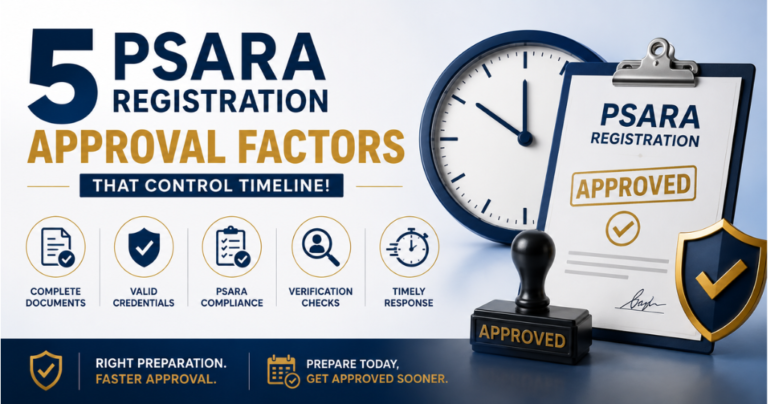
12. How long does it take to get a PSARA License?
This procedure normally requires a duration of between 45 and 60 days. This schedule will heavily rely on how fast the police verification will be carried out, which is a very crucial process prior to the license being officially granted by this controlling authority.
13. What is the fee for the PSARA License?
One district has a government fee of Rs 5,000, five districts have a fee of Rs 10,000, and the entire state has a fee of Rs 25,000. These PSARA government charges should be remitted during the application submission to the state controlling authority.
14. What happens if my PSARA license is canceled or suspended?
Suspension means that any agency should cease operations and seek to resolve the non-compliance concerns. The PSARA license cancellation may result in blacklisting, which is the inability of the owners to obtain a new license or provide security services for several years.
15. What are the consequences of operating without a PSARA License?
It may cause the closure of office premises and trigger the filing of an FIR because of operating illegally. Customers who employ the services of an unregistered security agency are also subject to legal liability, because the security agency does not have any form of officiality or ideally certified employees.
16. What are the penalties for not obtaining a PSARA license?
Fines of between Rs 10,000 and Rs 25,000 or even more, according to the state, are one of them. Moreover, disobeying employees can lead to a jail sentence of up to one year; thus, penalizing the lack of registration/compliance with the standards can be significantly more expensive than actually registering.
17. What is the validity of the PSARA License?
In the majority of the states, the license will be effective within five years after it has been issued. But in some states, such as Uttarakhand or Chhattisgarh, the period of the validity of the security license might be held to one year, and thus the license has to be renewed frequently in order to allow it to be in use.
18. Is it necessary to renew the PSARA License?
Yes, it is compulsory to extend operating beyond the expiry date; renewal is required. To prevent the inconvenience of discontinuing its services, the PSARA license renewal application must preferably be submitted 45 to 90 days before the expiration date of the current license.
19. Can a PSARA License be transferred?
No, there is no such thing as a PSARA License assigned to be transferred among individuals or between various business entities. Should the ownership structure be significantly altered, then a re-filing of a PSARA application would be required to capture the new management and maintain legal compliance.
20. What are the key responsibilities of a private security agency with a PSARA License?
Some of the responsibilities include keeping a register of all guards, supplying compulsory training, and making sure that uniforms are also different. An agency that is PSARA compliant should also have its supervisors (one supervisor per 15 guards) and have the staff background checks conducted on a routine basis.
21. Can a foreign company apply for a PSARA License?
No, the Act overtly limits the granting of licenses to Indian citizens or companies in which the majority share will consist of Indian citizens or companies. Although FDI in private security is permitted to 49%, management and major control should be among the citizens of India.
22. Is the PSARA License valid across India?
No, the license is a state-specific license, and it can only work in the state where the license is issued. In order to conduct business in more than one state, an agency should also have a different state PSARA license in the controlling authority of each respective state.

Related Posts





Our Clients







Featured In