Strike Off vs Winding Up: Complete Legal Guide to Company Closure in India 2026
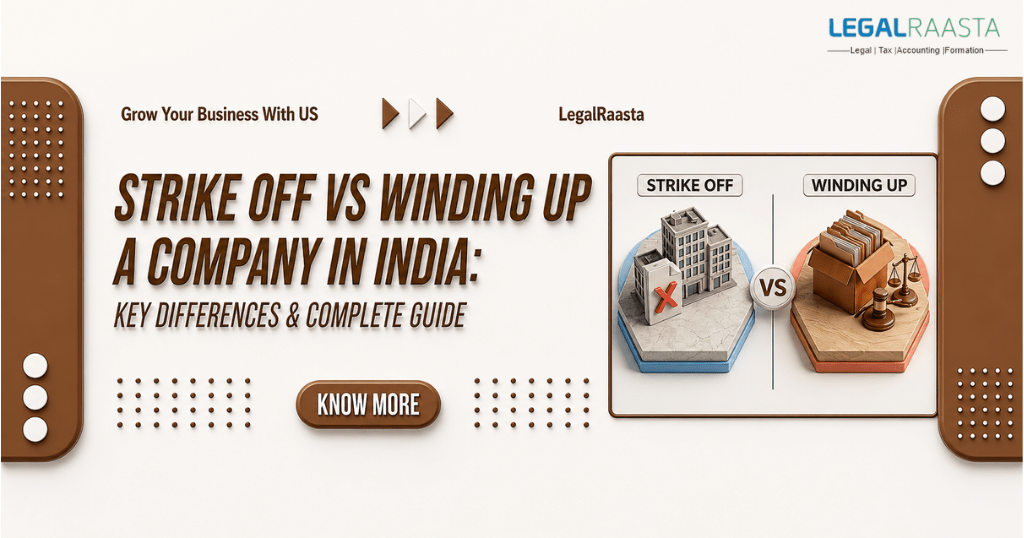
The decision to shut down a business is just as strategic as the decision to open one in the dynamic corporate environment in 2026. The Ministry of Corporate Affairs (MCA) offers two major options for quitting: Strike Off vs Winding Up, whether a startup is terminated or a larger company begins to restructure its business. Although both of these result in the termination of the legal existence of a company, their routes significantly differ in terms of the level of complexity, legal investigation, and financial consequences. Selecting the incorrect approach may result in years of litigation, “Director Disqualification,” or incurring hefty fines under the Companies Act, 2013.
By 2026, these processes will have been optimized by the introduction of the Fast-Track Exit (FTE) 2.0 and the digitalization of the National Company Law Tribunal (NCLT). It is no longer merely a liquidator thing, but an integral part of being a director and a shareholder to have a clear exit strategy; it is no longer known as Strike Off vs Winding Up in India because of the technical nuances to this application. To ensure a smooth and legally safe closeout of your business, leave your MCA filings and strike-off paperwork to the compliance experts at LegalRaasta.
What is the Strike Off of a Company? (The Fast-Track Exit)
The Strike Off process is simply the administrative deletion of the name of a company on the Register of Companies, which is kept by the Registrar (ROC). This is the most favored option in 2026 and is used in situations where the company has died out or the company never started operating.
Legal Basis and 2026 Updates
Under Section 248 of the Companies Act, 2013, a strike off is intended to be applied to companies that are either dormant or have zero assets and liabilities. Most recent 2026 regulations have further automated the official MCA STK-2 form to permit 90-120 day closures, as long as annual filings are current.
When is Strike Off Opted?
- No Business Activity: The company has yet to establish business after a period of one year of incorporation.
- Inactivity: The company has not done any business during the last two financial years, or has not filed an application for Dormant Status.
- Zero Liabilities: The company has cleared all its debts and also received a No Objection Certificate (NOCs) from the creditors.
Advantages of Strike Off
- Cost-Effective: The government charges are minimal when weighed against the high prices of a liquidator.
- Speed: It is quicker than the winding-up process, which may require years.
- Minimal Compliance: Does not presuppose the need for the appointment of a professional liquidator or major court hearings.
What is the Winding Up of a Company? (The Comprehensive Exit)
Winding Up is a stricter “judicial” or more properly, statutory process in which the assets of the company are sold to dispose of the debts of the company. It is the sole choice of companies that are characterized by 1) substantial assets, 2) complex liabilities, or 3) are in a state of insolvency.
Types of Winding Up in 2026
- Voluntary Winding Up: A voluntary liquidation initiated by shareholders under the Insolvency and Bankruptcy Code (IBC) 2016. It is selected in cases where the firm is solvent, but the owners desire to cease its operations.
- Compulsory Winding Up: It is a process initiated by the NCLT (National Company Law Tribunal) based on various reasons, such as the inability to settle debts, the company’s special resolution, or acting contrary to the sovereignty of India.
The Role of the Liquidator
Winding up, as opposed to a strike off, entails the use of an Insolvency Professional (IP) or an Official Liquidator. They are tasked to assume possession of all their assets and to pay off all their workmen and secured creditors, and then proceed to share the rest of the surplus with the shareholders.
Advantages of Winding Up
- Legal Finality: This gives the full settlement of all the claims, such that none of these claims will become a ghost liability in the future.
- Creditor Protection: Ensures equitable and clear distribution of assets among the stakeholders.
Strike Off vs Winding Up: The Ultimate 2026 Comparison
Strike off vs Winding up in India, big decisions are left out of your balance sheet. The major distinctions are emphasized in the table below.
Technical Comparison of Closure Methods
|
Feature |
Strike Off (Section 248) |
Winding Up (IBC / NCLT) |
|
Legal Nature |
Administrative Action by ROC |
Judicial/Legal Process |
|
Complexity |
Simple & Straightforward |
High & Procedural |
|
Applicability |
Inactive/Defunct Companies |
Active Companies with Assets/Debts |
|
Professional Involved |
Chartered Accountant / CS |
Official Liquidator / Insolvency Prof. |
|
Timeline |
3 to 6 Months |
1 to 2 Years (minimum) |
|
Cost |
Low (Govt. Fee + Basic Prof. Fee) |
Very High (Liquidator % + Legal Fees) |
|
Status of Assets |
Must be zero/disposed of before filing |
Assets are sold during the process |
|
Reinstatement |
Possible via NCLT appeal (up to 20 yrs) |
Once dissolved, it is permanent |
The Step-by-Step Process for Strike Off (2026 Workflow)
Should you choose to have a striking off company vs winding up as the correct way to deal with your defunct business, use the following streamlined 2026 workflow:
- Board Meeting & Resolution: Hold a board meeting to authorize a resolution to strike off the name.
- Shareholder Approval: 75% of the members (by the paid-up share capital) must give their approval through a Special Resolution.
- Extinguishing Liabilities: Pay all outstanding dues, utility bills, and statutory taxes.
- Preparation of Documents:
- Form STK-4: An affidavit by every director.
- Form STK-3: An indemnity bond.
- Statement of Accounts: Certified by a CA, not older than 30 days from the filing date.
- Filing Form STK-2: Submit the application to the MCA at a fee (in 2026, this amount is Rs 10,000).
- Public Notice (STK-5/6): A public notice of invitation of objections to the movement is published in the ROC for the view of the citizens and regulatory agencies (Income Tax, GST, RBI, etc.).
- Dissolution (STK-7): In case of no objection through responses within the set time, the ROC removes the name on the list and announces it in the Official Gazette.
The Procedural Workflow for Winding Up
In cases where winding up is required because there are operations or liabilities that continue, the procedure is much more complex:
- Petition/Resolution: An application is made to the NCLT (petition), or voluntary liquidation is resolved by way of special resolution.
- Appointment of Liquidator: A liquidator is appointed to assume control of the affairs of the company within 7 days.
- Public Announcement: The liquidator publicly announces the liquidation in the newspapers and invites creditors to write-in claims.
- Asset Liquidation: The liquidator recovers the value of all assets of the company (machinery, property, IP).
- Settlement of Claims: Dues shall be paid in priority of preference:
- Liquidation Costs > Secured Creditors/Workmen Dues > Unsecured Creditors > Shareholders.
- Final Report: The liquidator submits a final report to the ROC and NCLT.
- Dissolution Order: NCLT issues a final acceptable order of dissolution, which terminates the existence of the company under the law.
Cost Comparison: Strike Off vs Winding Up in India
The factor that normally decides for many of the SMEs and new businesses is financial burden.
Estimated Expenditure (2026 Standards)
|
Expense Head |
Strike Off Route |
Winding Up Route |
|
Government Filing Fees |
Rs 10,000 (Standard) |
Rs 25,000 – Rs 50,000 (Initial) |
|
Professional/Legal Fees |
Rs 15,000 – Rs 30,000 |
Rs 1,50,000 – Rs 5,00,000+ |
|
Liquidator Charges |
N/A |
% of Asset Realization (Regulated) |
|
Public Notices |
Minimal (Digital) |
High (Multiple Newspaper Ads) |
|
Audit/Accounting |
Basic Statement of Accounts |
Full Statutory Audits for 5+ years |
Legal Compliance and Implications for Directors
The consequence of not heeding the Strike Off vs Winding Up decision may have serious personal repercussions on directors. The MCA incorporates AI-powered surveillance to monitor Ghost Companies in 2026.
- Director Disqualification: Directors can be disqualified (temporarily banned on a 5-year basis) with their DIN (Director Identification Number) deactivated in the event that a company is struck off by the ROC Suo-Motu (on non-filing basis).
- Personal Liability: After the striking off of a company, pursuant to section 248(7), the liability of all directors and officers remains and can be enforced in the manner in which the company has not been dissolved.
- Tax Clearances: In both processes, one is required to get a Clean Chit issued by the Income Tax department. This is performed through the Integrated Compliance Portal in 2026, which has a connection between the GSTIN and PAN.
Which Should You Choose? A Decision Matrix
The following is a short checklist that you can use to complete the decision between Strike Off vs Winding Up in India:
Decision Matrix
|
Scenario |
Recommended Method |
|
The company has no assets and no debts. |
Strike Off |
|
The company has been inactive for over 2 years. |
Strike Off |
|
The company is solvent but has assets to sell. |
Voluntary Winding Up |
|
The company is insolvent and cannot pay its creditors. |
Compulsory Winding Up (IBC) |
|
Internal disputes between shareholders. |
Winding Up |
Common Pitfalls to Avoid in 2026
- Filing with Pending Litigations: You cannot use this application for a strike off in case any investigation or inquiry is ongoing against the company.
- Inaccurate Statement of Accounts: When the statement of accounts certified by the CA has been discovered to be a false statement, the company may be restored, and the directors charged with fraud.
- Neglecting Annual Filings: You are not allowed to file a strike off without the annual filing of AOC-4 and MGT-7 being duly filed as at the end of the financial year during which operations of the company have been terminated.
Conclusion: Strategic Exit for a New Beginning
To find a middle ground in the discussion between Strike Off and Winding Up, there is a need to weigh between speed and legal security. Although the strike-off route brings on board a “Fast Track” approach to dormant entities, winding up is the gold standard in active businesses to make sure that all liabilities are captured.
With the recent digitization of the MCA obtention in 2026, the procedure has become more transparent, yet the legal issues are quite complicated. Today, you can entrust your company’s closure with the professional soundness that only LegalRaasta can guarantee, keeping your directors off the disqualification list and having your venture leave the scene in a clean manner.
FAQs
-
What is the main difference between Strike Off and Winding Up?
The fundamental difference between Strike Off and Winding Up is complexity; Strike Off is applied to inactive firms through an administrative winding up, and Winding Up is applied to active firms through a legal winding up of assets.
-
Can an active company apply for Strike Off vs Winding Up in India?
As a rule, the option of strike off company vs winding up shortcut is not available to an active company; the company has to put a halt to its business operations within two years or liquidate all its business.
-
Is Strike Off vs Winding Up cheaper for a startup?
In the case of a small startup, when it has no assets, the Strike Off vs Winding Up comparison would always lean towards the former, since there is no need to incur the expensive costs of seeking the services of a liquidator.
-
What happens to assets in Strike Off vs Winding Up?
The division of assets in the case of Strike Off vs Winding up in India is such that, before Strike Off, there is a need to divide such assets, but in Winding up, they are sold by the liquidator to creditors.
-
How long does Strike Off vs Winding Up take in 2026?
When comparing Strike Off and Winding Up models with the strike off company vs winding up timeline, Strike Off consumes 3-6 months in completion, and Winding Up consumes 12-24 months through the NCLT model.
-
Can creditors object during Strike Off vs Winding Up?
Yes, and under both routes, Strike Off vs Winding Up in India, the ROC or Liquidator places a notice in public where objections by creditors may be made within 30 days.
-
Is director disqualification possible in Strike Off vs Winding Up?
Yes, provided that you take the wrong Strike Off vs Winding up route, or you turn a blind eye to filings, then the ROC can start a 5-year disqualification period of directors under Section 164.
-
What is the role of Form STK-2 in Strike Off vs Winding Up?
The particular application that directors should use is the strike off company vs winding up, which is form STK-2 to request the removal of the name of the company voluntarily.
-
Can a struck-off company be restored in Strike Off vs Winding Up?
In contrast with the Strike Off vs Winding Up in India, it is final with winding up; a struck-off company may be restored by the NCLT within 20 years under the condition of filing a grievance.
-
Do I need a liquidator for Strike Off vs Winding Up?
The strike off company vs winding up comparison shows that under Winding Up, a liquidator is thoroughly obligatory, whereas under voluntary Strike Off, there is no necessity.

Related Posts



Our Clients





Featured In