AI Startup Registration in India: Complete Legal & Compliance Guide 2026
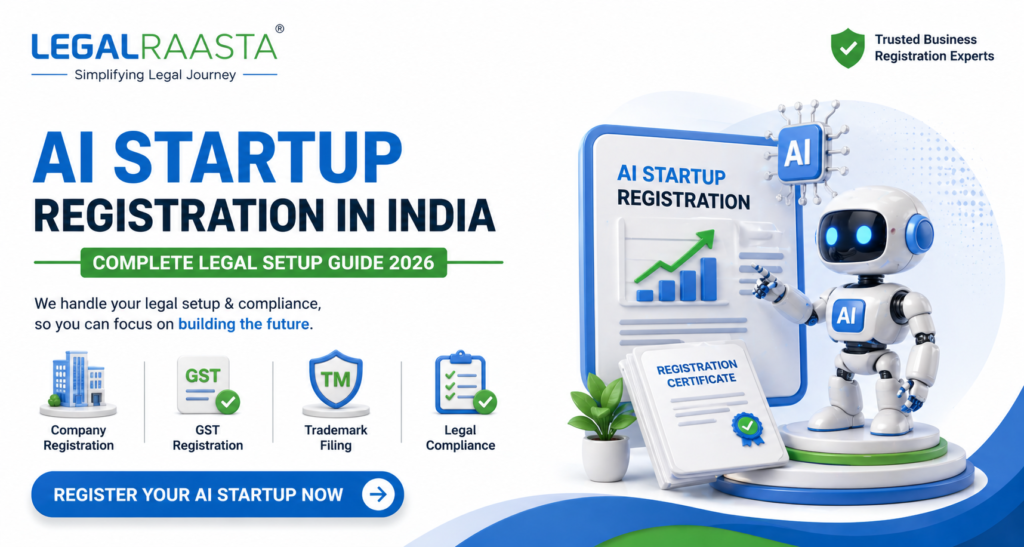
2026 is a landmark year for India’s tech startup ecosystem. The launch of the India AI Mission and the finalisation of the Digital Personal Data Protection (DPDP) Rules, 2026, regulations have moved the threshold for the AI industry from “coding” to “compliance and innovation”. An AI Startup Registration today is no longer just about certification; it’s about creating a scalable business structure, robust enough to handle big data, and attracting international venture funding.
LegalRaasta is your one-stop solution to navigate the AI regulatory scenario of 2026, with a focus on speedy company incorporation, DPIIT recognition, and cutting-edge IP Protection.
Introduction to AI Business Registration in India
India has emerged as the global laboratory for “AI at scale.” As of April 2026, the ecosystem has transitioned from simple wrappers to sovereign foundational models.
- Explosive Growth of AI Startups: The AI market in India is expected to grow to $17 billion by 2027. This is also reflected in the Union Budget 2026-27, which sees the “Creative Orange Economy” and Deep Tech as key engines of growth.
- India AI Mission (₹10,300 Cr): A massive government investment now fits into the budget of registered startups to afford access to more than 38,000 GPUs that have long been a “compute barrier” for Indian tech innovators.
- Legal Identity: To access the IndiaAI Marketplace and the AI Kosh (National Data Management Platform), your company must be registered for AI.
- How LegalRaasta Helps: We offer a “Techno-Legal” solution. We not only process your forms, but we also draft your Memorandum of Association (MoA) and Articles of Association (AoA) to account for AI-specific activities, which is a prerequisite for special government grants.
Why You Should Register Your AI Business
The regulatory landscape makes being an “unregistered developer” a risky move, particularly in terms of data liabilities.
- Data Fiduciary: Registered firms under the DPDP Act 2026 have the guidance for “Purpose Limitation”. Registration blocks the Single Owner’s unlimited personal liability risks of data breaches in a proprietorship.
- Increasing Investor Confidence: Institutional Investors and AIFs (Alternative Investment Funds) now seek AIMS (Artificial Intelligence Management Systems), ISO/IEC 42001. The first milestone towards this international gold standard is a Private Limited structure.
- Funding & Tax Advantages: The increase in the time limit for recognition of a Deep Tech Startup (to 20 years) and tax holiday (80-IAC) are only accessible to a registered Deep Tech Startup.
- Compute Subsidies: The government offers Compute Subsidies for GPUs for about ₹65 per hour to companies with a valid AI Startup Registration and DPIIT certificate.
Choose the Right Business Structure for AI
Your entity type in 2026 determines your level of “Gestation Period” and “Turnover Cap” support.
|
Structure |
Suitability for AI |
2026 Benefit Threshold |
|
High (Mandatory for VC) |
Can issue ESOPs; 100% FDI via automatic route. |
|
|
Deep Tech Startup |
Elite (New 2026 Category) |
₹300 Cr turnover cap; 20-year recognition. |
|
Medium (Best for Service) |
Lower compliance; no audit up to ₹40L turnover. |
|
|
OPC / Partnership |
Low (Sole Founders) |
Limited scalability; ineligible for most AI grants. |
Mandatory Registrations for AI Businesses
To access all benefits under the 2026 regime, the AI business registration online needs to be in order:
- Business Registration: Obtain your CIN, PAN, and TAN through the MCA SPICe+ portal.
- DPIIT Startup Recognition: Essential for “Self-Certification” under 9 labour and environment laws.
- Deep Tech Classification: A new 2016 requirement for R&D focused companies to receive R&D intensive funding.
- GST Registration: Essential if you are exporting digital services and claiming Input Tax Credit (ITC) on expensive Hardware/server.
- Import Export Code (IEC): Mandatory for using global credit cards for cloud services (Amazon Web Services (AWS) / Microsoft Azure) and exporting AI-as-a-service (AIaaS).
Trademark, Copyright & Patent Protection
In the age of Generative AI, Intellectual Property (IP) is your only moat.
- Trademark Registration: Protect your brand name and the unique names of your AI models/LLMs.
- Copyright for Source Code: Needed to protect the “literary” expression of your algorithms and datasets.
- Patents for AI Innovations: The IndiaAI Mission recently announced fast-track patent processing for those that depict “Technical Advancement” other than “Mathematical Method” in AI patent applications.
- IP Strategy: We assist with creating “Trade Secret” agreements for your weights and “System Prompts”.
Legal & Data Privacy Compliance for AI Startups
The DPDP Act 2026 has established rigorous “Data Fiduciary” compliance requirements for all AI businesses:
- Consent Management: AI models that are developed using personal data must maintain consent logs for all granted consent.
- Synthetically Generated Information (SGI): As required by the Feb 2026 amendment by the MeitY, all content generated by AI must be tagged with metadata (visible for 10% of the content duration).
- Data Protection Impact Assessment (DPIA): Significant Data Fiduciaries need to undertake annual reviews of the risk to personal privacy.
- ROC & Tax Filings: Meeting annual MGT-7 obligations, and keeping your AI company registration online in “Active” status for GST.
The “Deep Tech” Category: New 2026 Policy Reforms
India’s Department of Promotion of Industry and Internal Trade (DPIIT) announced a historic change in its startup policy framework on February 6, 2026. This marks the first instance where AI startups will be officially recognised as a distinct “Deep Tech” category.
- Longer Recognition Cycle: While startups are normally recognised for 10 years, the new AI and Deep Tech companies will now be recognised for 20 years. This is reflective of the extended R&D timeframes for building fundamental AI models.
- Turnover Thresholds: The annual turnover threshold for Deep Tech has increased to ₹300 Crore, enabling AI scale-up companies to benefit from tax and other regulatory incentives for a longer period.
- Qualification Criteria: To receive this status during your AI business registration online, you would need to show a high proportion of R&D expenses and have new Intellectual Property (IP) assets.
IndiaAI Mission: Subsidised Compute for Registered Startups
The most significant expenditure for an AI startup is on hardware. The government has made world-class infrastructure available to all under the ₹10,300 Crore IndiaAI Mission.
IndiaAI Mission Compute Access (April 2026)
|
Feature |
Benefit for Registered AI Startups |
Eligibility |
|
GPU Access Price |
₹65 per hour (Standardised) |
Valid DPIIT Startup Certificate |
|
Available Capacity |
Over 38,000 GPUs (Target: 100k) |
Verified AI Startup Registration |
|
AI Kosh (Data Kosh) |
Access to 9,500+ Indic Datasets |
Non-disclosure agreement (NDA) |
|
Cloud Credits |
Up to ₹50 Lakhs in subsidised credits |
MSME/Udyam Registered |
This long hole alone can slash the operating cost of an AI startup by 70%, making early entry into AI company registration in India a smart investment.
The DPDP Act 2026: Mandatory Guardrails for AI
The Digital Personal Data Protection (DPDP) Act is now fully operational, and AI startups are now “Data Fiduciaries”. “Compliance-by-Design” strategies must be part of your registration.
- Consent Management: Your AI models need to be trained with a dataset that has “explicit, informed, and withdrawable” consent recorded.
- Compulsory Labelling: The IT Amendment Rules 2026 require all AI-generated information (Synthetically Generated Information – SGI) to be identified by metadata or watermarks.
- Significant Data Fiduciary (SDF): If your startup handles high-risk data and processes it on a large scale, you need to have a Data Protection Officer (DPO) and conduct Data Protection Impact Assessments (DPIAs) every year.
Funding Readiness & Due Diligence Support
Startups in 2016 guard against “AI Wrappers.” They want structural and legal certainty before they put money in. LegalRaasta assists in:
- Clear Capitalisation Tables: No “dead equity” in your capital table, and correct shareholder details in your AI business registration online.
- IP Assignment (Development) Agreements: Binding documents that ensure all the code your developers write is owned by your AI startup.
- Compliance Certificates: Delivering the “Certificate of Good Standing” and “E-Governance Compliance” as demanded by Tier-1 VCs.
Step-by-Step AI Incorporation Workflow (2026)
|
Phase |
Action Item |
Timeline |
|
Phase 1 |
Name Approval (RUN) & Digital Signatures (DSC) |
1-2 Days |
|
Phase 2 |
Filing SPICe+ (MoA/AoA) & PAN/TAN Issuance |
3-4 Days |
|
Phase 3 |
DPIIT & Deep Tech Recognition Application |
7-10 Days |
|
Phase 4 |
DPDP Compliance Audit & Data Protection Officer Appointment |
Ongoing |
HR, Payroll & Founder Agreements
AI talent is the most expensive asset in 2026. LegalRaasta ensures your human capital is secure.
- Employment Contracts: Customised “Non-Compete” and “IP Assignment” for AI researchers.
- ESOP 2.0: Designing modern equity schemes to have a workforce in the world for your Indian AI Startup.
- Statutory Registrations: PF, ESIC, and Professional Tax (PT) – once your team grows to 10-20 members.
Funding, Investment & Compute Support
We help AI founders make their businesses “Due Diligence Ready”.
- Investor Agreements: Creating Shareholders’ Agreements (SHA) and Subscription Agreements (SSA).
- Compute Access Support: Helping apply for GPU subsidies under the IndiaAI Compute Capacity program.
- Startup India Seed Fund (SISFS): Guidance for AI startups to apply for a ₹20 Lakhs to ₹50 Lakhs grant for developing “Proof of Concept” (POC).
Why Choose LegalRaasta?
LegalRaasta is a trusted partner to high-tech startups as we understand the “Tech” in “Techno-Legal”.
- End-to-End Support: From AI company registration fees to complex patent filings.
- 2026 Domain Experts: Our professionals are updated with the new DPDP Act and India AI Governance Guidelines.
- Cost-effective & Quick: We provide clear pricing for AI company registration with no hidden charges, and a turnaround time of as little as 5 days.
How LegalRaasta Works
- Expert Consultation: We assess your eligibility for “Deep Tech” status.
- Digital Onboarding: Electronically submit your KYC and DSC (Digital Signature Certificate).
- Simultaneous Filing: We apply for MCA, GST, and DPIIT in a Go-Live application.
- Ongoing Compliance: Monthly GST returns and annual ROC maintenance through our dashboard.
Conclusion
An AI enterprise in India, in 2016, is not just a software development project; it is a registered entity that requires a delicate interplay between innovation and ethics. Through a strong AI Startup Registration and the innovative DPDP framework, your business is ready to go global and be accepted by institutions.
Secure a future-proof AI venture from the start with a sound legal framework; reach out to LegalRaasta to register your AI startup and ensure compliance.
FAQs
-
How do I register an AI company under the 2026 rules?
To start the AI Startup Registration process, you need to submit the SPICe+ form to the MCA, including details on how your objectives include AI development, which is eligible for the IndiaAI Mission.
-
Can I start my own AI company if I am the only founder?
Yes, you can go ahead with your AI startup registration India as a One Person Company (OPC), but for venture capital funding later, it is recommended to convert your company to a private limited company.
-
How do I start my own AI business with government subsidies?
After you complete your AI Startup Registration and receive the DPIIT nod, you can claim subsidies for infrastructure costs (GPU compute), bringing them down to almost ₹65 per hour of GPU usage.
-
What are the 12 sovereign AI foundational models in India?
The government funded 12 consortia (such as Sarvam AI and BharatGen) in early 2026 to leverage their AI Startup Registration to build native models that work best with the Indic languages.
-
How to start an AI startup in India and avoid data penalties?
You need to register as a “Data Fiduciary” via the AI Startup Registration and have a DPDP-compliant data consent management policy to avoid penalties of up to ₹250 Cr for data breaches.
-
What are the AI startup registration fees for a Private Limited entity?
The fees for AI Startup Registration range from ₹6,000 to ₹18,000, depending on the Authorised Capital and state of incorporation, but it does not include drafting fees.
-
Is AI startup registration online possible for non-residents?
However, non-residents can also file for AI Startup Registration online in India, by having one Indian resident director, and using apostilled documents for getting an Indian Corporate Identity Number (CIN).
-
What is the benefit of AI company registration online for IP?
You can apply for IP (patents and trademarks) in India as a “Startup” with an 80% discount on the government filing fee if you get AI Startup Registration early.
- Does AI business registration in India cover deep tech benefits?
If you pass the R&D cost criteria as part of AI Startup Registration (typically, R&D costs of the company are >15% of total cost), you can also secure “Deep Tech” recognition, allowing you 20 years of tax holiday.
-
Are there any AI business registration-free services?
The AI Startup Registration does charge government fees, but the follow-up registration to DPIIT (Startup India) and MSME/Udyam certificates is free to download from government portals.

Related Posts
 Startup
Startup Funding in India (2026): Stages, Sources, Process & Investor Requirements
Read More → Startup
Annual Compliance Checklist for Startups in India 2026: Due Dates, Filings, Penalties & Complete Guide
Read More →



Our Clients




Featured In