How to Start a Recycling Business in India (2026): Cost, Licenses & Profit Guide
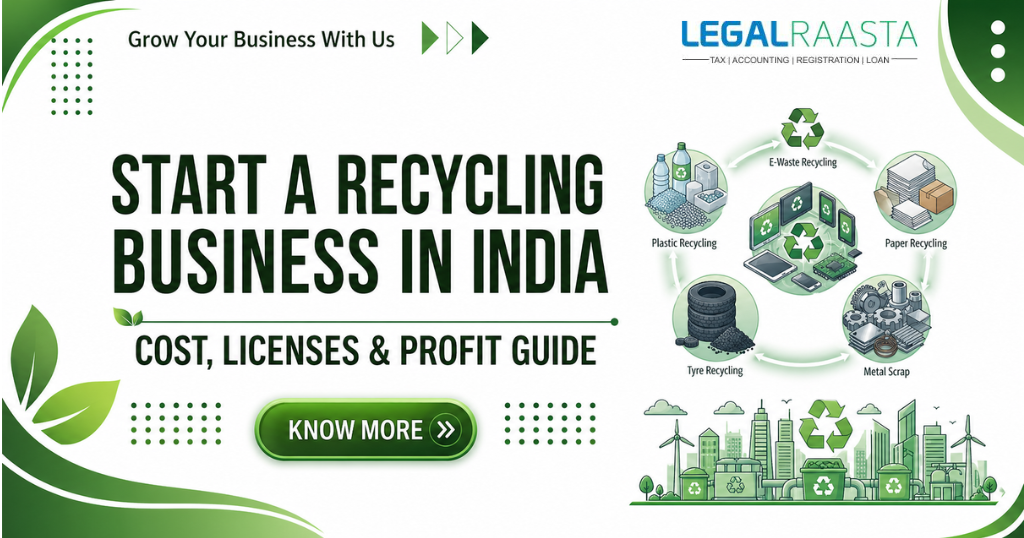
The recycling business in India has evolved into a multi-billion-dollar circular economy powerhouse, as opposed to being an unorganised scrap industry. With the motivation behind the program on Swachh Bharat, the obligatory Extended Producer Responsibility (EPR) schemes of 2026, recycling is no longer merely a service to the environment but a profitable enterprise. You may be planning to enter the plastic market, e-waste markets, or the construction scrap market, but in this guide, we have given you a technical road map in negotiating the cost, compliance, and capital you need to succeed.
Boost your green enterprising mission by letting the specialists at LegalRaasta get your EPR registration and your SPCB clearances to get a hassle-free recycling business in India.
Market Potential: Why Start a Recycling Business in India Now?
India produces a total of more than 62 million tons of waste in a year, out of which very little goes through a scientific process. New policies will require all brands to employ recycled material in the packaging by 2026, and this will bring in a colossal seller market to the recyclers.
Profit Margins by Waste Category (2026 Estimates)
| Waste Category | Typical Profit Margin | High-Value Output |
| Plastic Recycling | 15% – 25% | PET Flakes, HDPE Granules |
| E-Waste Recycling | 25% – 45% | Gold, Silver, Copper recovery |
| Paper Recycling | 10% – 18% | Kraft Paper, Cardboard |
| Tyre Recycling | 20% – 30% | Crumb Rubber, Pyrolysis Oil |
| Metal Scrap | 12% – 20% | Aluminium Ingots, Steel Billets |
Comprehensive Cost Analysis: Recycling Business in India Cost
Initial capital outlay of a recycling plant will involve a combination of capital outlay on heavy machinery and operating capital on sourcing raw material (feedstock).
Investment Tiers (Small to Large Scale)
| Expenditure Head | Small Scale (Scrap Yard) | Mid-Scale (Processing) | Large Scale (Plant) |
| Machinery & Tools | Rs 2L – Rs 8L | Rs 15L – Rs 40L | Rs 80L – Rs 3Cr+ |
| Land & Facility | Rented Warehouse | 5,000 – 10,000 sq ft | 1 – 2 Acres |
| Licenses & Compliance | Rs 20k – Rs 50k | Rs 1L – Rs 3L | Rs 5L – Rs 15L |
| Working Capital | Rs 5L – Rs 10L | Rs 20L – Rs 50L | Rs 1Cr+ |
| Total Estimated Cost | Rs 8L – Rs 20L | Rs 40L – Rs 1.2Cr | Rs 2.5Cr – Rs 5Cr+ |
Mandatory Licenses & Regulatory Roadmap
The penalty for running a recycling business in India can be extremely high in the absence of legitimate environmental clearances under the Green Tribunals of 2026.
- Business Incorporation: Register as a Private Limited Company or LLP to handle GST and corporate contracts.
- SPCB Consent (CTE/CTO): Obtain “Consent to Establish” and “Consent to Operate” from your State Pollution Control Board.
- EPR Registration: Mandatory for plastic, e-waste, and battery recyclers via the CPCB portal.
- Udyam (MSME) Registration: Crucial for availing government subsidies and easy bank loans.
- GST Registration: Necessary for inter-state scrap trading and claiming input tax credit.
- Trade License: Issued by the local Municipal Corporation for operating a commercial unit.
Top 10 Recycling Companies in India (Industry Leaders 2026)
Investigation into the leaders will enable you to know the magnitude and technology you will need to take command of the recycling business in India.
- Gravita India Ltd: Global leader in Lead, Aluminium, and Plastic recycling.
- Attero Recycling: India’s largest e-waste and Li-ion battery recycler.
- Ganesha Ecosphere: Dominant player in PET bottle to Polyester Fiber recycling.
- Antony Waste Handling Cell: Integrated municipal solid waste management giant.
- Eco Recycling Ltd (Ecoreco): Pioneer in end-to-end e-waste resource recovery.
- Banyan Nation: High-quality PCR (Post-Consumer Resin) plastic producers.
- Race Eco Chain: Fastest-growing tech-enabled EPR and plastic ecosystem.
- Shakti Plastics Industries: One of the oldest and most diverse plastic recyclers.
- Lucro Plastecycle: Specialist in recycling difficult, flexible, and multi-layered plastics.
- Baheti Recycling Industries: Leader in secondary aluminium processing for the auto sector.
Step-by-Step: How to Start a Recycling Business in India
The business idea to be implemented in 2026 will be to create a recycling enterprise that would base its operations on data, as manual sorting will be replaced by automated processing plants, which are up to international quality standards.
1. Market Research & Niche Selection
Determine the waste stream that is most locally available. As an example, opening up a plastic recycling business in India, in the areas around industrial facilities such as Pune or Ahmedabad, will guarantee a continuous flow of factory-grade scrap.
2. Sourcing & Collection Network
Your profit will be determined by your Buying Rate. Build a network of:
- Kabadiwalas: For household and retail scrap.
- Municipal Contracts: For urban solid waste.
- FMCG Brands: Partner with companies looking to fulfil their EPR targets.
3. Setting Up the Infrastructure
Go to an area that has industrial power lines with high tension. Recycling devices such as the shredders, extruders, and magnetic separators use high amounts of electricity.
4. Technology Integration
The purchase of 2026 demands Proof of Recycling. Create electronic monitoring solutions to issue certificates to your customers, which will assist them in achieving ESG (Environmental, Social, and Governance) targets.
Common Challenges & Success Tips
- Feedstock Price Volatility: On a daily basis, scrap prices change. Keep a 3-month buffer stock to stabilise production.
- Quality Contamination: You will have a poor sort, which means you will be decreasing the value of your finished granules. Invest in sorting machines or a skilled workforce.
- Compliance Delays: It may take 3-6 months to get pollution clearances. Submit your SPCB license application at least 120 days before your launch day.
The “Pre-Launch” Success Checklist
- Is your land zoned for “Industrial Use”?
- Have you secured an EPR registration certificate?
- Is your fire safety and wastewater treatment system (ETP) installed?
- Do you have offtake agreements (letters of intent) from buyers?
- Strategic Niche Selection: The 2026 High-Growth Sectors
The appropriate waste stream to be chosen in 2026 would be a compromise between the availability of such supplies on the one hand, and the new EPR (Extended Producer Responsibility) targets imposed by the CPCB, which are aggressive.
Although the term scrap is a very general one, the recycling businesses in India are the most lucrative and specialised in pursuing technical niche markets that are in high demand in India:
- Lithium-Ion Battery Recycling: Recycling of Cobalt/Lithium batteries is a sunrise industry, as the EV penetration will hit 30% by 2030.
- Textile Recycling (Panipat Model): India produces 70.73 lakh tonnes of textile waste every year. The possibility of converting pre-consumer waste into a shoddy yarn has a value of Rs 3,220 crore.
- Construction & Demolition (C&D) Waste: Starting April 1, 2026, the urban local authorities are bound to use recycled aggregates in all government work, and this provides a guaranteed market of B2G (Business-to-Government).
- Critical Mineral Recovery: The extraction of e-waste/catalytic converter minerals now qualifies for the Rs 1,500 crore new government scheme known as Critical Mineral Recovery.
Deep Dive: Machinery & Technology Requirements
Modern recycling is defying traditional manual recycling towards automated recycling, “Sensor-Based Sorting” in order to achieve 99% purity of materials demanded by machines to use in food packaging by the FMCG giants.
Core Machinery for a Plastic Recycling Plant
- Bale Breaker: To de-clump compressed scrap blocks.
- Trommel Screens: For removing sand, grit, and small stones.
- Optical Sorters (AI-Enabled): Use near-infrared (NIR) sensors to distinguish between PET, HDPE, and PP plastics automatically.
- Friction Washers: High-speed centrifugal cleaners to remove labels and adhesives.
- Granulators/Pelletizers: To melt and cut the plastic into uniform granules for sale.
Technical Specifications Comparison Table
| Machine Type | Function | Capacity (Per Hour) | Est. Power Consumption |
| Plastic Shredder | Size Reduction | 500 kg – 2 Tons | 15 kW – 45 kW |
| Magnetic Separator | Metal Removal | Continuous | 5 kW – 10 kW |
| Extruder (Single Screw) | Pelleting | 200 kg – 800 kg | 30 kW – 75 kW |
| Water Treatment Plant | Effluent Cleaning | 5,000 Liters | 7.5 kW |
Financial Incentives & Government Subsidies (2026)
Currently, the Indian government is providing aggressive capital subsidies to transform the recycling business in India into organised MSMEs that are out of the informal sector.
1. MSE-SPICE Scheme (Circular Economy Promotion)
The Scheme of Promotion and Investment in Circular Economy has been launched by the Ministry of MSME.
- Subsidy: Up to 25% capital subsidy on plant and machinery.
- Limit: Maximum subsidy of Rs 12.5 Lakhs for projects up to Rs 50 Lakhs.
- Eligibility: Must be a Brownfield unit registered on the Udyam portal.
2. National Critical Mineral Mission Incentives
In the case of high-tech recyclers that recover minerals such as Lithium, Copper, or Nickel:
- Capex Subsidy: 20% on plant and machinery.
- Opex Subsidy: Incremental sales incentives of 6% to 12% over the base year (FY 2025-26).
Operations: Managing the Feedstock Supply Chain
In the recycling business in India, to make a profit, you buy at the level of the recycling business, which is the Buying Stage and not the Selling Stage.
The First-Mile Collection Strategy
- Reverse Logistics: Collaborate with e-commerce companies such as Amazon or Flipkart to engage in direct waste collection programs, such as packaging during delivery to consumers.
- The “Digital Kabadi” App: It involves the creation of a B2C application through which the scheduled scrap pickups in the gated societies are ensured to guarantee the creation of a source-segregated waste that results in 30% better quality granules.
- Industrial Trades: Sign “Annual Maintenance Contracts” with manufacturers to have them clean their floor every day at a fixed rate.
Compliance Deep-Dive: The 2026 EPR Mandates
As of April 1, 2026, CPCB has increased the coverage of EPR to non-ferrous metals (Aluminium, Copper) and Glass, as well as to Plastics and E-waste.
Key Targets for 2026-27
- Rigid Plastic Packaging: 70% recycling target.
- EV Battery Recovery: 90% recovery rate requirement.
- Recycled Content: Rigid packaging must contain a minimum of 30% recycled material starting this fiscal year.
- QR Code Traceability: All recycled output must carry a unique QR code for real-time tracking on the CPCB portal.
Structured Technical Elements for Ranking
The “Zero-Waste” Facility Layout Checklist
- Zoning: Is the facility located in a “Red” or “Orange” industrial zone as per SPCB?
- ETP Setup: Does the plant have a functional Effluent Treatment Plant to prevent groundwater contamination?
- Safety Protocols: Are fire hydrants and dust collection systems installed to meet ISO 45001 standards?
- Lab Testing: Do you have an in-house testing kit to check MFI (Melt Flow Index) and density of recycled pellets?
Conclusion
There is no longer a trash business; a recycling business in India is now a green economy, driving the manufacturing process. Entrepreneurs can obtain guaranteed long-term agreements with international brands by adopting a policy of mandatory compliance, such as EPR, and investing in high-performance equipment. With the country heading towards a zero-waste target by the year 2030, pioneers in the recycling industry are set to experience multiple growth in their size.
Regulatory hurdles should not put a hold on your green mission today. Reach out to LegalRaasta and have an expert help you figure out the licenses, costs, and how to establish your recycling business in India!
FAQs
-
How profitable is a recycling business in India for startups?
Having a recycling business profit margin in India of between 15% and 40%, the industry is one of the most profitable, particularly in high-value streams such as e-waste or battery recycling.
-
How much does it cost to start a recycling business in India for plastic?
The recycling businesses in India cost of a medium-sized plastic plant in India begins at Rs 40 Lakhs, which includes the shredders, washing lines, and pelletizing machines.
-
Which is currently the largest recycling company in India?
Attero and Gravita India are considered to be the top 10 recycling companies in India, with the leaders of integrated metal and e-waste processing, respectively.
-
How to start a recycling business in India with low investment?
The most suitable place to start a recycling business with minimal capital is to start as a scrap aggregator or collector with the intention to sort and trade, then proceed to processing.
-
Is a recycling business profitable in India without government subsidies?
Yes, but the recycling business profit margin in India can be greatly increased by means of the use of MSME benefits, which will decrease interest rates on loans taken to purchase the necessary machinery.
-
What is the best recycling business to start in 2026?
Today, starting a plastic recycling business in India is the most common due to the establishment of EPR laws, providing a motivation for recycling granule demand.
-
What licenses are required to start a recycling business in India?
SPCB Consent (CTE/CTO), EPR Registration, GST, and a Trade License from the local authorities are required to start a recycling business in India.
-
What is the average recycling business profit margin in India for paper?
The paper recycling business has a stable recycling business profit margin in India of 10-18% as a result of increasing demand for environmentally friendly packaging and packaging materials.
-
How to start a plastic recycling business in India for PET bottles?
The recycling business proposal that is aimed at learning how to start a recycling business in India that specialises in PE is the establishment of a crushing and washing line to create flakes that are utilised in the textile sector.
-
Where can I find the cost of the recycling business in India for e-waste?
The investment in a professional e-waste plant setup incurs a cost of between Rs 60 Lakhs and Rs 2 Crores, depending on the technology that is applied to the precious metals recovery at the plant.
Related Posts

Our Clients




Featured In