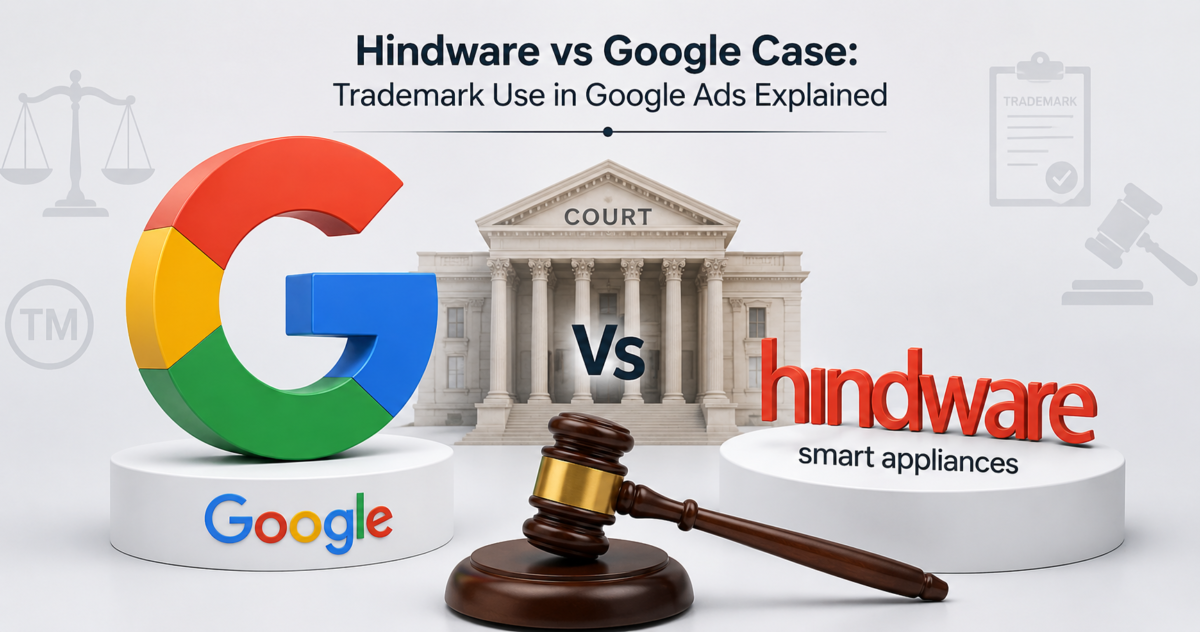
Hindware vs Google Case Explained: Can Competitors Legally Use Your Trademark in Google Ads?
Rahul, the founder of a homegrown D2C brand, spent five tough years building his brand name. One morning, he sits down with his chai, and he looks up his name on Google. He is hoping that his website will be ranked the highest. However, he sees there’s a powerful competitor’s paid ad at the top, stealing his potential customers.
What happened to Rahul is not rare. And in May 2026, India’s courts finally gave brand owners like him a clear answer – Hindware vs Google – came with the strongest verdict yet: that giving bids for a competitor’s trademark registration as a keyword – even in invisible mode – is trademark infringement. This decision alters the rules for persons doing business online in India.
|
Are you finding your brand keyword to be an easy target for Google Ads opponents? Talk to the brand protection specialists at LegalRaasta and conduct a comprehensive trademark assessment for your business today. |
In this blog, we are going to look at Hindware’s legal battle with Google in relation to the use of their trademark in Google ads. Let’s go over all the requirements you need to know about.
Let’s Dive into the Hindware vs Google Trademark Case
Something bad was spotted in 2013-2014 by a well-known Indian Sanitaryware manufacturer: Hindware. This time, competitors were Cera and Grohe, who had bought the keyword “HINDWARE” inside Google Ads.
The ad shown on a customer’s Hindware search page was at the top of the list when these competitors searched online.
Hindware sued, and the case went on the legal trail for several years. The crux of the matter was a simple question: When it comes to trademark use as an invisible hyperlink for a backend search, is there any difference between use in advertising or no use at all?
Google’s defense was easy – it’s a keyword in the back end. It never actually, in its visual appearance, shows up in the actual Ad. It shouldn’t bind Google, being a neutral platform, since it wasn’t trademark usage, nor can it be trademarked.
Numerous courts had already been faced with similar arguments. It finally settled on May 22, 2026, in India.
Understanding Trademark Bidding in Google Ads
Trademark Bidding is the process of bidding for a competitor’s registered trademark as a Keyword on Google Ads (or a search advertising platform). If a user searches for that brand name, the advertisement from the user who outbids can be served in the sponsored ads above the organic search results.
Google Ads works through an auction system. Advertisers pay for the ability to place their ads for the terms that they put up as keywords. Ads can be shown for whatever keyword the advertiser chooses, whether it be another advertiser’s brand or not.
The result? If a user clicks on, say, “Brand,” he or she is likely to find “Brand Y” right at the top of the web page first, before arriving at the Brand X web page. This is trademark keyword ad marketing done in full force.
Why Businesses Target Competitor Brand Keywords?
If someone searches for a particular brand name and they are a high-intent buyer, then the brand’s competitor can intercept that search. They can display themselves instead of the original through online marketing techniques. Finally, they are ready to convert traffic to their product pages.
Consequently, Competitor Brand Keywords see incredible conversion rates, and that is why businesses have a habit of targeting these kinds of keywords.
The customer has already conducted their own research. It’s the little push they need — and an ad placed at the top of the search results page is the right push!
For the poached brand, it can be a serious thing:
- A loss in revenue,
- a decrease in brand awareness, and
- even customer confusion with the possibility that they have ended up on a competitor’s page and do not know it.
Quick Reference: Is This Keyword Bidding Practice Legal?
|
Advertising Practice |
Visible in Ad? |
Legal Standing (Post-May 2026) |
|
Competing for branded and generic industry terms (e.g., ‘luxury bath fittings’). |
No |
Normally allowed – fair competition on a commercial basis |
|
Purchasing another competitor’s registered trademark or brand as a ‘back-end’ keyword. |
No |
Delhi HC held that the presence of ‘invisible use’ is still trademark infringement, illegal. |
|
Placing a competitor’s trademark in the ad head or body directly and literally, |
Yes |
Obviously unlawful – direct unauthorised interference, seen and more highly charged – if it is a direct act of infringement, and it is clearly visible,e it is obviously illegal. |
In the Hindware v. Google Case, what did the Court decide?
In the Hindware vs Google Trademark Case, Justice Mini Pushkarna of the Delhi High Court gave a landmark verdict on 22nd May, 2026.
Google’s ‘invisible use’ defence was completely rejected by the court. Under Indian law, the use of a registered trademark as a backend keyword, even with no visibility of the trademark in the ad copy, constitutes Trademark Infringement, the ruling stated.
The real objective is to steer traffic; the business damage is genuine, and the lack of the keyword in sight does not excuse the infringement.
Most significantly, the Court also removed Google’s ‘neutral platform’ safe harbour. As a result, the court has ruled that Google was not a passive intermediary, but a “gateway” that was enabling and profiting from keyword-based advertising.
The damages awarded: ₹30 Lakh — awarded jointly by the infringing advertisers and Google. This set a precedent that creates accountability in the case of platforms in digital ads law in India.
|
What is the greatest takeaway from the Hindware scenario? If you do not own it legally, then you can’t defend it. Stop brand and block poachers from stealing rewards, and prevent others from taking your rewards with them. File your Trademark Registration today with LegalRaasta. |
When is it Illegal to bid on Trademark Keywords?
According to the Hindware ruling, Trademark Bidding steps into illegal territory when:
- The targeted keyword is a registered and coined trademark that is protected by Indian trademark law.
- Its goal is to take over the brand-specific search traffic or the customers who are actively searching for a certain brand name.
- Bidders bidding for the same keyword create commercial losses by losing traffic, missing out on revenue, or causing consumer puzzlement about whether they are buying goods or services.
- The activity has a bearing on one platform, and it benefits; this is why Google was found to be jointly liable in the case of Hindware.
Competitive bidding conditions for terms that are readily understood, but not trademarks, descriptive terms, or non-trademark terms.
Safeguarding a Trademark Against Unauthorized Online Applications
To ensure that trademark rights are protected in the digital realm, they must be legally registered and monitored. These are simple 4- 4 playbook-style measures, easy to use:
Document Everything First. Once you see someone else putting an ad up for the same name as our business, snap a screenshot of the web page with a timestamp. The images you typically have will be your putting-up evidence. Include the date, time, device, and exact query.
Check Your Trademark Certificate. Ensure your trademark has been properly registered under the business class (e.g., Class 25 – Clothing, and Class 11 – Sanitaryware). The protection of the Hindware ruling is contingent on registration, so make sure you have the correct registration and it’s current.
Send a Cease and Desist Notice. Write a formal letter to the competitor, referring to the case law from the May 2026 Delhi High Court decision in the “Hindware” vs “Google” case. Such a recent, rarely issued, and specific decision has tremendous persuasive value.
Send Directly to Google. Follow the Google Trademark Complaint Portal to file a trademark complaint. There are even Google’s own rules that prohibit the use of trademarks in ad copy — and given recent back-to-back incidents with their use in lead generation ads, their history of following their own rules on back-to-back keyword complaints is there too.
Why is Registration of the trademark necessary for protecting the brand?
A basic but hard truth is illustrated by the Hindware case: you can’t impose rights that you don’t possess. Formal Trademark Registration is needed to protect your brand name even in the event of a successful court decision.
A registered trademark provides you with: exclusive rights to use your trademark in your business class; legal grounds for enforcing trademark rights, such as initiating trademark infringement actions and claiming damages; and a legal record of your trademark’s existence and priority in case proceedings.
The changed scenario of post-Hindware makes Trademark Registration an essential exercise. Trademark protection: Facilities for online enterprises in India. It is the foundation document of the legal framework of the marketplace of the electronic world.
Conclusion: Rahul Gets His Digital Real Estate Back
Remember Rahul, about whom I discussed at the start?
The founder, who lost his own brand’s search traffic to another competitor. Now see what he does to get out of this online business fraud.
Having gone through the famous Hindware case, Rahul’s lawyers promptly issued a cease-and-desist notice to the competitor within days of the case. They mentioned the Delhi HC’s firm stance on Trademark Bidding – invisible use of the keywords is infringement.
Within a week, the competitor withdrew his Trademark in the Google Ads campaign, fearing being held liable jointly with the ad platform.
Rahul’s brand got its deserved place in the top position of its own branded search results. Five years of trust building, sheltered. The secret? He had one thing right before the crisis struck: He had registered his trademark.
LegalRaasta can Safeguard your Trademark Rights: Know How
Your brand name has been established over a number of years. Don’t let a competitor profit from it in the new legalized “trademark keyword advertising.” Contact LegalRaasta today — and take the first step to ensure your online brand is untouchable. At LegalRaasta, our trademark attorneys and brand protection experts can assist you in multiple ways.
Have control of your search results now! Secure the perfect protection for your business and ensure your Trademark Registration is done right with LegalRaasta. Your brand deserves to be in its own spotlight, and not your competitor’s.
FAQs
-
Can I do trademark bidding on industry terms?
Yes, it is 100% legal to bid on industry terms like ‘affordable sanitaryware’, ‘running shoes online’, or ‘D2C clothing brand’. The Hindware judgment does not invalidate the use of registered and distinctive trademarks used as keywords, but rather the use of trademark terms that are of a generic category.
-
Will Google block competitors from bidding if they have a domain that is identical to Hindware?
No, as the reason is that the decision sets a precedent for law, but Trademark Protection is dependent on enforcement by the brand owner. Google is not monitoring all keyword auctions and doesn’t do it automatically.
One needs to regularly check search results, record the infringing sites, and go so far as to send out legal notices and complaints to Google.
-
If my brand name is not registered, what can I do?
If you don’t have a registered trademark, you only have common law rights (rights established through extended and long use), and this is far less easy to prove and enforce.
In the second case, any registered trademark owner is entitled to the full protection of the Hindware ruling. As a result, the primary concern for you in the first case is to get the Trademark Registration as soon as possible.
-
Can I sue Google directly for trademark infringement in India after the Hindware ruling?
Yes, you can. The Delhi High Court’s May 2026 verdict in the Hindware vs Google case established that Google is not a neutral platform but an active participant that enables and profits from keyword-based trademark bidding. Google was held jointly liable alongside the infringing advertisers and ordered to pay damages of Rs. 30 lakh. That said, pursuing a platform like Google in court is a long and resource-intensive process. Most brand owners start with a formal trademark complaint through Google’s own portal and a cease-and-desist to the competitor first.
-
Does the Hindware ruling apply to Bing Ads, Meta Ads, and other advertising platforms too?
The Delhi High Court ruling was specifically about Google Ads, but the legal reasoning it established applies broadly. Any platform that sells a competitor’s registered trademark as a bidding keyword and profits from that transaction could face similar liability under Indian trademark law. If you find your brand being targeted on Bing, Meta, or any other ad platform, the same steps apply: document it, verify your trademark registration, and send a legal notice citing the Trade Marks Act, 1999.
-
What damages can a brand owner claim if a competitor bids on their trademark keyword?
Based on the Hindware vs Google precedent, a brand owner can claim compensatory damages for lost traffic and revenue, legal costs, and in some cases punitive damages where the infringement is deliberate and ongoing. The court awarded Rs. 30 lakh in this case, shared between the infringing advertisers and Google. The actual amount in your case will depend on the scale of infringement, how long it has been going on, and how well you have documented the harm caused to your business.
-
What if the competitor is not using my trademark visibly in the ad but only as a backend keyword?
This was the exact argument at the heart of the Hindware case, and the Delhi High Court rejected it completely. The ruling clearly states that invisible use of a registered trademark as a backend keyword still constitutes trademark infringement under Indian law. The intention matters, which is to intercept brand-specific search traffic, and the commercial damage is real regardless of whether the keyword appears in the ad copy or not.
-
How quickly can I get a competitor’s Google Ad taken down after filing a complaint?
Google typically responds to trademark complaints filed through their official Trademark Complaint Portal within 7 to 14 working days. If your complaint is clear, your trademark registration is valid, and you provide the specific ad URLs, Google generally acts within that window. Sending a simultaneous cease-and-desist to the competitor often speeds things up because many competitors pull the ads themselves rather than risk joint liability, especially after the Hindware ruling made platform accountability very clear.
-
My trademark is pending registration, not yet fully approved. Am I still protected?
A pending trademark application gives you limited protection compared to a fully registered mark. The Hindware ruling’s strongest protections apply specifically to registered trademarks. However, a filed application does establish your priority date, meaning you can argue prior claim if a competitor tries to register the same name later. For immediate enforcement action against keyword bidding, a full registration certificate carries far more legal weight. This is another reason to file your trademark as early as possible rather than waiting.
-
Can a small business or startup use the Hindware ruling to protect their brand, or is it only for large companies?
The ruling applies equally to every registered trademark holder in India, regardless of business size. Hindware is a large brand, but the legal principle established protects any business whose registered trademark is being used without authorisation as a Google Ads keyword. If you are a small D2C brand or a startup with a registered trademark, you have the same right to send a cease-and-desist, file a Google trademark complaint, and pursue legal action as a large corporation does. The registration is what matters, not the size of your business.

Related Posts
 Trademark
Trademark Class 99 in India (2026): Meaning, Uses, Registration & Applicability
Read More → Trademark
Why Every Artist Needs a Trademark: A Complete Guide to Protecting Your Creative Identity in India (2026)
Read More → Trademark
Trademark Class 5 in India (2026): Pharmaceuticals, Veterinary Medicines, Pesticides & Registration Guide
Read More → Trademark
Trademark Class 4: Industrial Oils, Greases, Lubricants, Fuels, Candles & Wicks Guide
Read More →
Our Clients


Featured In