
UDI for Medical Devices in India (2026): Complete CDSCO Compliance Guide
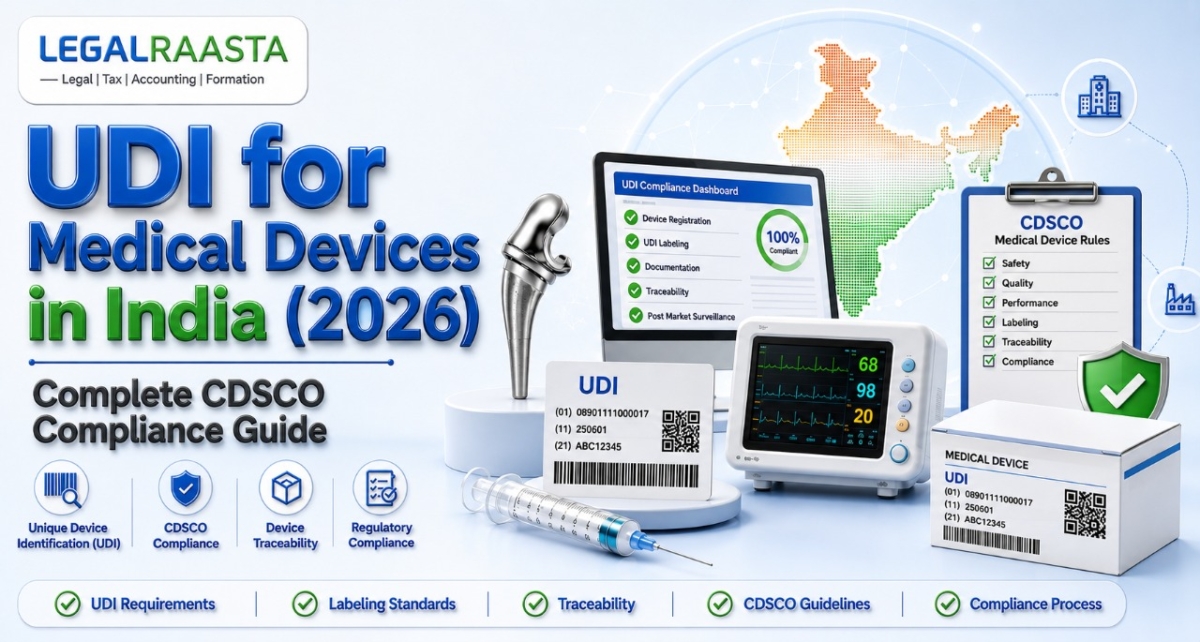
UDI for medical devices stands for Unique Device Identification. It is a system that assigns a unique code to every medical device so it can be tracked across its entire supply chain, from manufacturer to patient. In India, CDSCO (Central Drugs Standard Control Organisation) governs UDI under the Medical Devices Rules, 2017, as amended.
UDI compliance is now a regulatory requirement for medical device manufacturers and importers in India. Getting it wrong means penalties, market access issues, and supply chain disruptions that are far more expensive than setting it up correctly the first time.
LegalRaasta helps medical device manufacturers and importers achieve full CDSCO UDI compliance efficiently, so your products stay market-ready and legally protected.
What Is UDI for Medical Devices and Why Does It Matter?
UDI for medical devices is a unique numeric or alphanumeric code assigned to a medical device and its packaging. It allows regulators, hospitals, and supply chain partners to identify, track, and trace any device at any point in its lifecycle.
It matters for three clear reasons:
- Patient safety: Defective devices can be recalled quickly and accurately
- Supply chain transparency: Every device movement is traceable from factory to end user
- Regulatory compliance: CDSCO requires UDI as part of the medical device registration and post-market surveillance system
Without UDI, recalls are slow, counterfeiting is harder to detect, and adverse event reporting becomes unreliable.
CDSCO UDI Regulations in India (2026 Update)
CDSCO introduced UDI requirements under the Medical Devices Rules, 2017. The rules apply to all notified medical devices in India. In 2026, the phased implementation continues, with Class C and Class D devices under stricter timelines.
Key regulatory references:
- Medical Devices Rules, 2017 (amended): Primary governing framework
- CDSCO Circular on UDI Implementation: Specifies timelines by device class
- SUGAM portal: The official CDSCO portal where device information is submitted
- ISO/IEC 15459: International standard for unique identification referenced by CDSCO
CDSCO aligns its UDI framework broadly with global systems, including the US FDA UDI rule and the European MDR, while adapting it for Indian regulatory infrastructure.
Which Medical Devices Require UDI in India?
CDSCO’s UDI requirements apply based on device classification under the Medical Devices Rules, 2017.
|
Device Class |
Risk Level |
UDI Requirement Status (2026) |
|
Class A |
Low risk |
Phased implementation |
|
Class B |
Low to moderate risk |
Phased implementation |
|
Class C |
Moderate to high risk |
Mandatory, stricter timelines |
|
Class D |
High risk (implantable, life-sustaining) |
Mandatory, immediate compliance |
In addition, imported medical devices sold in India must carry UDI labels before entering the Indian market. Both domestic manufacturers and importers are responsible for compliance.
Components of UDI: UDI-DI and UDI-PI Explained
Every UDI for medical devices has two components. Understanding both is essential before applying for compliance.
|
Component |
Full Form |
What It Contains |
Changes When |
|
UDI-DI |
Device Identifier |
Manufacturer, device model, version, size |
Device model or version changes |
|
UDI-PI |
Production Identifier |
Lot number, serial number, expiry date, manufacture date |
Each production run |
Together, UDI-DI and UDI-PI create a complete, unique identity for each device unit or lot. The UDI-DI is the static part that links to the device database. The UDI-PI is the variable part that tracks individual production information.
UDI Labeling Requirements Under CDSCO
CDSCO requires the UDI to appear on the device label and packaging in both human-readable form and machine-readable form. Here is what the labeling must include:
- The UDI code in plain text
- A barcode or RFID tag carrying the UDI in machine-readable format
- Accepted carrier formats: GS1 barcode, HIBCC barcode, or ICCBBA format
- For implantable devices: UDI must appear on the device itself where technically feasible
- All labeling must comply with the language and format requirements under MDR 2017
CDSCO accepts the following issuing agencies for UDI assignment:
|
Issuing Agency |
Full Name |
Accepted By CDSCO |
|
GS1 |
Global Standards 1 |
Yes |
|
HIBCC |
Health Industry Business Communications Council |
Yes |
|
ICCBBA |
International Council for Commonality in Blood Banking Automation |
Yes |
How to Obtain UDI for Medical Devices in India: Step-by-Step Process
The complete UDI compliance process for India runs through the CDSCO SUGAM portal and involves these steps.
Step 1: Register with an Issuing Agency
Choose GS1, HIBCC, or ICCBBA. Register your organisation and obtain a company prefix. This prefix forms the base of your UDI-DI codes.
Step 2: Generate Your UDI-DI
Using your issuing agency’s system, generate a UDI-DI for each unique device model, configuration, and packaging level. Each variant gets its own UDI-DI.
Step 3: Submit Device Information to CDSCO Database
Log in to the SUGAM portal. Submit all required device information linked to each UDI-DI. This creates the searchable device record in the CDSCO database.
Step 4: Apply UDI Labels
Print UDI labels with both human-readable text and machine-readable barcodes on the device, primary packaging, and secondary packaging where required.
Step 5: Integrate UDI-PI into Production
Link production identifiers including lot number, serial number, and expiry date to each UDI at the manufacturing or import stage.
Step 6: Maintain Records and Update Database
Update the CDSCO database whenever device information changes. Keep internal records of all UDI assignments for post-market surveillance.
Information Required for UDI Registration
This section lists what CDSCO requires when submitting device information to the UDI database.
For UDI-DI Submission:
- Device trade name and model name
- Manufacturer’s name and address
- Issuing agency and UDI-DI code
- Device classification under MDR 2017
- Whether the device is sterile or contains latex
- Whether the device is single-use or reusable
- Device description and intended use
- CDSCO licence or registration number
For UDI-PI Submission:
- Manufacturing date
- Expiry date where applicable
- Lot or batch number
- Serial number for individually serialised devices
UDI Database and Device Information Management
The CDSCO UDI database works as a central repository. Manufacturers and importers submit device records linked to UDI-DI codes. Healthcare providers and regulators can then search this database to verify a device, check recalls, or review device specifications.
Key management obligations:
- Update UDI-DI records within 30 days of any device change
- Remove discontinued devices from active status in the database
- Maintain UDI records for the device’s full expected lifecycle plus a minimum additional period as specified by CDSCO
- Ensure that label UDI matches the database record at all times
Benefits of UDI Compliance for Manufacturers, Importers, and Healthcare Providers
UDI compliance benefits every stakeholder in the medical device supply chain. Here is how:
|
Stakeholder |
Key Benefit |
|
Manufacturers |
Faster recalls, reduced liability, better post-market data |
|
Importers |
Smoother CDSCO inspections, cleaner customs clearance |
|
Hospitals and healthcare providers |
Accurate inventory, faster adverse event reporting |
|
Regulators (CDSCO) |
Real-time device tracking, improved surveillance |
|
Patients |
Faster identification of defective devices, improved safety outcomes |
Common UDI Compliance Challenges and How to Overcome Them
- Challenge 1: Choosing the wrong issuing agency – Solution: Match the issuing agency to your existing global supply chain standards. Most Indian manufacturers align with GS1 because it integrates with existing barcode infrastructure.
- Challenge 2: Incomplete UDI database submissions – Solution: Use a pre-submission checklist that covers every required field before uploading to the SUGAM portal.
- Challenge 3: Label compliance across packaging level – Solution: Map every packaging level (unit, carton, pallet) separately and assign UDI at each level as required by CDSCO rules.
- Challenge 4: Managing UDI-PI integration in production – Solution: Integrate UDI-PI generation into your manufacturing ERP or batch tracking system so it happens automatically at production.
- Challenge 5: Keeping database records updated – Solution: Assign internal ownership of UDI database management with a defined update schedule tied to any device change notification.
Penalties for Non-Compliance with CDSCO UDI Requirements
CDSCO enforces UDI requirements under the Medical Devices Rules, 2017, which derive authority from the Drugs and Cosmetics Act, 1940.
|
Violation |
Consequence |
|
Missing UDI on required device |
Product cannot be marketed or imported legally |
|
Incorrect or incomplete UDI label |
Regulatory action, product seizure |
|
Failure to update device database |
Show cause notice, suspension of licence |
|
Non-compliant barcode or carrier format |
Label rejection, re-labeling requirement |
|
Continued non-compliance |
Licence cancellation under MDR 2017 |
Beyond legal penalties, non-compliance creates supply chain disruption, hospital rejection of products, and difficulty in insurance and tender eligibility.
UDI vs Barcode vs Serial Number: What’s the Difference?
Many manufacturers confuse UDI with barcodes or serial numbers. They are related but not the same.
|
Feature |
UDI |
Barcode |
Serial Number |
|
What it is |
Regulatory identification system |
Data carrier (physical format) |
Internal production identifier |
|
Contains |
UDI-DI + UDI-PI |
Can carry UDI, serial, or any data |
Unique production sequence number |
|
Regulated by |
CDSCO, FDA, MDR |
ISO standards |
Internal policy |
|
Linked to database |
Yes, mandatory |
Not inherently |
Not inherently |
|
Purpose |
Traceability and safety |
Data scanning |
Internal inventory |
In practice, a UDI is carried on the label using a barcode. The barcode is the physical format. The UDI is the regulatory system. The serial number may be one component of the UDI-PI.
Global UDI Standards: India vs US FDA vs European MDR
UDI for medical devices exists globally, but each jurisdiction has its own system. Understanding differences matters for manufacturers exporting or importing across markets.
|
Aspect |
India (CDSCO) |
US FDA |
European MDR |
|
Governing rule |
Medical Devices Rules 2017 |
21 CFR Part 830 |
EU MDR 2017/745 |
|
Database |
CDSCO SUGAM portal |
GUDID (FDA database) |
EUDAMED |
|
Issuing agencies accepted |
GS1, HIBCC, ICCBBA |
GS1, HIBCC, ICCBBA |
GS1, HIBCC, ICCBBA |
|
Implementation approach |
Phased by device class |
Fully implemented |
Phased by class |
|
Direct-to-device labeling |
Required for implantables |
Required for implantables |
Required for implantables |
India’s system is deliberately aligned with global standards to ease compliance for international manufacturers entering the Indian market.
Best Practices for Maintaining UDI Compliance
- Appoint a dedicated UDI compliance officer or assign the responsibility clearly to an existing regulatory affairs role.
- Build UDI generation into your product lifecycle management system so new device versions automatically trigger new UDI-DI creation.
- Conduct quarterly audits of your CDSCO database records against physical labels on current stock.
- Train your production, quality, and logistics teams on UDI labeling requirements and carrier format standards.
- Keep copies of all issuing agency correspondence and UDI assignments in a centralised document management system.
How LegalRaasta Helps with CDSCO UDI Compliance
LegalRaasta provides end-to-end support for UDI for medical devices compliance in India, covering every stage from issuing agency registration to SUGAM database submission.
- Issuing agency selection and registration guidance (GS1, HIBCC, or ICCBBA)
- UDI-DI generation support and structuring across device variants and packaging levels
- Complete SUGAM portal submission of device information records
- UDI labeling review to confirm carrier format and content compliance with CDSCO requirements
- Post-submission database update management when device specifications change
- Integration advice for linking UDI-PI into existing production and ERP systems
- Ongoing compliance monitoring and CDSCO regulatory update tracking
Conclusion
UDI for medical devices in India is no longer optional. CDSCO has moved UDI compliance from a future requirement to an active regulatory obligation, particularly for Class C and Class D devices. Manufacturers and importers who have not started the process are already behind.
The system itself is logical. An issuing agency, a structured code, a database submission, and a compliant label. What makes it complicated in practice is getting every detail right across every device variant, packaging level, and production run.
The cost of getting it wrong is supply chain disruption, product rejection, and regulatory action under the Medical Devices Rules, 2017. The cost of getting it right with proper support is significantly lower.
Connect with LegalRaasta today and get your CDSCO UDI compliance sorted correctly so your medical devices stay market-ready in India.
Frequently Asked Questions
1. What is UDI for medical devices in India?
UDI for medical devices is a unique numeric or alphanumeric code assigned to identify and trace medical devices across the supply chain. In India, CDSCO mandates it under the Medical Devices Rules, 2017, to improve patient safety and post-market surveillance.
2. Is UDI mandatory for all medical devices sold in India?
UDI for medical devices is being implemented in phases based on device class under CDSCO rules. Class C and Class D devices face mandatory compliance timelines in 2026. Class A and B devices are under phased rollout. Importers of notified devices must also comply.
3. Who issues UDI codes for medical devices in India?
CDSCO accepts three issuing agencies for UDI for medical devices: GS1, HIBCC, and ICCBBA. Manufacturers register with one of these agencies to obtain a company prefix. This prefix forms the base of all UDI-DI codes generated for their device portfolio.
4. What is the difference between UDI-DI and UDI-PI?
In the UDI for medical devices system, UDI-DI is the Device Identifier covering manufacturer and device model details. UDI-PI is the Production Identifier covering lot number, serial number, and expiry date. Together they create a complete unique identity for each device unit.
5. What information must a UDI label include under CDSCO rules?
A compliant UDI for medical devices label must include the UDI code in human-readable text and in machine-readable barcode format. Accepted carriers are GS1, HIBCC, or ICCBBA barcodes. The label must also carry the device trade name, manufacturer details, and expiry date where applicable.
6. How do manufacturers comply with CDSCO UDI requirements?
To comply with UDI for medical devices, manufacturers must register with an issuing agency, generate UDI-DI codes for each device, submit device records to the CDSCO SUGAM portal, apply compliant labels, and maintain updated records whenever device specifications change.
7. What are the penalties for non-compliance with UDI regulations in India?
Non-compliance with UDI for medical devices requirements can result in product seizure, show cause notices, licence suspension, and, in serious cases, licence cancellation under the Medical Devices Rules, 2017. Devices without compliant UDI labels cannot be legally marketed or imported in India.
8. Does UDI apply to imported medical devices sold in India?
Yes. UDI for medical devices requirements apply to both domestic manufacturers and importers. Imported devices must carry compliant UDI labels before entering the Indian market. Importers are responsible for ensuring the device and its packaging meet CDSCO labeling and database submission requirements.
9. Which international UDI standards does CDSCO accept in India?
CDSCO’s UDI for medical devices framework accepts the same three issuing agencies recognised by the US FDA and the European MDR: GS1, HIBCC, and ICCBBA. This alignment makes it easier for international manufacturers to adapt existing global UDI compliance for the Indian market.
10. How can LegalRaasta help with UDI compliance for medical devices?
LegalRaasta supports UDI for medical devices compliance from issuing agency registration through SUGAM portal submission, label review, and database maintenance. Their regulatory team handles every stage so manufacturers and importers meet CDSCO requirements without delays or submission errors.

Related Posts


Our Clients






Featured In