
Startup Funding in India (2026): Stages, Sources, Process & Investor Requirements
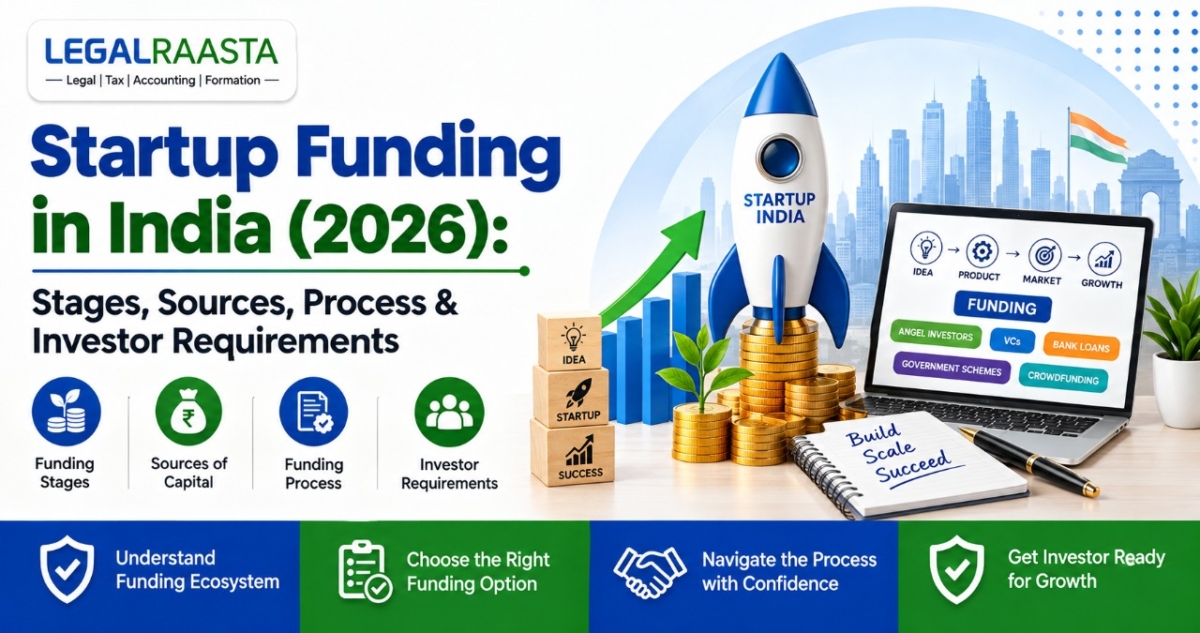
Two founders. Same product idea. One raised Rs 40 lakh from an uncle and two former colleagues before writing a single pitch deck. The other spent eight months chasing venture capital and came back with nothing but a folder of rejection emails. Startup Funding in India doesn’t run on one script. It runs on stage, sector, traction, and honestly, a fair bit of luck in who you happen to know. But the mechanics behind it- what investors actually check, what the government offers, what the law demands- those are learnable.
Most founders just never sit down and learn them before they start asking for money. This piece walks through the stages, the real sources, the paperwork, and the legal side nobody explains properly until something goes wrong. LegalRaasta’s startup advisory team handles the compliance end of this daily, so bring your fundraise to them before an investor’s lawyer finds the gap first.
Startup Funding in India: Quick Overview
|
Funding Stage |
Typical Range |
Common Source |
|
Bootstrapping |
Personal savings |
Founder’s own money |
|
Pre-Seed |
Rs 10 lakh to Rs 1 crore |
Friends, family, angel networks |
|
Seed |
Rs 1 crore to Rs 8 crore |
Angel investors, seed VC funds |
|
Series A |
Rs 15 crore to Rs 100 crore |
Venture capital firms |
|
Series B/C |
Rs 100 crore and above |
Growth-stage VCs, PE funds |
|
IPO/Exit |
Public markets |
Retail and institutional investors |
What Is Startup Funding in India?
Startup Funding in India is simply the capital a business raises to build, test, and grow before it earns enough on its own to be self-sustaining. It can come as equity, where you give up ownership, or debt, where you owe it back with interest. Grants sit in a third bucket entirely, since nobody expects that money returned.
Why Do Startups Raise External Funding?
Because building anything real costs more than most founders have sitting in a bank account. Hiring, product development, marketing- all of it eats cash long before revenue catches up. Raising Startup Funding in India buys time, and time is what turns an idea into something a customer will actually pay for.
Stages of Startup Funding in India
Money changes character as a startup grows. What counts as a big round at the seed stage looks tiny by Series B, and knowing where you actually stand matters more than founders like to admit.
Bootstrapping
Self-funded, using personal savings or early revenue. No dilution, no investor to answer to, but growth stays capped by whatever cash the founders can personally put in.
Pre-Seed Funding
The first outside money, usually from friends, family, or early-stage angel networks. It funds a prototype or an MVP, not a full product launch.
Seed Funding
Comes once there’s a working product and early signs of demand. Angel investors and seed-focused VC funds dominate this stage, focusing more on traction than polish.
Series A Funding
This is where real venture capital enters. Investors expect a proven business model and a clear path to scaling it, not just a promising idea anymore.
Series B & C Funding
Growth capital. The product works, the market is validated, and the money now goes toward expansion, new markets, bigger teams, sometimes acquisitions.
IPO & Exit Funding
The final stage, where a company lists publicly or gets acquired, giving early investors and founders a way to cash out their stake.
Major Sources of Startup Funding in India
Not every rupee comes from a VC term sheet. Founders pull from a mix of sources, often several at once, depending on stage and appetite for giving up equity.
|
Source |
Best Suited For |
Notes |
|
Bootstrapping |
Idea to early MVP stage |
No dilution, slow but controlled growth |
|
Angel Investors |
Pre-seed to seed |
Faster decisions, smaller cheques |
|
Venture Capital |
Series A onward |
Larger cheques, board involvement |
|
Government Schemes |
DPIIT-recognised startups |
Grants, guarantees, no equity given up |
|
Crowdfunding |
Consumer products |
Builds a customer base alongside capital |
|
Bank Loans / NBFCs |
Revenue-generating startups |
Debt, needs repayment regardless of outcome |
Government Funding Schemes for Startups in India
Government support shifted meaningfully in 2026, and a few schemes founders still ask about aren’t actually open anymore. Worth knowing before you waste a month on an application that won’t be reviewed.
|
Scheme |
Status in 2026 |
What It Offers |
|
Closed to new applications from 31 May 2026 |
Grants up to Rs 20 lakh, debt up to Rs 50 lakh (legacy cycle only) |
|
|
Credit Guarantee Scheme for Startups (CGSS) |
Live |
Collateral-free loans, guarantee cover up to Rs 20 crore |
|
Fund of Funds for Startups (FFS) + FFS 2.0 |
Live |
Rs 10,000 crore original corpus, plus a new Rs 10,000 crore tranche routed through SEBI-registered AIFs |
|
MUDRA TarunPlus |
Live |
Collateral-free loans up to Rs 20 lakh |
|
Section 80-IAC Tax Holiday |
Live |
100% income tax exemption on profits for 3 consecutive years; needs Inter-Ministerial Board certification |
SISFS closing doesn’t mean seed-stage government support vanished. It means the weight shifted to guaranteed debt through CGSS and equity routed indirectly through AIF-backed Fund of Funds money, rather than direct incubator-disbursed grants.
Angel Investors vs Venture Capitalists
Founders often use these two terms loosely, but they behave quite differently once real money is on the table.
|
Factor |
Angel Investors |
Venture Capitalists |
|
Stage |
Pre-seed, seed |
Series A and beyond |
|
Cheque size |
Rs 5 lakh to Rs 2 crore, typically |
Rs 15 crore upward |
|
Decision speed |
Faster, individual judgement |
Slower, committee-driven |
|
Involvement |
Mentorship, informal |
Board seats, formal governance |
|
Source of funds |
Personal wealth |
Pooled investor capital (LPs) |
How to Raise Funding for a Startup in India
Raising money isn’t a single event; it’s a sequence, and skipping steps almost always shows up later during due diligence.
Build a Fundable Pitch and Financial Model
Get your numbers, market size, and traction story straight before approaching anyone. Investors notice inconsistency within the first five minutes.
Identify the Right Investor Type for Your Stage
Approaching a Series B fund at pre-seed wastes everyone’s time. Match the investor to where your startup actually stands.
Network and Get Warm Introductions
Cold emails work occasionally. A warm introduction through a founder they’ve already backed works far more often.
Negotiate the Term Sheet
Valuation matters, but so do liquidation preference, board rights, and anti-dilution clauses. Read every line before signing.
Complete Legal Documentation and Compliance
File the required forms, update your cap table, and get shareholder agreements drafted properly before funds actually move.
Documents Required for Startup Fundraising
Investors and their lawyers will ask for these regardless of round size, so having them ready in advance shortens the process considerably.
|
Document |
Purpose |
|
Confirms legal existence of the entity |
|
|
Cap Table |
Shows current ownership structure |
|
Financial Statements |
Demonstrates financial health and burn rate |
|
Pitch Deck and Financial Model |
Explains the business and growth plan |
|
DPIIT Recognition Certificate |
Unlocks tax and compliance benefits |
|
Shareholders’ Agreement (prior rounds) |
Reveals existing investor rights and obligations |
How Startup Valuation Works in India
Valuation isn’t a science, whatever a founder’s spreadsheet suggests. Early-stage startups usually get valued using comparables- what similar startups in the sector are raised at, since there’s rarely enough revenue for a discounted cash flow model to mean anything. Later-stage rounds lean more on revenue multiples and growth rate. Either way, the number that matters isn’t what you think you’re worth. It’s what an investor is actually willing to sign a cheque against.
Convertible Notes and Valuation-Deferral Instruments
Not every early round fixes a valuation upfront, and that’s exactly the point of a convertible note.
A convertible note lets a DPIIT-recognised startup take in at least Rs 25 lakh in a single tranche without agreeing on a company valuation that day. The money sits as debt, then converts into equity later, at a discount or a valuation cap, once a properly priced round happens. Domestic rules under the Companies (Acceptance of Deposits) Rules give up to 10 years for that conversion or repayment, though cross-border deals with non-resident investors under FEMA’s NDI Rules often run on a tighter timeline, so the exact period genuinely depends on who’s writing the cheque. Either way, Section 62(3) of the Companies Act, 2013 needs a special resolution before issuing one, and foreign investor money brings its own RBI reporting on top through Form CN.
Investor Due Diligence Process
Before money moves, investors dig. Financial due diligence checks your books and burn rate. Legal due diligence checks incorporation documents, past agreements, IP ownership, and pending litigation. Commercial due diligence checks whether your market size claims hold up under scrutiny. A messy data room at this stage kills deals that looked promising two weeks earlier.
Legal and Regulatory Requirements for Startup Funding
The compliance side of Startup Funding in India changed meaningfully in the last two years, and a lot of founders are still operating on outdated assumptions here.
Angel tax under Section 56(2)(viib) of the Income Tax Act, 1961 is gone entirely, not just exempted for DPIIT-recognised startups. The Finance (No. 2) Act, 2024 removed the provision from the statute itself, effective for any share premium received from Assessment Year 2025-26 onward, covering every investor class, resident and foreign alike. Beyond that, equity issuance still needs to follow Section 42 of the Companies Act, 2013 for private placement, which caps an offer at 200 investors in a financial year and bars any public advertisement of the fundraise. Foreign investment needs FC-GPR reporting to the RBI under FEMA, and any fundraising from a SEBI-registered AIF or VC fund brings its own set of disclosure obligations.
Common Mistakes to Avoid While Raising Funds
Founders repeat the same handful of errors across sectors, and most are avoidable with a bit of preparation.
- Approaching investors before the pitch deck or financial model is genuinely ready.
- Ignoring valuation reality and holding out for a number no investor will match.
- Signing a term sheet without understanding liquidation preference or anti-dilution clauses.
- Treating DPIIT recognition as optional, when it gates several compliance and tax benefits.
- Messy or incomplete cap tables that stall due diligence for weeks.
Tips to Successfully Attract Startup Investors
This strategic checklist outlines the relationship-building and operational prerequisites for securing venture funding, emphasizing early investor engagement, verifiable traction metrics, organized data rooms, proactive regulatory compliance, and absolute transparency regarding business risks.
- Build relationships with investors months before you actually need the money.
- Show traction with real numbers, not projections dressed up as results.
- Keep your data room organised well before anyone asks for it.
- Get your DPIIT recognition and compliance basics sorted early, not during due diligence.
- Be upfront about risks, since investors trust founders who don’t oversell.
Get Professional Assistance for Startup Funding Compliance
Term sheets and cap tables look simple until an unresolved compliance gap surfaces mid-negotiation and stalls the whole round. LegalRaasta’s team handles DPIIT recognition, FEMA and RBI filings, private placement compliance under Section 42, and shareholder agreement drafting, so your fundraise doesn’t hit a legal snag an investor’s counsel finds first.
Conclusion
Startup Funding in India rewards founders who treat it as a process, not a single pitch meeting that either works or doesn’t. Know your stage, match it to the right source, and get the legal groundwork done before an investor asks for it. Talk to LegalRaasta before your next round, so compliance is one less thing standing between you and a signed term sheet.
Frequently Asked Questions About Startup Funding in India
1. What is the easiest stage to raise Startup Funding in India?
Pre-seed and seed rounds are generally easiest, since angel investors and early-stage funds judge potential over proof. Later rounds through venture capital demand real revenue and measurable traction first.
2. Is DPIIT recognition necessary for Startup Funding in India?
It isn’t legally mandatory, but skipping it means missing tax benefits, government scheme access, and self-certification perks that make Startup Funding in India considerably smoother to manage.
3. Do startups still pay angel tax on Startup Funding in India?
No. Angel tax under Section 56(2)(viib) was fully abolished from Assessment Year 2025-26, so Startup Funding in India from any investor class faces no such tax today.
4. Is the Startup India Seed Fund Scheme still open for Startup Funding in India?
No, SISFS closed to new applications on 31 May 2026. Founders seeking Startup Funding in India through government channels should look at CGSS or Fund of Funds routes instead.
5. How is startup valuation decided during Startup Funding in India?
Early rounds rely on comparable startup valuations in the same sector. Later Startup Funding in India rounds shift toward revenue multiples and growth metrics as real financial data builds up.
6. What is the difference between angel investors and venture capitalists in Startup Funding in India?
Angel investors write smaller cheques from personal wealth at early stages. Venture capitalists manage pooled funds and enter Startup Funding in India from Series A onward, with formal board involvement.
7. What legal documents matter most in Startup Funding in India?
A clean cap table, shareholders’ agreement, and Certificate of Incorporation matter most. Investors reviewing Startup Funding in India applications treat a messy data room as a serious red flag.
8. Does foreign investment in Startup Funding in India need RBI approval?
It needs FC-GPR reporting under FEMA rather than blanket approval in most sectors. Startup Funding in India from foreign investors still must follow sectoral caps where they apply.
9. Can a startup raise Startup Funding in India without giving up equity?
Yes, through debt or government schemes like CGSS, which offers collateral-free loans. This route to Startup Funding in India keeps full ownership with the founders.
10. How long does a typical Startup Funding in India round take to close?
Anywhere from two to six months, depending on stage and investor type. Startup Funding in India through angel investors usually closes faster than a full venture capital round.

Related Posts



Our Clients






Featured In