Sole Proprietorship vs Private Limited Company: Key Differences
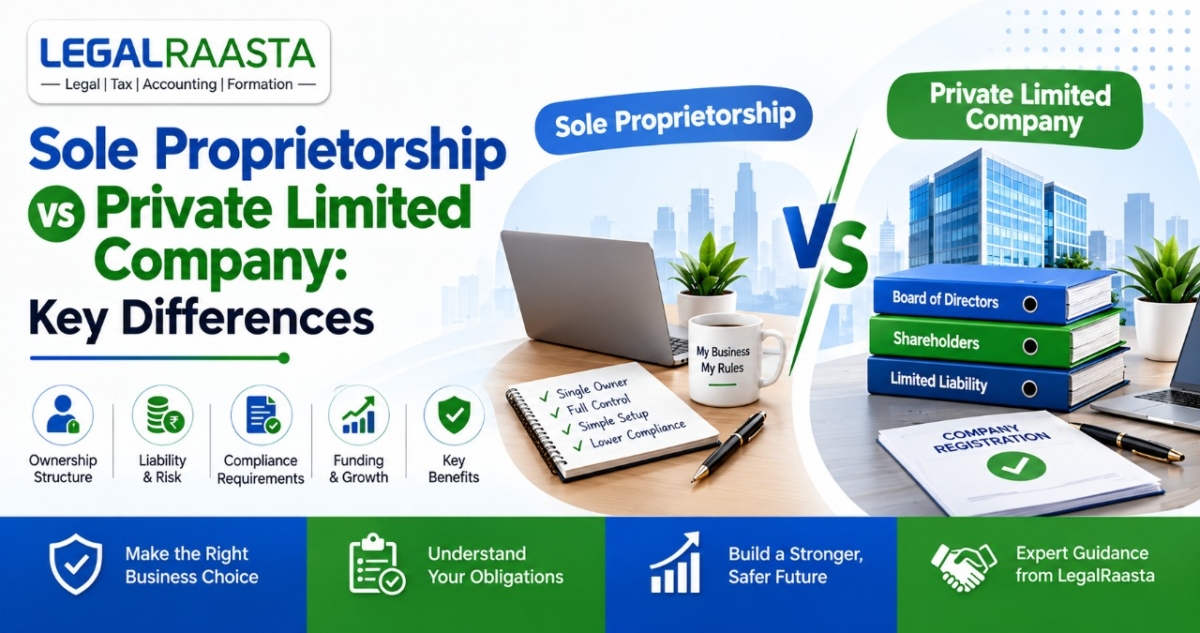
Starting a business in India means making a huge choice early on. You have to pick the right legal structure. Many founders get stuck deciding between a Sole Proprietorship vs Private Limited Company. The wrong choice blocks your funding. It can also risk your personal savings. You need clear facts about liability and taxation. Accelerate your growth and protect your operational future effortlessly with LegalRaasta.
Quick Answer: Business Setup at a Glance
|
Requirement |
Single Owner Setup |
Corporate Setup |
|
Registration Authority |
Local Municipal / MSME |
Ministry of Corporate Affairs |
|
Application Portal |
Udyam Portal |
MCA V3 Portal |
|
Minimum Owners |
Exactly 1 |
Minimum 2 |
|
Processing Time |
2 to 4 days |
10 to 15 days |
|
Personal Risk |
Extremely high |
Protected |
What Is a Sole Proprietorship?
A single person owns and runs this business type. You are the business. The law does not separate you from your shop or agency. Therefore, you enjoy all the profits alone. You also face all the risks completely alone. Most local vendors use this setup because it requires zero complex paperwork. You simply start selling your products or services. There is no official board of directors to answer to.
What Is a Private Limited Company?
This is a separate legal structure governed by strict government rules. A minimum of two directors must start it. The business holds its own assets and liabilities. Because it is separate, your personal bank account stays completely safe if the business fails. Startups looking for angel investors prefer this route. The government recognizes the company as an artificial legal person. Consequently, the company can buy land or sign legal contracts in its own corporate name.
Sole Proprietorship vs Private Limited Company: Key Differences
Analyzing these core business structures reveals massive gaps in legal safety and operational freedom.
Difference in Legal Status
Sole proprietorship shares their exact legal identity with the business. You use your personal PAN card for all business taxes. Meanwhile, a registered company gets a brand new corporate PAN from the income tax department. It has its own official identity. The company can legally sue other businesses. Other businesses can also sue the company without involving the directors personally.
Difference in Liability
Liability is the biggest dealbreaker for most modern founders. A sole trader has unlimited liability. Bank officials can legally sell your personal house to recover unpaid business loans. Conversely, company directors have limited liability. Your financial risk stops entirely at the exact capital you invested. Your family assets stay totally secure during a business bankruptcy.
Sole Proprietorship vs Private Limited Company in India: Comparative Analysis Matrix
|
Methodology |
Implementation Time |
Operational Risk |
Resource Efficiency |
|
Single Owner Model |
Very Fast |
Maximum Personal Risk |
Highly Efficient |
|
Corporate Entity |
Moderate |
Strictly Limited Risk |
Requires Accounting Help |
Difference in Registration Process
Following the correct online portal workflow ensures your business gets government approval without frustrating delays.
Single Owner Process
You do not need a formal incorporation certificate. Simply get an MSME certificate online. Open a current bank account using your local shop act license. The entire process takes hardly three days. You pay very minimal government fees. No legal experts are strictly required.
Corporate Entity Process
The process requires navigating the complex MCA portal. First, apply for name approval through the SPICe+ form. Next, draft the Memorandum and Articles of Association properly. Submit director KYC documents along with digital signatures. The government usually takes two weeks to issue the final incorporation certificate.
Difference in Compliance Requirements
You must meet distinct regulatory pillars depending on the specific business model you eventually select.
Single Owner Filings
Your paperwork stays minimal throughout the year. You file standard income tax returns based on your individual slab. If your revenue crosses the designated limit, you file GST returns. There are absolutely no mandatory annual audits unless your revenue exceeds specific tax audit limits. You save heavily on chartered accountant fees.
Corporate Legal Filings
Companies face strict and unforgiving regulatory pillars. You must hire an auditor within thirty days of starting. You need to hold regular documented board meetings. Furthermore, you must file AOC-4 and MGT-7 forms annually with the Registrar of Companies. Missing these exact deadlines attracts heavy late fees instantly.
Taxation: Sole Proprietorship vs Private Limited Company
Tax rules treat these two completely different business models in entirely separate ways under the law.
Individual Income Tax
Sole traders pay tax according to normal individual slabs. If you earn big profits, your tax rate easily hits thirty percent. You cannot legally retain money in the business at a lower tax rate. Therefore, scaling up becomes expensive due to heavy personal taxation.
Corporate Tax Rates
Companies enjoy a flat corporate tax rate. New manufacturing companies often pay as low as fifteen percent. Other service companies usually pay around twenty-five percent. Thus, you save massive amounts of tax money if you reinvest your profits back into the company operations.
Difference in Funding and Investment
Investors look at your official legal structure before they even read your startup business pitch.
Angel Investment
Investors hate single-owner setups completely. They cannot buy equity in a personal business. Therefore, raising venture capital is physically impossible for sole traders. A registered company can easily issue fresh shares. Private equity firms always demand a corporate structure before writing a large cheque.
Bank Loans
Banks hesitate to give large unsecured loans to sole owners. They view the model as highly unstable. However, banks trust corporate structures much more. Companies can secure heavy machinery loans based on their corporate financial records.
Difference in Business Continuity
The lifespan of your business completely depends on the legal entity type you initially register.
Single Owner Lifespan
The business dies instantly with the owner. If the proprietor falls sick or passes away, the operations freeze completely. Bank accounts get locked. You cannot automatically transfer the ongoing business name to your children without fresh paperwork.
Corporate Lifespan
A company lives forever under the law. Directors may change. Shareholders may sell their entire stake. However, the company continues its daily operations smoothly. This perpetual succession makes long-term business contracts highly secure.
Advantages and Disadvantages of Sole Proprietorship
Every simple business model comes with specific hidden operational costs that founders must handle.
Pros of Single Ownership
You control everything without asking anyone. Setup costs practically nothing. You can shut the entire business down instantly without asking for government permission. Total privacy exists because you never publish your financial records online for the public.
Cons of Single Ownership
You carry the entire workload alone. Good employees rarely join because you cannot offer them stock options. Finally, the unlimited liability threat constantly hangs over your personal savings. Your growth stays strictly limited to your own capital.
Advantages and Disadvantages of a Private Limited Company
Corporate structures provide massive safety but demand serious operational discipline from all active directors.
Pros of Corporate Structure
The limited liability fully protects your home. You attract top market talent using employee stock options. Customers trust a registered corporate brand much more easily than a local vendor. Global business expansion becomes legally possible.
Cons of Corporate Structure
You must spend serious money on yearly compliance. Closing the company takes months of painful legal paperwork. Directors face severe legal action if they commit financial fraud. You lose total privacy because your financials become public records.
Why Compliance is Complex in 2026
The government recently upgraded its tracking systems completely to monitor tax defaulters. The Ministry of Corporate Affairs now uses AI to scan your submitted documents. Tiny spelling mistakes in your director KYC cause instant rejection. Furthermore, the penalty for delayed annual filings is very severe. The system automatically blocks your company from updating details if you miss one deadline. Therefore, navigating the strict rules requires expert knowledge today.
Common Filing Mistakes to Avoid
Founders frequently lose time and money because of silly application errors. Many people apply for trademarked names during company registration. The registry rejects this instantly. Single owners often mix personal and business funds. This creates huge headaches during tax audits. Additionally, many directors forget to file their commencement of business certificate within the mandatory timeline. This specific mistake brings a hefty penalty and risks immediate company closure.
Risk Mitigation and Compliance Checklist
|
Risk Category |
Primary Vulnerability |
Mandatory Control |
Audit Frequency |
|
Structural Risks |
Mixing personal and business funds |
Open a separate current bank account |
Monthly |
|
Compliance Risks |
Missing ROC annual filing deadlines |
Hire a dedicated company secretary |
Annually |
|
Financial Risks |
Unlimited personal liability exposure |
One-time |
DIY vs Expert Registration Comparison
|
Feature |
DIY Registration Approach |
Expert Assisted Approach |
|
Error Rate |
Very high due to complex forms |
Zero errors |
|
Time Spent |
Weeks of frustrating research |
Processed in a few days |
|
Rejection Risk |
High chance of name rejection |
Pre-checked for exact availability |
|
Compliance Support |
You figure it out alone |
Guided post-registration alerts |
Sole Proprietorship vs Private Limited Company: Which Is Better?
Your final choice depends completely on your growth goals and your personal financial risk appetite.
When to Choose Single Ownership
Pick this if you run a local bakery or freelance business. Choose it if you have absolutely zero plans to raise investor money. It works perfectly for low-risk service providers who operate alone.
When to Choose Corporate Structure
Select this if you plan to build a massive tech startup. Choose it if you need venture capital soon. You must pick this if your industry involves high financial risks.
Can a Sole Proprietorship Be Converted into a Private Limited Company?
Yes. You can upgrade your legal structure easily as your revenue grows. The process requires formally transferring all assets and liabilities to the new corporate entity. You must draft a proper official takeover agreement. The new company then applies for fresh GST and bank accounts. Many successful founders choose this safe path after testing their product in the open market first.
Conclusion
Making the right legal choice on day one saves you years of future stress. Single ownership is cheap and simple. Corporate structures offer bulletproof legal safety and unlimited funding options. Do not make this decision blindly. Calculate your exact growth trajectory first. Understand your personal risk capacity clearly. Compare the long-term compliance costs. If you want to play safe, the corporate structure always wins. Keep your personal wealth separate from your business risks. Accelerate your growth and protect your operational future effortlessly with LegalRaasta.
Frequently Asked Questions
1. How do I choose between Sole Proprietorship vs Private Limited Company?
Look at your growth goals. If you want safety and outside funding, the corporate route is much better for your startup registration.
2. Which legal entity is cheaper to start in India?
Comparing a Sole Proprietorship vs Private Limited Company shows the single-owner model costs less initially. You skip heavy government portal fees.
3. Does a Sole Proprietorship vs Private Limited Company affect my tax rate?
Yes. Single owners pay tax according to standard individual slabs. Registered companies enjoy a much lower flat corporate tax rate on profits.
4. Which business registration process is faster?
A single-owner setup is practically instant. Meanwhile, forming a Sole Proprietorship vs Private Limited Company corporate structure takes about two weeks.
5. Can I convert my Sole Proprietorship vs Private Limited Company later?
Yes. You can easily upgrade your basic business to a registered corporate entity under the Companies Act 2013 whenever your revenue grows.
6. Do both structures require strict annual compliance?
A Sole Proprietorship vs Private Limited Company comparison shows that only companies face mandatory yearly audits. Single owners escape most of these filings.
7. Which setup is better for raising funds in a Sole Proprietorship vs Private Limited Company?
Investors only put money into corporate structures. Therefore, you need a limited liability setup to issue equity shares to angel investors.
8. Do I need Udyam registration for both types?
Yes. Evaluating Sole Proprietorship vs Private Limited Company rules shows both can get MSME certificates to claim special government loan benefits.
9. Does a Sole Proprietorship vs Private Limited Company protect my personal savings?
Only a registered legal entity provides asset protection. A single owner must sell personal property if the business cannot repay its bank debts.
10. Can a single person complete the MCA portal registration?
No. A Sole Proprietorship vs Private Limited Company analysis shows you need at least two directors to form a standard corporate company.
Related Posts
 Company Registration
ROC Registration in India: Process, Documents, Eligibility & Key Requirements
Read More → Company Registration
How to Improve Company Compliance in India: A Complete Guide for Businesses
Read More → Company Registration
Company Name Reservation in India (2026): MCA Process, Rules, Fees & Approval
Read More →
Our Clients


Featured In