
Pvt Ltd vs LLP vs OPC in India (2026): Key Differences, Benefits, Compliance & Which One to Choose
You’ve decided to start a business. Good. Now comes the part that trips up most first-time founders: picking the right legal structure before you file a single form. Pvt Ltd vs LLP vs OPC is the exact question every founder in India googles before registering.
Pick wrong, and you either end up with compliance costs you didn’t budget for, or a structure that scares off your first investor. Pick right, and everything after that is just routine paperwork. This guide breaks down all three structures as they stand in 2026, what they actually cost to run, and which one fits your situation. Talk to LegalRaasta’s company registration team before you file, and skip the guesswork entirely.
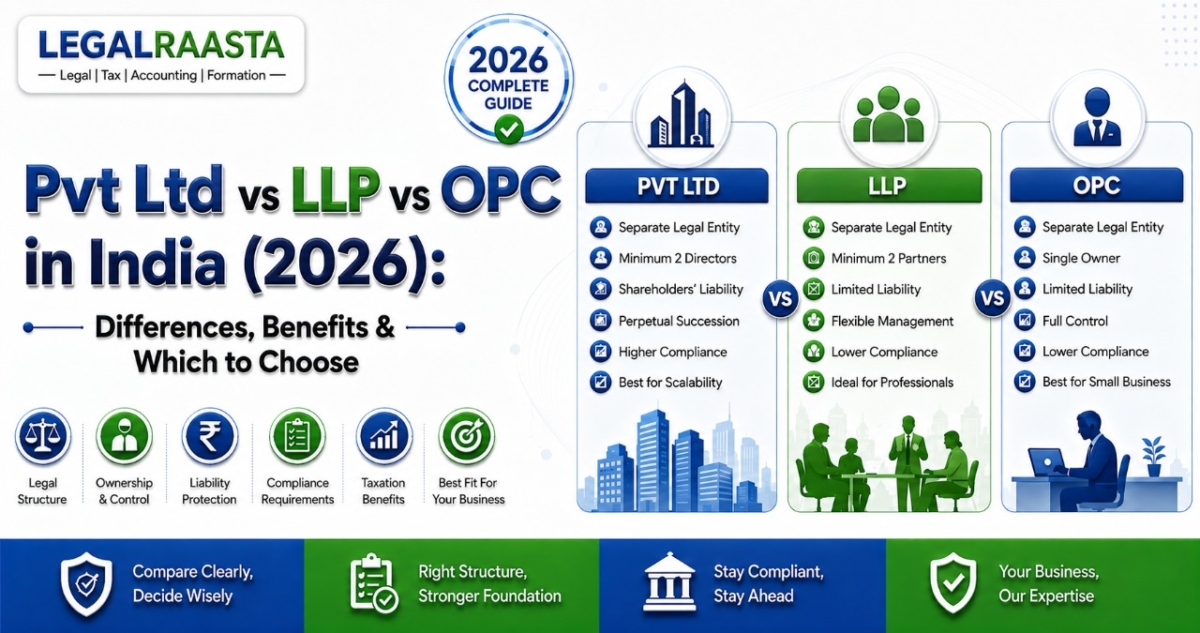
Quick Answer: Pvt Ltd vs LLP vs OPC at a Glance
|
Factor |
Pvt Ltd |
LLP |
OPC |
|
Members required |
2 to 200 shareholders |
2 partners, no upper limit |
1 member + 1 nominee |
|
Liability |
Limited to shares held |
Limited to contribution |
Limited to shares held |
|
Best suited for |
Startups raising VC funds |
Professional and service firms |
Solo founders needing a brand |
|
Incorporation form |
SPICe+ |
FiLLiP |
SPICe+ |
|
Mandatory audit |
Every year, no exceptions |
Only above Rs 40 lakh turnover or Rs 25 lakh contribution |
Every year, no exceptions |
|
Foreign ownership |
Allowed, mostly automatic route |
Allowed with strict conditions |
Not allowed |
|
Funding ease |
High. Issues equity shares easily. |
Low. Cannot issue equity. |
None. Cannot have outside investors. |
|
Closure difficulty |
High. Takes months to strike off. |
Medium. Easier than companies. |
High. Similar to private limited. |
What Are Pvt Ltd, LLP and OPC?
Three different laws sit behind these three structures. That is exactly why they behave so differently regarding compliance, taxation, and funding.
A Private Limited Company is registered under the Companies Act, 2013. It has its own legal identity; it sits completely separate from the people who own it, and it can sue people. People can sue it. The owners just hold shares.
An LLP comes from the Limited Liability Partnership Act, 2008. It blends partnership-style internal flexibility with corporate limited liability protection. You get the safety of a company without the board meeting headaches.
An OPC, also born out of the Companies Act, 2013, solves a very specific problem. It lets a single person own and run a full company. No finding a fake co-founder just to sign the papers. You run the show alone legally.
Private Limited Company in India
A Pvt Ltd is the default choice for anyone planning to raise venture capital. Full stop. If you want angel investors, you need this.
Key features: It operates as a separate legal entity. It offers limited liability. It has perpetual succession, meaning it survives even if the founders die. Shares exist, but they are not freely tradable on a public stock exchange like Reliance or Tata.
Eligibility: You need a minimum of 2 and a maximum of 200 shareholders. You need a minimum of 2 directors. One director must be a resident of India. You need a registered office address. The MCA must clear your unique company name first.
Advantages
- Investors prefer it. Equity is extremely easy to issue, divide, and transfer.
- Limited liability protects your personal assets. If the business goes bankrupt, the bank cannot take your personal house.
- Easier to get bank loans. Government tenders often strictly require this structure to even bid.
- Employee Stock Ownership Plans (ESOPs). You can attract top talent by giving them a piece of the company.
Disadvantages
- Highest compliance burden of the three. You live by the MCA calendar.
- Mandatory statutory audit regardless of turnover. Zero revenue? Still need an audit.
- Costlier to set up. Costlier to run. CA fees add up fast.
Compliance requirements: You file AOC-4 and MGT-7 (or MGT-7A for small companies) every single year. You hold an Annual General Meeting within six months of the financial year closing, you do DIR-3 KYC for every single director annually, and you hire an external auditor immediately upon incorporation.
Limited Liability Partnership (LLP) in India
An LLP suits consultants. It suits marketing agencies. It suits professional practices like lawyers and architects. These businesses want limited liability without the crushing company-level compliance load.
Key features: It remains a separate legal entity. But partners’ liability is strictly limited to their agreed financial contribution. There is no minimum capital requirement. You manage everything flexibly through a custom LLP Agreement.
Eligibility: You need a minimum of 2 designated partners. There is absolutely no cap on the maximum number of partners. At least one designated partner must be a resident of India.
Advantages
- Lower government fees upfront. MCA bases fees on partner contribution slabs, not massive authorized capital blocks.
- No mandatory audit. If your turnover stays under Rs 40 lakh and contribution under Rs 25 lakh, you skip the CA audit entirely.
- No board meetings. No AGM required. You run the business how the partners agree to run it.
- Easy profit extraction. Partners simply withdraw profits without dividend distribution tax issues.
Disadvantages
- Cannot issue equity shares. Raising VC funding is basically impossible.
- Foreign investment allowed only in sectors under the 100% automatic FDI route.
- Perceived as slightly less prestigious by some traditional banks and large enterprise clients.
Compliance requirements: You file Form 11 within 60 days of the financial year-end. You file Form 8 within 30 days of the six-month mark, you file ITR-5 every year for taxes, and you only hire an auditor once you cross the turnover or contribution thresholds.
One Person Company (OPC) in India
An OPC exists for exactly one kind of founder. Someone who wants a strict corporate structure but genuinely has no co-founder to bring in.
Key features: Single member. One mandatory nominee. Limited liability. It acts exactly like a private limited company but with one chair at the table.
Eligibility: The member must be an Indian citizen. Since the massive 2021 MCA amendment, NRIs who are Indian citizens can also form one. They just need to have stayed in India for at least 120 days in the previous financial year. Foreign nationals cannot register an OPC at all.
Advantages
- Full control stays with one person legally. No board disputes.
- Limited liability. Vastly superior to a risky sole proprietorship.
- No forced conversion. You used to have to convert to a regular company if you hit Rs 2 crore turnover. The government scrapped that rule. You can stay an OPC forever now.
Disadvantages
- Cannot raise equity funding from outside investors. You literally have no shares to give them.
- Statutory audit is mandatory every year. Same heavy cost as a bigger company.
- Only one member allowed. This heavily limits scaling unless you convert it later.
Compliance requirements: You file AOC-4 and the simplified MGT-7A. No AGM required because you cannot hold a meeting with yourself. Mandatory audit. DIR-3 KYC for the sole director every year.
Key Differences Between Pvt Ltd vs LLP vs OPC
Here is where the three structures actually pull apart factor by factor. Look closely at management style and succession.
|
Aspect |
Pvt Ltd |
LLP |
OPC |
|
Ownership and members |
2 to 200 shareholders |
2 partners, unlimited |
1 member, 1 nominee |
|
Liability protection |
Limited to unpaid share value |
Limited to contribution |
Limited to unpaid share value |
|
Registration form |
SPICe+ |
FiLLiP |
SPICe+ |
|
Capital and funding |
Equity funding, easiest for VCs |
No equity, only loans |
No external equity |
|
Management style |
Board of directors |
Partners, via LLP Agreement |
Sole director |
|
Taxation |
22% to 25% plus surcharge and cess |
Flat 30% plus surcharge and cess |
Same as Pvt Ltd |
|
Annual compliance |
AOC-4, MGT-7, AGM |
Form 11, Form 8 |
AOC-4, MGT-7A |
|
Audit requirement |
Always mandatory |
Above Rs 40 lakh turnover only |
Always mandatory |
|
Succession |
Perpetual, shares transfer freely |
Continues on partner exit |
Nominee takes over on death |
|
Conversion |
Can convert to LLP after 1 year |
Can convert to Pvt Ltd |
Converts to Pvt Ltd anytime, since 2021 |
Pvt Ltd vs LLP vs OPC: Cost and Compliance Comparison
Government fees are lower than most people expect. MCA charges nil incorporation fee for companies with authorised capital up to Rs 15 lakh today. So most early Pvt Ltd and OPC filings pay only stamp duty, DSC tokens, and PAN or TAN charges. This usually runs roughly Rs 4,000 to Rs 10,000 in total, depending on your state’s specific stamp duty rates.
LLP incorporation fees run on a sliding contribution slab. From Rs 500 for contributions up to Rs 1 lakh. Going up to Rs 5,000 for contributions above Rs 25 lakh. This usually keeps LLP setup slightly cheaper upfront. Annual running cost tells a completely different story.
A Pvt Ltd’s mandatory audit, AGM minutes drafting, and dual filings push yearly compliance spend to roughly Rs 15,000 to Rs 30,000 for a small company. You have to pay a CA to sign off. An LLP below the audit threshold often gets away with Rs 5,000 to Rs 10,000 a year because the partners can file basic returns themselves if they understand the portal. An OPC sits painfully close to Pvt Ltd costs. Because the audit is compulsory either way.
Pvt Ltd vs LLP vs OPC: Tax and Regulatory Considerations
Which brings us to tax. This heavily influences mature businesses. Companies, whether Pvt Ltd or OPC, are taxed at 22% under Section 115BAA if they give up certain specific deductions and exemptions. Or they sit at 25% to 30% under the regular regime, plus surcharge and cess. LLPs pay a flat 30% on total income. Plus a surcharge if income crosses Rs 1 crore. Plus cess.
There is no dividend distribution tax on companies anymore. Dividends are simply taxed in the shareholder’s hands at their income tax slab rate. LLP partners don’t pay tax again on their share of profit. Since it’s exempt under Section 10(2A) of the Income Tax Act. The LLP already paid the 30%, so the money is free to withdraw. GST registration applies the same way across all three once your turnover crosses the prescribed state threshold.
Which Business Structure Is Best for You?
Look at your actual daily operations. Match your reality to these profiles.
- Tech Startups seeking seed funding: Go with Pvt Ltd. Almost every VC and angel investor in India asks for equity. Only a company structure can issue that. Don’t waste time starting as an LLP just to save Rs 10,000. You will spend Rs 50,000 converting it later when the investor demands it.
- Small agencies, CA firms, and professional consultants: An LLP works best here. Lighter compliance. No forced audit at low turnover. Enough legal protection to shield your personal savings if a client sues your agency for breach of contract.
- Solo tech freelancers and independent ecommerce sellers: OPC gives you a company’s strict credibility with none of the co-founder hassle. Ideal if you want a formal brand identity to pitch to large corporate clients while working entirely alone from your bedroom.
- Family-owned manufacturing businesses: Start with Pvt Ltd directly. Family disputes destroy partnerships fast. A company board structure keeps voting rights clean and shares easily transferable to the next generation.
Common Mistakes to Avoid When Choosing Pvt Ltd vs LLP vs OPC
Founders make the same errors every single month. Avoid these entirely.
- Picking OPC just to save money, then hitting a wall the absolute moment you need a co-founder or investor.
- Choosing an LLP for a high-growth tech startup that will definitely need equity funding within a year.
- Ignoring the resident director requirement. You cannot run an Indian Pvt Ltd with two guys living in Dubai. Someone has to reside here.
- Assuming LLPs never need an audit. They absolutely do once turnover or contribution crosses the threshold.
- Not checking FDI sector restrictions before bringing a foreign partner into an LLP structure.
- Using personal bank accounts for company expenses and destroying the corporate veil protecting your liability.
Conclusion
There is no single universal winner in the Pvt Ltd vs LLP vs OPC debate. Only the structure that matches exactly where your business actually is right now. A solo founder testing a drop-shipping idea simply doesn’t need the same heavy setup as a robotics startup chasing a Series A funding round. What matters is picking based on your long-term funding plans, your actual compliance appetite, and how fast you honestly expect to grow. Do not just pick based on today’s cheap registration cost.
Get LegalRaasta’s experts to map your highly specific situation against the right corporate structure before you file absolutely anything with the MCA. Accelerate your growth and protect your operational future effortlessly with LegalRaasta.
Frequently Asked Questions (FAQs)
1. In the Pvt Ltd vs LLP vs OPC comparison, which one is cheapest to register?
LLP usually costs the least upfront. The LLP registration process charges much lower government fees based on contribution slabs on the MCA portal compared to the standard forms for companies.
2. What is one person company registration actually meant for?
It serves solo founders perfectly. When making the Pvt Ltd vs LLP vs OPC choice, a solo owner gets a formal corporate identity and limited liability without needing to find a co-founder just for paperwork.
3. Does the Pvt Ltd vs LLP vs OPC decision directly affect my fundraising chances?
Yes, massively. Venture capitalists almost always want equity shares. Company registration rules in India state that only companies can issue these shares. An LLP simply cannot issue equity to an angel investor.
4. What does ROC compliance look like for these three structures?
It varies heavily. Between Pvt Ltd vs LLP vs OPC, a private company files AOC-4 and MGT-7 yearly with mandatory audits. LLPs below specific financial thresholds skip the audit entirely and file simpler forms.
5. Which structure among Pvt Ltd vs LLP vs OPC always needs a statutory audit?
Both private limited and one-person setups need one every single year, regardless of zero revenue. LLPs are entirely exempt from statutory audit if they stay below Rs 40 lakh turnover or Rs 25 lakh contribution.
6. What exactly is the SPICe+ form used for?
It handles full incorporation online. Comparing Pvt Ltd vs LLP vs OPC, only the company structures use this specific form. Partnerships are registered through FiLLiP instead on the government portal.
7. Can foreign nationals invest freely across Pvt Ltd vs LLP vs OPC options?
Not equally at all. Foreigners can easily invest via FDI in India routes for private companies. LLPs need strict sector-specific government approval. Meanwhile, foreign nationals are banned from starting a solo company.
8. How do I get director identification for these structures?
You apply during incorporation. Comparing Pvt Ltd vs LLP vs OPC, company directors need a DIN and must file DIR-3 KYC annually. Partners get a DPIN, which follows the exact same yearly KYC rule.
9. Is a digital signature certificate mandatory for filing?
Yes. Every single director or designated partner needs a Class 3 DSC. You cannot submit incorporation papers or annual financial filings in the Pvt Ltd vs LLP vs OPC categories without one.
10. Which business structure converts most easily later on?
A solo company converts fastest today. In the Pvt Ltd vs LLP vs OPC landscape, the government removed the old two-year waiting period. You simply pass a resolution and file the conversion forms online.

Related Posts
 Company Registration
ROC Registration in India: Process, Documents, Eligibility & Key Requirements
Read More → Company Registration
How to Improve Company Compliance in India: A Complete Guide for Businesses
Read More →
Our Clients






Featured In