
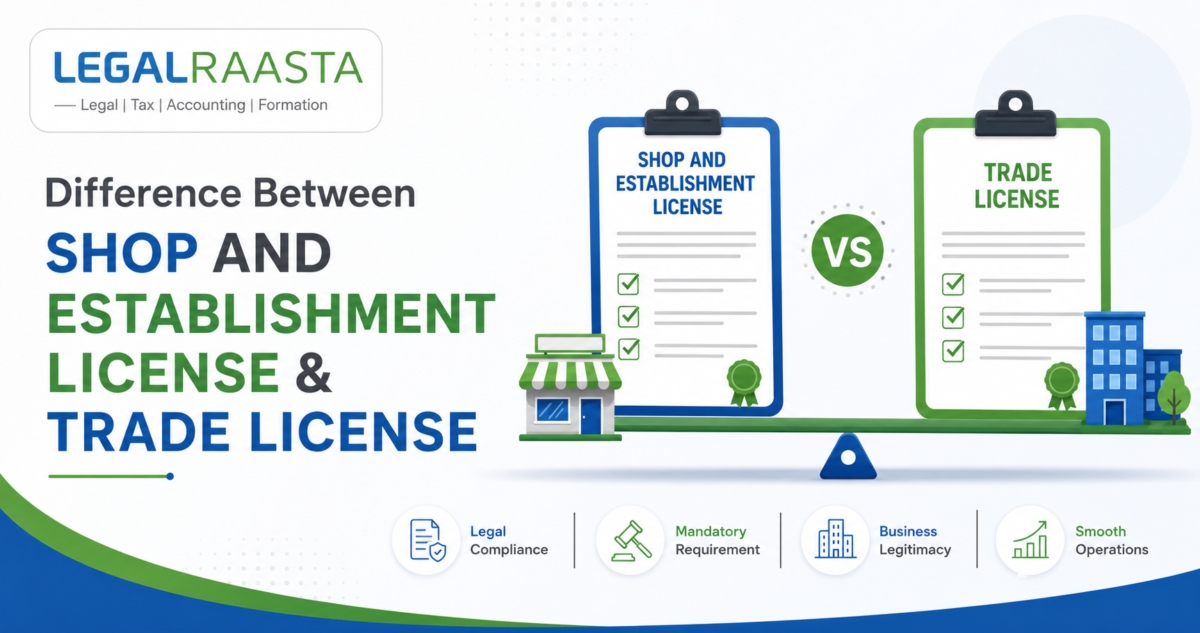
Difference Between Shop and Establishment License & Trade License
To start a business in India is exciting but confusing as well. You may find that you’ve established a shop or office and have a new line of questions, such as: What licenses do I need to have? What would be a suitable number of one and two? What’s the consequence of making a mistake?
In almost all cases, two kinds of licenses get in the way of every fresh business enterprise, which are the Shop and Establishment License and the Trade License. They sound similar. Some people think that they are the same. But they are not, and blending up can cost you money, time, and, if you don’t get it right, can cause a store closure.
It details exactly what each license is, which ones to use and which ones not to, the documents you need, how you went about applying for it, and what happens when people don’t do it.
Make your compliance framework a reality now with LegalRaasta.
What is a Shop and Establishment license?
Shop and Establishment License is a License granted by the Labour Department of the State. It is regulated through different rules and regulations under the respective state’s Shops and Establishments Act — hence, each state has a slightly different approach. Actually, this covers:
- Work hours for workers
- One week’s leave (paid) (5 days off).
- Overtime rules
- Working environments within the workplace.
- Conditions within the workplace wrt health and safety.
- The hiring and firing conditions.
In other words, these are the licenses of workers’ welfare/promotion and regulation of the work environment. The Labour Ministry wants to ask you about your Unit at Bangalore and the Software Office at Hyderabad, and how you are treating your employees.
Who issues the Shop and Establishment License? The State government’s labour department.
And you should use it generally within 30 days of starting the operation. In certain states, it is compulsory before opening up, for example, in the State of Maharashtra.
|
Note: The requirements for the Shop and Establishment License may apply to any business that has no employees, as well as a freelance photo studio or a small home office business. |
What is meant by Trade License?
A trade license is like a permit from the municipal corporation of your city/county and is granted to conduct a particular trade or business activity in a particular location. The following comes within its purview:
- Ensuring your business is operating in a safe environment for your neighbourhood.
- Being able to run your business in that kind of area (residential, commercial, industrial)
- Food safety and hygiene — particularly in food operations.
In simple terms, the Trade License is your local authority declaring that, yes, they know what you do here, and YOU won’t do anything that will cause them any nuisance or health reason.
For example, the restaurant will need to get a Trade License because cooking, handling raw food, and food preparation can pose a risk to public health. As part of Fire and Safety to the locality, a chemical warehouse must have one.
Who issues it? The local Urban Corporation (or local urban body) in your town/city
Validity (must be renewed annually): one year.
Who Needs Which License?
This is where most people miss a point. Let’s think about this another way:
To get the Shop and Establishment License, you must have:
-
- own a small business with things sold within an office building environment.
- own a commercial property with a trading business.
- Own a coaching centre or Tuition centre
- a beauty shop/salon on your hands (in most states) and any kind of registered business.
You need ONLY a Trade License:
If you own a business or have a commercial activity within the legal framework of the municipality (this is less frequent; most companies will need both).
You need both in the following scenarios:
- To keep a restaurant, café, or food stall open, food businesses need to have access to both.
- You are a doctor or pharmacist (pharmacy shop owner)
- Be a business owner of a factory or manufacturing company
- You are a guest house, hotel owner, or own a room rental business.
- You operate any chemical-based, flammable, and hazardous material businesses.
Assume that you are opening a café in Pune. Here, you require your Shop and Establishment License from the state labour department – they know that you have employees, they have their working hours, their fixed leave policy, etc.
Also, the Pune Municipal Corporation needs assurance that your safety measures around the kitchen and food handling won’t hurt the neighbors’ premises and all, and for this, you require a Trade License. So, actually, you need both licenses here.
Table 1: Quick Side-by-Side Comparison
|
Feature |
Shop and Establishment License |
Trade License |
|
Issued By |
State Labour Department |
Local Municipal Corporation |
|
Core Purpose |
Regulates employee welfare, working hours, and workplace conditions |
Ensures business activity is safe for public health and the local zone |
|
Applies To |
All shops, offices, and commercial establishments |
Businesses with specific trade activities (food, chemicals, hotels, etc.) |
|
Validity |
1–5 years (varies by state) |
1 year (annual renewal) |
|
When to Apply |
Within 30 days of starting operations |
Before commencing business |
|
Penalty for Non-Compliance |
Fines + closure notice from the labour department |
Fines + sealing by the municipal corporation |
|
Governed By |
State Shops & Establishments Act |
Municipal Corporation Act / local bylaws |
Keep the Documents Ready For Both Licenses
Making your documents ready in advance helps avoid several errors that may occur later. I have provided a clean checklist below. Please go through it once.
For ‘Shop’ and ‘Establishment’ License:
-
-
- Documents as business address proof — Rent agreement/owner documents for premises
- Owners’ proof of identity (Aadhaar card, PAN card, passport)
- Proof of address by the owner: Aadhaar, Utility bill, Driving license, Owner/proprietor’s passport-size photo(s)
- Employees’ details – Number of employees, name, designation, etc.
- The type of business and what you provide/do/services are offered.
- PAN number of the business (in case of any company/LLP)
- Certificate of Incorporation (for companies or LLPs)
-
For the Trade License:
-
-
- Invoices/Rent agreement or sale deed of business premises as proof
- A site plan/floor plan of the business facility
- In case of a rented property, NOCLS is required from the landlord
- Business owner’s identity and address proof.
-
How Can You Get Your Shop and Establishment License?
To get your shop and establishment license, go through the following online process. Here’s how it works:
-
-
- Visit your state’s labour department portal website, which could be the Shram Suvidha Portal (central), Aaplesarkar at Maharashtra’s labour department, the e-District portal at the Delhi labour department, and many more, naming only a few to cite examples.
- Sign up either with your Mobile Number or with an email ID.
- Complete the application form (Business Name, Address, Nature of Work, No. of employees, and Owner’s information).
- Upload documents: ID proof, address proof, rent agreement, and photos.
- Pay the registration fee – This depends on the state and the number of employees (will cost you at least ₹100 and up to ₹1,000).
- Submit and wait – Many states get an automated registration certificate immediately. In others, a labour inspector might be permitted to visit before approval.
- Download your certificate — left at the premises, both digital and physical.
-
How Can You Get Your Trade License?
To know the exact route of getting the Trade License through your city’s municipal corporation, refer to the following process and see how you will be proceeding along the way:
-
-
- Install websites of city municipal corporations in your city, such as MCGM for Mumbai, MCD for Delhi, BBMP for Bengaluru, PMC for Pune, etc.
- Sign up or log in, depending on whether you are registering or accessing your existing account.
- Choose the kind of trade, such as food establishment, retail, manufacturing, etc.
- Complete information on the business: Address, Area, Type of business conducted, and owners’ details.
- Attach relevant documents – Rent agreement, Floor Plan, NOC from Landlord, and Fire NOC if applicable.
- Do the online payment and remember that fees may vary by business type and square footage.
- A visit by a municipal officer — the officer carries out an inspection to check the application.
- Get your Trade License– After getting approved, download it and put it up on the premises.
-
What If You Don’t Have Any of These Licenses?
Without talking much, let’s get down to the facts. Remember that you cannot take any chance of not buying these licenses, as these uphold the utmost significance in ensuring the smoothness and effectiveness of your business.
In the absence of a Shop and Establishment License:
-
-
- Labour inspectors have the power to issue a show-cause notice.
- The Fines may vary but can be in the range of ₹2,000 to ₹25,000 or even more.
- If violations are repeated, they can result in business closure orders.
-
There are several valid business addresses you can legally use for banking, GST, MSME, and various aspects.
If no Trade License, then:
-
-
- It could happen at any moment that municipal officers can ban on your premises in almost no time.
- The city will fine you on a daily basis — up to $10.00 per day — for their violations.
- You may also be identified as an operation that does not have a sanitary permit from the municipality, by the FSSAI, if it is a food business.
- Your business reputation for compliance suffers, and it is important when you are seeking loans and tenders.
-
Case Study: It was a decision of the restaurant owner in Chennai that he would not get a Trade License, with the belief that it is not required. Six months later, while it was being used as the usual municipal driving exercise, the store was locked up for a week. Excessive fines, legal fees, and lost income — it was more expensive than the license ever would have been.
The bottom line is that both licenses are about protecting people – your workers, your customers, and your neighbours.
Sort Early and Reap the Benefits
It is not just a matter of avoiding trouble when it comes time to complete your Shop and Establishment License and Trade License. It is actually a proactive approach in inviting profitable opportunities; let’s see how:
Open a current account without hassle. The reason is that banks require your business to submit a Shop and Establishment License to substantiate your business. Not doing so will make it unduly difficult to obtain your company’s current account.
Simplify your GST registration process. The application for GST (CN16D) is attached to your business license documents. Keeping them handy goes a long way to getting things done quicker.
Benefits from MSME and government schemes. The two licenses discussed throughout the blog are essential for getting your business started on the MSME / Udyam portal, enjoying priority loans, the government scheme incentives, and easy passage of Government Tenders.
Improved lease negotiations in the office. Some commercial landlords in metropolises, such as Mumbai, Bengaluru, and Delhi, demand evidence of registration to enter into a longer-term contract.
Establishes clients’ and staff’s confidence. For the customer, the vendor, or potential employees, the commercial establishment via authentic and recognized licenses is a way of knowing that you’re a legitimate, responsible, and honest business.
Conclusion
A simple fact is that there is no direct connection between the Shop and Establishment License / Trade License. They are not issued by the same authority, and they don’t do the same job.
Shop and Establishment License is provided by the labour department in your state and has to do with your employees’ safety. The Trade License is granted by the local municipal corporation and has an observance of the public as its foundation.
Having both is essential to many businesses — particularly restaurants, hotels, medical stores, and those involving food or hazardous materials. The Shop and Establishment License may be all that’s needed in some offices/services and service firms. Very few businesses are truly restricted in their activities in this regard solely to a Trade License.
|
Avoid paperwork hassles in the implementation of a business idea. Obtain these licenses before opening or as soon as you may open. Grow with LegalRaasta, secure your operations’ future. |
FAQs
What is meant by ‘Shop and Establishment License,’ and who needs to be licensed?
A license that the State also issues to all types of commercial activities, including an office, a café, or a salon, etc. From small businesses to corporations, regardless of their niche, it is essential for all.
Should there be an exercise of a trade license despite having a Shop and Establishment License?
Yes, in many cases. Trades like food, hazardous goods, hotels, etc., require a separate trade license from the municipality. Two licenses, both issued by different authorities, for different things.
How long does it take to get a Shop & Establishment License?
It can take several days, depending on your state. It is now available instantly through many states’ websites. Some of our cases must be inspected by the labour department, and the process can take 5-7 working days. One should do so as soon as one has finalized the business address.
If I have no employees, still my startup requires a Shop and Establishment License?
Yes. For a single-person venture, even if it’s run from a rented-out commercial space, a Shop and Establishment License is generally a necessity per the labor department rules in most states. Be sure to specify the exact thresholds as stated in your state act.
What is the penalty for not renewing a Shop and Establishment License on time?
Late renewal attracts fines from the state labour department, typically between Rs. 200 and Rs. 2,000 depending on your state. Some states also issue show-cause notices. Renew at least 30 days before expiry to avoid any disruption to your business operations.
Can I apply for both licenses at the same time?
Yes, you can work on both applications simultaneously since they are filed on different portals. The Shop and Establishment License goes through your state labour portal and the Trade License through your city’s municipal corporation website. Having your documents ready beforehand makes running both processes together much easier.
Is a Shop and Establishment License valid across all states in India?
No. Each state issues its own license under its own Shops and Establishments Act. If your business operates in multiple states, you need a separate Shop and Establishment License for each state. The rules, fees, and renewal timelines also vary from one state to another.
How much does a Trade License cost in India?
Trade License fees vary by city and business type. Most municipal corporations charge between Rs. 500 and Rs. 5,000 annually depending on your business category, premises size, and location. Food businesses and hotels generally pay higher fees. Check your city’s municipal corporation website for the exact fee structure.
Do home-based businesses need a Shop and Establishment License?
It depends on your state and whether you have employees working from that address. Many states require registration even for home-based commercial operations. If you are running a business from home with even one employee, check your specific state’s Shops and Establishments Act to confirm whether registration applies to you.
What is the difference between a Trade License and a business registration?
Business registration, like company incorporation or LLP registration, creates your legal business entity through the Ministry of Corporate Affairs. A Trade License is a local-level permission from your municipal corporation to operate a specific trade at a specific location. Both are different and both may be required depending on your business type.
Can a freelancer or solo consultant operating from home skip both licenses?
Possibly, but not always. If you work alone with no employees and from a purely residential address, some states exempt you. However if you have clients visiting, use the address for GST registration, or have even one employee, a Shop and Establishment License is generally required. Verify with your state labour department to be sure.

Related Posts
 shop & establishment license
Shop and Establishment Act: Regulations on Working Hours, Leaves, and Wages
Read More → shop & establishment license
Small vs Large Establishments: Different Rules for License Renewal
Read More →
 shop & establishment license
How can you complete the Shop Registration Process within 30 Days?
Read More →

Our Clients








Featured In