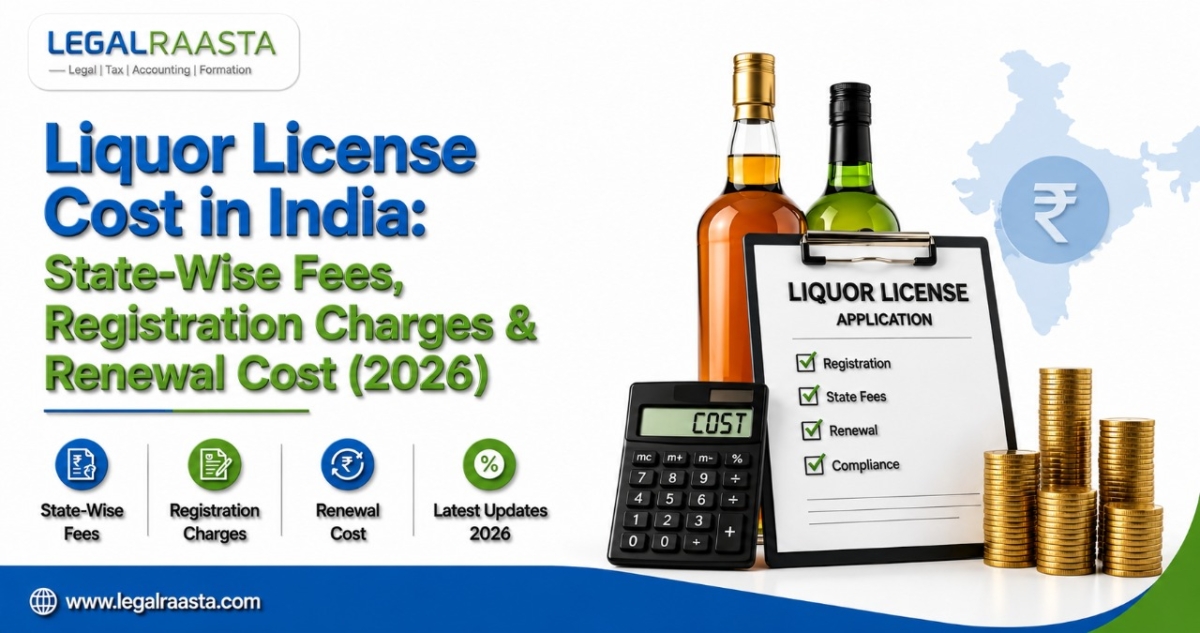
Liquor License Cost in India: State-Wise Fees, Registration Charges & Renewal Cost (2026)
Opening a bar, restaurant, hotel, or liquor retail shop in India? The liquor license cost is one of the first numbers you need to know before anything else. And it is not a simple number. It changes completely depending on which state you operate in, what type of establishment you run, and whether you are applying fresh or renewing an existing license.
Liquor licensing in India falls under state jurisdiction. Each state government sets its own excise policy, fees, and renewal charges through its State Excise Department. This means the liquor license cost for a restaurant in Goa can be under Rs 10,000 per year, while the same license for a similar restaurant in Maharashtra can run into lakhs. The difference is not arbitrary. It depends on the state’s excise policy, the type of license, and where your business is located within that state.
This guide covers state-wise liquor license costs, fee structures by establishment type, renewal charges, and every cost factor you need to budget for in 2026. LegalRaasta helps restaurants, hotels, bars, and retailers navigate the liquor licensing process state-by-state so you get the right license at the right cost without delays.
What is a Liquor License and Why Does the Cost Vary?
A liquor license is a government-issued permit that allows a business to sell, serve, or store alcohol legally. In India, the authority to regulate liquor rests entirely with state governments under Entry 8 of List II (State List) of the Seventh Schedule of the Constitution.
Because each state controls its own excise policy, the liquor license cost varies dramatically across India. Key reasons for the variation:
- Excise policy: Each state revises its policy annually, sometimes dramatically
- License category: A retail shop license costs far less than a five-star hotel license
- Location: Metropolitan areas have higher fees than smaller towns or rural zones
- Turnover-based pricing: Some states like Maharashtra charge fees based on seating capacity or projected revenue
- Dry zone proximity: Establishments near educational institutions or religious places may face additional surcharges or outright denial
Factors Affecting Liquor License Cost in India
Understanding what drives the liquor license cost helps you budget accurately before applying.
|
Factor |
Impact on Cost |
|
State excise policy |
Primary driver, varies by state annually |
|
Type of license (FL, CL, hotel, retail) |
Major variation; hotel licenses cost more |
|
Type of alcohol (beer and wine vs IMFL vs foreign liquor) |
IMFL and foreign liquor attract higher fees |
|
Seating capacity |
Higher capacity often means higher fees in restaurant categories |
|
Location (metro vs Tier 2 vs rural) |
Metro zones charge premium fees |
|
New application vs renewal |
Renewal fees are usually lower than fresh application |
|
Security deposit requirement |
Some states require refundable deposits separately |
State-Wise Liquor License Cost in India (2026)
This table shows approximate liquor license costs across major states for a standard restaurant or bar license. Costs vary by specific license sub-category within each state.
|
State |
Approx Annual Fee (Restaurant/Bar) |
Renewal Fee |
Key Notes |
|
Maharashtra |
Rs 5 lakh to Rs 25 lakh |
Rs 3 lakh to Rs 20 lakh |
Varies heavily by license type and area |
|
Delhi |
Rs 2 lakh to Rs 15 lakh |
Rs 1.5 lakh to Rs 12 lakh |
L-series licenses, multiple categories |
|
Goa |
Rs 8,000 to Rs 2 lakh |
Rs 5,000 to Rs 1.5 lakh |
One of the most affordable states |
|
Karnataka |
Rs 50,000 to Rs 10 lakh |
Rs 40,000 to Rs 8 lakh |
Bengaluru commands higher fees |
|
Rajasthan |
Rs 30,000 to Rs 5 lakh |
Rs 25,000 to Rs 4 lakh |
Tourism zones have separate licensing |
|
Tamil Nadu |
Controlled by TASMAC |
Not applicable |
Retail only through TASMAC, no private retail |
|
Kerala |
Rs 1 lakh to Rs 8 lakh |
Rs 80,000 to Rs 6 lakh |
Bar Hotels (BH) licenses |
|
Andhra Pradesh |
Near-prohibition policy |
Very limited |
Retail controlled by state-run shops |
|
Telangana |
Rs 50,000 to Rs 5 lakh |
Rs 40,000 to Rs 4 lakh |
Beer and wine licenses available |
|
Punjab |
Rs 50,000 to Rs 8 lakh |
Rs 40,000 to Rs 6 lakh |
L-type license categories |
|
Haryana |
Rs 30,000 to Rs 5 lakh |
Rs 25,000 to Rs 4 lakh |
L-series, varies by category |
|
Gujarat |
Prohibition state |
Not applicable |
Liquor prohibited except for non-residents with permit |
|
Uttar Pradesh |
Rs 30,000 to Rs 5 lakh |
Rs 25,000 to Rs 4 lakh |
Model Shop licenses available |
|
West Bengal |
Rs 50,000 to Rs 6 lakh |
Rs 40,000 to Rs 5 lakh |
Multiple license categories |
|
Himachal Pradesh |
Rs 25,000 to Rs 3 lakh |
Rs 20,000 to Rs 2.5 lakh |
Tourism influence on policy |
Liquor License Fees by Establishment Type Across India
The liquor license cost depends heavily on what kind of business you are running. Here is how the fee structure typically breaks down across establishment types.
|
Establishment Type |
Typical Fee Range (Annual) |
Alcohol Permitted |
|
Retail Liquor Shop (CL/FL) |
Rs 25,000 to Rs 5 lakh |
IMFL, country liquor |
|
Restaurant (with bar) |
Rs 50,000 to Rs 10 lakh |
Beer, wine, IMFL |
|
Standalone Bar |
Rs 1 lakh to Rs 15 lakh |
Beer, wine, IMFL, foreign liquor |
|
3-Star to 5-Star Hotel |
Rs 2 lakh to Rs 50 lakh |
Full bar including foreign liquor |
|
Club (members only) |
Rs 50,000 to Rs 5 lakh |
Beer, wine, IMFL |
|
Banquet Hall |
Rs 25,000 to Rs 3 lakh |
Event-based permit or annual |
|
Brewery or Microbrewery |
Rs 5 lakh to Rs 30 lakh |
Beer only |
|
Wine Bar |
Rs 50,000 to Rs 5 lakh |
Wine and beer |
Hotels with star ratings typically pay the highest liquor license cost because they hold FL3, FL3A, or equivalent hotel bar licenses that cover the full range of domestic and imported liquors.
Government Charges and Additional Costs Beyond the License Fee
The license fee itself is only part of the total liquor license cost. Budget for these additional charges as well:
- Security deposit: Rs 50,000 to Rs 5 lakh depending on state and license type (refundable)
- Inspection fees: Rs 1,000 to Rs 10,000 depending on state
- Label registration fees: Required for each brand you stock in some states
- Stamp duty: On the license agreement in some states
- NOC fees: From local municipal body, fire department, and police
- Excise duty on stock: Separate from the license fee, paid on actual liquor purchased
- Professional consultant fees: Rs 15,000 to Rs 1,50,000 depending on state and complexity
In Maharashtra, for example, the total cost of setting up a restaurant bar including license fee, security deposit, NOCs, and consultant charges can easily reach Rs 10 lakh to Rs 30 lakh before you pour the first drink.
Liquor License Application Fee vs Renewal Fee
A fresh application always costs more than renewal. Here is a general comparison across states:
|
License Type |
Fresh Application |
Annual Renewal |
Key Difference |
|
Retail Liquor Shop |
Rs 25,000 to Rs 5 lakh |
Rs 20,000 to Rs 4 lakh |
Fresh application includes processing and security deposit |
|
Restaurant Bar |
Rs 1 lakh to Rs 15 lakh |
Rs 75,000 to Rs 12 lakh |
Renewal requires compliance certificate |
|
Hotel Bar (3 Star+) |
Rs 3 lakh to Rs 50 lakh |
Rs 2.5 lakh to Rs 40 lakh |
Fresh application involves physical inspection |
|
Club License |
Rs 75,000 to Rs 5 lakh |
Rs 60,000 to Rs 4 lakh |
Membership records reviewed at renewal |
Renewal deadlines are strict. Missing the renewal window means your license lapses and operating without a valid license attracts heavy penalties. In some states, you also lose your application priority and must reapply from scratch.
Documents Required for Liquor License Registration
This section lists the documents needed across most states to apply for a liquor license in India.
Identity and Business Documents:
- PAN card and Aadhaar of the applicant or directors
- Certificate of Incorporation or Partnership Deed
- GST Registration Certificate
- FSSAI license (mandatory for restaurants)
- Trade License from municipal corporation
Premises and Location Documents:
- Proof of ownership or registered lease agreement of premises
- Building plan approved by local authority
- NOC from landlord if the property is rented
- Distance certificate from nearest educational institution or religious place
Clearances and NOCs:
- Police NOC or verification certificate
- Fire Department NOC
- Municipal Corporation NOC
- Completion certificate of building
Financial Documents:
- Bank statement or proof of financial capacity
- Security deposit payment challan
- Affidavit of non-conviction of the applicant
Validity and Renewal Cost of a Liquor License in India
Most liquor licenses in India are valid for one financial year (April 1 to March 31). Therefore, the liquor license cost is an annual recurring expense, not a one-time payment.
Key renewal rules:
- Apply for renewal at least 30 to 60 days before the current license expires
- Submit updated documents including fire NOC and trade license
- Pay the revised annual fee as per the current excise policy
- Some states conduct a fresh inspection before issuing the renewal
Late renewal in most states attracts a penalty of 10 to 25 percent of the annual fee in addition to the renewal amount. In Maharashtra, operating after the license expires, even by one day, can result in seizure of stock and cancellation of the license.
Penalties for Operating Without a Valid Liquor License
Running a business without a valid license or after expiry is a serious offence under each state’s Excise Act.
|
Violation |
Penalty Range |
|
Operating without a license |
Rs 50,000 to Rs 5 lakh fine and imprisonment |
|
License expired but still operating |
Fine plus possible licence cancellation |
|
Selling prohibited categories of liquor |
Fine plus seizure of stock |
|
Violation of license conditions |
Warning, suspension, or cancellation |
|
Serving to minors |
Criminal prosecution under state Excise Act |
Beyond financial penalties, a cancelled license creates enormous problems because reapplication waiting periods can run from six months to two years in some states.
How to Apply for a Liquor License in India: Step-by-Step
The application process differs by state but follows a broadly similar pattern across most jurisdictions.
Step 1: Identify the Correct License Type
Determine whether you need a retail, restaurant, hotel bar, club, or microbrewery license. The license type determines the fee category, so getting this right first saves time and money.
Step 2: Check State Excise Policy
Download the current year’s excise policy from your State Excise Department website. Policies are revised annually, so last year’s fee schedule may no longer apply.
Step 3: Prepare Documents
Gather all documents listed above. Ensure your trade license, FSSAI, and fire NOC are all current before applying.
Step 4: Submit Application to State Excise Department
Most states now accept applications online through the State Excise portal. Pay the application fee and upload all documents.
Step 5: Premises Inspection
The Excise Inspector visits your premises to verify compliance with distance norms, infrastructure requirements, and storage capacity.
Step 6: Pay License Fee and Security Deposit
On approval, pay the full annual liquor license cost and security deposit as specified in the approval letter.
Step 7: Collect License and Display It
The license must be displayed prominently at the premises at all times. Keep the original safe and display a clear copy.
State Excise Departments Responsible for Liquor Licensing
Each state manages its own licensing through a dedicated excise authority.
|
State |
Excise Authority |
|
Maharashtra |
Maharashtra State Excise Department |
|
Delhi |
Delhi Excise Department |
|
Karnataka |
Karnataka Excise Department |
|
Rajasthan |
Rajasthan State Excise Department |
|
Goa |
Goa Excise Department |
|
Tamil Nadu |
TASMAC (Tamil Nadu State Marketing Corporation) |
|
Kerala |
Kerala State Beverages Corporation and Excise Department |
|
Punjab |
Punjab Excise and Taxation Department |
|
West Bengal |
West Bengal Excise Directorate |
|
Telangana |
Telangana State Beverages Corporation and Excise |
How LegalRaasta Helps You Obtain a Liquor License
The liquor license cost is just the fee you pay the government. The real cost of getting it wrong includes rejected applications, delays, penalties, and months of lost business. LegalRaasta handles the complete process.
- Identifying the correct license type and category for your establishment
- Reviewing your premises for distance norm compliance before you apply
- Preparing and filing the complete application with correct documents
- Coordinating NOC applications with the fire department, police, and municipality
- Following up with the State Excise Department on application status
- Managing annual renewal before the deadline so your license never lapses
- Handling state-specific requirements across Maharashtra, Delhi, Karnataka, Goa, Rajasthan, and other states
Conclusion
The liquor license cost in India is not a fixed number. It ranges from a few thousand rupees in smaller Goa establishments to tens of lakhs for hotel bars in Mumbai or Delhi. The annual renewal makes it a recurring compliance cost, not a one-time expense.
Getting the license type wrong, missing a renewal deadline, or applying with incomplete documents costs far more than the license fee itself. The penalty for even a day of operation without a valid license can wipe out months of revenue.
Budget accurately, apply on time, and renew before the deadline. Those three things alone save most liquor-serving businesses from their most expensive compliance mistakes.
Connect with LegalRaasta today and get your liquor license application handled correctly so your restaurant, bar, or hotel starts serving without legal complications.
Frequently Asked Questions
1. What is the liquor license cost for a restaurant in India?
The liquor license cost for a restaurant varies by state. In Goa, it can be under Rs 2 lakh per year, while in Maharashtra it can reach Rs 10 lakh or more. Location, seating capacity, and license category all affect the final fee charged by the State Excise Department.
2. How much does a bar license cost in India?
A bar license falls under the liquor license cost category that typically runs from Rs 1 lakh to Rs 15 lakh annually, depending on the state. Maharashtra and Delhi have the highest bar license fees, while Goa, Rajasthan, and Himachal Pradesh are comparatively affordable for similar establishments.
3. What is the liquor license renewal fee compared to the fresh application fee?
The liquor license cost at renewal is generally 10 to 20 percent lower than the fresh application fee across most states. However, renewal requires updated NOCs, compliance certificates, and timely submission. Late renewal attracts penalty charges of 10 to 25 percent on top of the standard renewal fee.
4. How is the liquor license cost different for hotels vs retail shops?
A five-star hotel pays significantly more in liquor license cost than a retail liquor shop because hotel bar licenses cover full foreign liquor, IMFL, and domestic categories across multiple outlets. Retail shop licenses cover limited categories and therefore attract lower annual excise fees from state authorities.
5. Is the liquor license cost an annual expense in India?
Yes. The liquor license cost must be paid every year because most state excise licenses are valid for one financial year from April 1 to March 31. Each annual renewal requires a fresh payment, updated documents, and in some states a fresh premises inspection by the Excise Department.
6. What additional costs come beyond the liquor license fee?
Beyond the liquor license cost, businesses pay security deposits, police and fire NOC charges, label registration fees, inspection fees, stamp duty, and professional consultant charges. In high-cost states like Maharashtra, total setup costs including the license can reach Rs 10 lakh to Rs 30 lakh for a restaurant bar.
7. What is the liquor license cost for a microbrewery in India?
A microbrewery liquor license cost ranges from Rs 5 lakh to Rs 30 lakh annually, depending on the state and production capacity. Karnataka and Maharashtra have active microbrewery license categories with structured fee slabs based on annual production volume registered with the State Excise Department.
8. Which state has the lowest liquor license cost in India?
Goa has one of the lowest liquor license costs in India, with restaurant and bar licenses available from Rs 8,000 to Rs 2 lakh annually. This makes Goa attractive for hospitality businesses. In comparison, Maharashtra excise fees for similar establishments run several times higher per year.
9. Can the liquor license cost be reduced by choosing a smaller establishment category?
Yes. The liquor license cost depends on your license category, so applying for a restaurant with bar license instead of a full bar license can reduce fees significantly. However, each category carries different restrictions on what you can serve, so consult a state excise expert before choosing a lower-cost category.
10. How does LegalRaasta help reduce total liquor license cost?
LegalRaasta helps clients choose the correct license category to avoid overpaying the liquor license cost, prepares complete applications to prevent rejection-related resubmission costs, and manages timely renewals to avoid penalty charges, making the overall licensing process faster and more cost-effective across all states.

Our Clients




Featured In