
Lithium-Ion Battery Waste Management in India (2026): CPCB Rules, EPR & Recycling Guide
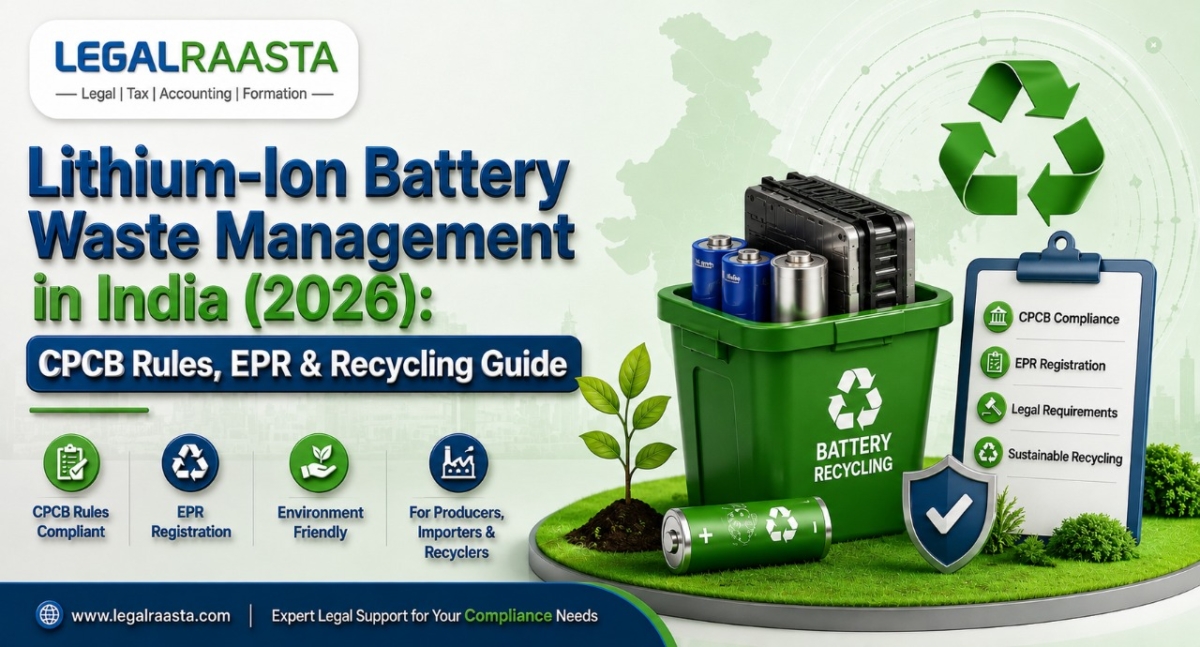
India is seeing a huge growth in electric vehicles, smartphones, and solar energy storage systems. Because of this growth, thousands of tons of spent battery cells enter the waste stream every month. Setting up a safe system for Lithium-Ion Battery Waste Management is now a strict legal requirement enforced by environmental authorities. The Ministry of Environment, Forest and Climate Change (MoEFCC) created clear rules to collect, process, and recycle used batteries safely. Businesses that manufacture, import, or sell battery packs must comply with digital tracking rules, meet annual recycling targets, and print tracking labels. Failing to meet these environmental standards leads to heavy financial fines and business closure risks. You can simplify your corporate registration and secure total legal compliance today with LegalRaasta.
What Is Lithium-Ion Battery Waste?
Lithium-ion battery waste includes all spent, degraded, damaged, or End-of-life batteries discarded from electric vehicles, laptops, mobile phones, and industrial power back-ups. These power units contain valuable metals like cobalt and nickel, but they also contain toxic chemicals that require careful industrial treatment.
Types of Lithium-Ion Battery Scrap
- Lithium Iron Phosphate (LFP): Used mostly in electric two-wheelers, three-wheelers, and commercial buses.
- Lithium Nickel Manganese Cobalt Oxide (NMC): Common in electric cars, laptops, and premium consumer electronics.
- Lithium Cobalt Oxide (LCO): Found in mobile phones, tablets, and portable gadgets.
- Lithium Titanate (LTO) & LMO: Used in heavy industrial machines, grid storage, and medical devices.
Why Proper Lithium-Ion Battery Waste Management Is Important
Dumping spent batteries in open landfills causes chemical leaks, underground water pollution, and severe landfill fires. Proper Lithium-Ion Battery Waste Management stops pollution while recovering precious minerals like lithium, cobalt, nickel, and copper for local manufacturing.
|
Strategic Impact |
Unmanaged Battery Disposal |
Managed Sustainable System |
|
Environmental Safety |
Heavy metals leak into groundwater. |
Zero-landfill closed-loop processing. |
|
Fire Safety |
Sudden fires in local trash dumps. |
Safe storage and electrical discharging. |
|
Resource Recovery |
Total loss of valuable raw metals. |
Up to 90% metal extraction efficiency. |
|
Legal Status |
Heavy fines and business shutdowns. |
Complete CPCB regulatory clearance. |
Lithium-Ion Battery Waste Management Rules in India: Legal Framework
The government notified the Battery Waste Management Rules 2022 on August 22, 2022, to manage used batteries across India. These modern rules replaced the old 2001 regulations and brought all lithium-ion, lead-acid, and nickel-based batteries under strict digital tracking.
- Regulatory Authority: The Ministry of Environment, Forest and Climate Change sets national rules.
- Digital Enforcement: The Central Pollution Control Board runs an online centralized portal for monitoring.
- Producer Mandate: Manufacturers and importers must collect and recycle used battery packs.
- Recycler Verification: Certified recycling units process scrap and issue digital compliance credits.
Every company selling batteries in India must track sales volumes, set up reverse logistics, and submit annual compliance reports. Starting in 2026, manufacturers must also print QR codes on battery packs for digital traceability.
Role of CPCB in Lithium-Ion Battery Waste Management
The Central Pollution Control Board (CPCB) acts as the main government body that runs the national registration portal, verifies sales data, and checks recycling reports. State Pollution Control Boards (SPCBs) support CPCB by inspecting physical recycling factories and granting local operational consents.
- Portal Management: CPCB runs the online portal where all battery producers, importers, and recyclers register.
- Target Calculation: The portal automatically calculates yearly recycling goals based on past sales.
- Credit Auditing: CPCB tracks the creation, sale, and cancellation of digital EPR certificates.
- Enforcement: CPCB inspects business records and levies financial fines on non-compliant companies.
What Is Extended Producer Responsibility (EPR) for Batteries?
Extended Producer Responsibility for Batteries means that companies making or selling batteries must pay for their collection and recycling after consumers finish using them. Instead of leaving waste management to local city councils, businesses must build take-back systems or hire certified industrial recyclers.
Producers buy digital recycling certificates on the government portal from certified recyclers to prove they collected and recycled their required tonnage of battery waste.
Who Needs Battery Waste EPR Registration in India?
Any business that manufactures, imports, or sells batteries—standalone or fitted inside devices or vehicles—must get CPCB EPR Registration before starting sales.
|
Business Entity Category |
Specific Industry Role |
Primary Legal Requirement |
|
Battery Manufacturers |
Companies making battery cells or assembling packs in India. |
Register on the portal & fulfill collection goals. |
|
Battery Importers |
Businesses importing loose cells, devices, or EVs. |
Possess active IEC & Producer EPR certificate. |
|
Brand Owners / OEMs |
Selling white-labeled batteries under their own brand name. |
Set up collection networks & file returns. |
|
EV Manufacturers |
Vehicle companies putting lithium batteries in electric vehicles. |
Complete sales-based recycling obligations. |
|
Recyclers & Refurbishers |
Industrial plants processing spent cells. |
Get SPCB consent & issue digital EPR credits. |
CPCB Compliance Requirements for Lithium-Ion Battery Waste in 2026
Regulators added strict digital tracking features for 2026 to stop illegal battery dumping and unorganized burning. Managing Lithium-Ion Battery Waste Management needs strict adherence to these active operational updates.
- Mandatory QR Code Labeling: Every battery pack must carry a scannable QR code linking directly to CPCB traceability portals.
- Quarterly Sales Reporting: Businesses must log quarterly battery sales numbers on the online portal instead of filing simple annual guesses.
- Strict Metal Recovery: Recyclers must extract minimum fixed percentages of lithium, nickel, and cobalt during recycling.
- Chartered Accountant Audits: Annual returns filed by June 30 must include verification certificates signed by practicing chartered accountants.
Step-by-Step Lithium-Ion Battery EPR Registration Process
Getting your official CPCB registration involves a clear 4-step digital application sequence on the central portal.
Step 1: Portal Account Setup
Applicants go to the official CPCB battery portal and choose their correct business category. The authorized manager verifies the profile using official company email IDs and mobile numbers with OTP codes.
Step 2: Document Upload & Data Filing
The applicant enters yearly battery sales numbers categorized by battery weight and cell chemistry type. Company tax certificates, ID proofs, and signed recycler tie-up agreements are uploaded in PDF formats.
Step 3: Fee Payment and Application Submission
The portal calculates the government fee based on the total yearly battery weight declared by the applicant. The business pays the fee online and submits the digital file for official checking.
Step 4: Verification and Certificate Grant
CPCB officers check the uploaded documents and ask for clarifications if data mismatches exist. Once verified, CPCB issues an official EPR Registration Certificate valid for 5 years.
Documents Required for Battery EPR Registration
Keeping accurate business paperwork ready avoids application rejections or long delay notices during government reviews.
|
Document Category |
Required File Types |
Primary Purpose |
|
Business Registration |
Company PAN, GST Certificate, Certificate of Incorporation / Partnership Deed. |
Confirms legal identity of the Indian business. |
|
Import Proofs |
Import Export Code (IEC), Bills of Entry, Customs Invoices. |
Proves legal import details for overseas battery packs. |
|
Technical Specs |
Battery chemistry declarations, cell weights, safety datasheets. |
Establishes exact metal weights and cell types. |
|
Recycling Tie-ups |
Agreement copy with CPCB-approved battery recycling plant. |
Shows physical collection and recycling capability. |
|
Authorization |
Board resolution, Signatory ID proof, Authorization Letter. |
Confirms authority of the person filing documents. |
Responsibilities of Producers, Importers, and Manufacturers
Producers hold the main legal responsibility for creating take-back systems and hitting annual recycling percentages.
- Obtain Registration: Getting valid CPCB portal authorization before selling any battery in India.
- Hit Collection Targets: Meeting yearly collection and recycling targets based on sales made three years prior.
- Customer Awareness: Informing buyers about safe disposal points and collection deposit centers.
- File Annual Returns: Submitting detailed yearly returns showing sales, collection, and bought credits by June 30.
Responsibilities of Battery Waste Recyclers and Refurbishers
Recycling plants process physical battery scrap and generate certified compliance credits on the central portal network.
- Get Local Consents: Securing valid Consent to Operate (CTO) and Hazardous Waste Authorization from State Pollution Control Boards.
- Eco-Friendly Processing: Operating non-polluting machinery that stops toxic smoke and chemical leaks.
- Issue Digital Credits: Creating verified EPR credits on the CPCB portal matching the exact weight of processed scrap.
- Follow Refurbishing Rules: Testing and re-certifying old battery packs for secondary uses like solar energy storage.
Lithium-Ion Battery Waste Collection and Recycling Process
Collecting used batteries needs special safety steps because damaged lithium cells can catch fire during transit.
Collection and Reverse Logistics
Producers set up collection centers, deposit boxes, and trade-in offers at service centers. Transport teams pack used batteries into fireproof containers to move them safely on highways.
Discharge and Mechanical Dismantling
At the recycling plant, workers soak battery packs in salt-water baths to clear all leftover electrical power. Technicians manually remove outer plastic covers, wiring, and electronic circuit boards.
Mechanical Shredding and Separation
Discharged battery modules enter sealed shredding machines filled with nitrogen gas to prevent fires. Air sorters, magnets, and mesh screens separate plastic, copper foils, and aluminum sheets from the active battery powder called “black mass”.
How Lithium-Ion Batteries Are Recycled in India
Extracting pure metals from shredded black mass requires specialized chemical processing in modern factories.
- Hydrometallurgical Extraction: Black mass is dissolved in acid solutions like sulphuric acid and hydrogen peroxide. Chemical solvents then separate pure cobalt sulphate, nickel sulphate, and lithium carbonate.
- Pyrometallurgical Smelting: High-temperature furnaces melt whole battery packs into metallic alloys containing copper, nickel, and cobalt. However, this process loses lithium in slag waste and uses high energy.
- Direct Cathode Recycling: A newer method that cleans and reuses existing cathode materials directly, saving chemical costs.
EPR Targets and Compliance Requirements
Legal rules set progressive yearly recycling targets based on the total weight of batteries sold three years prior.
|
Financial Year |
Collection Target (% of Sales 3 Years Prior) |
Mandatory Recycling Rate |
Minimum Material Recovery Goal |
|
2024–25 |
40% |
25% of collected weight |
70% metal weight recovery |
|
2025–26 |
50% |
30% of collected weight |
80% metal weight recovery |
|
2026–27 |
60% |
35% of collected weight |
90% metal weight recovery |
|
2027–28 |
70% |
40% of collected weight |
90% metal weight recovery |
Businesses facing collection gaps must buy digital credits from authorized recyclers to complete their mandatory targets.
EPR Certificate for Battery Waste Recycling & Trading
When a certified recycler processes battery scrap, the CPCB portal generates digital EPR credits showing the exact metric tons recycled. These digital credits serve as legal proof of compliance.
Through built-in portal mechanisms, companies with target shortfalls buy credits via EPR certificate trading from recyclers with extra capacity. Every transaction automatically cancels sold credits on the government system to prevent double usage.
Penalties and Environmental Compensation for Non-Compliance
Failing to register or missing yearly recycling goals leads to heavy fines called Environmental Compensation.
|
Non-Compliance Issue |
Government Action |
Financial Consequences |
|
Unregistered Sales |
Immediate sales ban & customs clearance block. |
Per-unit financial penalty on sold items. |
|
Recycling Shortfalls |
Target carried forward to next financial year. |
Financial compensation fee charged per KG shortfall. |
|
False Data Submissions |
Registration cancellation & legal audit. |
Legal prosecution under the Environmental Protection Act. |
|
Unauthorized Recycling |
Plant closure orders by SPCB authorities. |
Machine seizure and heavy cash fines. |
Paying penalty fines does not excuse companies from their recycling duties; unmet recycling goals move forward into the next year.
Cost of Lithium-Ion Battery EPR Registration in India
Official CPCB portal fees depend directly on the total weight of batteries produced or imported each year.
|
Annual Production / Import Volume (Metric Tons) |
Government CPCB Registration Fee |
Registration Certificate Validity |
|
Up to 10 MT per year |
₹5,000 |
5 Years |
|
10 MT to 50 MT per year |
₹10,000 |
5 Years |
|
50 MT to 500 MT per year |
₹25,000 |
5 Years |
|
Above 500 MT per year |
₹50,000 |
5 Years |
Note: Extra costs include legal advisory charges, state pollution consents, and annual report filing fees.
Why Compliance is Complex & Common Filing Mistakes
Submitting portal applications requires complete data matching across customs records, GST sales, and battery spec sheets.
- Sales Mismatches: Differences between customs Bill of Entry weights and portal declarations.
- Wrong Chemistry Choices: Selecting generic battery categories for high-cobalt EV cells.
- Expired Recycler Tie-ups: Attaching agreements with recyclers whose state permits have expired.
- Late Annual Returns: Missing the June 30 return deadline, which triggers automatic fine notices.
How LegalRaasta Helps with Battery EPR Registration & Compliance
LegalRaasta simplifies government filings through experienced corporate lawyers and environmental compliance teams.
|
LegalRaasta Service |
Practical Application |
Client Benefit |
|
Eligibility Assessment |
Analysis of battery types, sales metrics, and import codes. |
Avoids wrong category filings. |
|
Document Preparation |
Formatting spec sheets, IEC proofs, and board resolutions. |
Ensures error-free portal submissions. |
|
CPCB Liaisoning |
Direct coordination with CPCB officers to answer query letters. |
Gets approvals in 15 to 30 days. |
|
Recycler Tie-ups |
Connecting businesses with approved recycling facilities. |
Secures genuine recycling credit certificates. |
|
Annual Filing Support |
Tracking yearly sales and submitting June 30 annual returns. |
Prevents heavy compensation penalties. |
DIY vs LegalRaasta Expert Assistance
Working with experts speeds up approvals while protecting your business from portal query notices and fines.
|
Compliance Factor |
Self-Filing Approach |
LegalRaasta Managed Services |
|
Processing Timeline |
45 to 90 days with multiple query delays. |
Quick 15 to 30 working days processing. |
|
Data Calculation Risk |
High chance of weight conversion mistakes. |
CA-verified weight and sales calculations. |
|
Recycler Access |
Hard to find reliable credit pricing. |
Direct access to audited recycling partners. |
|
2026 Tracking Rules |
High risk of missing new QR code norms. |
Complete monitoring and proactive updates. |
Conclusion
Following proper Lithium-Ion Battery Waste Management rules protects our environment, recovers precious minerals, and fulfills mandatory legal requirements in India. Managing CPCB portal accounts, meeting yearly targets, and purchasing verified recycling credits requires continuous legal attention. Business owners should complete registration early to avoid sales bans, customs delays, or heavy government fines. Contact LegalRaasta today to secure your CPCB registration swiftly and automate your annual battery compliance requirements effortlessly.
Frequently Asked Questions (FAQs)
1. What is Lithium-Ion Battery Waste Management under Indian law?
It is the mandatory collection, handling, and eco-friendly recycling of used battery cells as specified under the Battery Waste Management Rules 2022 enforced across India.
2. Who must apply for CPCB EPR Registration in India?
Any manufacturer, importer, or brand owner handling EVs or portable electronics must set up Lithium-Ion Battery Waste Management systems to legally operate.
3. Is Extended Producer Responsibility for Batteries compulsory for EV importers?
Yes, every commercial entity importing electric vehicles must register and execute proper Lithium-Ion Battery Waste Management to meet annual collection goals.
4. What happens if a company fails in Lithium-Ion Battery Waste Management compliance?
Non-compliant businesses face heavy financial penalties known as Environmental Compensation issued directly by central pollution regulators.
5. Where do recyclers obtain Hazardous waste authorization for processing cells?
Authorised recyclers get approved by State Pollution Control Boards before joining the central Lithium-Ion Battery Waste Management portal network.
6. How does Lithium-Ion Battery Waste Management protect the environment?
Safe disposal prevents toxic heavy metals like cobalt and lithium from leaking into soil while boosting Lithium-Ion Battery Recycling India initiatives.
7. Can companies buy credits through EPR certificate trading to meet goals?
Yes, producers can purchase verified recycling credits on the CPCB portal to achieve their official Lithium-Ion Battery Waste Management requirements.
8. How are End-of-life batteries collected across Indian cities?
Producers establish dedicated take-back centers and deposit points as part of their mandated Lithium-Ion Battery Waste Management infrastructure.
9. What is the primary role of the Central Pollution Control Board?
The Central Pollution Control Board oversees portal registrations, audits recycling data, and enforces rules governing Lithium-Ion Battery Waste Management in India.
10. How are annual EPR targets calculated under Lithium-Ion Battery Waste Management guidelines?
Targets are calculated based on the total weight of cells sold three years prior under statutory CPCB EPR Registration mandates.

Related Posts
Our Clients








Featured In