
How to Start an Ayurveda Business in India: AYUSH License, Registration & Compliance Guide
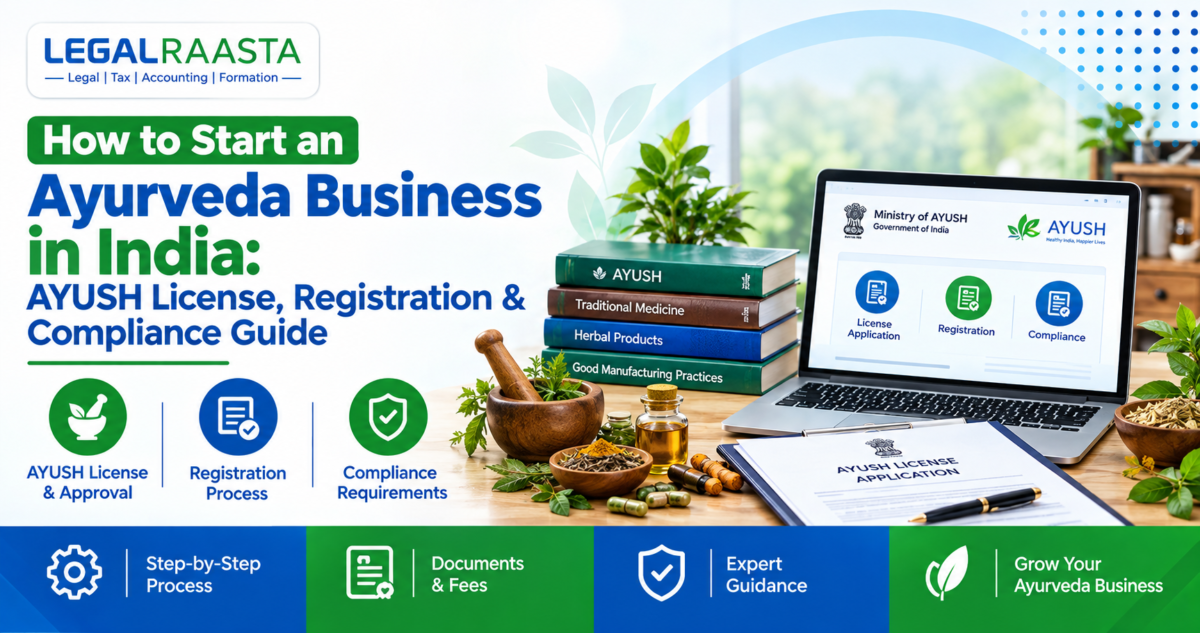
A Kerala-based founder spent four months building her Ayurvedic skincare line. Formulation done, packaging designed, first batch ready. Then a distributor asked for her AYUSH licence number, and she realised she’d never actually applied for one. Start an Ayurveda business the right way, and licensing comes before the product launch, not after a distributor asks an awkward question.
The portal handling this licensing also just went through a complete reset in 2026, so even founders who checked the rules last year are working off outdated information now. This guide walks through what’s actually required today, the licence types, the new portal rules, and where the process trips people up. Talk to the regulatory team of LegalRaasta before you manufacture your first batch, not after.
Start an Ayurveda Business in India: Quick Overview
|
Requirement |
Detail |
|
Governing law |
Drugs and Cosmetics Act, 1940, Chapter IVA |
|
GMP standard |
Schedule T, Drugs and Cosmetics Rules, 1945 |
|
Licensing portal |
|
|
Regulator |
|
|
Manufacturing licence form |
Form 24-D, under Rule 153 |
|
Licence validity |
Perpetual, GMP revalidated every 5 years |
|
2026 portal update |
Fresh registration required, new applications reopened 28 April 2026 |
What Is an Ayurveda Business in India?
An Ayurveda business covers manufacturing, marketing, or selling products based on classical Ayurvedic formulations, medicines, cosmetics, or supplements built around Ayurvedic ingredients and principles. Not every herbal product counts as Ayurvedic in the legal sense. What decides that is whether the formulation traces back to an authoritative text listed under the Drugs and Cosmetics Act, or whether it’s registered as a proprietary Ayurvedic medicine instead.
That distinction shapes everything downstream: licensing, labelling, even how a product gets marketed. A brand selling classical formulations like Chyawanprash or Triphala churna sits in one regulatory bucket. A brand launching a new proprietary blend, something nobody’s registered before, sits in a slightly different one, since proprietary Ayurvedic medicines need their own formulation approval before manufacturing begins.
Is an AYUSH License Mandatory for an Ayurveda Business in India?
Yes, if you’re manufacturing anything marketed with a therapeutic or medicinal claim. A face cream calling itself “Ayurvedic” without disease-related claims might skip AYUSH licensing and fall under cosmetic rules instead. The moment a product claims to treat, cure, or prevent a condition, Ayurvedic medicine rules apply, and that means AYUSH licensing, full stop. Selling without one isn’t a grey area either; it’s manufacturing an unlicensed drug, and state drug inspectors do act on this when a complaint or routine market check flags it.
Types of AYUSH Licenses for Ayurvedic Products
Picking the wrong licence type at the start wastes months, so knowing which one actually fits your setup matters before you file anything.
|
Licence Type |
Form |
Used When |
|
Manufacturing Licence |
Form 24-D |
You own and run the manufacturing facility |
|
Loan Licence |
Form 25-E |
You manufacture at another approved licensed unit |
|
Sale Licence |
State-specific form |
You sell or distribute ASU drugs without manufacturing |
|
COPP |
Separate application |
You plan to export Ayurvedic products |
e-AUSHADHI Portal: Major 2026 Changes You Need to Know
Every AYUSH licence, existing or new, runs through this one government portal, and it changed shape significantly this year.
- Complete re-registration required: the Ministry reset user accounts on 16 April 2026, and existing logins from before that date no longer work
- Fresh applications reopened 28 April 2026: a gap sat between the reset and new applications actually being accepted again
- Legacy Module added: existing licence holders can now enter past approval data, Form 25-D and Form 48 records, to get new licence numbers under the rebuilt system
- TA Schedule updates requested: manufacturers are being asked to update technical staff details on the new portal directly
- Old approval records need re-entry: licence holders with pre-2026 approvals should not assume that history carried over automatically without checking
Anyone who last checked AYUSH requirements before mid-2026 is working with an outdated picture of how this actually works now.
How to Register an Ayurveda Business in India
Licensing comes second. Setting up the actual business entity comes first, and skipping proper incorporation before applying for AYUSH approval creates paperwork headaches later. Most founders register a private limited company or LLP, get Udyam MSME registration if they qualify as an MSME, and only then move toward the manufacturing facility and AYUSH application stage.
AYUSH Manufacturing License: Eligibility, Documents & How to Apply
Getting this licence means proving your facility, staff, and formulation all meet the standard, and the process runs through a handful of clear stages.
Documents Required for the Application
|
Document |
Purpose |
|
Facility layout plan |
Confirms Schedule T-compliant separation of manufacturing areas |
|
Machinery and equipment list |
Shows production capacity matches declared scale |
|
Technical staff qualification proof |
Confirms a qualified Ayurvedic expert oversees production |
|
Formulation reference |
Links the product to an authoritative Ayurvedic text or proprietary approval |
|
Constitution documents |
Proof of business registration, partnership deed, or incorporation certificate |
|
Site ownership or lease proof |
Confirms legal right to operate at the declared premises |
Step 1: Set Up a Compliant Manufacturing Facility
Build the unit according to Schedule T layout requirements, with separate areas for raw materials, processing, packaging, and quality testing.
Step 2: Appoint Qualified Technical Staff
Hire a qualified Ayurvedic expert, typically a BAMS graduate or someone with equivalent experience, to oversee production.
Step 3: Prepare Documentation
Gather the facility layout plan, machinery list, formulation details tied to an authoritative text, and staff qualification proof.
Step 4: Register and Apply on e-AUSHADHI
Complete the mandatory fresh registration, then file Form 24-D for a manufacturing licence or Form 25-E for a loan licence.
Step 5: Undergo Inspection and Receive the Licence
A state drug inspector reviews the facility before the licence is issued, and it remains valid perpetually from that point, subject to annual compliance declarations.
GMP Requirements Under Schedule T
Every manufacturer needs to meet Schedule T of the Drugs and Cosmetics Rules, 1945, covering facility hygiene, equipment standards, water quality, and documentation practices right down to how raw materials get stored and tracked. GMP certification itself needs revalidation every five years, with a retention fee of Rs 1,000 payable online, and random inspections happen on that same five-year cycle to confirm the facility still matches what was originally approved.
Worth watching closely, the Ministry has proposed amendments to Schedule T under draft GSR 140(E), pushing toward stricter process validation and data integrity standards closer to modern pharmaceutical norms. Equipment qualification, in-process checks, and recordkeeping would all tighten under the draft, so today’s baseline may not stay the baseline for long. Manufacturers building a facility right now would do well to build slightly ahead of the current minimum rather than exactly to it.
Ayurvedic Product Labeling and Packaging Requirements
Labels need the product name, list of ingredients by their Ayurvedic names, batch number, manufacturing licence number, and manufacturing and expiry dates clearly printed, along with the manufacturer’s full address and any recommended dosage or usage instructions. Therapeutic claims on the label must match exactly what’s registered with the licence, since a mismatch between packaging claims and the approved formulation is a common reason products get flagged during inspection. Getting this wrong after printing thousands of units is an expensive mistake, so it pays to have the label text checked against the licensed formulation before anything goes to print.
AYUSH License vs FSSAI License: What Is the Difference?
This distinction confuses more founders than almost anything else in this space, and it’s worth getting exactly right before you print a single label.
|
Point |
AYUSH License |
FSSAI License |
|
Applies to |
Products with therapeutic/medicinal claims |
Food products, including Ayurveda Aahar items |
|
Governing law |
Drugs and Cosmetics Act, 1940 |
Food Safety and Standards Act, 2006 |
|
Claims allowed |
Can claim to treat or manage conditions |
Cannot claim to cure or treat disease |
|
Example |
Classical Ayurvedic medicine, proprietary formulations |
Herbal teas, Ayurveda-based food supplements |
A herbal product positioned as food rather than medicine, under the Ayurveda Āhāra framework introduced in 2022, needs FSSAI clearance instead, not an AYUSH licence.
Cost and Timeline to start an Ayurveda Business in India
Budgeting realistically upfront avoids the nasty surprise of running out of runway halfway through licensing, since Ayurveda manufacturing carries higher upfront costs than a typical trading or service business.
|
Stage |
Typical Cost Range |
Typical Timeline |
|
Rs 8,000 to Rs 20,000 |
1 to 2 weeks |
|
|
Facility setup, Schedule T compliant |
Varies widely by scale |
2 to 6 months |
|
AYUSH manufacturing licence |
State-specific fee |
2 to 4 months post-inspection |
|
GMP certification |
Included in licensing |
Revalidated every 5 years |
|
COPP, if exporting |
Additional fee per application |
Filed after manufacturing licence is active |
Facility setup is usually the real budget swing factor here; a small-batch herbal cosmetics unit costs a fraction of what a full-scale classical medicine manufacturing plant needs, so getting a realistic quote from an architect familiar with Schedule T layouts early on saves a lot of guesswork later.
Common Mistakes to Avoid When Starting an Ayurveda Business in India
Most delays and rejections trace back to a short list of avoidable errors, not genuinely complicated regulatory disputes.
- Assuming an old e-AUSHADHI login still works after the April 2026 portal reset
- Marketing a product with disease-cure claims without holding an actual AYUSH manufacturing licence
- Confusing Ayurveda Aahar food products with classical Ayurvedic medicine licensing
- Skipping proper business registration before starting the AYUSH application process
- Ignoring Schedule T facility requirements until an inspector points them out
- Launching a proprietary formulation without securing separate approval for it first
- Underestimating how long facility construction and inspection scheduling actually take together
How LegalRaasta Can Help With Ayurveda Business Compliance
Getting facility layout, technical staff qualifications, and formulation documentation right the first time saves months against a rejected application. LegalRaasta’s team handles company registration, prepares your AYUSH manufacturing licence file end to end, and keeps track of Schedule T’s evolving requirements so a proposed amendment doesn’t catch your facility off guard later.
Conclusion
Start an Ayurveda business on outdated assumptions about e-AUSHADHI or Schedule T, and you’ll spend months undoing avoidable mistakes. The portal changed this year, GMP norms are shifting too, and the AYUSH-versus-FSSAI line trips up even experienced founders. Get your licensing mapped correctly from day one with the regulatory team of LegalRaasta.
If your compliance paperwork is sorted but your brand still has no real online presence to sell through, that gap is worth closing too. CloudGeta (cloudgeta.com) builds the websites, runs the SEO, and manages the digital marketing that gets an Ayurvedic brand actually discovered once the licence is in hand.
Frequently Asked Questions About Ayurveda Business and AYUSH License
1. What licence is needed to start an Ayurveda business in India?
An AYUSH manufacturing licence, Form 24-D, is mandatory to legally start an Ayurveda Business involving therapeutic claims, filed through the e-AUSHADHI portal under Rule 153.
2. How long does AYUSH licensing take in 2026?
Roughly 2 to 4 months post-inspection. Founders looking to start an Ayurveda Business should also factor in facility setup time before the licence timeline even begins.
3. Is a manufacturing facility required to start an Ayurveda business in India?
Only for a manufacturing licence. A loan licence lets you start an Ayurveda business using another approved unit’s facility instead of building your own from scratch.
4. Does every herbal product need an AYUSH license?
No, only products with medicinal or therapeutic claims. Someone planning to start an Ayurveda business selling food-category herbal products may only need FSSAI clearance instead.
5. What changed on the e-AUSHADHI portal in 2026?
A complete user reset happened in April 2026. Anyone trying to start an Ayurveda business in India using an old login will find it no longer works on the rebuilt portal.
6. Can a loan license help someone start an Ayurveda business without a factory?
Yes, Form 25-E lets you manufacture through another licensed facility. This route helps founders start an Ayurveda business with lower upfront capital investment.
7. What is Schedule T in the context of starting an Ayurveda business in India?
It’s the GMP standard every manufacturer must follow. Anyone planning to start an Ayurveda business needs a facility that meets these documented hygiene and process requirements.
8. Is AYUSH license validity permanent now?
Yes, licences became perpetual under the 2021 rule amendment. Businesses that start an Ayurveda business today only need annual compliance declarations, not full renewals.
9. How is AYUSH License vs FSSAI decided for a new product?
The presence of a therapeutic claim decides it. A founder planning to start an Ayurveda business around food-based herbal products should check the Ayurveda Aahar framework first.
10. Can LegalRaasta help someone start an Ayurveda business from scratch?
Yes, LegalRaasta handles entity registration, AYUSH licence filing, and Schedule T documentation together, so founders can start an Ayurveda business in India without juggling three separate consultants.

Related Posts





Our Clients






Featured In