
EPR Rules for Electronic Waste in India 2026 – Complete CPCB Compliance Guide
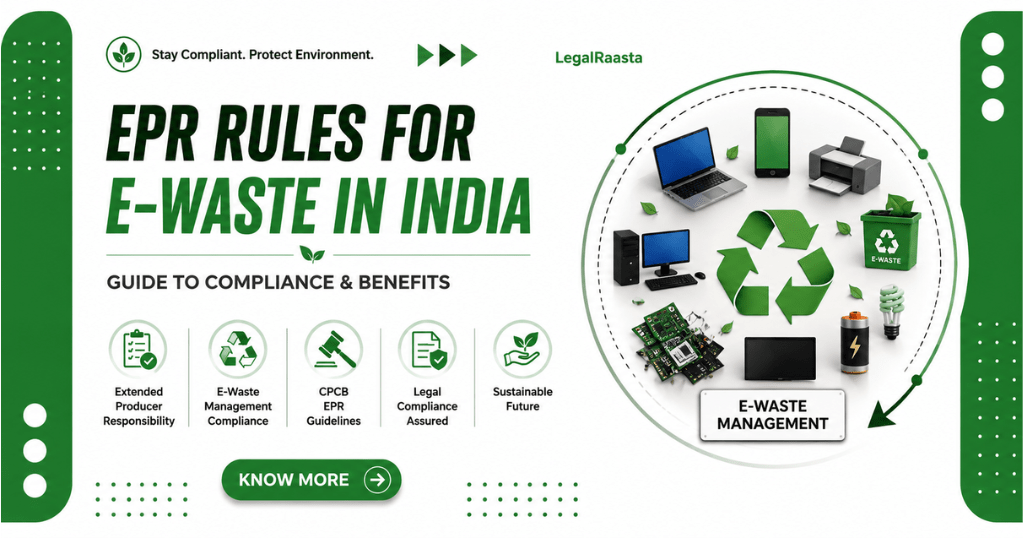
In the fiscal year 2026-27, India’s electronic landscape has reached a critical tipping point. As one of the world’s largest consumers of technology, the nation generates millions of tonnes of electronic scrap annually. The Ministry of Environment, Forest, and Climate Change (MoEFCC) has strengthened the EPR Rules for E-waste in India to contain this tsunami of discarded hardware by laying the sustainability-related responsibility squarely on the shoulders of the industry under the concept of Extended Producer Responsibility (EPR).
For any business—whether a multinational manufacturer or a specialized importer—navigating the EPR rules for e-waste is no longer a peripheral task. A fundamental operation necessity that defines your legal license to operate in the Indian market. Get your business seamlessly secured for the future by engaging LegalRaasta today to take expert services relating to corporate incorporation and digital compliance.
Why Compliance is Complex for E-Waste Stakeholders
The e-waste policy in 2026 is a lot stricter than in past decades. Three major factors lead to the complexity:
- Granular Categorization: There are currently more than 106 categories of Electrical and Electronic Equipment (EEE) in the CPCB. Any little confusion about what qualifies as a” Medical Device ” and a” Consumer Electronics ” may cause huge variations in your recycling goals.
- The Shadow of the Informal Sector: By approximation, 90-95% of e-waste in India is still processed by the unorganized sector. The 2026 rules mandate that producers bridge this gap by creating formal “Take-back” incentives, shifting the waste flow toward authorized recyclers.
- Technological Traceability: Through blockchain at the gate system of the CPCB portal, each EPR for an e-waste certificate undergoes validation with the physical ability to recycle. Paper-only compliance is no longer an option.
Practical filing workflow for 2026-27
The e-waste management rules dictate that compliance must be done in a stepwise manner. Here is the real-world workflow for the current 2026-27 cycle:
Step 1: Centralized CPCB Portal Registration
Every stakeholder—Producer, Manufacturer, Refurbisher, and Recycler—must register on the eprewastecpcb.in the portal. In 2026, the portal is linked with your GST and Customs (ICEGATE) data, making it impossible to hide sales volumes.
Step 2: Sales Data & Average Life Calculation
You are required to post the amount of EEE you have put on the market. The system relies on the “Average Life” of the product (as indicated in Schedule I) to realize when such a unit is already a waste. In 2026-27, your targets will probably be determined by sales 2-5 years ago, depending on the item.
Step 3: Formalizing Recycler MoUs
Enter into a Memorandum of Understanding with a CPCB-licensed recycler, which is a legally binding document. By 2026, the government mandates that these recyclers should possess a “Zero-Liquid Discharge” (ZLD) and an “Advanced Material Recovery” (AMR) facility, so that valuable metals such as Gold and Palladium are really extracted.
Step 4: Quarterly & Annual Filing
Compliance isn’t a one-time event.
- Quarterly Returns: Filing Sales and collection data after every three months.
- Annual Return (Form-3): Filed on 30th June of the following year, which provides a summary of the compliance throughout the year.
Estimated Government Processing Time: 30-60 working days to get new registrations processed.
India-Specific Scenario: In case the companies are operating in more than one state, the Central EPR registration is intended to cover an operation pan-India, although state-based SPCB audits might happen.
Legal & Regulatory Accuracy (2026-27 Updates)
The Environment (Protection) Act, 1986, forms the legal basis of the EPR rules for e-waste. Nevertheless, the 2022 framework, revised up to 2025 and 2026, has brought high-precision amendments.
Key Targets for 2026-27
As per the current schedule, the recycling targets have peaked. For most IT and Consumer electronics, the target is now 70% of the sales figure of the relevant preceding year (Y-X).
Expansion to New Categories
The 2026-27 cycle now strictly includes:
- Solar PV Modules & Cells: Inventory management is mandatory, with recycling obligations kicking in by 2034.
- Medical Devices: Schedule I now covers all electronic medical equipment (except infectious ones).
- Non-Ferrous Metals: This involves a new sub-rule that stipulates the recovery of certain percentages of Copper and Zinc.
RoHS Compliance (Reduction of Hazardous Substances)
Producers under the e-waste rules are required to make sure that their products do not surpass the e waste threshold of 10 hazardous substances, which include:
- Lead (Pb): < 0.1% by weight
- Mercury (Hg): < 0.1% by weight
- Cadmium (Cd): < 0.01% by weight
- Hexavalent Chromium: < 0.1% by weight
Brand Positioning Framework
To become an EPR Compliant in 2026 is now a badge of honor that enhances brand value. But the road to this is full of traps.
Common Filing Mistakes
- Mismatch in Weights: Describing the weight of the Box rather than the weight of the Electronic Component.
- Ghost Certificates: Buying credits from recyclers who have reached their capacity. CPCB now uses AI to flag “Over-generation” of certificates.
- Missing Spares: Forgetting that components, consumables, and spare parts also carry an EPR obligation under the e-waste management rules.
Why Compliance is Complex for DIY Businesses
There have to be complex logistics in the operation of a pan-India collection network. The infrastructures are not available to most manufacturers to trace a discarded smartphone in a village in Bihar to a recycling facility in Chennai. It is here that a Producer Responsibility Organization (PRO) or a dedicated consultant, such as LegalRaasta, is necessary.
Comparison Table: DIY vs. LegalRaasta Support
|
Feature |
DIY Compliance |
LegalRaasta Expert Support |
|
Registration Accuracy |
High risk of portal queries |
100% Query-free documentation |
|
Target Procurement |
Subject to market volatility |
Assured credits via vetted recycler network |
|
RoHS Documentation |
Complex lab coordination |
Seamless self-declaration & testing support |
|
Audit Preparation |
Unorganized records |
Digital-ready audit trails for CPCB |
|
Cost Risk |
High potential for “EC” fines |
Optimized compliance to minimize penalties |
The “Polluter Pays” Principle & Penalties
Transparency is the core of the 2026 e-waste policy. The government has automated the penalty system.
What happens if you don’t comply?
- Environmental Compensation (EC): This is a financial liability for failing to meet your 2026-27 targets. The fine is not a “fee” to escape recycling; it is a penalty for the damage caused.
- Calculation: Shortfall (kg) × Handling/Processing Cost (Rate determined by CPCB).
- Backlog Obligation: Even after paying the EC fine, the recycling target is carried forward. The shortcomings of last year must be calculated in the following year.
- Blacklisting: Businesses that fail to settle their EPR for e-waste payments get denied entry of their goods and are out of the window to the GeM (Government e-Marketplace).
- Imprisonment: Criminal actions that can be prosecuted under the Environment Act are serious violations: illegal dumping or falsifying documents.
Detailed Analysis: E-Waste Recycling Targets for 2026-27
The 2026-27 financial year marks a significant era where recycling percentages are at their highest. Producers must plan their “Credit Purchase” strategy early in the year to avoid the March “liquidity crunch” where certificate prices skyrocket.
Schedule III: Recycling Target Progression
|
Year |
Target Percentage |
|
2023-24 |
60% |
|
2024-25 |
60% |
|
2025-26 |
70% |
|
2026-27 |
70% |
|
2027-28 Onwards |
80% |
Note: The target is applied to the weight of the quantity of EEE placed in the market in the year (Y-X), where X is the average life of the product.
How LegalRaasta Helps You Master EPR
At LegalRaasta, EPR rules for e-waste are not considered as a liability and are a strategic approach to your supply chain. Our 2026- 27 compliance package will cover:
- EPR Strategy & Planning: We examine your sales records over your previous 10 years to determine your present and future liabilities in relation to recycling in this case.
- Portal Management: Starting with the registration process, through Filing Form-2 and Form-3, we deal with the complete online interface with the CPCB.
- Audit Support: We have made your Material Flow Balance ideal, so that by the time the CPCB inspectors come, your records will be in line with the physical reality.
- RoHS Certification: This is done with your R&D and procurement departments checking to confirm that all the imported parts are within the limits of hazardous substances in India.
- Certificate Trading: We are your trading broker on the CPCB floor, where we ensure you get EPR certificates at the most competitive prices.
India-Specific Compliance Scenarios
- The “Used” Import Rule: It means that even when you import second-hand electronics to serve your own office purposes, you remain a Producer under the e-waste rules and need to consider their end-of-life disposal.
- State Pollution Board Inspections: While the portal is Central, the SPCBs in states like Maharashtra, Karnataka, and Tamil Nadu are extremely active in physical site inspections.
- Bulk Consumer Responsibility: Large IT parks and banks must ensure their waste is handed over only to registered recyclers. They must maintain a record in Form 2 to avoid fines during tax audits.
The Role of Refurbishers in the 2026 Circular Economy
A key addition to the e-waste management rules is the formalization of refurbishers. If you extend the life of a product:
- Refurbishing Certificate: You can generate certificates that reduce the recycling obligation of the original producer.
- Life Extension: When you add one year to the life of a laptop, the responsibility of the manufacturer is postponed.
- Hazardous Waste Management: Refurbishers should make sure that the cannibalized parts (non-functional components) are disposed of at a recycler and not in a landfill.
Future Outlook: Beyond 2027
The e-waste policy is moving toward “Design for Environment” (DfE). In the coming years, producers who design products that are easier to dismantle will likely receive “EPR Rebates.” Staying ahead of the EPR rules for e-waste now means you are future-proofing your business against the next decade of environmental regulations.
Conclusion: Securing Your Business in the Green Era
The current compliance cycle of 2026-27 is the most taxing in the history of India. EPR regulations on e-waste have evolved into the advanced digital ecosystem, where the accuracy of data and the process of recycling on the physical level should be flawless. Through knowledge of the e-waste management regulations and collaborating with professionals who can tell you the legalities involved, your brand can easily make this transition without incurring the high cost of environmental damages involved in paying compensation, and help in creating a cleaner, more sustainable India. Let the team at LegalRaasta.com deal with your licensing and regulatory needs so that regulatory filings and compliance are no longer an issue.
FAQs
- What are the rules for e-waste management in India?
The e-waste rules require producers, manufacturers, and importers to ensure that they dispose of electronics at the end-of-life. CPCB-controlled in the form of required registration, mandated amounts, and annual recycling with EPR certificates, and under compulsory limits of RoHS hazardous materials are the terms of these rules.
- Is EPR mandatory in India?
Yes, the Extended Producer Responsibility (EPR) applies to every organization engaged in the production or importation of equipment that would be found in Schedule I. Failure to comply would lead to hefty fines as environmental compensation, and may face criminal liability under the Environment (Protection) Act.
- What are the new e-waste rules 2026?
The 2026 updates bring on board blockchain-issued EPR credits, an expanded number of categories, including solar PV modules, and peak recycling rates of 70%. These regulations require digital traceability of the CPCB portal, such that each credit would be associated with a physical recycling event.
- Which license is required for e-waste?
Manufacturers need to obtain EPR Authorization with CPCB. Recyclers and refurbishers must be granted a Grant of Registration and a Consent to Operate by the respective State Pollution Control Boards, so that their facilities can meet high standards of material recovery and zero-liquid discharge.
- How to get an EPR certificate for e-waste?
The process of waste processing by authorized recyclers generates EPR certificates within the portal of the CPCB. Manufacturers acquire them through recycling and collecting waste or by trading credits with registered recyclers on the online trading floor on the portal to achieve their targets.
- What rules and regulations apply to producers for e-waste management?
Manufacturers are required to enroll in the CPCB portal, monitor their Material Flow Balance, and recycle according to product lifespan requirements. They also have the duties of applying Take-back schemes, submitting quarterly returns, and certifying products to be within RoHS safety thresholds.
- What are the 3 Rs of e-waste?
The 3Rs include Reduce, Reuse, and Recycle. Reuse is in place through refurbishing certificates that defer obligations, and recycling deals with high-precision recovery of precious metals such as gold and copper in an element that failed to work anymore.
- What are the 6 categories of e-waste?
The CPCB divides waste broadly into IT and Telecommunication, Consumer Electronics, Large Electrical Tools, Medical Devices, Laboratory Equipment, and Solar PV Modules. All the categories have specific recycling levels and particular average life expectancies against the 2026-27 plan.
- How much gold is in electronic waste?
E-waste presents a prime source of urban mining, with 40-800 times more gold per ton than traditional mining. The 2026 regulations require Advanced Material Recovery that will guarantee gold, silver, and palladium high-efficiency extraction in the processing.
- What is the EPR scheme for e-waste?
The EPR scheme is a polluter pays system in which producers are paid an amount to manage waste. It establishes a market-oriented system in which brands are required to show that a percentage of their past volume sales has been recycled by certified and legal CPCB-trained mediums.

Related Posts

Our Clients








Featured In