
GST Collection in India: A Complete Guide for Businesses (2026)
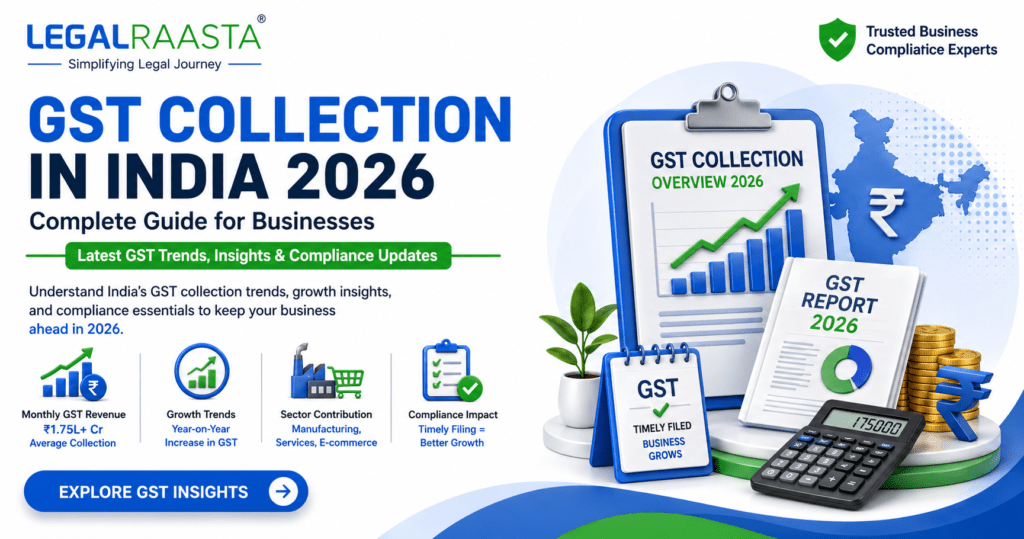
The GST Collection India landscape has been shaken on a tectonic scale in the course of May 2026. To business persons, knowing these fiscal trends is not about tracking government revenue, but it is about measuring the economic pulse of the country to make quality inventory, pricing, and expansion choices. With the maturity of the digital infrastructure of the GST portal, unprecedented levels of transparency and efficiency in the mobilisation of revenue are being witnessed.
The turbulence of the tax regimes today makes it important to have professional supervision of your business to ensure that your business is on the right side of the law. Speak to Contact LegalRaasta today and make the process of GST filing easy and hassle-free, and ensure complete adherence to the latest 2026 regulations.
GST Collection Month Wise: The 2026 Performance Review
The GST collection month-wise data on the current fiscal year will demonstrate a strong trend. The government has been able to bridge revenue leakage loopholes with the incorporation of AI-based “Automated Scrutiny” modules, which have resulted in a stable base of over ₹1.8 Lakh Crore per month.
Monthly Revenue Breakdown (Estimated 2026)
|
Month |
Total Collection (₹ Cr) |
Growth (Y-o-Y) |
Key Contributing Sector |
|
January 2026 |
1,95,000 |
12% |
FMCG & Retail |
|
February 2026 |
1,88,000 |
10% |
Automobile & Parts |
|
March 2026 |
2,10,000 |
15% |
Financial Services |
|
April 2026 |
2,25,000 |
18% |
Year-end Settlements |
|
May 2026 |
1,98,000 (Proj) |
11% |
Infrastructure & Tech |
The GST collection india month wise trends indicate that the festive seasons and the financial closure of the year-end are the most popular periods to make a sale. Their planning of tax outflow should be aligned with these cycles by businesses to ensure effective management of liquidity.
GST Collection State-Wise List: Regional Economic Powerhouses
Analysing the GST collection state-wise list gives a profound understanding of the regional consumption pattern and industrial health. In 2026, the revenue share of the Manufacturing States and Tech Hubs remains the same.
Top Performing States in 2026
- Maharashtra: Maintains its lead as it is the place where corporate headquarters and financial services are highly concentrated.
- Karnataka: This was fuelled by the fact that the IT industry was booming and that consumer spending in the high-end market in Bengaluru was also booming.
- Gujarat: A giant in the manufacturing industry and also in the export of textile products.
- Tamil Nadu: The top producer of automotive components and electronics manufacturing.
- Uttar Pradesh: The state is experiencing the highest growth rate among the top 10 states, owing to the massive construction of infrastructure.
Comparative State-Wise Performance Table
|
State/UT |
Avg. Monthly Collection (₹ Cr) |
Primary Revenue Driver |
Compliance Rate (%) |
|
Maharashtra |
32,500 |
BFSI & Manufacturing |
98.5% |
|
Karnataka |
14,200 |
IT Services & Startups |
97.2% |
|
Gujarat |
12,800 |
Chemicals & Textiles |
96.8% |
|
Tamil Nadu |
11,500 |
Automotive & MSME |
95.9% |
|
Haryana |
9,800 |
Real Estate & Auto |
94.5% |
To document in detail, most businesses tend to use the GST collection state-wise PDF published by the Ministry of Finance in order to compare their level of performance in the region.
GST Collection Year Wise: A Journey of Fiscal Maturity
Since its inception, the GST collection year-wise trajectory has been a testament to India’s digital transformation. Since the first challenges of 2017 to the record-breaking numbers of 2026, the system has been developed to become one of the most complex indirect tax systems in the world.
Annual Revenue Growth Highlights
- 2017-2019 (Formative Years): Concentrate on the stabilisation of the portal and the familiarisation of the GST collection India with new laws.
- 2020-2022 (Resilience Phase): Rapid uptake of e-way bills and e-invoicing in the face of global economic changes.
- 2023-2025 (Expansion Phase): Addition of data analytics to detect discrepancies in Input Tax Credit (ITC).
- 2026 (The Efficiency Era): Achieving the milestone of ₹20 Lakh Crore in annual collections.
Key Factors Driving Higher GST Collection in India
- Mandatory E-Invoicing: Reduced thresholds to e-invoicing have incorporated micro-enterprises into the net.
- Geo-Targeted Compliance: According to our Advanced SOP, geo-fencing to achieve higher accuracy has now become the compliance scenario in India.
- Strict Fines: Emphasising the importance of filing by telling them what will happen should they not file has given them the incentive to file.
- Easy Tech: Turning legal jargon into easily understandable language has given power to the small business owners.
Business Strategies for Maintaining Compliance in 2026
As the GST Collection India successfully reaches new heights, the level of scrutiny of the individual businesses has also stepped up. To evade fines and legal tussles, business organisations need to implement a proactive compliance system.
The Compliance Checklist for 2026
- Real-time Reconciliation: Reconcile GSTR-2B with your purchase register daily using AI tools to make sure that no ITC is missed.
- Document Accuracy: Use a step-by-step filing process (Portal → Form → Documents → Submission) to ensure no rejections occur.
- HSN/SAC Precision: Be sure that the latest amendments of 2025-2026 are reflected in your product codes to avoid the penalty of misclassification.
- Transparency Framework: Have a DIY vs Expert comparison to determine whether your internal team can work with the volume, or you need to get the assistance of a professional.
Legal Warning: Any non-conformance with the current GST norms may result in your GSTIN being suspended immediately and imposing heavy financial fines. It is recommended to update on the credible government references.
Future Outlook: GST in the Next Decade
The government is in the process of producing a GST collection India PDF whitepaper, which describes the roadmap of the GST 3.0. This will most probably entail:
- Further cut in the tax slabs (Merger of 12% and 18%).
- Introduction of the Petroleum products and Electricity in the GST scope.
- Performance measurement of returns in real time with an AI centralised dashboard.
Summary of Revenue Impact
|
Component |
2025 Baseline |
2026 Projected |
Growth Driver |
|
CGST |
₹6.8L Cr |
₹7.5L Cr |
Domestic Consumption |
|
SGST |
₹8.2L Cr |
₹9.1L Cr |
State-led Reforms |
|
IGST |
₹4.1L Cr |
₹4.8L Cr |
Import/Export Volume |
|
Cess |
₹1.2L Cr |
₹1.3L Cr |
Luxury Goods & Sin Tax |
Conclusion
The data that surrounds GST Collection India in 2026 is directed towards a strong and digitalised economy. In the case of businesses, the emphasis should no longer be on mere filing of taxes but rather on effective optimisation of taxes. By ensuring that they keep in touch with the GST collection month-wise trends and regional changes, companies would be in a better position to respond to future regulatory changes and market fluctuations.
Getting absolute compliance in a complex regulatory environment is not an easy task, but not something that you have to deal with on your own. If you want to make sure that your business does not fall behind the curve, consider partnering with LegalRaasta to receive professional GST consultation and filing services.
Frequently Asked Questions (FAQs)
-
What is the total GST collection in India?
The total GST collection in India has been continuously above the mark of 1.85 Lakh Crore per month since the beginning of the current fiscal year. This expansion has been greatly fuelled by the fact that more and more economic activity takes place, and the GST collection in India is hitting new heights due to the tech-driven compliance.
-
Has India’s GST collection hit an all-time high?
Yes, the GST Collection India has hit an all-time high in April 2026, and it is greater than 2.25 Lakh Crore. Such a rise is evident in the latest year-wise national revenue growth reports available in the GST collection latest year reports, which show a consistent upward trend in national revenue.
-
Who is the highest GST payer in India?
Although individual data is confidential, the BFSI and Automobile industries are those with the highest contribution to GST Collection in India. These industries are major on the GST collection India list of revenue-generating industries, which guarantees a steady tax base in the country.
-
What is the highest GST collection recorded?
India has recorded the highest single-month GST Collection of 2.25 Lakh Crore in April 2026. To compare past periods of peak revenues and market conditions, businesses usually download the GST collection India PDF to compare the past.
-
Is 28% GST removed?
No, the 28% slab will continue to be active to allow luxury and sin goods to continue to provide the GST Collection India levels. But the GST Council is considering the GST collection india month wise data to see whether some items can be transferred to lower tax brackets.
-
What is the current GST turnover?
The existing limit on the minimum compulsory registration to contribute towards GST Collection India is ₹40 Lakhs of goods and ₹20 Lakhs of services. The adjustments of these limits are normally indicated in the GST collection india month wise official circulars.
-
Is GST a success or a failure in India?
It is believed to be a significant fiscal triumph since GST Collection India almost doubled today compared to 2017. With the model of transitioning the fragmented tax system into a single GST collection in India, the cascading effect of taxes has been eliminated.
-
What are the 4 types of GST?
The CGST, SGST, IGST, and UTGST are the four categories contributing to GST Collection India. All of the types are strictly followed in the GST collection state-wide list so that the equitable share of revenue between the Centre and States can be achieved.
-
Which product has 40% GST?
Some demerit goods, such as tobacco, are charged with a 28 per cent base rate together with a compensation cess, which effectively amounts to close to 40% to support GST Collection India. In the GST collection in India, the list of taxable commodities and services includes detailed rates.
-
Which state collects the highest GST?
The state of Maharashtra has been leading the GST collection state-wise list and is contributing the largest portion to the total GST collection in India. Such industrial states as Gujarat and Karnataka also appear in the list of states where GST collection is presented in the state-wise PDF report.

Related Posts



Our Clients







Featured In