
Why BIS Certification Applications Get Rejected: Top Reasons & How to Avoid Them (2026 Guide)
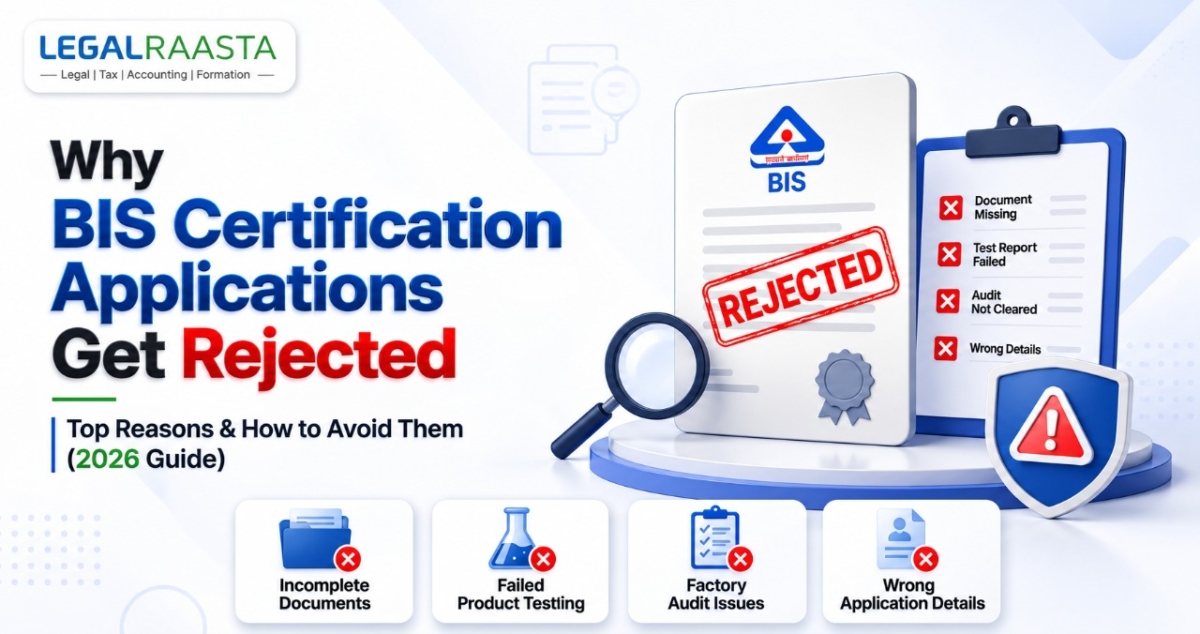
Getting BIS certification wrong is expensive. Not just in fees but in time, delayed product launches, and lost market access. Despite this, thousands of BIS certification applications get rejected every year for entirely preventable reasons.
Under the BIS Act, 2016, any product falling under a Quality Control Order must carry BIS certification before it can be manufactured, imported, or sold in India. The Bureau of Indian Standards manages this through the Manak Online portal at manakonline.in. Once submitted, applications go through document scrutiny, lab testing, and factory inspection before granting a license. Any gap at any one of these stages can and does result in rejection.
This guide covers exactly why BIS certification applications get rejected, what the most common documentation and process mistakes look like in practice, and what you need to do differently to get it right the first time around.
LegalRaasta helps manufacturers and importers prepare BIS applications that clear scrutiny the first time, without the delays and costs that come with rejection.
What Is BIS Certification and Why Does It Matter?
Before getting into why applications fail, it helps to understand what the certification process actually involves and why the stakes are this high.
BIS certification is the official approval from the Bureau of Indian Standards confirming that a specific product meets the Indian Standard code applicable to its category. It is mandatory under the BIS Act, 2016, for all products covered under Quality Control Orders issued by the Government of India. There is no alternative, no exemption based on size or turnover, and no grace period once your product falls under a notified QCO.
|
Certification Scheme |
Applies To |
Portal Used |
|
ISI Mark (Domestic) |
Indian manufacturers of QCO-covered goods |
Manak Online |
|
CRS Registration |
Electronics and IT product importers and brands |
Manak Online |
|
FMCS |
Foreign manufacturers supplying India |
Manak Online |
|
BIS Hallmarking |
Jewellers selling gold and silver jewellery |
Manak Online |
Selling covered products without valid BIS certification means stock seizure, import detentions, platform delisting, and criminal proceedings under the BIS Act. Because the consequences are this serious, getting the application right from the start is not optional. It is the only practical path forward.
Top Reasons BIS Certification Applications Get Rejected
This section breaks down every major category of rejection that causes BIS certification applications to get rejected, based on common patterns seen across ISI Mark, CRS, and FMCS applications on the Manak Online portal.
1. Wrong IS Code Selected
Every product category has a specific Indian Standard code assigned to it. Selecting the wrong IS code is one of the single most common reasons BIS certification applications get rejected at the document scrutiny stage. In many cases, applicants confuse adjacent product categories or, just as often, use outdated IS codes that have since been revised or superseded.
2. Expired or Ineligible Lab Test Reports
BIS requires test reports from NABL-accredited or BIS-recognised laboratories. For CRS applications specifically, reports must come from labs empanelled under the Compulsory Registration Scheme. Beyond lab eligibility, the reports themselves must cover every single technical parameter listed under the applicable IS code. There is an additional requirement that reports must be dated within 90 days of the submission date for CRS applications. Expired reports, the wrong lab, or incomplete parameter coverage will all result in rejection without exception.
3. Incomplete or Incorrect Application Form
Missing fields, the wrong entity type selected, a business name in the application that does not match the supporting documents, and product descriptions that do not align with the IS code wording all trigger rejection. The Manak Online portal does not catch every error automatically before you submit. As a result, many rejections come from entirely straightforward form errors that nobody noticed until the BIS scrutiny team reviewed the file.
4. Factory Inspection Failure
For ISI Mark domestic licenses and FMCS applications, a BIS officer physically visits the manufacturing premises. If the factory layout does not match the floor plan you submitted, if required testing equipment is not there, if the designated QC person cannot actually demonstrate the tests the IS code requires, or if hygiene and process standards are below what BIS expects, the inspection fails. The application then gets rejected, and the factory must address every finding before a re-inspection can even be requested.
5. Inadequate Quality Control Setup
BIS requires that manufacturers have an in-house quality testing function that fully matches the IS code requirements for their product. If the QC person on paper lacks the required qualifications, if equipment is missing or not calibrated at the time of inspection, or if there are no documented SOPs showing how testing is carried out, the inspector records it as non-compliant. At that point, the application simply does not move forward.
6. Business Entity Mismatch
The name on the application must exactly match the legal name as it appears on the business registration certificate, GST certificate, and every other supporting document attached to the file. A single spelling difference, a missing suffix, an abbreviation, or a prefix in one document that does not appear in another is enough to cause rejection at scrutiny.
7. Failure to Respond to BIS Queries
After submission, BIS frequently raises queries on specific aspects of the application through the Manak Online portal. These queries come with a response window, and applicants must reply within that timeframe. Those who miss the query notification or respond after the deadline have their applications either rejected outright or treated as withdrawn.
Common Documentation Mistakes That Cause BIS Application Rejection
Documentation errors are the leading cause of why BIS certification applications get rejected at the initial scrutiny stage, often before a single inspection or lab review has even been considered. The table below maps the most common document mistakes to their direct consequences.
|
Document |
Common Mistake |
Consequence |
|
Name differs from application form |
Scrutiny rejection |
|
|
Lab test report |
Report from non-empanelled or non-NABL lab |
Rejection at technical review |
|
Lab test report (CRS) |
Report older than 90 days at submission |
Rejection for CRS applications |
|
Factory floor plan |
Does not match actual premises layout |
Inspection failure |
|
IS code reference |
Wrong or outdated code listed |
Scrutiny rejection |
|
GST certificate |
Address differs from factory address |
Mismatch rejection |
|
QC documentation |
Missing SOPs or qualification certificates |
Inspection non-compliance |
|
Expired at time of submission |
Portal submission failure |
How to Avoid BIS Certification Application Rejection
Getting the application right the first time costs less in both money and time than recovering from a rejection. Here is exactly what needs to happen before any BIS certification application goes in.
Before You Apply:
- Confirm the correct IS code on bis.gov.in before preparing a single document
- Verify the lab is NABL-accredited or BIS-recognised and specifically empanelled for your product category, not just for BIS work generally
- For CRS applications, check that your test report date falls within 90 days of your planned submission date, not your lab engagement date
- Cross-check the exact legal name of your business across every document you plan to attach, character by character
- Ensure your DSC is valid and will not expire within the next 30 days, because a mid-process expiry causes its own set of problems
During Application Preparation:
- Prepare the factory floor plan professionally and confirm it reflects the actual current layout of the premises, not a previous version
- Confirm your QC person holds the specific qualifications that match your IS code requirements, not just general quality management credentials
- List all testing equipment with active calibration certificates attached
- Write the goods description precisely and match the wording directly to the IS code product category, not a paraphrase of it
After Submission:
- Log into Manak Online consistently, ideally every few days, to check for queries raised by BIS
- Respond to every query within the specified timeframe and keep a record of your responses
- For ISI Mark and FMCS applications, make sure the factory is fully inspection-ready well before the BIS officer’s visit is confirmed, not the day before
What to Do If Your BIS Certification Application Is Rejected
A rejection does not mean the process is over. However, it does reset specific timelines and carries fresh costs. Here is how to handle it properly rather than rushing into a resubmission that has the same problems.
- Read the rejection notice in full and identify every reason stated by BIS, not just the first one.
- Do not reapply immediately without addressing every issue mentioned, because submitting the same application with one fix and the same remaining errors leads to the same outcome.
- If the rejection was due to documentation errors, correct every gap before preparing the fresh application.
- If the rejection came from an inspection failure, fix the non-compliant areas first and only then request re-inspection
- If the rejection relates to a lab report, get fresh test reports from the correct empanelled laboratory before doing anything else.
- Filing fees are not refunded after rejection, which means each resubmission carries a fresh full fee obligation.
- For FMCS applications where the overseas factory failed inspection, the factory must fully address every finding in the BIS inspection report before a re-inspection visit can be scheduled and approved.
The key point here is that resubmission without a systematic review of every rejection wastes both the new fee and the time it takes BIS to process the second application.
BIS Certification Rejection vs Application Delay: Key Difference
A lot of applicants confuse a rejection with a delay. In practice, they are treated very differently on the Manak Online portal and require completely different responses from the applicant.
|
Parameter |
Rejection |
Delay |
|
Definition |
Application formally refused by BIS |
Application still under review or pending action |
|
Filing fee |
Not refunded |
Not applicable, application still active |
|
Next step |
Fresh application after fixing all issues |
Respond to queries or wait for next stage |
|
Priority date |
Lost on rejection |
Retained during delay |
|
Timeline impact |
Full restart required |
Partial, depends on stage reached |
|
Common cause |
Wrong documents, inspection failure |
High application volume, pending queries |
BIS Certification Application Checklist
Before submitting any BIS certification application, go through every item below. This checklist covers the three stages where rejections most commonly occur.
Pre-Application:
- Correct IS code confirmed on bis.gov.in
- Product category verified against the applicable Quality Control Order
- NABL or BIS-recognised lab identified and confirmed as empanelled for the specific product
- All test parameters under the IS code fully covered in the lab report
- CRS test report dated within 90 days of planned submission
Documentation:
- Business name identical across application form, registration certificate, GST certificate, and every attached document
- GST registration address matches factory or principal place of business address
- Current factory floor plan prepared and confirmed to match the actual premises
- QC person qualification certificates attached and matching IS code requirements
- Testing equipment calibration certificates included for every listed instrument
- DSC of authorised signatory valid and active at time of submission
Post-Submission:
- Manak Online portal checked regularly for queries
- All BIS queries responded to within the specified deadline
- Factory inspection date confirmed and premises fully prepared well in advance
Going through this checklist thoroughly before submission takes a fraction of the time that a rejection and reapplication process costs. It is the single most effective thing an applicant can do to reduce rejection risk before the application goes in.
Why Choose LegalRaasta for BIS Certification?
The majority of BIS certification applications that get rejected fail at stages that experienced consultants handle as a matter of routine. What looks like a minor oversight from the outside- an IS code one number off, a lab report three days past the 90-day window, a floor plan prepared six months ago-is exactly the kind of thing that causes rejection and restarts the entire timeline.
LegalRaasta provides end-to-end support built specifically to prevent rejection before it happens, not to manage it after the fact.
- Correct IS code identification before any document preparation begins
- Direct connections to BIS-recognised and NABL-accredited labs for specific product categories
- Complete Manak Online portal filing with accurate goods description, and all required attachments verified
- Factory inspection preparation for ISI Mark and FMCS applicants, covering documentation, equipment, and QC function readiness
- Active query monitoring and response within BIS-specified deadlines
- Fresh test report coordination for CRS applications timed within the 90-day validity window
- Reapplication support when a previous application has already been rejected, covering a full audit of what went wrong before resubmission
Conclusion
BIS certification applications get rejected for predictable reasons. Wrong IS codes, expired lab reports, mismatched documents, failed inspections, and missed query deadlines account for the overwhelming majority of rejections across every BIS scheme. None of these are unavoidable. Every single one of them is preventable with thorough preparation before the application is submitted.
The real cost of a rejection goes beyond the reapplication fee. It is the weeks or months lost while the process resets, the product launch is pushed back, and the market access is delayed while a fresh application works its way through scrutiny again. Getting it right the first time is not just cleaner. It is genuinely the cheaper and faster path by a significant margin.
Connect with LegalRaasta today and get your BIS certification application prepared and submitted correctly so your product reaches the market without rejection delays.
Frequently Asked Questions
1. Why do BIS certification applications get rejected most commonly?
The most common reasons BIS certification applications get rejected include wrong IS code selection, expired or incomplete lab test reports, business name mismatches across documents, failed factory inspections, and missed BIS query response deadlines on the Manak Online portal.
2. What are the common documentation mistakes that cause BIS application rejection?
For BIS certification applications that get rejected due to documentation, the usual culprits are test reports from non-empanelled labs, CRS reports older than 90 days, expired DSC of the signatory, GST address mismatches, and factory floor plans that do not reflect actual premises.
3. How can I avoid BIS certification application rejection?
Verify the correct IS code before preparing documents, use only NABL or BIS-recognised labs, ensure all business names match exactly across every attached document, and monitor the Manak Online portal for queries after submission to avoid having your BIS certification application rejected on procedural grounds.
4. Can I reapply after my BIS application is rejected?
Yes. After fixing every issue mentioned in the rejection notice, a fresh application can be submitted. BIS certification applications that get rejected lose their original priority date, so the process restarts from the beginning with a new application fee payable on the Manak Online portal.
5. Is the BIS application fee refunded after rejection?
No. Filing fees paid for BIS certification applications that get rejected are not refunded under the BIS Act, 2016. Each resubmission requires fresh payment of the applicable government fee based on your product category and manufacturing scale.
6. How long does BIS certification approval take after applying?
CRS registrations typically take 2 to 8 weeks. ISI Mark domestic licenses take 3 to 6 months, including factory inspection. FMCS takes 4 to 9 months. Timelines extend significantly when BIS certification applications get rejected and must be resubmitted from scratch.
7. What happens if my product fails the BIS lab test?
If the product fails testing, the BIS certification application gets rejected at the technical review stage. You must address the product deficiency, obtain fresh test results from a BIS-recognised lab covering all IS code parameters, and resubmit a new application with valid passing test reports.
8. What documents are required for BIS certification to avoid rejection?
To prevent BIS certification applications from getting rejected, submit business registration documents with the exact legal name, GST certificate, current factory floor plan, QC staff qualifications, calibration certificates for testing equipment, and valid lab test reports from a BIS-recognised or NABL-accredited laboratory.
9. Can foreign manufacturers apply for BIS certification without rejection risk?
Yes, under FMCS. To reduce the risk of BIS certification applications getting rejected, foreign manufacturers must appoint a qualified Authorised Indian Representative, submit ISO 9001 certification, and ensure their factory passes physical BIS inspection before the license is granted.
10. Should I hire a BIS consultant to avoid rejection?
Yes. Most BIS certification applications that get rejected fail on preparation errors a consultant catches before submission. LegalRaasta handles IS code selection, lab coordination, Manak Online portal filing, inspection preparation, and query responses to prevent rejection at every stage.

Related Posts
Our Clients







Featured In