
Shell Companies in India (2026): Meaning, Legality, Risks & Compliance Guide
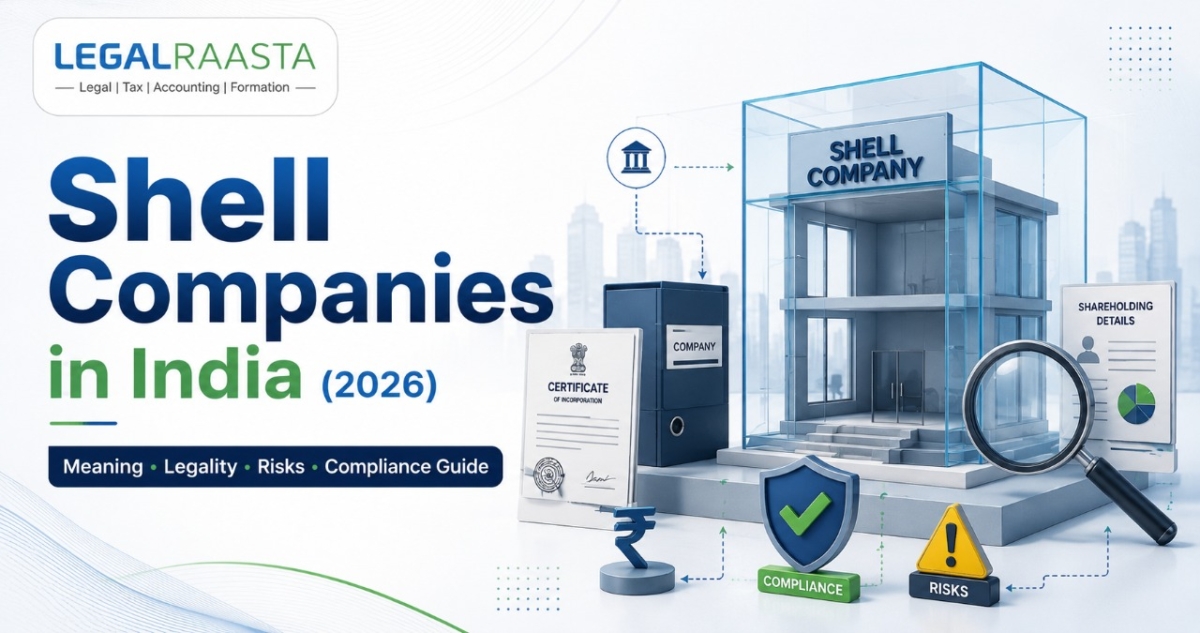
In 2017, the Indian government struck off over 2 lakh companies in a single sweep. Most of them were shell companies in India that existed only on paper, with no real business, no employees, and no actual operations. Post demonetisation, these companies had been used to park black money and route unaccounted cash. That crackdown did not stop there. The MCA, Income Tax Department, and Enforcement Directorate continue targeting shell structures in 2025 and 2026. The question most business owners ask is simple: what exactly makes a company a shell company, and where does the legal line fall?
Some shell structures are completely legitimate. Others are criminal. The difference lies in what the company actually does and how it is used. LegalRaasta helps businesses stay on the right side of that line with proper ROC compliance, annual filings, and corporate structuring advice that keeps companies genuinely active and legally clean.
What is a Shell Company and How Does It Work?
A shell company has a legal existence but no real business activity. No employees, no products, no services. Just a registered entity with a bank account and directors on paper.
How it works depends on who is using it and why. At its most basic, a shell company receives money, holds assets, or facilitates transactions on behalf of someone else. The company itself is the instrument, not the business.
|
Feature |
Shell Company |
Legitimate Business |
|
Business activity |
None or minimal |
Active operations |
|
Employees |
Usually zero |
Actual staff |
|
Revenue |
Often just fund transfers |
Genuine sales or services |
|
Assets |
May hold assets on paper only |
Real business assets |
|
Annual filings |
Often non-compliant |
Filed regularly |
|
Purpose |
Holding, routing, or hiding money |
Running a business |
Not every company that looks dormant is a shell. Some holding companies, SPVs for real estate, or newly incorporated companies with no revenue yet can look similar on paper. Context matters enormously.
Are Shell Companies Legal in India?
Short answer: sometimes yes, sometimes absolutely not.
The Companies Act, 2013 does not define the term shell company. There is no specific law that says shell companies are illegal. What the law targets is what a shell company is used for.
Legal uses of shell structures:
- Holding companies that own subsidiaries across industries
- Special Purpose Vehicles created for a single project like infrastructure or real estate
- Dormant companies kept active for potential future use
- Overseas holding structures used in legitimate cross-border investment
- Companies incorporated but not yet started operations
Illegal uses that courts and agencies target:
- Routing black money or cash generated from illegal activity
- Layering transactions to disguise the origin of funds under PMLA
- Benami property transactions where real ownership is hidden
- Tax evasion by showing fake expenses or bogus invoices
- Round-tripping of funds to claim foreign investment benefits
The line between legal and illegal shell company use in India depends on whether the structure has genuine economic substance and whether it follows all filing and disclosure obligations.
Key Laws Governing Shell Companies in India
Multiple laws apply to shell companies in India depending on what the shell is being used for and which agency is investigating.
|
Law / Act |
What It Covers |
Enforcing Agency |
|
Companies Act, 2013 – Section 248 |
Strike off of inactive companies |
MCA / ROC |
|
Prevention of Money Laundering Act (PMLA), 2002 |
Money laundering through shell structures |
Enforcement Directorate |
|
Benami Transactions (Prohibition) Amendment Act, 2016 |
Holding assets in someone else’s name |
Income Tax Department |
|
Income Tax Act, 1961 – Section 68 |
Unexplained cash credits in books |
Income Tax Department |
|
Foreign Exchange Management Act (FEMA) |
Illegal foreign exchange routing |
RBI / ED |
|
Indian Penal Code – Sections 420, 471 |
Fraud and forgery through shell entities |
Police / CBI |
|
SEBI Act (for listed entities) |
Price manipulation through shell companies |
SEBI |
When shell companies in India are used to launder money, the ED can attach assets under PMLA. The Income Tax Department treats unexplained credits under Section 68 as income. The ROC can strike off companies under Section 248. Often all three agencies act simultaneously on the same entity.
Government Actions Against Shell Companies in India (2026 Update)
Enforcement has not slowed down. If anything, it has gotten more targeted and data-driven.
Recent government actions:
- MCA’s Project Bhamasha tracks companies with no filings for multiple years and flags them for ROC action
- The Income Tax Department now uses AI-powered data analytics to map fund flows across bank accounts linked to the same promoters
- SEBI took action against hundreds of companies that were used to manipulate stock prices through circular trading
- The ED has attached properties worth thousands of crores linked to shell company networks in real estate, mining, and education sectors
- Central Board of Direct Taxes identified over 18,000 shell entities in a single exercise through Operation Clean Money in 2022-23, with many cases still active in 2025-26
The government now cross-references MCA filing data, income tax returns, GST returns, and bank transaction data. A company that files nothing while showing large bank transactions gets flagged automatically.
Red Flags That May Indicate a Shell Company
Whether you are a banker, investor, vendor, or regulator, these are the warning signs.
|
Red Flag |
What It Suggests |
|
No annual ROC filings for multiple years |
Company is inactive or deliberately non-compliant |
|
Registered address is a CA office or virtual address |
No actual business premises |
|
Directors with no verifiable background |
Dummy or benami directors |
|
Large bank transactions with no corresponding GST filings |
Possible fake billing or money routing |
|
Multiple companies at the same address with same directors |
Possible shell network |
|
No employees but large payroll in accounts |
Fake salary expenses |
|
Frequent name or address changes |
Hiding a trail |
|
No website, no phone, no verifiable product |
Nothing real behind the company |
Doing business with a company that shows multiple red flags above exposes you to tax scrutiny, PMLA investigations, and reputational damage even if you are the innocent party.
Compliance Requirements to Avoid Being Classified as a Shell Company
Any real company can end up on an MCA or Income Tax watchlist if compliance slips. These are the minimum requirements every active company must maintain.
Annual ROC Compliances:
- File AOC-4 (financial statements) within 30 days of AGM
- File MGT-7 or MGT-7A (annual return) within 60 days of AGM
- Hold minimum number of board meetings as required under the Companies Act
- Maintain updated director KYC (DIR-3 KYC) every year
Income Tax Compliances:
- File ITR-6 every year regardless of profit or loss
- Explain all cash credits under Section 68 with proper documentation
- Maintain books of accounts and supporting vouchers
- Deduct and deposit TDS as applicable
GST Compliances:
- File GSTR-1 and GSTR-3B monthly or quarterly
- Reconcile purchase and sales data to avoid fake invoice flags
- Maintain e-way bills for goods movement
A company that files all of these consistently, maintains actual business records, and has a verifiable business address has very little risk of being classified among the problem shell companies in India.
Consequences of Being Classified as a Shell Company
Getting flagged is not the end of the road, but the consequences stack up fast.
ROC:
- Company name struck off the register under Section 248
- Directors disqualified under Section 164(2) from holding directorships in any company for 5 years
- Difficulty restoring the company once struck off
Income Tax Department:
- Cash credits treated as income under Section 68 and taxed at maximum rate plus surcharge
- Penalty of 30 to 60 percent of unexplained income under Section 271AAC
- Prosecution in serious cases
Enforcement Directorate:
- Property attachment under PMLA
- Personal arrest of directors in serious laundering cases
- FEMA violation notices with penalties up to three times the transaction value
SEBI (for market-linked shells):
- Trading ban
- Disgorgement of illegal gains
- Delisting
Due Diligence Checklist Before Dealing With Any Company
Before signing a contract, making a payment, or accepting investment from any company, run through this basic check.
|
Check |
Where to Verify |
|
Is the company registered and active? |
MCA21 portal at mca.gov.in |
|
Are annual filings up to date? |
MCA21 filing history |
|
Does the company have a real GST registration? |
GST portal at gst.gov.in |
|
Do the directors have verifiable identities? |
MCA DIN search |
|
Is the registered address real? |
Google Maps + physical visit if needed |
|
Does the company file income tax returns? |
Ask for ITR copies with CA certification |
|
Any pending legal cases? |
Cause list search on court websites |
|
SEBI or RBI orders? |
SEBI enforcement orders portal |
This takes under an hour for most companies. Skipping it is how businesses end up unknowingly linked to shell companies in India and facing subsequent regulatory scrutiny.
Best Practices for Businesses to Stay Compliant
These apply whether you are running a startup, a growing business, or a holding structure.
- File all ROC, GST, and Income Tax returns on time every year without exception
- Maintain actual books of accounts with supporting invoices and contracts
- Ensure your registered office is a real, verifiable address where correspondence actually reaches
- Do not let director KYC lapse; file DIR-3 KYC annually
- Keep bank transactions linked to actual business activity with proper documentation
- Do not enter into transactions with companies that show multiple red flags listed above
- If your company is dormant by genuine business circumstance, apply for dormant company status under Section 455 of the Companies Act rather than just stopping filings
How to Restore a Company Struck Off as a Shell Entity
This section explains the legal process and documentation required to restore a company’s active status after an ROC strike-off.
If the Registrar of Companies (ROC) strikes off your entity under Section 248 for non-compliance, you cannot simply pay a basic fine to reopen your bank account. You must file a formal appeal before the National Company Law Tribunal (NCLT) under Section 252 of the Companies Act, 2013.
To convince the tribunal that your business is legitimate and not an illegal shell entity, you must present solid operational evidence.
Key Documents Required for NCLT Restoration:
- Audited Financial Statements: Certified balance sheets and profit and loss accounts for all defaulting financial years.
- Bank Transaction Proofs: Certified bank statements showing active business receipts, vendor payments, or regular transactions.
- Tax Filing Copies: Income Tax Returns (ITR) and GST return acknowledgments corresponding to the inactive period.
- Premises and Operational Proof: Valid lease agreements, utility bills, or employee salary records showing an active physical setup.
- Director Affidavits: Sworn affidavits confirming the company was not used for money laundering, round-tripping, or tax evasion.
Once the NCLT issues a favorable restoration order, file Form INC-28 with the ROC, clear all overdue AOC-4 and MGT-7 filings with statutory late fees, and reactivate your business status.
How LegalRaasta Helps Businesses Stay Clean
LegalRaasta provides complete annual compliance support to make sure your business never ends up on the wrong side of an MCA or Income Tax investigation.
- ROC annual filing: AOC-4, MGT-7 or MGT-7A, and DIR-3 KYC
- Income Tax return filing for companies under ITR-6
- GST compliance and return filing
- Corporate restructuring advice for legitimate holding structures
- Company restoration if previously struck off
- Director disqualification resolution
- Legal advice on structuring SPVs and holding companies correctly
Conclusion
Shell companies in India are not automatically illegal. But they carry serious risk when they stop filing, stop operating, or start being used to route money outside the law. The government’s surveillance has become sophisticated enough that even a one-year gap in filings triggers flags across multiple databases simultaneously. If your company is real, keep its filings real. If your company is dormant, formalise that status. And if you are dealing with another company, verify it before you sign anything.
The difference between a legitimate holding structure and a shell that invites trouble is almost entirely about compliance discipline. Connect with LegalRaasta today and keep your company’s compliance clean so it never gets confused with the shell companies in India that regulators are actively targeting.
Frequently Asked Questions
1. What are shell companies in India and are they always illegal?
Shell companies in India are registered entities with no active business operations. They are not always illegal. Legal uses include holding companies and SPVs. Illegal use involves money laundering, benami transactions, and tax evasion under PMLA and the Benami Transactions Prohibition Act.
2. How does the MCA identify shell companies in India?
The MCA identifies shell companies in India by cross-referencing ROC filing data, bank transactions, and income tax records. Companies that show no annual filings for multiple years get flagged under MCA Project Bhamasha and face strike-off proceedings under Section 248 of the Companies Act, 2013.
3. What laws apply to shell companies in India?
Multiple laws apply to shell companies in India, including the Companies Act 2013, PMLA 2002, Benami Transactions Prohibition Act 2016, Income Tax Act 1961, and FEMA. Depending on the violation, the ROC, Enforcement Directorate, SEBI, or Income Tax Department may take enforcement action simultaneously.
4. Can a holding company be classified among shell companies in India?
A holding company with real subsidiaries and proper compliance filings is not classified among shell companies in India. However, a holding company that files no returns, has no economic activity, and exists only to route funds can be flagged and investigated by the MCA and Enforcement Directorate.
5. What happens when a company is classified as a shell company in India?
When flagged as one of the problem shell companies in India, a company faces ROC strike-off under Section 248, director disqualification under Section 164(2), tax demands under Section 68, property attachment under PMLA, and possible criminal prosecution of directors depending on the nature of violations.
6. How do I check if a company is a genuine business or one of the shell companies in India?
To verify against shell companies in India, check the company’s MCA filing history at mca.gov.in, verify GST registration at gst.gov.in, confirm the registered address is real, and ask for certified copies of income tax returns. Directors should also have verifiable identities through the MCA DIN search.
7. What is Section 68 of the Income Tax Act and how does it relate to shell companies in India?
Section 68 treats unexplained cash credits as taxable income. It directly targets shell companies in India that receive large deposits without documentary proof of the source. The Income Tax Department imposes tax at maximum rates plus penalties on such unexplained credits found during scrutiny assessments.
8. Can directors of shell companies in India face personal liability?
Yes. Directors of shell companies in India used for illegal purposes face personal liability under PMLA, the Benami Act, and the IPC. They can be arrested, have their personal assets attached, and be barred from holding directorships in any company for up to five years under Section 164(2).
9. What is the difference between dormant companies and shell companies in India?
A dormant company is one formally registered under Section 455 of the Companies Act with proper ROC status. Shell companies in India are typically companies that have stopped filing without formalising dormancy. The legal status and protection offered to dormant companies are completely different from defaulting inactive entities.
10. How does LegalRaasta help businesses avoid being classified among shell companies in India?
LegalRaasta manages ROC filings, ITR-6, GST returns, director KYC, and annual compliance for companies to ensure they never get flagged as shell companies in India. LegalRaasta also helps struck-off companies apply for restoration and assists directors in resolving disqualification issues with the MCA.

Related Posts





Our Clients








Featured In