
BIS Certification vs Product Testing: Key Differences & Compliance
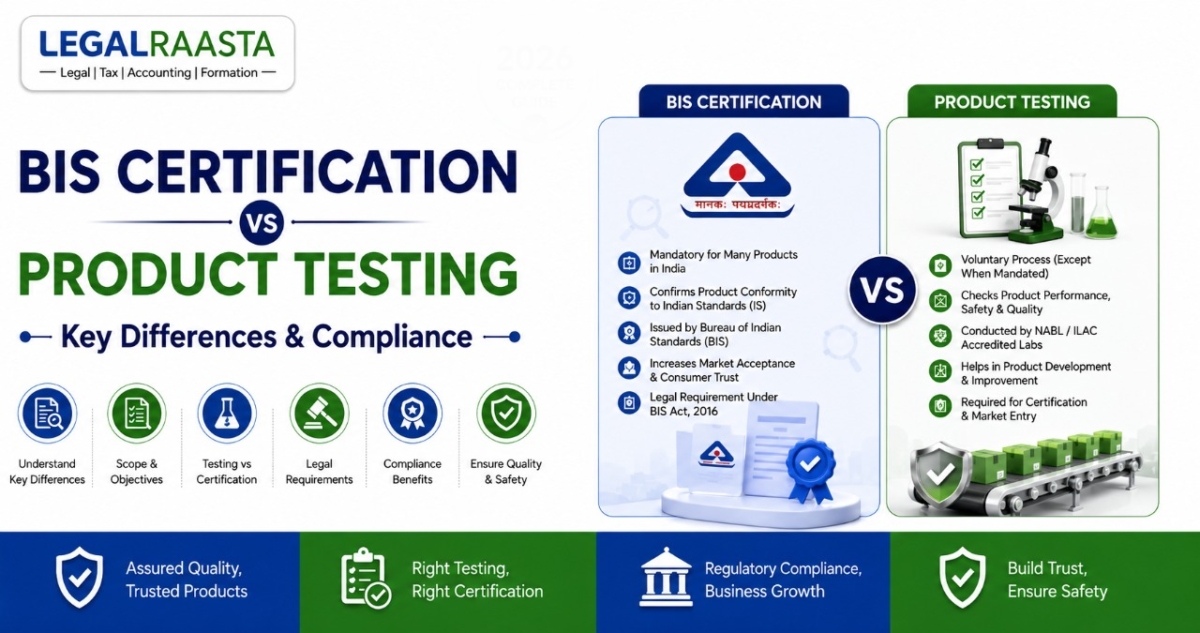
Selling a product without checking these two things separately is how most Indian manufacturers get their goods stuck at customs or pulled off shelves. BIS Certification vs Product Testing sounds like one topic, but it’s actually two different questions. One asks whether your product is legally allowed to be sold in India. The other asks whether it actually works the way it’s supposed to.
Confuse the two, and you either waste money testing something nobody asked for, or you sell a product that was never legally cleared in the first place. This guide breaks down what each term means, where they overlap, and where they don’t. Talk to LegalRaasta’s compliance team if you want your exact product mapped against the correct BIS requirement before you manufacture or import another unit.
BIS Certification and Product Testing: An Overview
Both terms get thrown around loosely in trade conversations, and that’s exactly why so many businesses get confused about what they actually need.
BIS Certification is the legal approval issued by the Bureau of Indian Standards that lets you sell a product in India under a specific Indian Standard. Product testing is the technical process of checking a sample against that standard in a laboratory. One is a government clearance. The other is a lab activity. You usually need both, but they aren’t interchangeable, and understanding that difference saves real money down the line.
What Is BIS Certification in India?
BIS Certification is granted under the Bureau of Indian Standards Act, 2016, and it’s the mark that tells a customer, a retailer, or a customs officer that your product meets an Indian Standard. It comes mainly through two active routes today, since BIS Scheme X for machinery and electrical equipment was formally withdrawn by the Ministry of Heavy Industries on 14 January 2026.
- Scheme I, the ISI Mark: covers products like cement, steel bars, helmets, LPG cylinders, and packaged drinking water. It needs a factory audit plus product testing, and the licence needs periodic renewal backed by surveillance checks.
- Scheme II, the Compulsory Registration Scheme (CRS): covers electronics and IT products like chargers, power banks, LED lights and laptops. No factory audit is needed, but testing at a BIS-recognised lab is compulsory before registration.
What Is Product Testing?
Product testing is simply the lab work, checking a sample against safety, performance, or quality parameters defined in the relevant Indian Standard, or any other standard a business chooses to test against.
It happens for plenty of reasons that have nothing to do with BIS. A company might test a product for its own quality control, to meet a foreign buyer’s requirement, or purely to catch defects before mass production. Testing on its own proves a sample performed a certain way on a certain day. It doesn’t grant permission to sell anything.
BIS Certification vs Product Testing: Key Differences
The confusion mostly comes from the fact that one sits inside the other. Product testing is a step. BIS Certification is the outcome.
A test report from any lab, even a good one, doesn’t let you legally sell a notified product in India. Only a valid BIS licence or CRS registration does that, and testing has to happen at a BIS-recognised laboratory specifically for that registration to count. Plenty of manufacturers get this wrong; they get a product tested at a random NABL lab, assume they’re compliant, and find out only when a market surveillance officer asks for the registration number.
BIS Certification vs Product Testing: Comparison Table
|
Point |
BIS Certification |
Product Testing |
|
What it is |
Legal approval to sell a product in India |
Lab verification of product parameters |
|
Issued by |
Any accredited or BIS-recognised lab |
|
|
Mandatory for |
Products under a Quality Control Order |
Only if required by BIS, buyer or internal QA |
|
Involves factory audit |
Yes, for ISI Mark (Scheme I) |
No |
|
Result |
A licence number or registration number |
A test report |
|
Validity |
Needs periodic renewal |
One-time result for that sample batch |
Is Product Testing Mandatory for BIS Certification?
Yes, without exception. Whether you’re applying for the ISI Mark or CRS registration, your product must be tested first, and the report has to come from a laboratory recognised by BIS specifically for that product category. A test report from an ordinary private lab, however accurate, will not be accepted in either scheme.
How Product Testing Fits Into the BIS Certification Process
Testing isn’t a side step here; it’s baked directly into both certification routes, just at a different point depending on the scheme.
Under the ISI Mark, BIS conducts a factory audit first, draws a sample during that visit, and sends it for testing at a BIS-recognised lab. The licence gets granted only once that report clears. Under CRS, the manufacturer arranges testing independently at a recognised lab before applying, and BIS reviews the submitted report as part of the registration itself. Either way, no test report, no certification.
Types of Products That May Require BIS Certification
Not every product needs this, but the list covers more everyday items than most people expect.
|
Category |
Examples |
Scheme |
|
Electronics and IT |
Mobile chargers, power banks, LED lights, laptops |
CRS (Scheme II) |
|
Construction materials |
Cement, steel bars, TMT rods |
ISI (Scheme I) |
|
Household and safety items |
Pressure cookers, helmets, LPG cylinders |
ISI (Scheme I) |
|
Food and packaged goods |
Packaged drinking water, milk powder |
ISI (Scheme I) |
|
Toys |
Children’s toys under age-based safety norms |
ISI (Scheme I) |
India currently has well over 150 Quality Control Orders in force across these categories, and the government keeps adding more, so a product that was exempt last year might not be exempt today.
When Is Product Testing Required Without BIS Certification?
Testing without any BIS angle at all happens more often than people assume. Export-bound products often need testing against a foreign standard like CE or UL instead of an Indian one. A manufacturer might test a prototype purely for internal quality control before it ever reaches a production line. Some businesses also test voluntarily to build buyer confidence, even when the product category isn’t under a Quality Control Order and BIS Certification isn’t legally required at all.
BIS Certification Requirements for Manufacturers and Importers
Indian manufacturers and foreign manufacturers face slightly different paths here, and getting this wrong is one of the most common filing mistakes.
Indian manufacturers apply directly to BIS, and for ISI Mark products, the factory itself gets audited before a licence is granted. Foreign manufacturers, on the other hand, must either register under the Foreign Manufacturers Certification Scheme for ISI products, or appoint an Authorised Indian Representative for CRS registration, since BIS does not accept applications directly from a company with no legal presence in India.
Documents Required for BIS Certification and Product Testing
Paperwork differs slightly by scheme, but a few documents show up across almost every BIS application.
|
Document |
ISI Mark (Scheme I) |
CRS (Scheme II) |
|
Test report from a BIS-recognised lab |
Required |
Required |
|
Factory layout and manufacturing process details |
Required |
Not required |
|
Business incorporation and constitution documents |
Required |
Required |
|
Authorised Indian Representative appointment |
Only for foreign manufacturers |
Required for foreign manufacturers |
|
Product technical specification sheet |
Required |
Required |
BIS Certification and Product Testing Process in India
The full journey runs through a handful of stages, and skipping the order rarely works out well.
Step 1: Identify the Applicable Scheme
Check whether your product falls under ISI or CRS, since the entire process branches from here.
Step 2: Arrange Product Testing
Get your sample tested at a laboratory that BIS specifically recognises for that product category, not just any accredited lab.
Step 3: Factory Audit, If Applicable
ISI Mark applicants go through a physical factory inspection before a licence gets issued.
Step 4: Submit the Application
File through the BIS portal at https://www.bis.gov.in/?lang=en with your test report, documents, and applicable fee attached.
Step 5: Receive the Licence or Registration
Once approved, you get a licence number for ISI products or a registration number for CRS products, both of which are publicly verifiable on the BIS website.
Common Compliance Mistakes to Avoid
- Assuming any NABL-accredited lab report satisfies BIS, when only BIS-recognised labs count for the actual filing
- Selling a product under a Quality Control Order without checking if it’s been notified this year
- Treating CE marking or a foreign test certificate as valid for the Indian market
- Missing licence renewal and surveillance testing deadlines after certification is granted
- Assuming BIS Scheme X still applies to machinery products, when it was withdrawn in January 2026
BIS Certification vs Product Testing: Which One Does Your Business Need?
If your product falls under any Quality Control Order, you need full BIS Certification, and testing is simply the first step toward getting it. If your product isn’t notified but you still want quality assurance, buyer confidence, or export compliance, standalone product testing without BIS registration works perfectly well for that purpose.
Expert Compliance Guidance for BIS Certification
Figuring out which scheme applies, and which lab actually counts as BIS-recognised for your specific product, trips up even experienced importers. LegalRaasta’s team identifies the correct scheme for your product, coordinates testing with a recognised laboratory, and manages the full application through to licence approval, so you’re not left guessing whether your paperwork will hold up during a market surveillance check.
Conclusion: Understanding the Difference Between BIS Certification and Product Testing
BIS Certification vs Product Testing isn’t really a competition between two options; it’s a sequence. Testing tells you what your product does. Certification tells the government, and your customer, that it’s legally allowed to be sold. Skip the certification step, and you’re exposed, no matter how good your test report looks. Get LegalRaasta to confirm your product’s exact BIS requirement and manage the testing and filing together, so nothing falls through the gap between the two.
Frequently Asked Questions About BIS Certification and Product Testing
1. Is product testing enough without BIS Certification vs Product Testing being fully understood?
No. Product testing alone doesn’t authorise sale in India. A valid BIS Certification, backed by a report from a recognised laboratory, is what actually permits legal sale of a notified product.
2. What is the Compulsory Registration Scheme mentioned in BIS Certification vs Product Testing comparisons?
It’s the BIS route for electronics and IT products. Unlike the ISI Mark, it skips the factory audit but still requires product testing at a BIS-recognised lab before registration.
3. Does BIS Certification vs Product Testing apply differently to importers?
Yes. Foreign manufacturers need an Authorised Indian Representative for BIS registration, since applications tied to ISI Mark certification or CRS cannot be filed directly by a company without a legal presence in India.
4. How long does a BIS-recognised laboratory take to test a product?
It varies by product complexity, usually a few weeks. In the BIS Certification vs Product Testing sequence, this report has to be cleared before any licence or registration gets issued.
5. Can a company skip BIS Certification vs Product Testing if it already has CE marking?
No. CE marking is a European standard and doesn’t substitute for Indian requirements. Products under a Quality Control Order still need BIS Certification, regardless of any existing foreign certification held.
6. What happens if a notified product is sold without BIS Certification?
It’s a violation under the BIS Act, 2016, attracting penalties and potential seizure. In the BIS Certification vs Product Testing framework, a test report alone never substitutes for the actual licence.
7. Is factory audit part of every BIS Certification vs Product Testing route?
No. Factory audits apply only to the ISI Mark scheme. CRS registration for electronics skips the audit entirely but still mandates product testing at a BIS-recognised laboratory beforehand.
8. Does BIS Certification vs Product Testing status ever expire?
Yes, in most cases. ISI Mark licences need periodic renewal backed by surveillance testing, while CRS registration also carries a fixed validity period requiring timely renewal to stay compliant.
9. What is a Quality Control Order in the context of BIS Certification vs Product Testing?
It’s a government notification making BIS Certification mandatory for a specific product category. Once notified, product testing and certification both become compulsory before that item can be legally sold.
10. Who verifies whether a laboratory qualifies for BIS Certification vs Product Testing purposes?
The Bureau of Indian Standards maintains and publishes the official list of recognised laboratories. Only reports from labs on that list are accepted for either ISI Mark or CRS registration.

Related Posts
Our Clients






Featured In