
BIS CRS Registration for Smart Glasses & XR Devices in 2026: AR, VR & MR Classification Guide
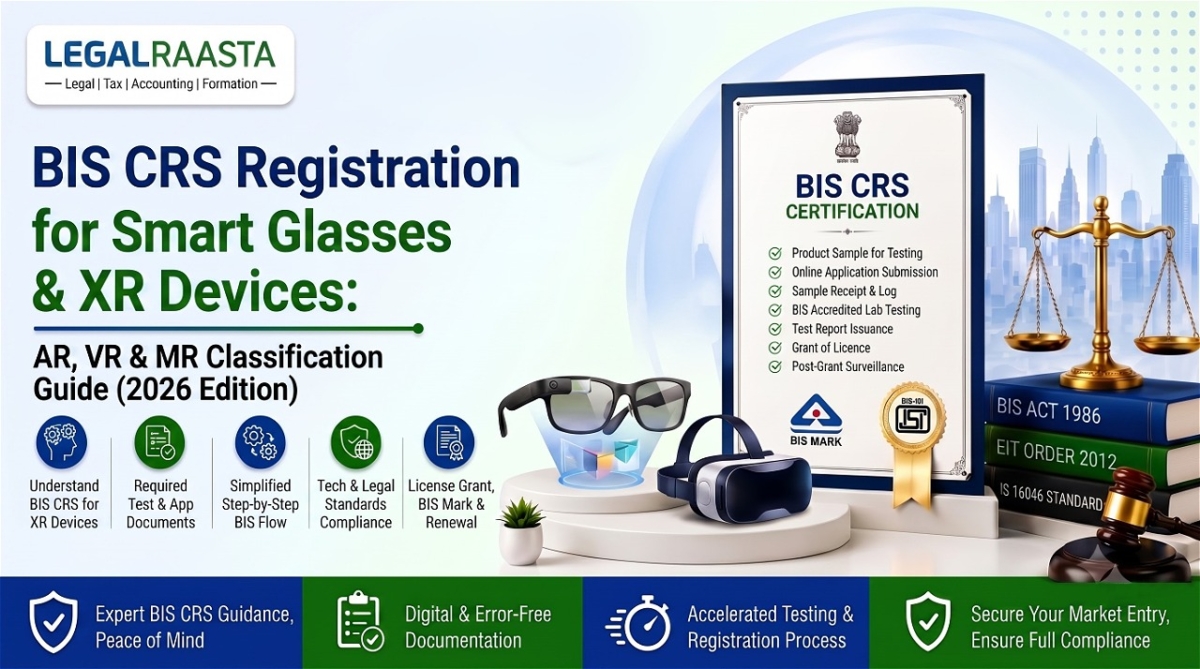
Smart glasses used to sit in a regulatory grey zone in India. Not anymore. BIS CRS Registration for Smart Glasses & XR Devices became a real, enforceable requirement after the Ministry of Electronics and Information Technology notified these products in October 2025, and the Bureau of Indian Standards sharpened the rules further with a fresh classification update in August 2026.
If you manufacture, import, or sell AR glasses, VR headsets, or MR devices in India, this isn’t optional paperwork anymore; it’s the difference between a legal product launch and a seized shipment. This guide breaks down the new classification, the applicable standard, and exactly what you need to file. Talk to LegalRaasta’s compliance team to get your specific device classified correctly before you submit anything to BIS.
Quick Answer: BIS CRS for Smart Glasses & XR Devices
|
Requirement |
Detail |
|
Regulation |
Electronics and IT Goods (Requirement of Compulsory Registration) Order, 2021 |
|
Covered since |
29 October 2025, MeitY notification |
|
Applicable standard |
IS/IEC 62368-1:2023 |
|
Old standards phased out |
IS 13252 (Part 1):2010, IS 616:2017, by 1 May 2026 |
|
Classification update |
13 August 2026, BIS Registration Department |
|
Portal |
|
|
Factory audit |
Not required |
|
Foreign manufacturers |
Must appoint an Authorised Indian Representative |
What Is BIS CRS Registration for Smart Glasses & XR Devices?
It’s the mandatory clearance from the Bureau of Indian Standards that allows AR, VR and MR products, including smart glasses, to be legally manufactured, imported or sold in India. Unlike the ISI Mark, this route skips a factory inspection and relies on a test report from a BIS-recognised lab instead. No registration, no legal sale, simple as that.
Are Smart Glasses Covered Under BIS CRS in India in 2026?
Yes, and this changed fairly recently. Before October 2025, XR hardware sat outside the compulsory list entirely. MeitY’s notification brought AR, VR, and MR devices, smart glasses included, squarely under the Compulsory Registration Scheme, closing a gap that let plenty of imported wearables slip into the market without any safety check at all.
New BIS Classification for Smart Glasses, AR, VR & MR Devices
BIS refined how these products get sorted on 13 August 2026, and the split matters because your product’s exact category decides which licence you actually need.
|
Product Category |
Sub-Category |
Product Name |
|
Wireless Earphones and Headphones |
Audio Glasses |
Audio Glasses |
|
Digital Camera |
Smart Glasses |
Smart Glasses (photo only) |
|
Video Camera |
Smart Glasses |
Smart Glasses (photo and video) |
|
Extended Reality Products |
AR Glasses |
AR Glasses, Other AR Devices |
|
Extended Reality Products |
MR Glasses |
MR Glasses, Other MR Devices |
|
Extended Reality Products |
VR Headset |
VR Headset |
Audio glasses with Bluetooth calling and voice assistant features fall under the earphone category, not Extended Reality at all. Smart glasses split further based on whether the camera shoots stills only or also records video, one detail that changes the whole classification. BIS requires a separate licence for each product name listed here, so a brand selling both AR glasses and a VR headset needs two registrations, not one.
Applicable BIS Standard for Smart Glasses & XR Products
Every product in this category now answers to a single safety benchmark, replacing what used to be scattered across older standards.
IS/IEC 62368-1:2023 covers audio, video, IT and communication equipment, and it’s the standard XR devices must test against going forward. A transition window lets manufacturers keep using the older IS 13252 (Part 1):2010 or IS 616:2017 alongside it, but only until 1 May 2026. After that date, licences still running on the old standards face cancellation unless updated test reports come in.
|
Standard |
Status |
|
IS/IEC 62368-1:2023 |
Mandatory from 1 May 2026 onward |
|
IS 13252 (Part 1):2010 |
Legacy, valid only till 1 May 2026 |
|
IS 616:2017 |
Legacy, valid only till 1 May 2026 |
Which Smart Glasses & XR Devices Require BIS CRS Registration?
Most connected eyewear and immersive hardware sold in India falls somewhere in this net now, and the list is broader than most sellers expect.
- AR smart glasses with an overlay display
- VR headsets used for gaming, training, or enterprise
- MR head-mounted displays
- Audio-only smart glasses with wireless connectivity
- Camera-enabled smart glasses, whether photo-only or with video
- XR controllers sold alongside a headset
BIS CRS Registration Requirements for Smart Glasses
Getting registered means matching your product to the right category, arranging testing, and filing with accurate technical documentation. There’s no factory audit involved, so the real work sits in getting the paperwork and lab report right the first time. Indian manufacturers can file directly. Brand owners who source from a third-party manufacturer still need the registration tied to their brand name and product.
BIS CRS Registration Process for Smart Glasses in India
Filing runs entirely online through the CRS portal, and the sequence rarely changes regardless of which XR sub-category applies to you.
Step 1: Confirm the Exact Product Classification
Match your device against the August 2026 category table before doing anything else, since the wrong category means the wrong standard.
Step 2: Get the Product Tested
Send a sample to a BIS-recognised lab for testing against IS/IEC 62368-1:2023.
Step 3: Prepare the Application and Documents
Compile your test report, business documents, and label artwork ready for submission.
Step 4: Submit Online and Send Hard Copies
File through crsbis.in, then post the signed hard copy within 15 days, since BIS doesn’t accept online-only submissions as final.
Step 5: Respond to Queries and Receive the R-Number
Clear any BIS queries quickly, since unanswered ones reset your processing clock, and once approved, you get a registration number to mark on the product.
Documents Required for BIS CRS Registration of Smart Glasses
Paperwork stays fairly standard across XR sub-categories, though foreign brands carry one extra requirement.
|
Document |
Required For |
|
Test report from a BIS-recognised lab |
All applicants |
|
Company incorporation or GST certificate |
All applicants |
|
Label and packaging artwork |
All applicants |
|
Authorised Indian Representative agreement |
Foreign manufacturers only |
|
Brand authorisation letter |
Brand owners using third-party manufacturing |
BIS Testing Requirements for Smart Glasses & XR Devices
Testing has to happen at a lab BIS specifically recognises, and the report can’t be older than 90 days when you submit your application. No factory inspection gets scheduled under CRS, which makes this test report the single most important document in the entire file. A weak or expired report is the fastest way to see your application rejected outright.
BIS CRS Registration for Indian & Foreign Manufacturers
Indian manufacturers apply directly through the CRS portal using their own business credentials. Foreign manufacturers can’t do that; they must appoint an Authorised Indian Representative first, an Indian entity that takes legal responsibility for the product in India and manages the entire registration on the manufacturer’s behalf.
BIS CRS Registration Fees for Smart Glasses in 2026
Costs stack up from a few different sources, not just one flat government charge.
|
Cost Component |
Typical Range |
|
BIS government fee |
Around Rs 28,000 + GST per model |
|
Lab testing charges |
Rs 15,000 to Rs 60,000 per model |
|
Total realistic cost per model |
Rs 45,000 to Rs 1,20,000 |
Complex XR hardware with multiple sensors or display modules often lands toward the higher end, since more parameters mean more testing.
BIS CRS Registration Timeline for Smart Glasses
Plan for this to take longer than a quick monthly filing, especially the first time round for a new XR category.
|
Stage |
Typical Duration |
|
Testing |
2 to 4 weeks |
|
Application review |
60 to 90 days end to end |
|
With queries or corrections |
Add 2 to 4 weeks |
Common BIS CRS Compliance Mistakes for Smart Glasses
A lot of applications stumble on the same handful of avoidable errors, and knowing them upfront saves a full rejection cycle.
- Classifying camera-enabled smart glasses under the wrong sub-category by ignoring the photo-only versus video distinction
- Continuing to test against IS 13252 or IS 616 without a plan for the 1 May 2026 cutoff
- Submitting a test report older than 90 days
- Missing the 15-day hard copy deadline after online submission
- Treating one registration as covering every product name, when BIS requires separate licences per product
BIS CRS vs Other Compliance Requirements for Smart Glasses
BIS CRS isn’t the only clearance an XR device might need, and confusing it with the others causes real delays.
|
Requirement |
Applies To |
Purpose |
|
BIS CRS |
Safety, under IS/IEC 62368-1:2023 |
Product safety compliance |
|
Wireless-enabled devices |
Wireless frequency approval |
|
|
BEE Registration |
Certain power-consuming electronics |
Energy labelling |
A smart glass with Bluetooth or Wi-Fi will very likely need both BIS CRS and a separate WPC ETA approval, not one instead of the other.
BIS CRS Compliance for Manufacturers, Importers & Brand Owners
Registration sits with the manufacturer, not the importer or the retailer selling the product. That said, importers carry real exposure too, since they’re expected to confirm the specific product they’re bringing in actually holds a valid registration before it clears customs. Brand owners using contract manufacturing need the registration tied to their own brand name, even if someone else physically builds the device.
Consequences of Selling Smart Glasses Without BIS CRS Registration
Selling an unregistered device isn’t a paperwork slip; it’s a legal violation with real teeth. Products can be seized at the port or pulled from shelves during a market surveillance check, and penalties under the BIS Act follow on top of that. Ecommerce listings for unregistered XR products also risk takedown once flagged, which hits sales momentum hard right when a product launch needs it least.
How to Verify BIS CRS Registration for Smart Glasses & XR Products
Checking a registration takes a couple of minutes on the official portal. Head to crsbis.in, search using the R-number printed on the product or its packaging, and confirm the registered product name matches exactly what you’re holding. A mismatch between the label and the registered product name is a red flag worth acting on immediately.
Get Expert Assistance for BIS CRS Registration of Smart Glasses & XR Devices
Classification alone can make or break this filing, and the August 2026 update makes that riskier for anyone guessing their category. LegalRaasta’s team identifies the correct product name and sub-category for your device, coordinates testing against IS/IEC 62368-1:2023, and manages the entire CRS filing, so you’re not caught out by a transition deadline or a documentation mismatch. That kind of preparation is what keeps a launch on schedule instead of stuck at port.
Conclusion
BIS CRS Registration for Smart Glasses & XR Devices isn’t a formality anymore; it’s the line between a product that sells legally and one that gets pulled at the border. The August 2026 classification made this sharper too, since a smart glass with a video camera now sits in a different bucket than one that only takes photos, and getting that wrong costs weeks of rework later. Add the 1 May 2026 cutoff for the old testing standards, and there’s genuinely no room left to guess your way through this. Get LegalRaasta to confirm your exact classification and manage the filing before that deadline catches your product off guard.
Frequently Asked Questions About BIS CRS Registration for Smart Glasses
1. Is BIS CRS Registration for Smart Glasses & XR Devices mandatory now?
Yes, it has been mandatory since the October 2025 MeitY notification. Every AR, VR, and MR device sold in India needs registration under IS/IEC 62368-1:2023 before it reaches the market.
2. What changed with BIS classification for smart glasses in August 2026?
BIS split wearable glasses into audio, camera-based, and Extended Reality sub-categories. This directly affects how BIS CRS Registration for Smart Glasses & XR Devices gets filed, since each product name now needs its own licence.
3. Does BIS CRS Registration for Smart Glasses & XR Devices need a factory audit?
No factory audit applies here. The process relies entirely on a test report from a BIS-recognised laboratory, making the CRS portal registration route faster than the ISI Mark scheme for most XR hardware.
4. Can foreign brands complete BIS CRS Registration for Smart Glasses & XR Devices directly?
No, foreign manufacturers cannot file directly. They need an Authorised Indian Representative to submit the application, sign declarations, and take legal responsibility for the product inside India.
5. What happens to older test reports under IS 616 after May 2026?
They stop being valid for fresh filings. BIS CRS Registration for Smart Glasses & XR Devices now requires IS/IEC 62368-1:2023 test reports exclusively once the transition window closes on 1 May 2026.
6. How much does BIS CRS Registration for Smart Glasses & XR Devices typically cost?
Budget roughly Rs 45,000 to Rs 1,20,000 per model, covering the government fee and lab testing charges together. Complex Extended Reality Products classification cases often land toward the higher end of that range.
7. Are audio glasses treated the same as AR glasses under BIS rules?
No. Audio glasses fall under the wireless earphone category, while AR glasses sit under Extended Reality Products. BIS CRS Registration for Smart Glasses & XR Devices treats these as entirely separate product names.
8. What is the typical timeline for BIS CRS Registration for Smart Glasses & XR Devices?
Most clean applications clear in 60 to 90 days, including testing time. Delays usually stem from unanswered BIS queries rather than the IS/IEC 62368-1:2023 testing itself.
9. Can one BIS CRS Registration for Smart Glasses & XR Devices cover multiple product names?
No, separate licences are required per product name under the August 2026 guidance. A brand selling both smart glasses and a VR headset needs distinct R-numbers for each.
10. How can a buyer verify BIS CRS Registration for Smart Glasses & XR Devices before purchase?
Check the R-number on the crsbis.in portal and confirm it matches the exact product name on the packaging, since a mismatch usually signals an invalid or borrowed registration.

Related Posts
Our Clients







Featured In