
Start a Dairy Farm Business in India – Registration Process, Documents & Setup Cost
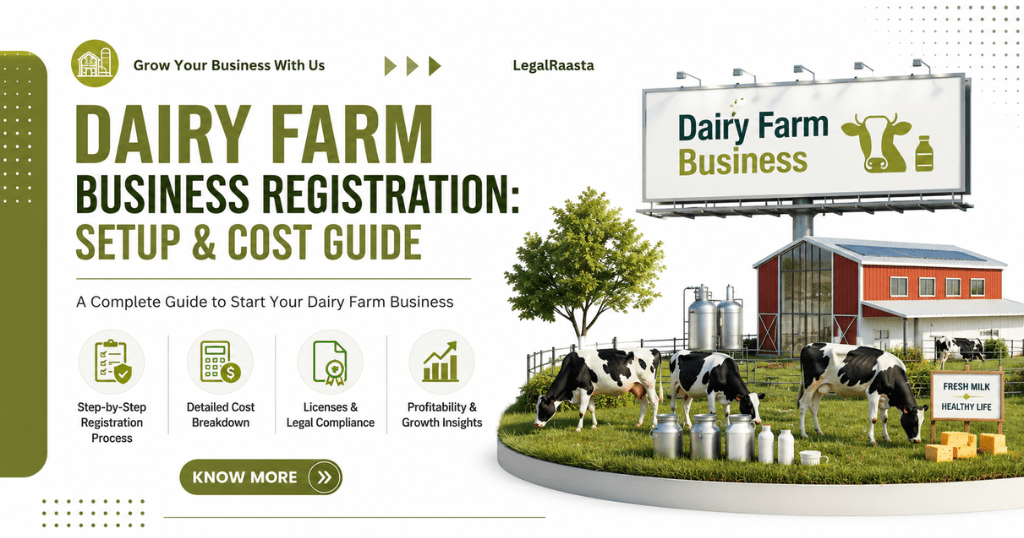
Dairy farm businesses in India have witnessed a significant annual growth rate in milk production. The rising demand for packaged and high-quality products is reflecting the increasing needs of the Dairy Farm Business Registration. As of 2026, India has become the world’s largest milk producer.
The major factors that are expanding this sector are urbanization, increasing health consciousness, and a shift towards value-added items like yogurt and cheese. Apart from that, a significant portion of dairy farms contributes to the Indian agricultural GDP. Nevertheless, establishing a dairy farm can generate profit for you in India, but this business requires planning, following legal processes, creating a budget, building up infrastructure (like the barn), operating the operation, etc.
Here is all that is needed for registration as a business owner when starting a dairy farm, from the registrations needed to the documentation that must be provided to the costs associated with the registration process.
Who Can Start a Dairy Farm Business in India?
Are you going to start the dairy farm business operation in India? Anyone over 18 years old and less than 70 years old who is a farmer, entrepreneur, or member of a cooperative can begin this business. The amount needed to get started with this type of business generally ranges between Rs 5 lacs and Rs 20 lacs, depending upon the operation you wish to run. Below are the minimum qualifications/requirements to operate as a dairy farmer in India:
- Eligibility & Skills: The operator of a dairy farm business must hold Indian citizenship. There is not much requirement for technical experience, but one must know about animal husbandry and dairy management steps.
- License & Compliance: Applying for mandatory registrations for permission from the dairy department, municipality pr Panchayat is crucial. FSSAU license and business registration are also required.
- Infrastructure: Adequate land for grazing; well-ventilated barns; adequate drainage; sufficient water supply; and all the equipment needed, such as milking machines, coolers, feed storage, etc.
- Financing Sources and Loans: Costs vary; your total investment level could be anywhere between $5,000 (two animals) and over $500,000 (large-scale commercial dairy). The Government of India offers programs through NABARD, which provides up to a 33.33% subsidy to dairy enterprises through the Dairy Entrepreneur Development Scheme (DEDS).
Why Choose a Dairy Farm Business?
Starting the dairy farm business in India means gaining a wide range of opportunities. Here are the key reasons why you should choose a dairy farm business:
Regular & Consistent Income
Unlike seasonal crops, the operators of dairy farms enjoy the daily, weekly, or monthly cash flow that maintains financial stability.
Sustain Demand & Growing Market
The consumption population is too high in every corner of India.
Highest Profit
The dairy farm business is considered the most lucrative business; it is managed accurately, improves breed selection, and employs scientific farming techniques. As compared to raw milk sales, the income from milk products like ghee and paneer is 2x greater.
Scalability
A dairy farm can be started on a small, medium, or large scale.
Government Support: The Government of India supports the dairy farm startups with subsidies, loans, and a training program, creating an easier route to start early.
Low-Waste & Sustainability
The dairy farm business is considered eco-friendly. Even animal waste, like cow dung, can be converted into biogas or organic manure.
Employment Creation
This sector offers significant employment opportunities to startups. It even creates jobs in rural areas.
Step-by-Step Guide: Start a Dairy Farm Business
Follow this simple dairy farm business setup process to avoid possible errors.
Step 1: Determine Business Scale
Before commencing milk factory business, your first step is to decide what the scale of your milkhouse should be.
- Small Scale: A great scale for beginners, who can start with 10-20 cattle. To start it, it required lower capital investment, including the manageable use of family members or minimal staff.
- Medium Scale (50-100 cattle): An accurate milking process with dedicated infrastructure and a few professional staff is enough to start it.
- Large Scale (100+ Cattle): Establishing such a large-scale milk farm business requires structured infrastructure with dedicated and advanced technology and direct-to-market distribution.
A business plan should always include the requirements, such as target customers, price of dairy products, profit margin, and expenses invested in feed, labor, and utilities.
Step 2: Legal Business Registration
To operate any entity legally in India, you need a business structure and registration. The type of business structure is selected based on size and requirements. Here are a few recommended legal business structures for your dairy farm:
- Sole Proprietorship: Ideal for dairy farmers who want to operate on a small scale. It is simple to do, but there is unlimited liability.
- Partnership Firm: Suitable if it wants to be managed with two or more people.
- Limited Liability Partnership (LLP): Partners enjoy the limited liability protection.
- Private Limited Company: Large-scale dairy farmers can choose between faster growth and greater protection.
After registering your dairy farm entity through the MCA portal, your next step is to fulfill these required registration requirements.
- GST Registration: Mandatory if your annual turnover exceeds the threshold.
- Udyam (MSME) Registration: Beneficial if you are looking for loans and subsidies.
- Current Account: To manage the business transactions separately.
- PAN & TAN: Required to meet tax compliance requirements.
Step 3: Licenses & Legal Permits
All milk/dairy businesses must apply for all these registrations/permits:
|
License/Registration |
Features |
Issuing Authority |
Registration Timeline |
|
FSSAI License/Registration |
Ensure safety and quality standards of dairy products |
FSSAI Registration (Basic); FSSAI State License, issued by the State government; and FSSAI Central License, issued by the Central Government (Central Licensing Authority). |
|
|
Trade License |
Grants permission to carry on a specific trade or business on a particular premise. |
Municipal Corporation or Local Urban Body (ULB) |
7-30 working days |
|
Pollution Control Board Consent |
“Consent to Establish” and “Consent to Operate” are required for environmental compliance. |
State Pollution Control Boards (SPCBs) or Pollution Control Committees (PCCs) in Union Territories. |
Maximum 4 months |
|
Veterinary Dept Registration |
Required for animal health monitoring |
State Veterinary Council (SVC) and Veterinary Council of India (VCI) |
Approx. 1 month |
Step 4: Apply for the FSSAI License for the Dairy Farm
The FSSAI Food License is one of the most common pieces of documentation used to help run a food-related enterprise in India. You would face a significant penalty for only operating a dairy farm without it (i.e., be subject to legal action by the food safety authority).
Three Types of FSSAI Licenses
- FSSAI Basic Registration—Used by very small-scale food type producers (annual turnover limit of Rs 12 L)
- FSSAI State License—Used by Mid-Scale Food Type producers (Annual Turnover Between Rs 5 crore and Annual Turnover of Rs 20 crore)
- FSSAI Central License—Required for Large-Scale Businesses (annual turnover of goods brought to the market that exceeds the total value of goods produced is greater than Rs 20 crores).
Documentation required
- Proof of Address and Identity of the Applicant.
- Vehicle Registration Certificate.
- NOC from Local Government/Municipal Council/Township/Traffic Authority.
- Layout of Dairy Farm.
- A report from water testing produced by an accepted Lab
- Food Safety Management System FSMS Plan
Step-by-Step Guide: FSSAI License Registration
Log on to the FoSCoS Portal (go to FSSAI.GOV.IN).
Complete Form A/B (as applicable).
Give the food business incorporation date, place of registration, and business name, as well as the type/annual turnover value.
Attach Required Documentation
Submit the completed application with all required supporting documents—the Food Safety Management System Plan included as an attachment.
Official Fees
Fees can be paid through the internet (up to a total of two hundred rupees or the issuing of an FSSAI Central License (between Rs. 2,500.00 and 5,000.00), depending on how big your company is, etc.).
Inspection and Approval
The food inspector will make an appointment with you about the inspection/approval of your dairy farm. The FSSAI will issue your license when all phases are complete.
Step 5: Documents Are Required for Dairy Farm Business
Starting a dairy farm requires legal, financial, and operational documentation. The major paperwork required is:
- Local Authority NOC
- Ownership proof (land ownership/lease agreement)
- Land use conversion certificate (for converting agricultural land to commercial dairy)
- Detailed project report (DPR), covering project layout, cost, and ROI
- Last 6 months’ bank statement
- Income Tax Returns
- PAN card and Aadhaar card for partners’/owners’ identity & address proof
- Milk testing reports from the laboratory
- BIS certification for quality standards
Note: Document requirements vary based on farm size and state-specific legislation.
Step 5: Investment Required in Infrastructure & Equipment Setup
The table guides you on how much investment is required to start a dairy farm business in India. Essential investment includes:
Category |
Estimated Cost (₹) |
|
Land & Shed Construction |
₹100,000–₹500,000+ |
|
Livestock (10 animals) |
₹600,000–₹800,000 |
|
Feed & Fodder |
₹90,000–₹120,000 |
|
Milking machines |
₹50,000–₹100,000 |
|
Water and Power Setup |
₹50,000–₹80,000 |
|
Veterinary care & insurance |
₹30,000–₹50,000 |
|
Miscellaneous & licensing |
₹40,000–₹60,000 |
Step 6: Livestock & Operations
6.1: Right Dairy Breed
Milk production and profitability depend on accurate animal selection, feeding, housing, and healthcare. To choose the right dairy breed, consider this guide:
- Holstein Friesian (HF): Have capacity to produce 20-30 liters/day if managed properly.
- Jersey: Adapts to the Indian climate easily and can produce 15-25 liters/day
- Gir, Sahiwal, and Red Sindhi: Require lower maintenance and standards for A2 milk demand.
Tip: As a beginner in the dairy farm business, one must choose crossbreeds, as it is often suggested for rapid returns.
6.2 Housing & Shed Management
Maintaining ventilation and hygiene in the shed reduces significant disease risks. Covered/open area per cow should be between 40 and 100 sq. ft. Implement an accurate drainage system, and the floor should not be slippery. The water should be clean and continuous for animals.
6.3 Feeding & Nutrition Management
A balanced diet for animals is essential. As the feed accounts for 60-70% of total operational cost, accurate planning is mandatory. Must include these items for a balanced diet:
- Green fodder (Napier grass, maize)
- Dry fodder (hay, straw)
- Concentrate feed (protein mix)
- Mineral mixture & salt
6.4: Veterinary Care & Vaccination
Consistent healthcare is compulsory. Add the vaccinations for foot & mouth disease (FMD), hemorrhagic septicemia (HS), and brucellosis. Careful pregnancy monitoring and routine deworming are important.
Step 8: Financial Support by the Indian Government
To grow the dairy business across India, the Indian government has introduced various schemes & subsidies. The common subsidies and schemes include:
- NABARD Dairy Loan
It is ideal to get a term loan for livestock purchase & infrastructure. The loan is issued based on the project size.
- Dairy Entrepreneurship Development Scheme (DEDS)
General category dairy farmers gets 25% subsidy benefit, whereas 33% subsidy for SC/ST farmers get a 33% subsidy.
- PM Formalisation of Micro Food Processing Enterprises (PMFME)
35% subsidy benefit for dairy processing units
Step 9: Additional Tips for Success
Consistency, branding, and accurate management are the keys to success in the dairy farming business. Follow these tips:
Tip 1: Maintain Hygiene Standards
To prevent infection risks, must clean sheds and equipment regularly
Tip 2: Focus on Quality
Quantity doesn’t matter, but the demand for high-fat milk is much higher due to quality standards.
Tip 3: Connect Direct Distribution Channels
Utilize suitable, effective, and Direct Distribution Channels for the sale to local homes, hotels, restaurants, etc., of Dairy Products to incorporate Intermediaries.
Tip 4: Branding & Packaging
Developing a brand name for your own farm-fresh Products such as Organic Milk, Ghee, Paneer, and A2 milk (uncertain on the definition of A2 milk).
Tip 5: Utilize Latest Technology
Developing a brand name for your own farm-fresh Products such as Organic Milk, Ghee, Paneer, and A2 milk (uncertain on the definition of A2 milk).
Tip 6: Waste Management
The management of cow dung is further crucial. Must convert it into biogas, organic fertilizer, and vermicompost.
Final Discussion
In essence, the dairy farm business offers long-term success if it selects the proper breed, balanced nutrition, healthcare, and msart marketing strategies. Within 1-2 years, your dairy farm can become a stable and highly profitable business. But, to start, it requires strong planning, permits, important licenses, and strategy. To make your dairy farm business successful, take assistance from LegalRaasta professionals. The platform offers free consultancy with assistance throughout the company registration process.
Why Choose LegalRaasta to Start a Dairy Farm Business?
A dairy farm in India can face many legal, regulatory, or compliance challenges when establishing its business; therefore, the operator must deal with everything regarding how to run their operation (e.g., registrations and licenses) in addition to seeking regulatory approvals regularly, which can be difficult. However, by partnering with an experienced/knowledgeable partner and receiving proper advice from him or her, you will be able to overcome these obstacles. That’s where LegalRaasta enters, standing out as a trusted consultation partner for dairy farmers. The platform provides:
- Expert Guidance on License & Registrations
- Hassle-Free Documents Preparation & Filing
- Personalized Support & Dedicated Account Manager
- Compliance Assurance & Legal Updates
- Affordable & Transparent Pricing
Frequently Asked Questions
- Is registration compulsory to start a dairy farm business?
Ans. Yes, it is highly recommended to register your dairy farm with the right business structure.
- Is FSSAI registration mandatory?
Ans. Yes, obtaining the FSSAI license is a crucial step to start the milk farm business legally in India. Under the BIS Act, it is required to verify dairy products’ safety and quality standards.
- Which licenses are required for a dairy farm in India?
Ans. The major licenses includes are:
- FSSAI license/registration
- GST registration certificate
- Trade license
- Pollution Control Board NOC
- How much investment is required to start a dairy farm business?
Ans. The exact investment depends on the scale of the dairy farm. For example, if planning to operate a small dairy farm with 8-10 cows, it may require Rs 6-12 lakh.
- Is the dairy farming business profitable in India?
Ans. Yes, the dairy farming business in India is profitable if managed properly.

Related Posts






Our Clients






Featured In