
GST on Flight Tickets in India – Domestic & International Tax Rates Explained 2026
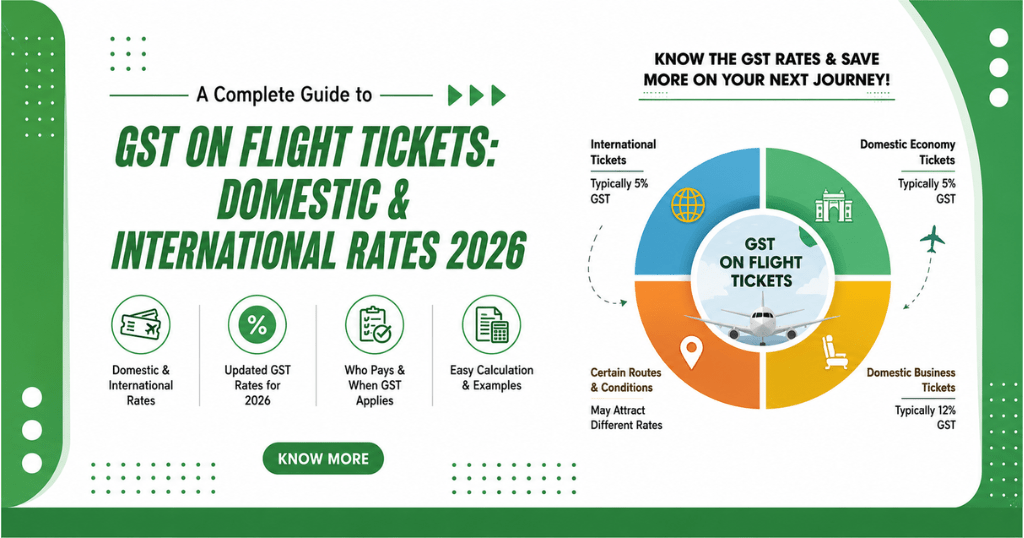
A major reconstitution realized through the GST 2.0 aviation reforms in late 2025 and early 2026 has completely changed the way air transport is taxed in India. The Goods and Services Tax (GST) structure is simplified into a more effective two-tier system in the fiscal year 2026-27 that affects all things in terms of the GST rate on economy tickets 2026 and entitlement to the input tax credit on flight tickets. Be it a corporate traveller who is managing a budget or a leisure traveller planning a vacation, the new GST on flight tickets is important in understanding flight ticket costs and the costs associated with planning a trip.
The comprehensive guide outlines the existing GST on flight tickets in India, including domestic and international airlines, ancillary services, and 2026 digital compliance. Be sure that your travel business or corporate organization keeps pace with regulatory changes through LegalRaasta all inclusive GST registration and filing.
Overview of the 2026 GST Structure for Aviation
The GST 2.0 aviation reforms have simplified the old structure of multi-slabs (5%, 12%, 18%, 28%). To the aviation industry, this brought a sharp division on the basis of the level of travel. Although the government has continued with a reduced tax on fuel-saving travel, high-end services are now subject to the general 18% rate.
|
Travel Class |
2025 GST Rate |
2026 GST Rate |
Purpose of Change |
|
Economy Class |
5% |
5% |
Maintain affordability for mass transit. |
|
Premium Economy |
12% |
18% |
Rationalization under the 18% standard slab. |
|
Business Class |
12% |
18% |
Taxing premium services as standard services. |
|
First Class |
12% |
18% |
Alignment with the luxury service framework. |
GST on Flight Tickets Domestic: Rules and Regulations
To travel within India, GST on domestic flight tickets is based mainly on the Class of Travel. Economy passengers still enjoy a 5% merit rate, which adds value to regional connectivity and the mid-income traveller. The decision to raise the GST in India from 12% to 18%, however, portrays this policy of 2026, whereby premium services will be subject to the normal rate.
Key Rules for Domestic Travel:
- Intrastate Travel: When the origin and destination are located within the same state (e.g., Mumbai to Nagpur), the tax would be divided into CGST (2.5% or 9) and SGST (2.5% or 9).
- Interstate Travel: In case of travel between states (e.g., Delhi to Bangalore), only one IGST (5% or 18%) would apply.
- Regional Connectivity Exemptions: Economy class becomes 0% GST on flights entering or leaving underserved airports under the scheme of UDAN (e.g., certain locations in the North East) to ensure that local development occurs.
GST on International Flight Tickets in 2026
One such area of hustle is the question of whether GST on international flight tickets is different from the domestic structure. In 2026, the rates are technically identical, but the rules of Place of Supply determine the leviness of the tax in the first place.
1. Outbound International Flights
In the case of the flight tickets of an Indian airport to an international destination (i.e., Mumbai to Dubai), the GST is levied on classes of the tickets:
- Economy: 5% GST.
- Premium/Business: 18% GST.
2. Inbound International Flights
Flights that are not based within India and terminate at an Indian airport (e.g., London-Delhi), the GST does not generally apply to flights where the ticket was booked elsewhere or via a foreign airline not subject to the Indian GST system. The reason is that the Place of Supply is the point of embarkation, not in the taxable territory of India.
3. Intermediate Stops
When a domestic journey has an international booking on the same PNR (Passenger Name Record), the whole journey is not taxed as a domestic flight, unless it is a non-international flight.
How to Calculate GST on Airline Tickets
To know how to calculate GST on airline tickets, it is first necessary to recognize what parts of the ticket price should be considered taxable. Taxes on airline tickets in India are not imposed on the amount paid, but on the Taxable Value.
Taxable Components:
- Base Fare: The fundamental cost of the seat.
- Fuel Surcharge: The additional amount charged to cover aviation turbine fuel costs.
Non-Taxable/Exempt Components:
- User Development Fee (UDF): A fee collected on behalf of the airport operator.
- Passenger Service Fee (PSF): For airport security and passenger facilities.
- CUTE Fee: Common User Terminal Equipment charges.
Calculation Formula:
GST Amount = (Base Fare + Fuel Surcharge) × GST Rate Percentage (5% or 18%)
Example Calculation (Domestic Economy):
- Base Fare: Rs 3,500
- Fuel Surcharge: Rs 500
- Airport Fees: Rs 1,200 (Non-taxable)
- Taxable Value = Rs 4,000
- GST @ 5% = Rs 200
- Total Ticket Price = Rs 5,400
Input Tax Credit on Flight Tickets for Businesses
One of the most notable benefits of the GST-registered firms is the input tax credit on flight tickets. The 2026 rules have, however, added some more restrictive eligibility criteria to deter misuse.
Eligibility for ITC:
- Class of Travel: ITC can not be used on economy class tickets (5% rate) because it is a concessional rate. ITC is fully available for business class GST India and premium economy tickets (18% rate).
- Business Purpose: The travel should be business-based (meetings, site visits, conferences).
- Invoice Accuracy: The airline GST invoice should include the legal name and GSTIN of the company.
|
Aspect |
Economy Class (5%) |
Premium/Business (18%) |
|
ITC Availability |
No |
Yes |
|
Reason for Restriction |
Concessional tax rate |
Standard tax rate with full flow |
|
Impact on Business Cost |
5% tax is an expense |
18% tax is an offsettable asset |
GST on Ancillary Services and Add-ons
The new GST on flight tickets also extends to ancillary services. Under the concept of “Composite Supply,” add-ons booked along with the ticket usually follow the tax rate of the main journey class.
|
Ancillary Service |
GST Rate (Economy) |
GST Rate (Business) |
|
Seat Selection |
5% |
18% |
|
In-flight Meals (Pre-booked) |
5% |
18% |
|
Excess Baggage |
18% (Treated as cargo) |
18% |
|
Lounge Access |
18% |
18% |
|
Cancellation Fees |
5% |
18% |
Note: Cancellation fees are taxed at the same rate as the original ticket. If you cancel an economy ticket, the cancellation fee attracts 5% GST; for business class, it attracts 18%.
The Importance of the Airline GST Invoice
Successfully claiming ITC requires the acquisition of a valid airline GST receipt. Most airlines have automated this process in 2026, though it includes the passenger giving the GSTIN during booking.
Mandatory Details on the Invoice:
- Airline GSTIN: The registration of the airline within the state of origin.
- Recipient GSTIN: Your company’s registration number.
- HSN/SAC Code: Typically 9964 for passenger transport.
- Place of Supply: The state where the journey commences.
Important: The majority of airlines do not permit adding GST details post-generation of PNR, like IndiGo and Air India. These details should be provided when making the first booking.
Comparison of Pre-GST and 2026 GST Regimes
The taxes on airline tickets in India are no longer a complicated tangle of service taxes and cess to a single destination tax.
|
Component |
Pre-GST Regime |
GST 2.0 (2026) |
|
Base Tax |
Service Tax (~6% – 9%) |
GST (5% or 18%) |
|
Additional Cesses |
Swachh Bharat, Krishi Kalyan |
None (Subsumed) |
|
Invoice Complexity |
High (Multiple headers) |
Low (Single Tax Header) |
|
Transparency |
Low (Hidden surcharges) |
High (Clear tax breakup) |
How LegalRaasta Assists with Aviation GST Compliance
Large organizations with extensive travel can find the new GST on flight tickets tricky to navigate. LegalRaasta offers comprehensive services to small businesses to make them as tax-efficient as possible.
- GST Registration: Assistance in registering businesses in various states in order to claim the local SGST/CGST credits.
- ITC Reconciliation: Abusing your travel invoices to GSTR-2B data matched with the help of AI-based tools.
- Corporate Policy Review: Assisting you in drafting the travel policies to benefit ITC-eligible bookings.
- Filing Services: Detailed filing of monthly returns on the basis of travel-related tax deductions.
Conclusion
GST on flight tickets is an important factor for individual and corporate travellers in 2026. The GST rate on economy tickets in 2026 is still friendlier to travellers by keeping it at 5%, but the premium cabin increased to 18% is a good reason to manage taxes professionally. After making your airline GST invoice correct and learning the domestic flight GST rules, the necessary tax can be balanced to manage as a business cost.
The professionals at LegalRaasta will be happy to help individuals who wish to ease their regulatory filing processes or maximize their input tax credit on flight tickets. We can deal with the legalities, and you do the journey.
Frequently Asked Questions (FAQs)
- How to claim GST on flight tickets?
To claim input tax credit on flight tickets, you must provide your company’s GSTIN and registered name during the booking process. Once the journey is completed (or at the time of booking), the airline will issue a tax-compliant invoice. This invoice should then be matched with your GSTR-2B and the credit feasible from them in your monthly returns.
- How to calculate GST on flight tickets?
To calculate GST on airline tickets, add the base fare and the fuel surcharge. Ignore airport fees like UDF or PSF. Multiply the sum by the applicable rate—5% for economy or 18% for premium classes. This will give you the exact GST component of your fare.
- What is the GST on flight tickets?
GST on flight tickets in India is a value-added tax imposed on the services of transporting passengers. It is divided into two major brackets: 5% to the economy category and 18% to the premium cabins, business class, and premium first class.
- What is the GST rate on tickets?
The GST rate on economy tickets in 2026 is 5%. The rate on all other classes, such as premium economy and business class, is 18%. This rate is charged on domestic and international travel that originates in India.
- Do you pay GST on flight tickets?
Yes, all flight tickets where an Indian airline or travel portal has been used to purchase the flight ticket attract GST on journeys within India. The tax is often contained in the aggregate fare; however, it is shown as a break in the invoice.
- Can I claim a GST refund on flight tickets?
Personal passengers cannot claim a GST refund on a trip already taken. But when a ticket is cancelled, the GST amount is normally refunded as a total refund. The GST can be taken back by businesses in input tax on flight tickets.
- Is GST charged on flight tickets?
Yes, GST on flight tickets is an obligatory tax within the present Indian tax system of indirect tax. The airline charges it to the passenger and remits it to the government.
- Is GST applicable to international flight tickets?
Yes, the GST on international flight tickets applies to all the flights that are leaving an Indian airport. When flying out of India to a foreign country, the GST is paid at the same rate as when flying locally (5% or 18%).
- Is GST different for domestic and international flights?
No, the percentage rates are the same for both domestic and international travel originating in India. However, international flights starting outside India and landing in the country are generally exempt from Indian GST.
- How to claim GST back at the airport?
There is currently no provision in India to claim a GST refund at the airport counter for flight tickets. Tax-registered businesses must claim it through their electronic credit ledger, while individual travellers are not eligible for a “refund” or “cash-back” of the tax paid.

Related Posts


Our Clients








Featured In